fuel ACURA NSX 2020 Owner's Manual
[x] Cancel search | Manufacturer: ACURA, Model Year: 2020, Model line: NSX, Model: ACURA NSX 2020Pages: 491, PDF Size: 20.24 MB
Page 379 of 491

377
uuBefore Performing MaintenanceuSafety When Performing Maintenance
Maintenance
Safety When Performing Maintenance
Some of the most important safety precautions are given here. However, we cannot
warn you of every conceivable hazard that can arise in performing maintenance.
Only you can decide whether you should perform a given task. • To reduce the possibility of fire or explos ion, keep cigarettes, sparks, and flames
away from the 12-volt battery, all High Volt age system, and all fuel related parts.
• Never leave rags, towels, or other flammable objects under the hood and hatch.
uHeat from the engine and exhaust can ignite them, causing a fire.
• To clean parts, use a co mmercially available degreas er or parts cleaner, not
gasoline.
• Wear eye protection and protective clothing when working with the 12-volt
battery or compressed air.
• Engine exhaust contains carbon monoxide, which is poisonous and can kill you.
uOnly operate the engine if th ere is sufficient ventilation.
• The vehicle must be in a stationary condition.
uMake sure your vehicle is parked on le vel ground, the parking brake is set, and
the power system is turned off.
• Be aware that hot parts can burn you.
uMake sure to let the power system, including the engine and exhaust system,
cool thoroughly before touching vehicle parts.
• Be aware that moving parts can injure you.
uDo not activate the power system unle ss instructed, and keep your hands and
limbs away from moving parts. When the power system is on, the engine can
automatically start, or the radiator fa n may start operating without the engine
running.
■Maintenance Safety
■Vehicle Safety
1Safety When Performing Maintenance
3WARNING
Improperly maintaining this vehicle or
failing to correct a pr oblem before driving
can cause a crash in which you can be
seriously hurt or killed.
Always follow the inspection and
maintenance recommendations according
to the schedules in this owner’s manual.
3WARNING
Failure to properly follow maintenance
instructions and precautions can cause you
to be seriously hurt or killed.
Always follow the procedures and
precautions in this owner’s manual.
20 ACURA NSX PMC-31T6N6300.book 377 ページ 2019年9月11日 水曜日 午後4時51分
Page 384 of 491
382
uuMaintenance MinderTMuTo Use Maintenance Minder TM
Maintenance
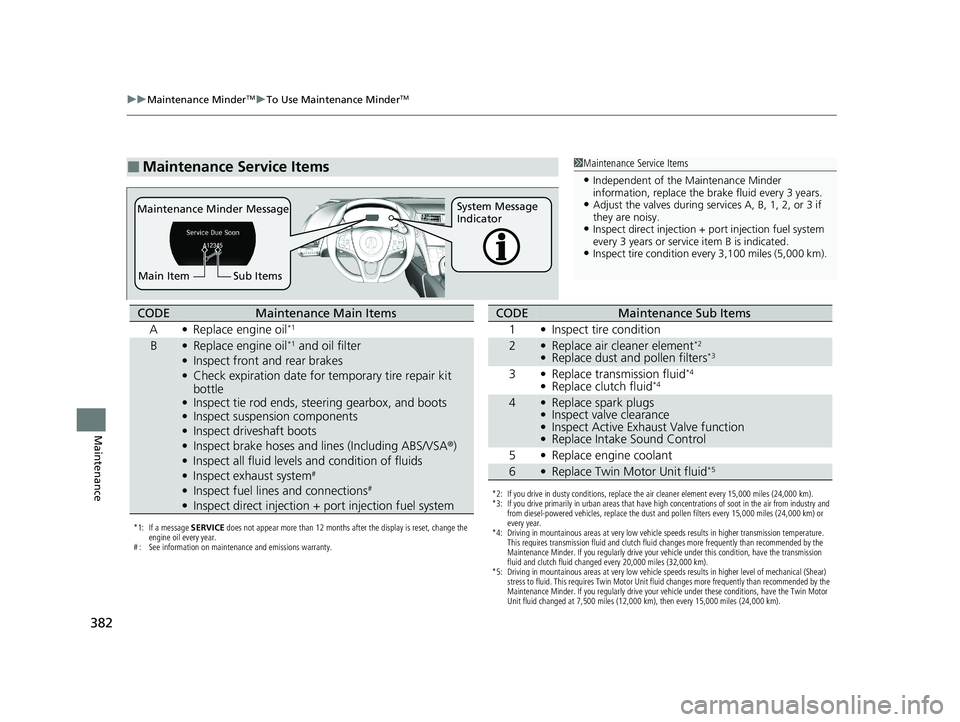
■Maintenance Service Items1Maintenance Service Items
• Independent of the Maintenance Minder
information, replace the brake fluid every 3 years.
• Adjust the valves during services A, B, 1, 2, or 3 if
they are noisy.
• Inspect direct injection + port injection fuel system
every 3 years or service item B is indicated.
• Inspect tire condition ev ery 3,100 miles (5,000 km).
Maintenance Minder Message System Message
Indicator
Main Item Sub Items
*1: If a message SERVICE does not appear more than 12 months after the display is reset, change the
engine oil every year.
# : See information on maintenance and emissions warranty.
CODEMaintenance Main Items
A •Replace engine oil *1
B•
Replace engine oil *1
and oil filter
• Inspect front and rear brakes
• Check expiration date for temporary tire repair kit bottle
• Inspect tie rod ends, steering gearbox, and boots
• Inspect suspension components
• Inspect driveshaft boots
• Inspect brake hoses and li nes (Including ABS/VSA®)
• Inspect all fluid levels and condition of fluids
• Inspect exhaust system #
• Inspect fuel lines and connections #
• Inspect direct injection + port injection fuel system
*2: If you drive in dusty conditions, replace the air cleaner element every 15,000 miles (24,000 km).
*3: If you drive primarily in urban areas that have high concentrations of soot in the air from industry and
from diesel-powered vehicles, replace the dust and pollen filters every 15,000 miles (24,000 km) or every year.
*4: Driving in mountainous areas at very low vehicle speeds results in higher transmission temperature. This requires transmission fluid and clutch fluid changes more frequently than recommended by the
Maintenance Minder. If you regularly drive your vehicle under this condition, have the transmission
fluid and clutch fluid changed every 20,000 miles (32,000 km).
*5: Driving in mountainous areas at very low vehicle speeds results in higher level of mechanical (Shear) stress to fluid. This requires Twin Motor Unit fluid changes more frequently than recommended by the
Maintenance Minder. If you regularly drive your vehicle under these conditions, have the Twin Motor
Unit fluid changed at 7,500 miles (12,000 km), then every 15,000 miles (24,000 km).
CODEMaintenance Sub Items
1 •Inspect tire condition
2•Replace air cleaner element *2
• Replace dust and pollen filters *3
3 •Replace transmission fluid *4
• Replace clutch fluid *4
4•
Replace spark plugs
• Inspect valve clearance
• Inspect Active Exhaust Valve function
• Replace Intake Sound Control
5 •Replace engine coolant
6• Replace Twin Motor Unit fluid *5
20 ACURA NSX PMC-31T6N6300.book 382 ページ 2019年9月11日 水曜日 午後4時51分
Page 393 of 491

391
uuMaintenance Under the Hood and HatchuOil Check
Continued
Maintenance
Oil Check
We recommend that you check the engine oil level every time you refuel.
1. Bring up the Oil Level Check Assist
display on the driver information interface. 2 Driver Information Interface P. 98
2. Warm up the engine until all the bars in the Warm Up gauge light up.
3. When the bars turn green, park the
vehicle on level ground and select
(P .
4. Allow the engine to continue idling until
all the bars in the Idle Time gauge in the
engine Oil Level Check Assist display
light up.
uDo not depress the accelerator pedal
while the engine is idling, as this will
reset the Idle Time .
1Oil Check
NOTICE
Do not open a door or the hatch before the Ready
To Check Oil Level message appears.
If a door or the hatch is open, the corresponding
warning message will be given priority, and the Oil
Level Check Assist will not be displayed.
20 ACURA NSX PMC-31T6N6300.book 391 ページ 2019年9月11日 水曜日 午後4時51分
Page 398 of 491
396
uuMaintenance Under the Hood and HatchuCooling System
Maintenance
Cooling System
This coolant is premixed with 50% antifreeze and 50% water. Do not add any
straight antifreeze or water.
We recommend you check the engine coolant level every time you refuel. Check the
reserve tank. Add the engine coolant accordingly.1. Make sure the engine and radiator are cool.
2. Open the hatch.
2 Opening the Hatch P. 387
3. Remove the left engine compartment
cover.
2 Engine Compartment Cover P. 389
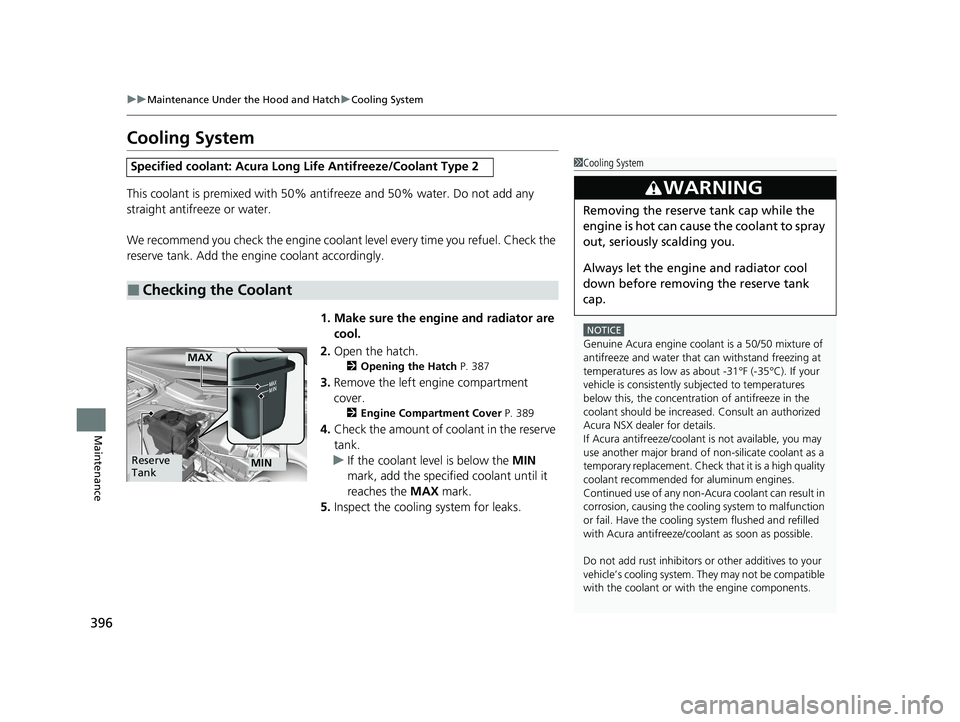
4. Check the amount of c oolant in the reserve
tank.
uIf the coolant level is below the MIN
mark, add the specified coolant until it
reaches the MAX mark.
5. Inspect the cooling system for leaks.
Specified coolant: Acura Long Life Antifreeze/Coolant Type 2
■Checking the Coolant
1Cooling System
NOTICE
Genuine Acura engine cool ant is a 50/50 mixture of
antifreeze and water that can withstand freezing at
temperatures as low as a bout -31°F (-35°C). If your
vehicle is consistently subjected to temperatures
below this, the concentration of antifreeze in the
coolant should be increased. Consult an authorized
Acura NSX dealer for details.If Acura antifreeze/coolant is not available, you may
use another major brand of non-silicate coolant as a
temporary replacement. Check that it is a high quality
coolant recommended for aluminum engines.
Continued use of any non-Ac ura coolant can result in
corrosion, causing the coo ling system to malfunction
or fail. Have the cooling system flushed and refilled
with Acura antifreeze/cool ant as soon as possible.
Do not add rust inhibitors or other additives to your
vehicle’s cooling system. Th ey may not be compatible
with the coolant or with the engine components.
3WARNING
Removing the reserve tank cap while the
engine is hot can cause the coolant to spray
out, seriously scalding you.
Always let the engine and radiator cool
down before removing the reserve tank
cap.
Reserve
Tank
MAX
MIN
20 ACURA NSX PMC-31T6N6300.book 396 ページ 2019年9月11日 水曜日 午後4時51分
Page 400 of 491

398
uuMaintenance Under the Hood and HatchuInverter Coolant
Maintenance
Inverter Coolant
This coolant is premixed with 50% antifreeze and 50% water. Do not add any
straight antifreeze or water.
We recommend you check the inverter coolant level every time you refuel.
Have an authorized Acura NSX deal er replace the inverter coolant.
1. Open the hood.
2 Opening the Hood P. 388
2. Check the fluid level in the tank.
3. If the coolant level has dropped below the
MIN level, have your vehicle serviced at an
authorized Acura NSX dealer.
uOnly a properly trained technician can
refill the coolant an d check the system
for leaks.
Specified coolan t: Acura Long Life Antifreeze/Coolant Type 2
■Checking the Coolant
1Inverter Coolant
NOTICE
Genuine Acura engine cool ant is a 50/50 mixture of
antifreeze and water that can withstand freezing at
temperatures as low as a bout -31°F (-35°C). If your
vehicle is consistently subjected to temperatures
below this, the concentration of antifreeze in the
coolant should be increased. Consult an authorized
Acura NSX dealer for details. If Acura antifreeze/coolant is not available, you may
use another major brand non- silicate coolant as a
temporary replacement. Check that it is a high quality
coolant recommended fo r aluminum engines.
Continued use of any non-Ac ura coolant can result in
corrosion, causing the coo ling system to malfunction
or fail. Have the cooling system flushed and refilled
with Acura antifreeze/cool ant as soon as possible.
Do not add rust inhibitors or other additives to your
vehicle’s cooling system. Th ey may not be compatible
with the coolant or with the motor components.
MAX
MIN
Filler
Tank
20 ACURA NSX PMC-31T6N6300.book 398 ページ 2019年9月11日 水曜日 午後4時51分
Page 409 of 491
407
Maintenance
Checking and Maintaining Tires
Checking Tires
To safely operate your vehicle, your tires must be of the proper type and size, in
good condition with adequate tread, and properly inflated.
■ Inflation guidelines
Properly inflated tires provide the best combination of handling, tread life, and
comfort. Refer to the driver’s doorjamb labe l or specifications page for the specified
pressure.
Underinflated tires wear unev enly, adversely affect handling and fuel economy, and
are more likely to fail from overheating.
Overinflated tires make your vehicle ride ha rshly, are more prone to road hazards,
and wear unevenly.
Every day before you drive, look at each of the tires. If one looks lower than the
others, check the pressure with a tire gauge.
At least once a month or before long trips, use a gauge to measure the pressure in all
tires. Even tires in good condition can lose 1 – 2 psi (10 – 20 kPa, 0.1 – 0.2 kgf/cm2
)
per month.
■ Inspection guidelines
Every time you check inflation, also examine the tires and valve stems. Look for: • Bumps or bulges on the side or in the tread. Replace the tire if you find any cuts,
splits, or cracks in the side of the tire . Replace it if you see fabric or cord.
• Remove any foreign objects and inspect for air leaks.
• Uneven tread wear. Have an authorized Acura NSX dealer check the wheel
alignment.
• Excessive tread wear.
2 Wear Indicators P. 412
• Cracks or other damage around valve stem.
1Checking Tires
Measure the air pressure when tires are cold. This
means the vehicle has been parked for at least three
hours, or driven less than 1 mile (1.6 km). If necessary, add or releas e air until the specified
pressure is reached.
If checked when hot, tire pressure can be as much as 4 – 6 psi (30 – 40 kPa, 0.3 – 0.4 kgf/cm 2
) higher than
if checked when cold.
Have an authorized Acura NSX dealer check the tires
if you feel a consistent vi bration while driving. New
tires and any that have be en removed and reinstalled
should be properly balanced.
3WARNING
Using tires that are excessively worn or
improperly inflated can cause a crash in
which you can be seriously hurt or killed.
Follow all instruction s in this owner’s
manual regarding ti re inflation and
maintenance.
20 ACURA NSX PMC-31T6N6300.book 407 ページ 2019年9月11日 水曜日 午後4時51分
Page 424 of 491
422
uuCleaninguExterior Care
Maintenance
Exterior Care
Dust off the vehicle body after you drive. Regularly inspect your vehicle for scratches
on painted surfaces. A scratch on a painted surface can result in body rust. If you
find a scratch, promptly repair it.
Wash the vehicle regularly. Wash more frequently when driving in the following
conditions: • If driving on roads with road salt.
• If driving in coastal areas.
• If tar, soot, bird droppings, insects, or tree sap are stuck to painted surfaces.
Do not use an automated car wash. • Keep sufficient distance between the cleaning nozzl e and the vehicle body.
• Take particular care around the windows. St anding too close may cause water to
enter the vehicle interior.
• Do not spray high pressure water directly into the engine compartment. Instead,
use low pressure water and a mild detergent.
■Washing the Vehicle
■Using an Automated Car Wash
■Using High Pressure Cleaners
1Washing the Vehicle
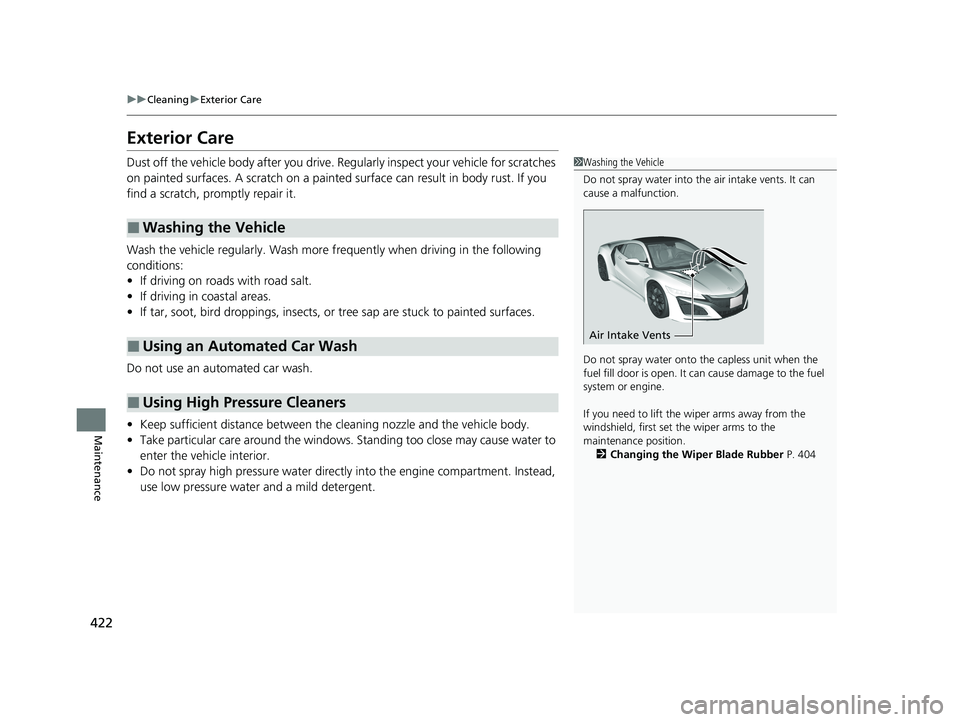
Do not spray water into the air intake vents. It can cause a malfunction.
Do not spray water onto the capless unit when the
fuel fill door is open. It ca n cause damage to the fuel
system or engine. If you need to lift the wiper arms away from the
windshield, first set the wiper arms to the
maintenance position.
2 Changing the Wiper Blade Rubber P. 404
Air Intake Vents
20 ACURA NSX PMC-31T6N6300.book 422 ページ 2019年9月11日 水曜日 午後4時51分
Page 430 of 491

428
Maintenance
Storage
Vehicle Storage
If you need to park your vehicle for an extended period (more than one month),
there are several things you should do to prepare it for storage. This helps reduce
possible deterioration of vehicle components and overall condition, which allows
you to get the vehicle back on the road with minimal delay. These are:
• If possible, store your NSX in a garage or enclosed area.
• Fill the fuel tank completely.
• Change the engine oil and filter.
• Wash and dry the exterior completely.
• Clean the interior. Make sure the carpeti ng, floor mats, etc., are completely dry.
• Put the transmission in
(P .
Release the parking brake.
• Leave one window open slightly (if th e vehicle is being stored indoors).
• To maintain the low-voltage 12-volt batte ry, connect it to an accessory battery
charger. For more information on how to maintain your 12-volt battery, consult
an authorized Acura NSX dealer. 2 Checking the 12-Volt Battery P. 417
• If the vehicle is to be stored for a longer period of time, it should be supported on
jack stands to raise the tires off th e ground to prevent tire flat spotting.
2 Handling of the Jack P. 444
• Support the front wiper blade arms with a folded towel or rag so they do not
touch the windshield.
• Cover the vehicle with a “breathable” co ver, one made from a porous material
such as cotton. Nonporous materials (suc h as plastic sheeting) may trap moisture,
which can damage the paint.
• If possible, remove the vehicle from th e garage or enclosed area, remove
covering, and periodically run the engi ne until it reaches full operating
temperature (the cooling fa n cycles on and off twice).
Preferably, do this once a month.
20 ACURA NSX PMC-31T6N6300.book 428 ページ 2019年9月11日 水曜日 午後4時51分
Page 465 of 491

463
Handling the Unexpected
When You Cannot Unlock the Fuel Fill Door
If you cannot unlock the fuel fill door, use the following procedure.
1.Open the hatch.
2. Pull the release lever toward you.
uThe release lever unlocks the fuel fill door
when it is pulled.
■What to Do When Unable to Unlock the Fuel Fill Door1When You Cannot Unlock the Fuel Fill Door
After taking these steps, c ontact an authorized Acura
NSX dealer to have your vehicle checked.
Release Lever
20 ACURA NSX PMC-31T6N6300.book 463 ページ 2019年9月11日 水曜日 午後4時51分
Page 467 of 491

465
Handling the Unexpected
Refueling
Refueling from a Portable Fuel Container
If you have run out of fuel and need to refuel your vehicle from a portable fuel
container, use the funnel provided with your vehicle.
1.Turn off the power system.
2. Press the fuel fill door release button.
uThe fuel fill door opens.
3. Take the funnel out of the tool box in the trunk.
2 Types of Tools P. 432
4. Place the end of the funnel on the lower
part of filler opening, then insert it slowly
and completely.
uMake sure that the end of the funnel
goes down along with the filler pipe.
5. Fill the tank with fuel from the portable fuel
container.
uPour fuel carefully so you do not spill any.
6. Remove the funnel from the filler neck.
uWipe up any fuel from the funnel before
storing it.
7. Shut the fuel fill door by hand.
1Refueling from a Portable Fuel Container
NOTICE
Do not insert the nozzle of a portable fuel container
or any funnel other than the one provided with your
vehicle. Doing so can damage the fuel system.
Do not try to pry open or push open the filler opening
with foreign objects. This can damage the filler
opening and its seal.
Make sure the fuel in the portable fuel container is
gasoline before you refuel.
3WARNING
Gasoline is highly flammable and explosive.
You can be burned or seriously injured
when handling fuel. • Turn the power system off, and keep
heat, sparks, and flame away.
• Handle fuel only outdoors.
• Wipe up spills immediately.
Funnel
20 ACURA NSX PMC-31T6N6300.book 465 ページ 2019年9月11日 水曜日 午後4時51分