steering ACURA NSX 2020 Service Manual
[x] Cancel search | Manufacturer: ACURA, Model Year: 2020, Model line: NSX, Model: ACURA NSX 2020Pages: 491, PDF Size: 20.24 MB
Page 339 of 491

337
uuWhen DrivinguIntegrated Dynamics System
Continued
Driving
CategoryQUIET SPORT SPORT+ TRACK
Information DisplayDriver Information InterfaceMinimized and not intrusive.Easy to read information for every
day driving.Information for more aggressive driving is added
(engine oil temp, SH-AWD® system temp,
tachometer position prioritizes high engine speed).
Chassis
Control Steering
Steering effort is balanced for city and highway use.
Increased steering effort for driver feedback.
Suspension
Damping Damping is set for balanced use in every day
driving. Damping is set for higher body control and
performance in a performance driving
environment.
Braking Feel settings are balanced for operation on all public road environments. Feel setting is
calibrated for high
temperature operation on track.
VSA ® Balanced calibration for VSA
® and Traction control
in all environments. Enhanced control for
Agile Handling Assist, VSA
®, and Traction
Control during
performance driving. Track oriented control
allowing increased
freedom for the driver.
20 ACURA NSX PMC-31T6N6300.book 337 ページ 2019年9月11日 水曜日 午後4時51分
Page 345 of 491

343
uuWhen DrivinguCruise Control
Continued
Driving
Cruise Control
Maintains a constant vehicle speed without having to keep your foot on the
accelerator. Use cruise control on freeways or open roads where you can travel at a
constant speed with little ac celeration or deceleration.
1Cruise Control It may not be possible to maintain a constant speed
when driving uphill or downhill.
When not using cruise control:
Turn off cruise control by pressing the CRUISE
button.
3WARNING
Improper use of the cruise control can lead
to a crash.
Use cruise control only when traveling on
open highways in good weather.When to use
■ Gear positions for cruise control:
In D (Drive) or M (Manual) Always keep sufficient distance
between you and the vehicle in
front of you.
■
Vehicle speed for cruise control:
Desired speed in a range above
roughly 25 mph (40 km/h) ~
■ Integrated Dynamics System
modes for cruise control: QUIET,
SPORT , SPORT+ mode
How to useCRUISE MAIN is on in
the instrument panel.
Cruise control is ready to
use.
■ Press the CRUISE button on
the steering wheel.
20 ACURA NSX PMC-31T6N6300.book 343 ページ 2019年9月11日 水曜日 午後4時51分
Page 347 of 491

345
uuWhen DrivinguCruise Control
Driving
Increase or decrease the vehicle speed using the RES/+/SET/– switch on the steering
wheel. • Each time you press the switch up or dow n, the vehicle speed is increased or
decreased by about 1 mph (1.6 km/h).
• If you keep the switch pressed up or down, the vehicle speed increases or
decreases until you release it. This speed is then set.
To cancel cruise control, do any of the
following: •Press the CANCEL button.
• Press the CRUISE button.
• Depress the brake pedal.
The CRUISE CONTROL indicator goes off.
■To Adjust the Vehicle Speed1To Adjust the Vehicle Speed
You can set the vehicle speed pressing the RES/+/
SET/– switch down on the steering wheel when
adjusting the speed with the accelerator and brake pedals.
■To Cancel
To decrease speed
To increase speed
1To Cancel
Resuming the prior set speed:
After cruise control has be en canceled, you can still
resume the prior set speed by pressing the RES/+/
SET/– switch up while driving at a speed of at least
25 mph (40 km/h) or more.
You cannot set or resume in the following situations: • When vehicle speed is less than 25 mph (40 km/h)
• When the CRUISE button is turned off
At vehicle speeds of 22 m ph (35 km/h) or less, cruise
control is canceled automatically.
CANCEL
Button
CRUISE
Button
20 ACURA NSX PMC-31T6N6300.book 345 ページ 2019年9月11日 水曜日 午後4時51分
Page 352 of 491

350
uuWhen DrivinguAgile Handling Assist
Driving
Agile Handling Assist
Lightly brakes each of the front and rear wheels, as needed, when you turn the
steering wheel, and helps support the vehicle’s stability and performance during
cornering.
1Agile Handling Assist
The agile handling assist ca nnot enhance stability in
all driving situations. You still need to drive and corner at speeds appropriate for the conditions and
always leave a sufficient margin of safety.
When the VSA ® system indicator comes on and stays
on while driving, the agil e handling assist does not
activate.
You may hear a sound coming from the front of the car while the agile handling assi st is activated. This is
normal.
20 ACURA NSX PMC-31T6N6300.book 350 ページ 2019年9月11日 水曜日 午後4時51分
Page 361 of 491
Continued359
uuBrakinguBrake System
Driving
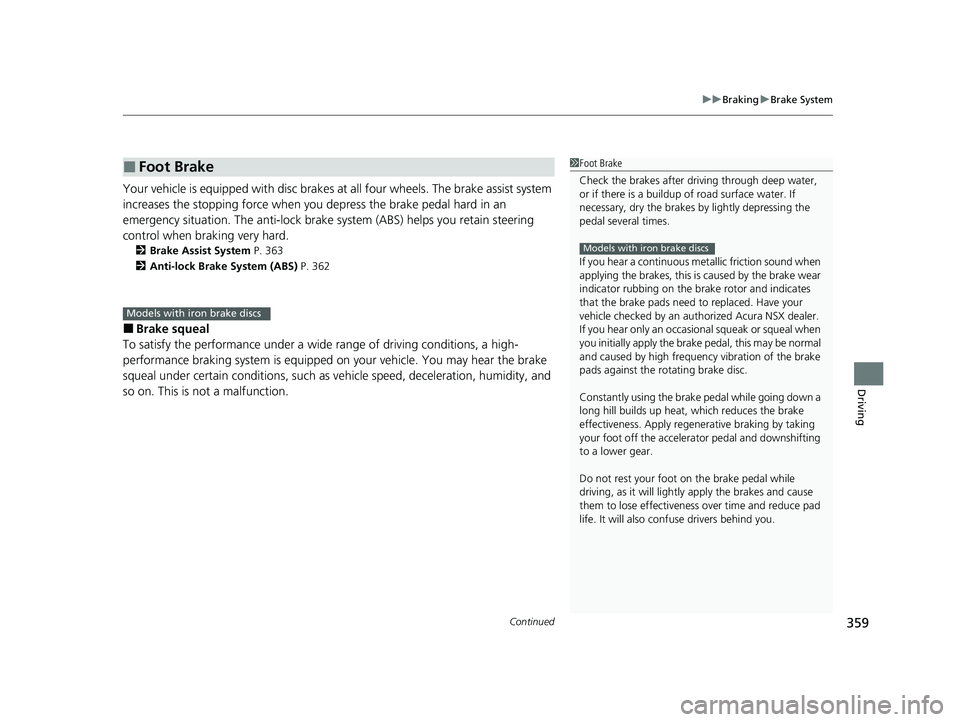
Your vehicle is equipped with disc brakes at all four wheels. The brake assist system
increases the stopping force when you depress the brake pedal hard in an
emergency situation. The an ti-lock brake system (ABS) helps you retain steering
control when brak ing very hard.
2 Brake Assist System P. 363
2 Anti-lock Brake System (ABS) P. 362
■ Brake squeal
To satisfy the performance under a wide range of driving conditions, a high-
performance braking system is equipped on your vehicle. You may hear the brake
squeal under certain conditions, such as vehicle speed, deceleration, humidity, and
so on. This is not a malfunction.
■Foot Brake1Foot Brake
Check the brakes after driving through deep water,
or if there is a buildup of road surface water. If
necessary, dry the brakes by lightly depressing the
pedal several times. If you hear a continuous me tallic friction sound when
applying the brakes, this is caused by the brake wear
indicator rubbing on the brake rotor and indicates
that the brake pads need to replaced. Have your
vehicle checked by an authorized Acura NSX dealer.
If you hear only an occasion al squeak or squeal when
you initially apply the brake pedal, this may be normal
and caused by high frequen cy vibration of the brake
pads against the rotating brake disc.
Constantly using the brake pedal while going down a
long hill builds up heat, which reduces the brake
effectiveness. Apply regene rative braking by taking
your foot off the accelera tor pedal and downshifting
to a lower gear.
Do not rest your foot on the brake pedal while
driving, as it will lightly apply the brakes and cause
them to lose effectiveness over time and reduce pad
life. It will also conf use drivers behind you.
Models with iron brake discs
Models with iron brake discs
20 ACURA NSX PMC-31T6N6300.book 359 ページ 2019年9月11日 水曜日 午後4時51分
Page 364 of 491

362
uuBrakinguAnti-lock Brake System (ABS)
Driving
Anti-lock Brake System (ABS)
Helps prevent the wheels from locking up, and helps you retain steering control by
pumping the brakes rapidly, much faster than you.
The electronic brake distributi on (EBD) system, which is part of the ABS, also
balances the front-to-rear braking distri bution according to vehicle loading.
You should never pump the brake pedal. Let the ABS work for you by always
keeping firm, steady pressure on the brake pe dal. This is sometimes referred to as
“stomp and steer.” ■ ABS operation
You may hear an operating noise when the ABS is working. Depress the brake pedal
and keep holding the pedal firmly down. On dry pavement, you will need to press
on the brake pedal very hard before the AB S activates. However, you may feel the
ABS activate immediately if you are trying to stop on snow or ice.
ABS may activate when you depress the brake pedal when driving on:
• Wet or snow covered roads.
• Roads paved with stone.
• Roads with uneven surfaces, such as potholes, cracks, manholes, etc.
When the vehicle speed goes unde r 6 mph (10 km/h), the ABS stops.
■ABS1Anti-lock Brake System (ABS)
NOTICE
The ABS may not function correctly if you use an
incorrect tire type and size.
When the ABS indicator comes on while driving,
there may be a problem with the system.
While normal braking is not affected, there is a
possibility of the ABS not operating. Have your
vehicle checked by an authorized Acura NSX dealer
immediately.
The ABS does not reduce the ti me or distance it takes
to stop the vehicle. It only helps with steering control
during hard braking.
In the following cases, yo ur vehicle may need more
stopping distance than a vehicle without the ABS:
• When driving on rough road surfaces, including
when driving on uneven surf aces, such as gravel or
snow.
• When tire chains are installed.
The following may be observed with the ABS system:
• Motor sounds coming from the engine
compartment when the brakes are applied, or
when system checks are being performed after the engine has been started and while vehicle is
accelerates.
These sounds are normal to ABS systems and are
no cause for concern.
20 ACURA NSX PMC-31T6N6300.book 362 ページ 2019年9月11日 水曜日 午後4時51分
Page 366 of 491

364
Driving
Parking Your Vehicle
When Stopped 1.Depress the brake pedal firmly.
2. With the brake pedal depressed, pull up th e electric parking brake switch slowly,
but fully.
3. Change the gear position to
(P .
4. Turn off the power system.
uThe electric parking brake indicator goes off in about 15 seconds.
Always confirm the electric parking brake is se t, in particular if you are parked on an
incline.
During Auto Engine Stop, th e gear position changes to
(P and the engine restarts
automatically under the following conditions:
• You unfasten the driver side seat belt and open the door.
1Parking Your Vehicle
Do not park your vehicle near flammable objects,
such as dry grass, oil, or timber.
Heat from the exhaust can cause a fire.
3WARNING
The vehicle can roll aw ay if left unattended
without confirming that Park is engaged.
A vehicle that rolls away could cause a crash
resulting in seriou s injury or death.
Always keep your foot on the brake pedal
until you have confirmed that
(P is shown
on the gear position indicator.
1When Stopped
NOTICE
The following can damage the driveline: • Depressing the accelera tor and brake pedals
simultaneously.
• Changing to
(P before the vehicle stops completely.
When facing uphill, do not hold the vehicle by
depressing the accelerator pedal.
Doing so may cause the power system to overheat
and fail.
In extremely cold temperatures, the parking brake may
freeze up if applied. If such temperatures are expected, do
not apply the parking brake. If parking on a slope, either
turn the steering wheel so one of the front tires will contact
the curb or block the wheels to keep the vehicle from
moving. If you do not take either precaution, the vehicle
may roll unexpectedly, leading to a crash.
When the Integrated Dynamics System mode is in QUIET mode or SPORT mode
20 ACURA NSX PMC-31T6N6300.book 364 ページ 2019年9月11日 水曜日 午後4時51分
Page 371 of 491

369
Continued
Driving
Multi-View Rear Camera
About Your Multi-View Rear Camera
The audio/information screen
can display your vehicle’s rear view. The display
automatically changes to the rear view when the gear position is changed to
(R.
■Multi-View Rear Camera Display Area
1About Your Multi-View Rear Camera
The rear camera view is restricted. You cannot see
the corner ends of the bumper or what is underneath the bumper. Its unique le ns also makes objects
appear closer or farther than they actually are.
Visually confirm that it is safe to drive before backing
up. Certain conditions (such as weather, lighting, and
high temperatures) may also restrict the rear view. Do
not rely on the rearview display which does not give
you all information about conditions at the back of
your vehicle.
If the camera lens is cove red with dirt or moisture,
use a soft, moist cloth to keep the lens clean and free of debris.
You can change the Fixed Guideline and Dynamic
Guideline settings.
2 Customized Features P. 244
Fixed Guideline On : Guidelines appear when you select
(R.
Off : Guidelines do not appear.
Dynamic Guideline On : Guidelines move according to the steering wheel
direction.
Off : Guidelines do not move.
Top Down View Mode
Normal View Mode
Wide View Mode
Guidelines
Bumper
Camera
Approx. 39 inches (1 m)
Approx. 20 inches (50 cm)
20 ACURA NSX PMC-31T6N6300.book 369 ページ 2019年9月11日 水曜日 午後4時51分
Page 384 of 491
382
uuMaintenance MinderTMuTo Use Maintenance Minder TM
Maintenance
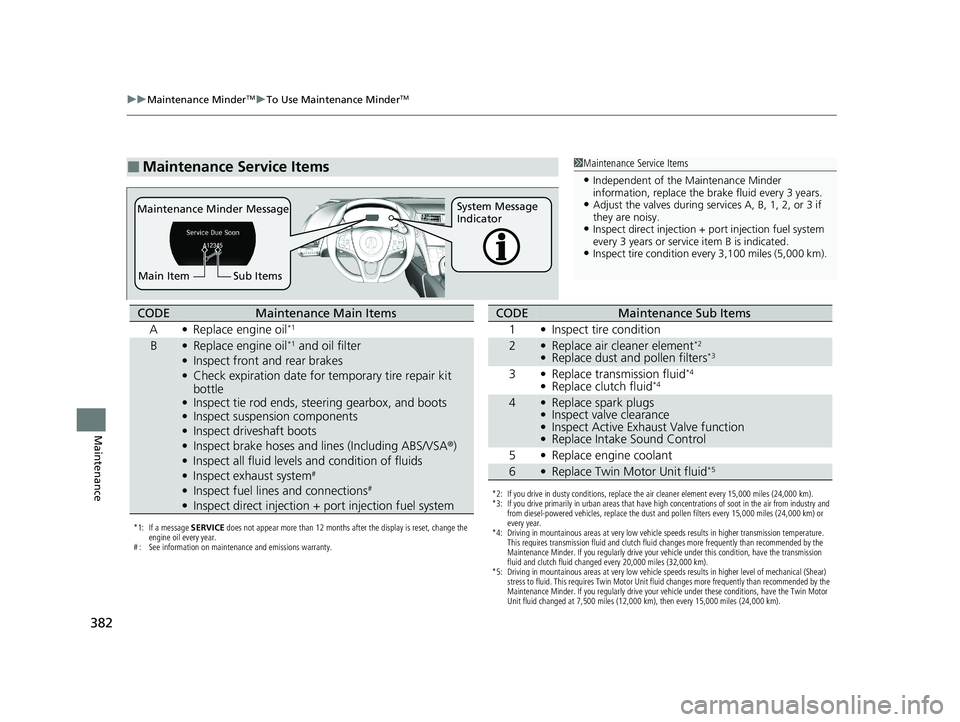
■Maintenance Service Items1Maintenance Service Items
• Independent of the Maintenance Minder
information, replace the brake fluid every 3 years.
• Adjust the valves during services A, B, 1, 2, or 3 if
they are noisy.
• Inspect direct injection + port injection fuel system
every 3 years or service item B is indicated.
• Inspect tire condition ev ery 3,100 miles (5,000 km).
Maintenance Minder Message System Message
Indicator
Main Item Sub Items
*1: If a message SERVICE does not appear more than 12 months after the display is reset, change the
engine oil every year.
# : See information on maintenance and emissions warranty.
CODEMaintenance Main Items
A •Replace engine oil *1
B•
Replace engine oil *1
and oil filter
• Inspect front and rear brakes
• Check expiration date for temporary tire repair kit bottle
• Inspect tie rod ends, steering gearbox, and boots
• Inspect suspension components
• Inspect driveshaft boots
• Inspect brake hoses and li nes (Including ABS/VSA®)
• Inspect all fluid levels and condition of fluids
• Inspect exhaust system #
• Inspect fuel lines and connections #
• Inspect direct injection + port injection fuel system
*2: If you drive in dusty conditions, replace the air cleaner element every 15,000 miles (24,000 km).
*3: If you drive primarily in urban areas that have high concentrations of soot in the air from industry and
from diesel-powered vehicles, replace the dust and pollen filters every 15,000 miles (24,000 km) or every year.
*4: Driving in mountainous areas at very low vehicle speeds results in higher transmission temperature. This requires transmission fluid and clutch fluid changes more frequently than recommended by the
Maintenance Minder. If you regularly drive your vehicle under this condition, have the transmission
fluid and clutch fluid changed every 20,000 miles (32,000 km).
*5: Driving in mountainous areas at very low vehicle speeds results in higher level of mechanical (Shear) stress to fluid. This requires Twin Motor Unit fluid changes more frequently than recommended by the
Maintenance Minder. If you regularly drive your vehicle under these conditions, have the Twin Motor
Unit fluid changed at 7,500 miles (12,000 km), then every 15,000 miles (24,000 km).
CODEMaintenance Sub Items
1 •Inspect tire condition
2•Replace air cleaner element *2
• Replace dust and pollen filters *3
3 •Replace transmission fluid *4
• Replace clutch fluid *4
4•
Replace spark plugs
• Inspect valve clearance
• Inspect Active Exhaust Valve function
• Replace Intake Sound Control
5 •Replace engine coolant
6• Replace Twin Motor Unit fluid *5
20 ACURA NSX PMC-31T6N6300.book 382 ページ 2019年9月11日 水曜日 午後4時51分
Page 417 of 491

415
uuChecking and Maintaining TiresuWinter Tires
Maintenance
Winter Tires
If driving on snowy or frozen roads, mount all-season marked M+S tires, snow tires,
or tire chains; reduce speed; and maintain sufficient distance between vehicles when
driving.
Be particularly careful wh en operating the steering wheel or brakes to prevent
skidding.
Use tire chains, snow tires, or all-season tires when necessary or according to the law.
When mounting, refer to the following points.
For winter tires: • Mount the tires to all four wheels.
For tire chains:• Install them on the rear tires only.
• Because your vehicle has limited tire clea rance, we strongly recommend using the
chains listed below:
*1:Tire chains to be used only on optional 295/30R20 winter tires.
*2:Tire chains to be used only on optional 305/30R20 winter tires.• Follow the chain manufactur er’s instruction when installing. Mount them as
tightly as you can.
• Check that the chains do not touc h the brake lines or suspension.
• Drive slowly.
Recommended Winter Tires: •Michelin Alpin PA4
Front: 245/35R19 (93W)
Rear: 295/30R20 (97V)• Pirelli SottoZero 3
Front: 245/35R19 (93W)
Rear: 305/30R20 (103W)
• Auto-trac 232405 *1
• K-Summit K-44 *2
1Winter Tires
NOTICE
Traction devices that are the wrong size or improperly
installed can damage your
vehicle’s brake lines,
suspension, body, and wheels. Stop driving if they are hitting any part of the vehicle.
When tire chains are mounted, follow the chain
manufacturer’s instructi ons regarding vehicle
operational limits.
If your vehicle is equipp ed with summer tires, be
aware that these tires are not designed for winter
driving conditions. For more information, contact an
authorized Acura NSX dealer.
3WARNING
Using the wrong chains, or not properly
installing chains, can damage the brake
lines and cause a crash in which you can be
seriously injured or killed.
Follow all instruction s in this owner’s
manual regarding the selection and use of
tire chains.
20 ACURA NSX PMC-31T6N6300.book 415 ページ 2019年9月11日 水曜日 午後4時51分