tires ACURA NSX 2021 Owners Manual
[x] Cancel search | Manufacturer: ACURA, Model Year: 2021, Model line: NSX, Model: ACURA NSX 2021Pages: 494, PDF Size: 16.57 MB
Page 7 of 494
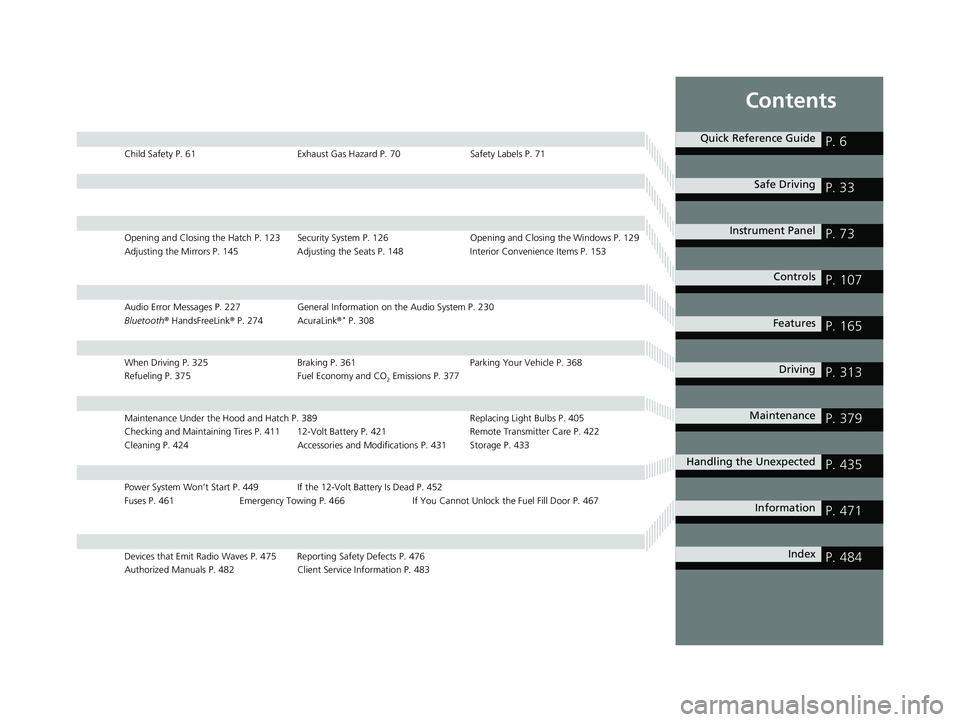
Contents
Child Safety P. 61Exhaust Gas Hazard P. 70Safety Labels P. 71
Opening and Closing the Hatch P. 123 Security System P. 126 Opening and Closing the Windows P. 129
Adjusting the Mirrors P. 145 Adjusting the Seats P. 148 Interior Convenience Items P. 153
Audio Error Messages P. 227General Information on the Audio System P. 230
Bluetooth ® HandsFreeLink ® P. 274 AcuraLink ®* P. 308
When Driving P. 325 Braking P. 361Parking Your Vehicle P. 368
Refueling P. 375 Fuel Economy and CO
2 Emissions P. 377
Maintenance Under the Hood and Hatch P. 389 Replacing Light Bulbs P. 405
Checking and Maintaining Tires P. 411 12-Volt Battery P. 421 Remote Transmitter Care P. 422
Cleaning P. 424 Accessories and Modifications P. 431 Storage P. 433
Power System Won’t Start P. 449 If th e 12-Volt Battery Is Dead P. 452
Fuses P. 461 Emergency Towing P. 466 If You Cannot Unlock the Fuel Fill Door P. 467
Devices that Emit Radio Waves P. 475 Reporting Safety Defects P. 476
Authorized Manuals P. 482 Client Service Information P. 483
Quick Reference GuideP. 6
Safe DrivingP. 33
Instrument PanelP. 73
ControlsP. 107
FeaturesP. 165
DrivingP. 313
MaintenanceP. 379
Handling the UnexpectedP. 435
InformationP. 471
IndexP. 484
21 ACURA NSX PMC-31T6N6400.book 5 ページ 2020年10月8日 木曜日 午後3時7分
Page 12 of 494

Visual Index
10
Quick Reference Guide❚Maintenance Under the Hood (P 389)
❚Windshield Wipers (P 139, 408)
❚Power Door Mirrors (P 146)
❚Headlights (P 135, 405)
❚How to Refuel (P 376)
❚High-Mount Brake Light (P 407)
❚Opening/Closing the Hatch (P 123)
❚Brake/Taillights (P 406)
❚Front Turn Signal/Parking Lights (P 134, 135, 405)
❚Back-Up Lights (P 406)
❚Rear License Plate Lights (P 407)
❚Hatch Release Button (P 123)
❚Door Lock/Unlock Control (P 111)
❚Front Side Marker Lights (P 135, 405)
❚Daytime Running Lights (P 138, 405)
❚Tires (P 411, 437)
❚Taillights (P 406)
❚Rear Turn Signal Lights (P 406)
❚Rear Side Marker Lights (P 406)
❚Multi-View Rear Camera (P 373)
21 ACURA NSX PMC-31T6N6400.book 10 ページ 2020年10月8日 木曜日 午後3時7分
Page 30 of 494

28
Quick Reference Guide
Maintenance (P 379)
Press the hatch release button on the
driver’s door.
Lights (P405)
●Inspect all lights regularly.
Under the Hatch (P390)
●Check engine oil and engine coolant.
Add when necessary.
Tires (P411)
●Inspect tires and wheels regularly.●Check tire pressures regularly.●Install winter tires for winter driving.
Handling Summer Only tires and Ultra High Performance
(UHP) tires in low ambient temperatures.
2 Cold Weather Driving (P420)
21 ACURA NSX PMC-31T6N6400.book 28 ページ 2020年10月8日 木曜日 午後3時7分
Page 86 of 494

84
uuIndicators u
Instrument Panel
IndicatorNameOn/BlinkingExplanationMessage
Low Tire Pressure/
TPMS Indicator
•Comes on for a few seconds when
you set the power mode to ON,
then goes off.
• Comes on if the tire pressure of any
of the tires becomes significantly
low.
• Blinks for about one minute, and
then stays on if there is a problem
with the TPMS.•Comes on while driving - Stop in a safe
place, check tire pres sures, and inflate the
tire(s) if necessary.
• Blinks and remains on - Have your
vehicle checked by an authorized Acura
NSX dealer.
System Message
Indicator
• Comes on for a few seconds when
you set the power mode to ON,
then goes off.
• Comes on along with a beep when
a problem is detected. A system
message on the driver information
interface appears at the same time.•While the indicator is on, roll the right
selector wheel to see the message again.
• Refer to the Indicators information in this
chapter when a system message appears
on the driver inform ation interface. Take
the appropriate action for the message.
• The driver information interface does not
return to the normal screen unless the
warning is canceled, or the right selector
wheel is rolled.
—
21 ACURA NSX PMC-31T6N6400.book 84 ページ 2020年10月8日 木曜日 午後3時7分
Page 98 of 494

96
uuIndicators uDriver Information Interface Wa rning and Information Messages
Instrument Panel
MessageConditionExplanation
•Appears when a problem with the transmission
prevents a gear from changing to
(R.
•Have your vehicle checked by an authorized Acura NSX
dealer.
• Appears when the High Voltage battery is extremely
low and cannot start the power system.•Have your vehicle checked by an authorized Acura NSX
dealer.
• Appears when the vehicle cannot be driven by the
engine.•Stop your vehicle in a safe place and contact an
authorized Acur a NSX dealer.
•Appears when the engine speed exceeds reduced REV
LIMIT while engine temperature is low.•Continue driving at a low engine speed until the engine
temperature becomes warm.
• Appears when braking ability is reduced.•Slow down and drive carefully. Have your vehicle
checked by an authorized Acura NSX dealer.
• Appears if you are driving at an extremely high speed
and one or more tires are underinflated.•Decelerate and drive your vehicle until the message
disappears.
21 ACURA NSX PMC-31T6N6400.book 96 ページ 2020年10月8日 木曜日 午後3時7分
Page 316 of 494

314
Driving
Before Driving
Driving Preparation
Check the following items before you start driving.
• Make sure there are no obstructions on th e windows, door mirrors, exterior
lights, or other parts of the vehicle.
u Remove any frost, snow, or ice.
u Remove any snow on the roof, as this can slip down and obstruct your field of
vision while driving. If frozen solid , remove ice once it has softened.
u When removing ice from around the wheel s, be sure not to damage the wheel
or wheel components.
• Make sure the hood is securely closed.
u If the hood opens while driving, your front view will be blocked.
• Make sure the tires are in good condition.
u Check air pressures, and check for damage and excessive wear.
2Checking and Maintaining Tires P. 411
•Make sure there are no people or ob jects behind or around the vehicle.
u There are blind spots from the inside.
• Check the front bumper duct s and side intercooler ducts for mud, leaves, and
road debris that could build up and prevent proper cooling performance.
■Exterior Checks1 Exterior Checks
NOTICE
When doors are frozen s hut, use warm water around
the door edges to melt any ice. Do not try to force
them open, as this can damage the rubber trim
around the doors. When done, wipe dry to avoid
further freezing.
Do not pour warm water into the key cylinder.
You will be unable to insert the key if the water
freezes in the hole.
Heat from the engine and exhaust can ignite
flammable materials left und er the hatch, causing a
fire. If you’ve parked y our vehicle for an extended
period, inspect and remove any debris that may have
collected, such as dried grass and leaves that have
fallen or have been carried in for use as a nest by a
small animal.
Also check under the hatch for leftover flammable
materials after you or so meone else has performed
maintenance on your vehicle.
21 ACURA NSX PMC-31T6N6400.book 314 ページ 2020年10月8日 木曜日 午後3時7分
Page 317 of 494

Continued315
uuBefore Driving uDriving Preparation
Driving
• Store or secure all items on board properly.
u Carrying too much cargo, or improperly storing it, can affect your vehicle’s
handling, stability, sto pping distance, and tires, and make it unsafe.
2Maximum Load Limit P. 317
•Do not pile items higher than the seat height.
u They can block your view and may be thrown forward in the event of sudden
braking.
• Do not place anything in the seat footwe lls. Make sure to secure the floor mat.
u An object or unsecured floor mat can in terfere with your brake and accelerator
pedal operation while driving.
• If you have any animals on board, do not let them move around in the vehicle.
u They may interfere with driv ing and a crash could occur.
• Securely close and lock both doors and the hatch.
2 Locking/Unlocking the Doors from the Inside P. 119
•Adjust your seating position properly.
2 Adjusting the Seats P. 148
•Adjust the mirrors and steering wheel properly.
u Adjust them while sitting in the proper driving position.
2 Adjusting the Mirrors P. 145
2 Adjusting the Steering Wheel P. 144
■Interior Checks1Interior Checks
The headlight aim is set by the factory, and does not
need to be adjusted. Howeve r, if you regularly carry
heavy items in the trunk ha ve the aiming readjusted
at an authorized Acura NS X dealer or by a qualified
technician.
21 ACURA NSX PMC-31T6N6400.book 315 ページ 2020年10月8日 木曜日 午後3時7分
Page 322 of 494

320
uuBefore Driving uHigh-Performance Driving
Driving
High-performance driving requires special skills, knowledge and experience, as the
safety risks are greatly increased when the NSX is operated at its upper performance
abilities. As a responsible NSX driver, you should not drive above your skill limits or
training, even if the NSX’s performance le vels would otherwise allow you to do so.
If you intend to engage in high-perform ance driving, Acura strongly recommends
that:
• You first obtain appropriate, professional training
• Turn off any devices or systems that may distract you from the driving task
High-performance driving in general, and the use of TRACK mode and Launch
Control in particular, puts very high loads on the NSX and its components, and
results in greater wear and tear on the vehicl e. Because of these high loads, if your
NSX is not in top condition or if certain comp onents, such as the brakes or tires, have
undue wear, those components could experience a loss of performance, or fail,
when engaging in high-performance driv ing. Therefore, Acura highly recommends
that you undertake more proactive and fre quent maintenance than that required
under normal use and have your vehicle inspected at an authorized Acura NSX
dealer (and all necessary repairs or adju stments made) before you engage in any
high-performance driving. In addition to any required maintenance, there are
certain NSX specific items and protocols th at you should pay special attention to
before, during and after engaging in any high-performance driving. Ultimately, the
decision whether to engage in high-performance driving is yours, and depending on
your NSX’s condition and prior usage, the items and protocols listed below may or
may not be sufficient to ensure a safe driving experience.
BEFORE DRIVING
•With the vehicle parked on level gro und, properly bleed brake system after
replacing with Acura Heavy Duty Brake Fluid DOT 4 or equivalent
• Inspect brake pad thickness an d replace if 6.0 mm or less
21 ACURA NSX PMC-31T6N6400.book 320 ページ 2020年10月8日 木曜日 午後3時7分
Page 323 of 494

Continued321
uuBefore Driving uHigh-Performance Driving
Driving
• Burnish the brake pads shortly before high-performance driving so that they have
the performance characteristics necessary to repeatedly and quickly slow the NSX
when it is being operated at signific antly high speeds. (While the NSX’s brake
pads are properly burnished for the demands expected in ordinary day-to-day
driving, high-performance driving puts unique demands on the brake system
which require further burnishing.)
• Inspect ALL cooling openings to confirm th ey are open and free of debris such as
leaves, etc. Cooling openings include engi ne undercover ducts, heat resistance
ducts, brake ducts, radi ators, and intercoolers
• Remove Tire Repair Kit from the trunk, along with any other cargo area contents
• Check tire wear and tire pressure, and m ake certain wheel lug bolts are properly
torqued, as driving at high speed puts additional strain on tires and wheels. Never
use slick tires, and do not use Summer On ly tires and Ultra High Performance tires
if temperatures will be lower than 45°F (7°C)
• If you anticipate sustained driving at speeds greater than 168 mph/270 km/h,
adjust the cold tire pressure as shown on the driver door jamb warning label. This
will help avoid heat build-up and sudden tire failure1 High-Performance Driving
3WARNING
Use of slick tires/racing slicks may subject
the chassis and body components to higher
dynamic loads than they were designed for.
Higher than intended dynamic loads could
result in component fail ure, loss of control,
and serious injury or death to you or others.
Do not install slick tires on the NSX.
Canadian models
U.S. models
21 ACURA NSX PMC-31T6N6400.book 321 ページ 2020年10月8日 木曜日 午後3時7分
Page 330 of 494

328
uuWhen Driving uPrecautions While Driving
Driving
Precautions While Driving
Avoid driving in deep water and on flooded roads. This can damage the power
system or driveline, or caus e electrical component failure.
The vehicle is equipped with ultra high pe rformance summer tires that, due to their
decreased tread depth, are at greater risk of hydroplaning on wet roads compared
to regular tires. Exercise caut ion when driving on wet surfaces.
The vehicle is equipped with ultra high performance summer tires. These tires are
designed for optimum performance and handling in warm climates, and are not
suitable for below freezing, snowy or ic y weather conditions. If you drive under
these circumstances, use of winter tire s is recommended and may be mandatory,
depending on your region, province or territory.
2 Winter Tires P. 419
2 Cold Weather Driving P. 420
Due to limitations of the Lithium-ion Hi gh Voltage battery, the minimum starting
temperature for the vehicle is -4°F (-20°C).
Inability to start the vehicle and/or decrease d performance is expected if the vehicle
is operated at temperatures below -4°F (-20°C).
■In Rain
■In Snow and Ice
1 Precautions While Driving
NOTICE
Do not select a shift button while pressing the
accelerator pedal.
NOTICE
The following can damage the under spoiler, under
covers, front bumper, rear diffuser, brake cooling
components, and side sill:
•Parking the vehicle by a parking block•Parallel pa rking along the road shoulder•Driving toward the bottom of a hill•Driving up or down to a different surface level
(such as a road shoulder)
•Driving on a rutted or bumpy road•Driving on a road with potholes•Driving over speed bump
NOTICE
If you repeatedly turn the steering wheel at an
extremely low speed, or hold the steering wheel in
the full left or right position for a while, the electric
power steering (EPS) system heats up. The system
goes into a protective mode, and limits its
performance. The steering wheel becomes harder
and harder to operate. Once the system cools down,
the EPS system is restored.
Repeated operation under these conditions can
eventually damage the system.
If the power mode is set to ACCESSORY while
driving, the power system will shut down and all
steering and brake power a ssist functions will stop,
making it difficult to control the vehicle.
Driving in snow or icy c onditions may accumulate ice
on the brake disk surface, reducing br aking power.
21 ACURA NSX PMC-31T6N6400.book 328 ページ 2020年10月8日 木曜日 午後3時7分