transmission Acura RDX 2011 User Guide
[x] Cancel search | Manufacturer: ACURA, Model Year: 2011, Model line: RDX, Model: Acura RDX 2011Pages: 517, PDF Size: 27.89 MB
Page 382 of 517

To shift from:Do this:
PtoR Press the brake pedal, and
press the shift lever release
button.
RtoP
NtoR DtoS Press the shift lever release
button.
StoD
DtoN
NtoD
RtoN Move the shift lever.
Park (P)
-This position
mechanically locks the transmission.
Use Park whenever you are turning
off or starting the engine. To shift out
of Park, you must press on the brake
pedal and have your foot off the
accelerator pedal. Press the release
button on the front of the shift lever
to move it.
If you have done all of the above and
still cannot move the lever out of
Park, see Shift Lock Release on
page 379.
To avoid transmission damage, come
to a complete stop before shifting
into Park. You must also press the
release button to shift into Park. The
shift lever must be in Park before
you can remove the key from the
ignition switch. Reverse (R)
-Press the brake
pedal and press the release button on
the front of the shift lever to shift
from Park to reverse. To shift from
reverse to neutral, come to a
complete stop, and then shift. Press
the release button before shifting
into reverse from neutral.
Neutral (N) -Use neutral if you
need to restart a stalled engine, or if
it is necessary to stop briefly with the
engine idling. Shift to the Park
position if you need to leave your
vehicle for any reason. Press on the
brake pedal when you are moving
the shift lever from neutral to
another gear.
CONTINUED
Automatic Transmission
377
Driving
10/06/08 17:42:32 11 ACURA RDX MMC North America Owner's M 50 31STK640 enu
Page 383 of 517

Drive (D)-Use this position for
your normal driving. The
transmission automatically adjusts to
keep the engine at the best speed for
the driving conditions.
S Position (S) -To shift into the S
position, press the release button on
the front of the shift lever, and move
the lever to S. This position is similar
to D, except only gears from first to
fourth are selected. The S position
keeps the transmission from cycling
between fourth and fifth gears in
stop-and-go driving. With the shift lever in D or S, you
can also use the paddle shifters to
shift the transmission up or down.
Once you begin to use the paddle
shifters in S, the transmission will no
longer upshift or downshift
automatically. For more information
of driving with the paddle shifters,
see page 380.
Engine Speed Limiter
If you exceed the maximum speed
for the gear you are in, the engine
speed will enter into the
tachometer's red zone. If this occurs,
you may feel the engine cut in and
out. This is caused by a limiter in the
engine's computer controls. The
engine will run normally when you
reduce the rpm below the red zone.Automatic Transmission37810/06/08 17:42:32 11 ACURA RDX MMC North America Owner's M 50 31STK640 enu
Page 384 of 517
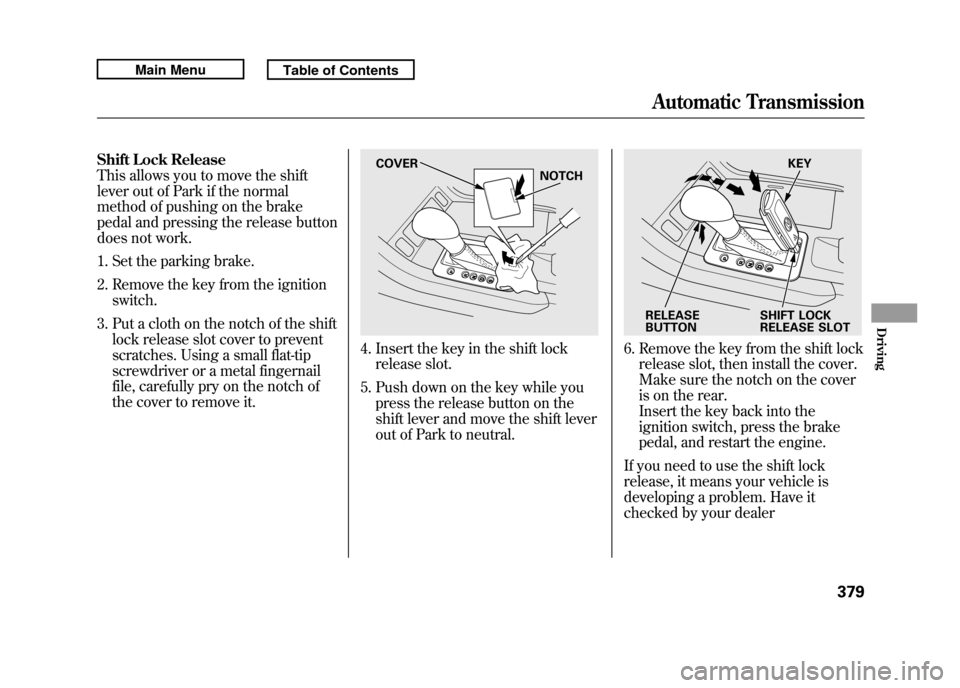
Shift Lock Release
This allows you to move the shift
lever out of Park if the normal
method of pushing on the brake
pedal and pressing the release button
does not work.1. Set the parking brake.
2. Remove the key from the ignition switch.
3. Put a cloth on the notch of the shift lock release slot cover to prevent
scratches. Using a small flat-tip
screwdriver or a metal fingernail
file, carefully pry on the notch of
the cover to remove it.
4. Insert the key in the shift lockrelease slot.
5. Push down on the key while you press the release button on the
shift lever and move the shift lever
out of Park to neutral.
6. Remove the key from the shift lockrelease slot, then install the cover.
Make sure the notch on the cover
is on the rear.
Insert the key back into the
ignition switch, press the brake
pedal, and restart the engine.
If you need to use the shift lock
release, it means your vehicle is
developing a problem. Have it
checked by your dealer
COVER NOTCH
KEY
RELEASE
BUTTON SHIFT LOCK
RELEASE SLOT
Automatic Transmission
379
Driving
10/06/08 17:42:32 11 ACURA RDX MMC North America Owner's M 50 31STK640 enu
Page 385 of 517
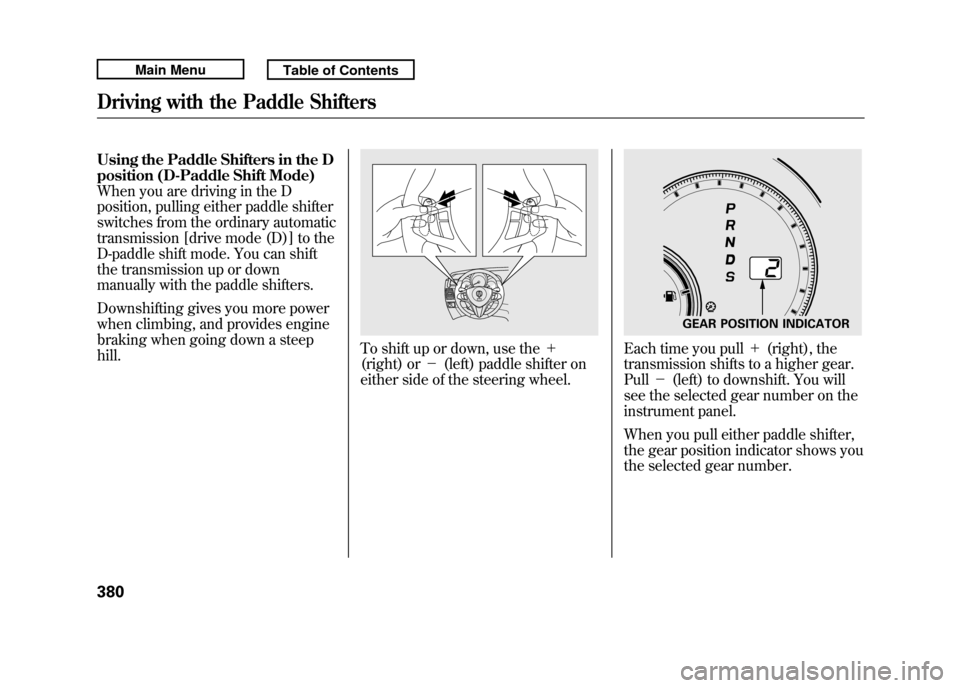
Using the Paddle Shifters in the D
position (D-Paddle Shift Mode)
When you are driving in the D
position, pulling either paddle shifter
switches from the ordinary automatic
transmission [drive mode (D)] to the
D-paddle shift mode. You can shift
the transmission up or down
manually with the paddle shifters.
Downshifting gives you more power
when climbing, and provides engine
braking when going down a steep
hill.
To shift up or down, use the+
(right) or -(left) paddle shifter on
either side of the steering wheel.
Each time you pull +(right), the
transmission shifts to a higher gear.
Pull -(left) to downshift. You will
see the selected gear number on the
instrument panel.
When you pull either paddle shifter,
the gear position indicator shows you
the selected gear number.
GEAR POSITION INDICATOR
Driving with the Paddle Shifters38010/06/08 17:42:32 11 ACURA RDX MMC North America Owner's M 50 31STK640 enu
Page 386 of 517

The transmission control system
monitors the accelerator pedal use
and your driving conditions. When
you press the accelerator pedal as in
normal driving, the system judges
that you are driving at a constant
cruising speed without using the
paddle shifters. Under these
conditions, D-paddle shift mode is
canceled, and the transmission
automatically returns to drive mode
(D).
When the transmission returns to
drive mode (D), the displayed gear
number disappears.
The transmission remains in the
selected gear if you do not
accelerate.
Each time you pull either paddle
shifter, the transmission shifts one
gear up or down. If you want to shift
up or down more than two gears, pull
the paddle shifter twice, pause, and
then pull it again.The automatic transmission will not
allow you to shift up or down if:
●You downshift before the engine
speed reaches the highest
threshold of the lower gear.
If you try to do this, the gear
position indicator will flash the
number of the lower gear several
times, then return to a higher gear.●You upshift before the engine
speed reaches the lowest
threshold of the higher gear.●You pull both paddle shifters at the
same time.●You pull one of the two paddle
shifters while continuously pulling
on the other one.
The transmission downshifts to first
gear and returns to drive mode (D)
when the vehicle comes to a
complete stop or the vehicle speed is
about 6 mph (10 km/h).
If there is a problem in the
transmission while you are driving
with the paddle shifters, the D
indicator flashes, the D-paddle shift
mode is canceled, and the
transmission returns to drive mode
(D).
CONTINUED
Driving with the Paddle Shifters
381
Driving
10/06/08 17:42:32 11 ACURA RDX MMC North America Owner's M 50 31STK640 enu
Page 387 of 517

Using the Paddle Shifters in the S
position (Sequential Shift Mode)
With the shift lever in the S position,
you can select the sequential shift
mode to shift gears; much like a
manual transmission using the
paddle shifters, but without a clutch
pedal.
To enter the sequential shift mode,
press the release button on the front
of the shift lever, move the lever to
the S position, then pull either paddle
shifter. To cancel the sequential shift
mode and return to the ordinary
automatic transmission, move the
shift lever from the S position. When
moving the shift lever, be careful not
to operate incorrectly. While you are
driving in the sequential shift mode,
the transmission will not
automatically return to ordinary
automatic transmission.
When you move the shift lever from
‘‘D ’’to ‘‘S ’’ and pull either paddle
shifter, the gear position indicator
displays ‘‘M’’ along with the selected
gear number.
To upshift, pull the +(right) paddle
shifter. To downshift, pull the -
(left) paddle shifter. When you accelerate from a stop, the
transmission starts in first gear, and
you must manually upshift between
first and fifth gears. Make sure you
upshift before the engine speed
reaches the tachometer's red zone.
The transmission remains in the
selected gear (5, 4, 3, 2, or 1). There
is no automatic downshift when you
push the accelerator pedal to the
floor.
When you are driving in 4th or 5th
gear, the transmission downshifts to
the lower gear under the following
conditions:
●The vehicle slows down to a
certain speed.●You press the brake pedal.
GEAR POSITION INDICATOR
‘‘ M’’ INDICATOR
Driving with the Paddle Shifters38210/06/08 17:42:32 11 ACURA RDX MMC North America Owner's M 50 31STK640 enu
Page 388 of 517

Downshifting with the paddle shifter
allows you to increase the engine
braking when going down steep or
long hills, and provides more power
when climbing uphills. You can
upshift the transmission manually to
reduce the rpm.
The transmission also shifts
automatically as the vehicle comes to
a complete stop. It downshifts to first
gear when the vehicle speed reaches
6 mph (10 km/h) or less.The automatic transmission will not
allow you to shift up or down if:
●You downshift before the engine
speed reaches the highest
threshold of the lower gear.
If you try to do this, the gear
position indicator will flash the
number of the lower gear several
times, then return to a higher gear.●You upshift before the engine
speed reaches the lowest
threshold of the higher gear.●You try to shift to third or a higher
gear when the vehicle is
stationary.●You pull both paddle shifters at the
same time.●You pull one of the two paddle
shifters while continuously pulling
on the other one.
Starting in Second GearWhen you are in sequential shift
mode, and the vehicle is stopped,
pull the
+(right) paddle shifter to
shift to second gear. You will see
‘‘ M2’’ in the display. Starting in
second gear helps to reduce
wheelspin in deep snow or on a
slippery surface.
CONTINUED
Driving with the Paddle Shifters
383
Driving
10/06/08 17:42:32 11 ACURA RDX MMC North America Owner's M 50 31STK640 enu
Page 391 of 517

Always use the parking brake when
you park your vehicle. Make sure the
parking brake is set firmly, or your
vehicle may roll if it is parked on an
incline.
Set the parking brake before you put
the transmission in Park. This keeps
the vehicle from moving and putting
pressure on the parking mechanism
in the transmission.Parking Tips
●Make sure the moonroof and the
windows are closed.●Turn off the lights.●Place any packages, valuables, etc.
in the cargo area or take them with
you.●Lock the doors and the tailgate.●Never park over dry leaves, tall
grass, or other flammable
materials. The hot three way
catalytic converter could cause
these materials to catch on fire.
●If the vehicle is facing uphill, turn
the front wheels away from the
curb.●If the vehicle is facing downhill,
turn the front wheels toward the
curb.●Check the indicator on the
instrument panel to verify that the
security system is set.●Make sure the parking brake is
fully released before driving away.
Driving with the parking brake
partially set can overheat or
damage the rear brakes.
Parking38610/06/08 17:42:32 11 ACURA RDX MMC North America Owner's M 50 31STK640 enu
Page 409 of 517

Driving on HillsWhen climbing hills, closely watch
your temperature gauge (see page
78). If it nears the H (Hot) mark, turn
the A/C off, reduce speed and, if
necessary, pull to the side of the road
to let the engine cool.
When driving down hills, reduce
your speed, and shift down to S
position, or use the paddle shifters to
the lower gear (3, 2 or 1)in the S
position. When towing a trailer, do
not‘‘ride ’’the brakes, and remember,
it will take longer to slow down and
stop when towing a trailer.
If you must stop when facing uphill,
use the foot brake or parking brake.
Do not try to hold the vehicle in place
by pressing on the accelerator, as
this can cause the automatic
transmission to overheat.
Handling Crosswinds and BuffetingCrosswinds and air turbulence
caused by passing trucks can disrupt
your steering and cause the trailer to
sway. When being passed by a large
vehicle, keep a constant speed, and
steer straight ahead. Do not try to
make quick steering or braking
corrections.
Backing UpAlways drive slowly and have
someone guide you when backing
up. Grip the
bottom
of the steering
wheel; then turn the wheel to the left
to get the trailer to move to the left,
and turn the wheel right to move the
trailer to the right.
ParkingFollow all normal precautions when
parking, including putting the
transmission in Park and firmly
setting the parking brake. Also, place
wheel chocks at each of the trailer's
tires.Towing Your VehicleYour vehicle is not designed to be
towed behind a motor home. If your
vehicle needs to be towed in an
emergency, see page 475.
Towing a Trailer40410/06/08 17:42:32 11 ACURA RDX MMC North America Owner's M 50 31STK640 enu
Page 412 of 517

Crossing a Stream
Avoid driving through deep water. If
you encounter water in your route (a
small stream or large puddle, for
example), evaluate it carefully before
going ahead. Make sure it is shallow,
flowing slowly, and has firm ground
underneath. If you are not sure of the
depth or the ground, turn around and
find another route.
Driving through deep water can also
damage your vehicle. The water can
get into the transmission and
differential, diluting the lubricant and
causing an eventual failure. It can
also wash the grease out of the wheel
bearings.If You Get Stuck
Avoid driving on soft sand, deep
mud, or other surfaces where you
could get stuck. If you do happen to
get stuck because of inclement
weather or other conditions, choose
a safe and appropriate course of
action.
You should never use a jack to try
getting unstuck. A jack only works
on firm, level ground. Also, your
vehicle could easily slip off the jack
and hurt you or someone else.
If you spin the wheels excessively
trying to get unstuck, you may
overheat the components of the
SH-AWD system. The SH-AWD
indicator on the instrument panel will
blink to indicate the rear differential
temperature is too high.
You will also see an
‘‘SH-AWD DIFF
TEMP. HIGH ’’message on the multi-
information display (see page 385).
If this happens, stop and allow
everything to cool down. The
SH-AWD indicator goes off after the
rear differential temperature drops.
Off-Highway Driving Guidelines
407
Driving
10/06/08 17:42:32 11 ACURA RDX MMC North America Owner's M 50 31STK640 enu