light Acura RDX 2012 Owners Manual
[x] Cancel search | Manufacturer: ACURA, Model Year: 2012, Model line: RDX, Model: Acura RDX 2012Pages: 518, PDF Size: 26.43 MB
Page 467 of 518
Although this seems like a simple
procedure, you should take several
precautions.
A battery can explode if you do
not follow the correct
procedure, seriously injuring
anyone nearby.
Keep all sparks, open flames,
and smoking materials away
from the battery.
You cannot start your vehicle by
pushing or pulling it.
To Jump Start Your Vehicle:1. Open the hood, and check the physical condition of the battery.
In very cold weather, check the
condition of the electrolyte. If it
seems slushy or frozen, do not try
jump starting until it thaws.If a battery sits in extreme cold, the
electrolyte inside can freeze. Attempting
to jump start with a frozen battery can
cause it to rupture.
2. Turn off all electrical accessories:heater, A/C, climate control, audio
system, lights, etc. Put the
transmission in Park, and set the
parking brake.
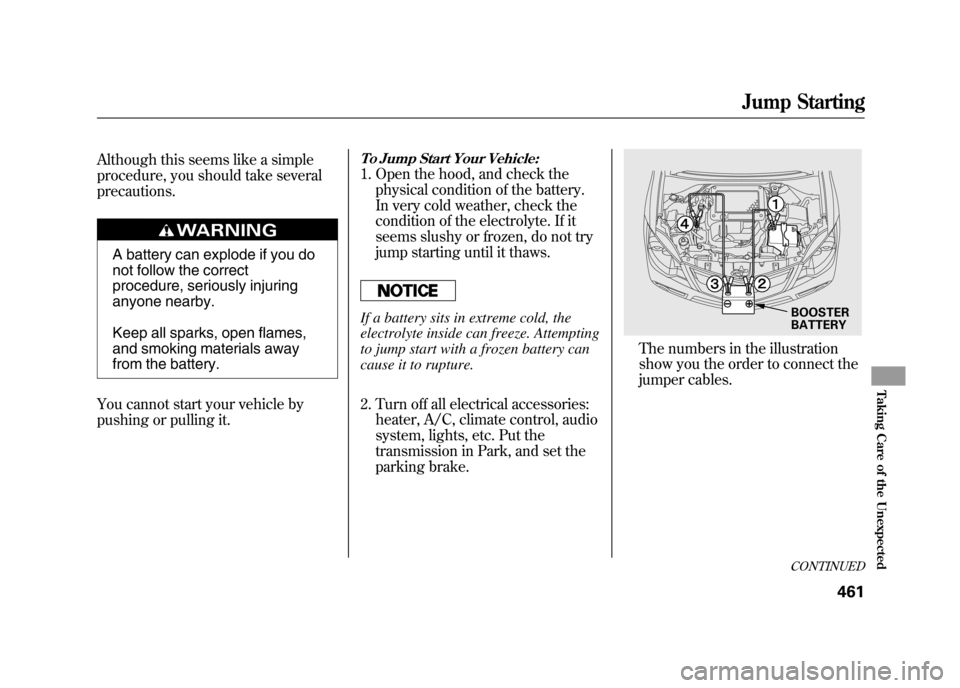
The numbers in the illustration
show you the order to connect the
jumper cables.
BOOSTER
BATTERYCONTINUED
Jump Starting
461
Taking Care of the Unexpected
11/06/16 17:42:51 12 ACURA RDX MMC North America Owner's M 50 31STK650 enu
Page 469 of 518
The reading of the vehicle's
temperature gauge on the multi-
information display should stay in the
midrange. If it climbs to the H (Hot)
mark, you should determine the
reason (hot day, driving up a steep
hill, etc.).
If the coolant temperature rises to
224°F (118°C) or more, the
temperature gauge will appear on the
display and blink for several times.
At the same time, the beeper will
sound once.
If your vehicle overheats, you should
take immediate action. The only
indication may be the temperature
gauge climbing to the H (Hot) mark.
Or you may see steam or spray
coming from under the hood.
Driving with the temperature gauge
reading at the H (Hot) mark can cause
serious damage to the engine.
Steam and spray from an
overheated engine can
seriously scald you.
Do not open the hood if steam
is coming out.
1. Safely pull to the side of the road. Put the transmission in Park, and
set the parking brake. Turn off all
accessories, and turn on the
hazard warning lights. 2. If you see steam and/or spray
coming from under the hood, turn
off the engine. Wait until you see
no more signs of steam or spray,
then open the hood.
3. If you do not see steam or spray, leave the engine running and
watch the temperature gauge. If
the high heat is due to
overloading, the engine should
start to cool down almost
immediately. If it does, wait until
the temperature gauge comes
down to the midpoint, then
continue driving.
4. If the temperature gauge reading stays at the H (Hot) mark, turn off
the engine.
CONTINUED
If the Engine Overheats
463
Taking Care of the Unexpected
11/06/16 17:42:51 12 ACURA RDX MMC North America Owner's M 50 31STK650 enu
Page 471 of 518
Low Oil Pressure Indicator
This indicator should never
come on when the engine is
running. If it starts flashing or stays
on, the oil pressure has dropped very
low or lost pressure. Serious engine
damage is possible, and you should
take immediate action.
You will also see an ‘‘OIL PRESSURE
LOW ’’message on the multi-
information display (see page 79).
The indicator notifies you of low oil
pressure and does not measure the
oil level. Check your vehicle's oil
level at each refueling.
Running the engine with low oil
pressure can cause serious mechanical
damage almost immediately. Turn off
the engine as soon as you can safely get
the vehicle stopped. 1. Safely pull off the road, and shut
off the engine. Turn on the hazard
warning lights.
2. Let the vehicle sit for a minute. Open the hood, and check the oil
level (see page 357). An engine
very low on oil can lose pressure
during cornering and other driving
maneuvers.
3. If necessary, add oil to bring the level back to the full mark on the
dipstick (see page 420).
4. Start the engine, and watch the oil pressure indicator. If it does not go
out within 10 seconds, turn off the
engine. There is a mechanical
problem that needs to be repaired
before you can continue driving
(see Emergency Towing on page
475). Charging System Indicator
If the charging system
indicator comes on brightly
when the engine is running, the
battery is not being charged.
You will also see a ‘‘CHECK
CHARGING SYSTEM ’’message on
the multi-information display (see
page 79).
Immediately turn off all electrical
accessories. Try not to use other
electrically operated controls such as
the power windows. Keep the engine
running; starting the engine will
discharge the battery rapidly.
Go to a service station or garage
where you can get technical
assistance.
Low Oil Pressure Indicator, Charging System Indicator
465
Taking Care of the Unexpected
11/06/16 17:42:51 12 ACURA RDX MMC North America Owner's M 50 31STK650 enu
Page 473 of 518

Brake System Indicator
(Red)U.S. CanadaThe brake system indicator (red)
normally comes on when you turn
the ignition switch to the ON (II)
position, and as a reminder to check
the parking brake. It will stay on if
you do not fully release the parking
brake.
If the brake system indicator (red)
comes on while driving, the brake
fluid level is probably low. Press
lightly on the brake pedal to see if it
feels normal. If it does, check the
brake fluid level the next time you
stop at a service station (see page
429).
You will also see a‘‘BRAKE FLUID
LOW ’’message on the multi-
information display (see page 79). If the fluid level is low, take your
vehicle to a dealer, and have the
brake system inspected for leaks or
worn brake pads.
However, if the brake pedal does not
feel normal, you should take
immediate action. A problem in one
part of the system's dual circuit
design will still give you braking at
two wheels. You will feel the brake
pedal go down much farther before
the vehicle begins to slow down, and
you will have to press harder on the
pedal.
You will also see a
‘‘CHECK BRAKE
SYSTEM ’’message on the multi-
information display (see page 79). Slow down by shifting to a lower
gear, and pull to the side of the road
when it is safe. Because of the long
distance needed to stop, it is
hazardous to drive the vehicle. You
should have it towed, and repaired as
soon as possible (see
Emergency
Towing on page 475).
If you must drive the vehicle a short
distance in this condition, drive
slowly and carefully.
If the ABS indicator and the VSA
system indicator come on with the
brake system indicator, have your
vehicle inspected by your dealer
immediately.
Brake System Indicator
467
Taking Care of the Unexpected
11/06/16 17:42:51 12 ACURA RDX MMC North America Owner's M 50 31STK650 enu
Page 476 of 518
Checking and Replacing Fuses
If something electrical in your
vehicle stops working, the first thing
you should check for is a blown fuse.
Determine from the chart on pages
473 and 474, or the diagram on the
fuse box lid, which fuse or fuses
control that device. Check those
fuses first, but check all the fuses
before deciding that a blown fuse is
the cause. Replace any blown fuses,
and check if the device works.1. Turn the ignition switch to the LOCK (0) position. Make sure the
headlights and all other
accessories are off.
2. (Under-hood fuse boxes) Remove the cover from the fuse
box.
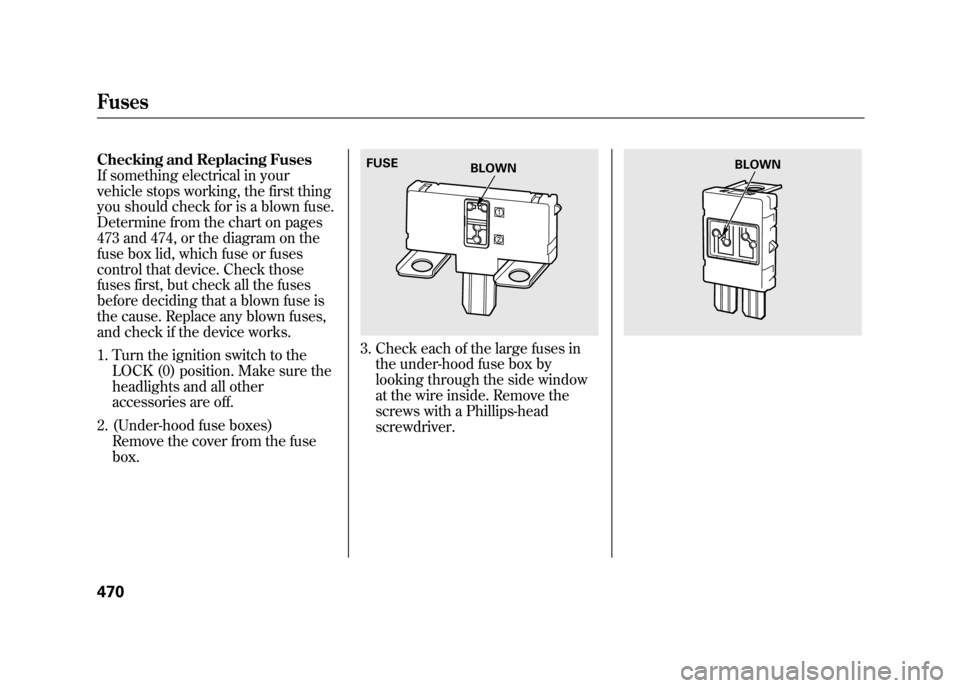
3. Check each of the large fuses inthe under-hood fuse box by
looking through the side window
at the wire inside. Remove the
screws with a Phillips-head
screwdriver.FUSE BLOWN
BLOWN
Fuses47011/06/16 17:42:51 12 ACURA RDX MMC North America Owner's M 50 31STK650 enu
Page 479 of 518
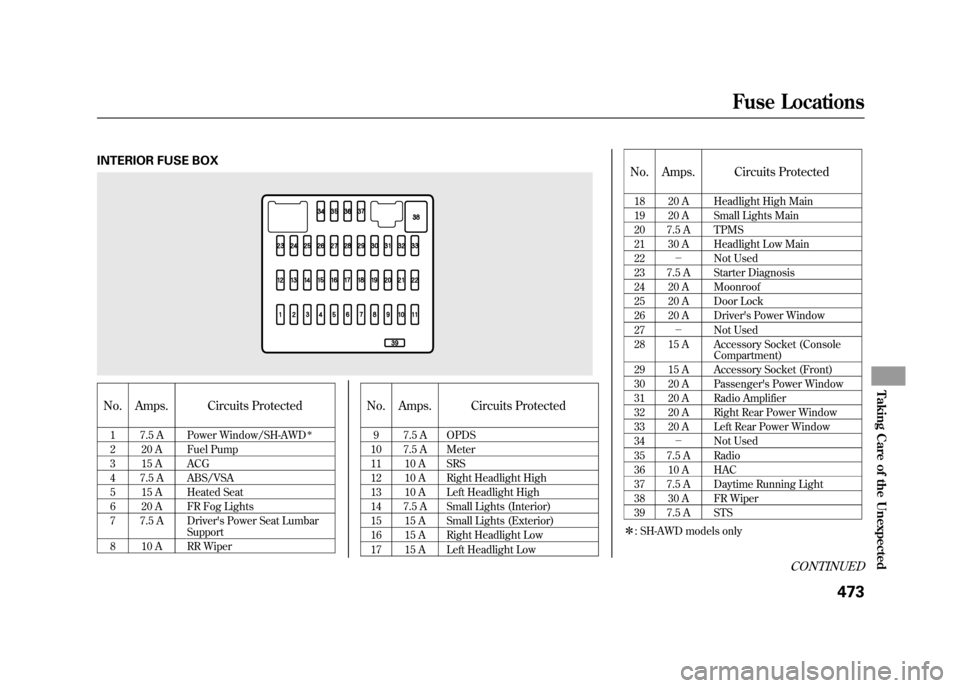
INTERIOR FUSE BOXNo. Amps.Circuits Protected1 7.5 A Power Window/SH-AWD
ᤳ
2 20 A Fuel Pump
3 15 A ACG
4 7.5 A ABS/VSA
5 15 A Heated Seat
6 20 A FR Fog Lights
7 7.5 A Driver's Power Seat Lumbar
Support
8 10 A RR Wiper
No. Amps. Circuits Protected9 7.5 A OPDS
10 7.5 A Meter
11 10 A SRS
12 10 A Right Headlight High
13 10 A Left Headlight High
14 7.5 A Small Lights (Interior)
15 15 A Small Lights (Exterior)
16 15 A Right Headlight Low
17 15 A Left Headlight Low
No. Amps. Circuits Protected18 20 A Headlight High Main
19 20 A Small Lights Main
20 7.5 A TPMS
21 30 A Headlight Low Main
22
- Not Used
23 7.5 A Starter Diagnosis
24 20 A Moonroof
25 20 A Door Lock
26 20 A Driver's Power Window
27 - Not Used
28 15 A Accessory Socket (Console Compartment)
29 15 A Accessory Socket (Front)
30 20 A Passenger's Power Window
31 20 A Radio Amplifier
32 20 A Right Rear Power Window
33 20 A Left Rear Power Window
34 - Not Used
35 7.5 A Radio
36 10 A HAC
37 7.5 A Daytime Running Light
38 30 A FR Wiper
39 7.5 A STS
ᤳ : SH-AWD models only
CONTINUED
Fuse Locations
473
Taking Care of the Unexpected
11/06/16 17:42:51 12 ACURA RDX MMC North America Owner's M 50 31STK650 enu
Page 480 of 518

UNDER-HOOD FUSE BOXES PRIMARYSECONDARY
Primary Fuse BoxNo. Amps. Circuits Protected1 100 A Main Fuse
30 A SH-AWD
ᤳ
2 80 A Option Main50 A Ignition Switch Main
3 40 A ABS/VSA Motor 20 A ABS/VSA Fail Safe
4 50 A Headlight Main 40 A Power Window Main
5 30 A Passenger's Power Seat Reclining
6 30 A Main Fan Motor
7 30 A Sub Fan Motor
8 30 A Rear Defogger
9 40 A Blower
10 15 A HazardSecondary Fuse Box
No. Amps. Circuits Protected1 7.5 A Electric Vacuum Pump
2 20 A Passenger's Power Seat
Reclining
No. Amps. Circuits Protected11 15 A LAF
12 15 A Stop & Horn
13 20 A Driver's Power Seat Reclining
14 20 A Driver's Power Seat Sliding
15 7.5 A IGPS Oil Level
16 20 A Passenger's Power Seat Sliding
17 15 A Electric Vacuum Pump
18 15 A IG Coil
19 15 A FI Main
20 7.5 A MG Clutch
21 15 A DBW
22 7.5 A Interior Light
23 10 A Back Up
ᤳ : On SH-AWD models only
Fuse Locations47411/06/16 17:42:51 12 ACURA RDX MMC North America Owner's M 50 31STK650 enu
Page 487 of 518

LightsHeadlights High12 V-60 W (HB3)
Low
ᤳ
12 V -35 W (D2S)
Front turn signal/parking lights 12 V -24/2.2 CP (Amber)
Front fog lights 12 V -55 W (H11)
Front side marker lights 12 V -3CP
Rear turn signal lights 12 V -21 W
Brake/Taillights (in fenders) 12 V -21/5 W
Taillights (in tailgate) 12 V -3CP
Back-up lights 12 V -21 W
Rear side marker lights 12 V -2CP
License plate lights 12 V -3CP
High-mount brake light 12 V -16 W
Front ceiling lights/Spotlights 12 V -4CP
Rear ceiling light 12 V -8W
Glove box light 14 V -1.4 W
Console compartment light 14 V -1.4 W
Vanity mirror lights 12 V -2W
Door courtesy lights 12 V -2CP
Cargo area light 12 V -5W
ᤳ : The low beam headlights are high voltage discharged type.
Replacement of a low beam headlight bulb should be performed by
your dealer.
Air ConditioningRefrigerant type HFC-134a (R-134a)
Charge quantity 15.8-17.6 oz (450 -500 g)
Lubricant type SP-10BatteryCapacity12 V-52 AH/5 HR
12 V -65 AH/20 HRFusesInterior See page 473 or the fuse label
attached to the dashboard.
Under-hood See page 474 or the fuse box
covers.AlignmentToe-in Front 0.0 in (0 mm)
Rear 0.10 in (2.5 mm)
Camber Front 0 ° 10’
Rear -1°
Caster Front 2 ° 57’TiresSize Front/Rear P235/55R18 99V
Spare T165/80D17 104M
Pressure Front/Rear 32 psi (220 kPa , 2.2 kgf/cm
2)
Spare 60 psi (420 kPa , 4.2 kgf/cm2)
Specifications
481
Technical Information
11/06/16 17:42:51 12 ACURA RDX MMC North America Owner's M 50 31STK650 enu
Page 493 of 518

The burning of gasoline in your
vehicle's engine produces several by-
products. Some of these are carbon
monoxide (CO), oxides of nitrogen
(NOx), and hydrocarbons (HC).
Gasoline evaporating from the tank
also produces hydrocarbons.
Controlling the production of NOx,
CO, and HC is important to the
environment. Under certain
conditions of sunlight and climate,
NOx and HC react to form
photochemical‘‘smog. ’’Carbon
monoxide does not contribute to
smog creation, but it is a poisonous
gas. The Clean Air Act
The United States Clean Air Act
ᤳ
sets standards for automobile
emissions. It also requires that
automobile manufacturers explain to
owners how their emissions controls
work and what to do to maintain
them. This section summarizes how
the emissions controls work.
Scheduled maintenance is on page
418.ᤳIn Canada, Acura vehicles comply
with the Canadian emission
requirements, as specified in an
agreement with Environment
Canada, at the time they are
manufactured. Crankcase Emissions Control
System
Your vehicle has a positive crankcase
ventilation system. This keeps
gasses that build up in the engine's
crankcase from going into the
atmosphere. The positive crankcase
ventilation valve routes them from
the crankcase back to the intake
manifold. They are then drawn into
the engine and burned.
Evaporative Emissions Control
System
As gasoline evaporates in the fuel
tank, an evaporative emissions
control canister filled with charcoal
adsorbs the vapor. It is stored in this
canister while the engine is off. After
the engine is started and warmed up,
the vapor is drawn into the engine
and burned during driving.
Emissions Controls
487
Technical Information
11/06/16 17:42:51 12 ACURA RDX MMC North America Owner's M 50 31STK650 enu
Page 497 of 518

8. Select a nearby lightly traveledmajor highway where you can
maintain a speed of 50 to 60 mph
(80 to 100 km/h) for at least 20
minutes. Drive on the highway in
D. Do not use the cruise control.
When traffic allows, drive for 90
seconds without moving the
accelerator pedal. (Vehicle speed
may vary slightly; this is okay.) If
you cannot do this for a continuous
90 seconds because of traffic
conditions, drive for at least 30
seconds, then repeat it two more
times (for a total of 90 seconds). 9. Then drive in city/suburban traffic
for at least 10 minutes. When
traffic conditions allow, let the
vehicle coast for several seconds
without using the accelerator pedal
or the brake pedal.
10. Make sure the vehicle has been parked with the engine off for 30
minutes.
If the testing facility determines the
readiness codes are still not set, see
your dealer.
Emissions Testing
491
Technical Information
11/06/16 17:42:51 12 ACURA RDX MMC North America Owner's M 50 31STK650 enu