page 61 Acura RDX 2012 Owner's Manual
[x] Cancel search | Manufacturer: ACURA, Model Year: 2012, Model line: RDX, Model: Acura RDX 2012Pages: 518, PDF Size: 26.43 MB
Page 6 of 518

Your RDX has higher ground clearance than a passenger vehicle designed for use only on pavement. Higher ground
clearance has many advantages for off-highway driving. It allows you to travel over bumps, obstacles, and rough
terrain. It also provides good visibility so you can anticipate problems earlier.
These advantages come at some cost. Because your vehicle is taller and rides higher off the ground, it has a high
center of gravity. This means your vehicle can tip or roll over if you make abrupt turns. Utility vehicles have a
significantly higher rollover rate than other types of vehicles. In a rollover crash, an unbelted person is significantly
more likely to die than a person wearing a seat belt. As a reminder, make sure you and your passengers always wear
seat belts.
For information on how to reduce the risk of rollover, read‘‘Driving Guidelines ’’on page 372 of this manual and theOff-Highway Driving Guidelines
section on page 405. Failure to operate your vehicle correctly might result in loss of
control or an accident.
Important Handling Informationiv11/06/16 17:42:51 12 ACURA RDX MMC North America Owner's M 50 31STK650 enu
Page 7 of 518

Your Vehicle at a Glance(main controls)
....................................................................................................................
3
Driver and Passenger Safety (seat belts, SRS, and child protection)
...........................................................................
5
Instruments and Controls (indicators, gauges, multi-information display, dashboard, and steering column)
...........
61
Features (
climate control, audio, steering wheel, security, cruise control, HomeLink
®, and other convenience items
)...
163
Before Driving (fuel, vehicle break-in, and cargo loading)
.......................................................................................
351
Driving (engine and transmission operation)
...........................................................................................................
371
Maintenance (minders, fluid checking, minor services, and vehicle storage)
..........................................................
409
Taking Care of the Unexpected (flat tire, jump starting, overheating, and fuses)
...................................................
453
Technical Information (vehicle specifications, tires, and emissions controls)
........................................................
477
Warranty and Client Relations (U.S. and Canada only) (warranty and contact information)
...............................
493
Index
..............................................................................................................................................................................
I
INDEX
Service Information Summary (fluid capacities and tire pressures)
...............................................................
last page
Contents
1
11/06/16 17:42:51 12 ACURA RDX MMC North America Owner's M 50 31STK650 enu
Page 12 of 518

You'll find many safety
recommendations throughout this
section, and throughout this manual.
The recommendations on this page
are the ones we consider to be the
most important.Always Wear Your Seat Belt
A seat belt is your best protection in
all types of collisions. Airbags are
designed to supplement seat belts,
not replace them. So even though
your vehicle is equipped with
airbags, make sure you and your
passengers always wear your seat
belts, and wear them properly (see
page 15).
Restrain All Children
Children age 12 and under should
ride properly restrained in a back
seat, not the front seat. Infants and
small children should be restrained
in a child seat. Larger children
should use a booster seat and a lap/
shoulder belt until they can use the
belt properly without a booster seat
(see pages 36
-56). Be Aware of Airbag Hazards
While airbags can save lives, they
can cause serious or fatal injuries to
occupants who sit too close to them,
or are not properly restrained.
Infants, young children, and short
adults are at the greatest risk. Be
sure to follow all instructions and
warnings in this manual.
Don't Drink and Drive
Alcohol and driving don't mix. Even
one drink can reduce your ability to
respond to changing conditions, and
your reaction time gets worse with
every additional drink. So don't drink
and drive, and don't let your friends
drink and drive, either.Important Safety Precautions611/06/16 17:42:51 12 ACURA RDX MMC North America Owner's M 50 31STK650 enu
Page 13 of 518

Pay Appropriate Attention to the
Task of Driving Safely
Engaging in mobile phone
conversation or other activities that
keep you from paying close attention
to the road, other vehicles and
pedestrians could lead to a crash.
Remember, situations can change
quickly, and only you can decide
when it is safe to divert attention
away from driving.Control Your Speed
Excessive speed is a major factor in
crash injuries and deaths. Generally,
the higher the speed, the greater the
risk, but serious injuries can also
occur at lower speeds. Never drive
faster than is safe for current
conditions, regardless of the
maximum speed posted.
Keep Your Vehicle in Safe
Condition
Having a tire blowout or a
mechanical failure can be extremely
hazardous. To reduce the possibility
of such problems, check your tire
pressures and condition frequently,
and perform all regularly scheduled
maintenance (see page 444).
Important Safety Precautions
7
Driver and Passenger Safety
11/06/16 17:42:51 12 ACURA RDX MMC North America Owner's M 50 31STK650 enu
Page 14 of 518
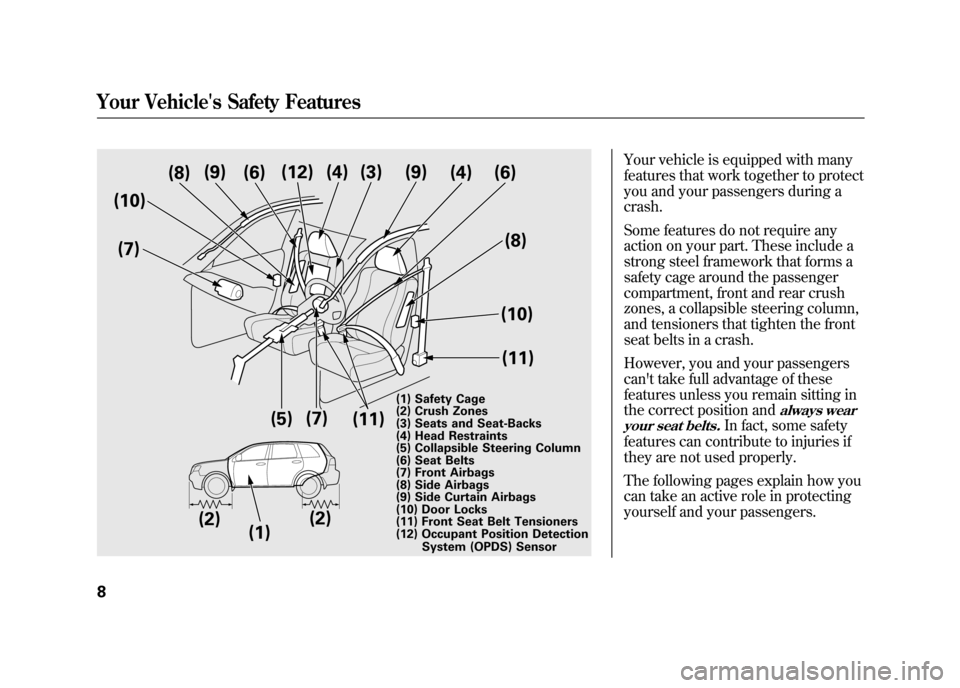
Your vehicle is equipped with many
features that work together to protect
you and your passengers during a
crash.
Some features do not require any
action on your part. These include a
strong steel framework that forms a
safety cage around the passenger
compartment, front and rear crush
zones, a collapsible steering column,
and tensioners that tighten the front
seat belts in a crash.
However, you and your passengers
can't take full advantage of these
features unless you remain sitting in
the correct position and
always wear
your seat belts.
In fact, some safety
features can contribute to injuries if
they are not used properly.
The following pages explain how you
can take an active role in protecting
yourself and your passengers.
(10)
(7) (8)
(6)
(3)
(4)
(9)
(1) (2)
(8)
(11)
(1) Safety Cage
(2) Crush Zones
(3) Seats and Seat-Backs
(4) Head Restraints
(5) Collapsible Steering Column
(6) Seat Belts
(7) Front Airbags
(8) Side Airbags
(9) Side Curtain Airbags
(10) Door Locks
(11) Front Seat Belt Tensioners
(12) Occupant Position Detection
(5)
(2) (7)(9)
(10)
(12) (4)
(6)
(11)
System (OPDS) Sensor
Your Vehicle's Safety Features811/06/16 17:42:51 12 ACURA RDX MMC North America Owner's M 50 31STK650 enu
Page 16 of 518
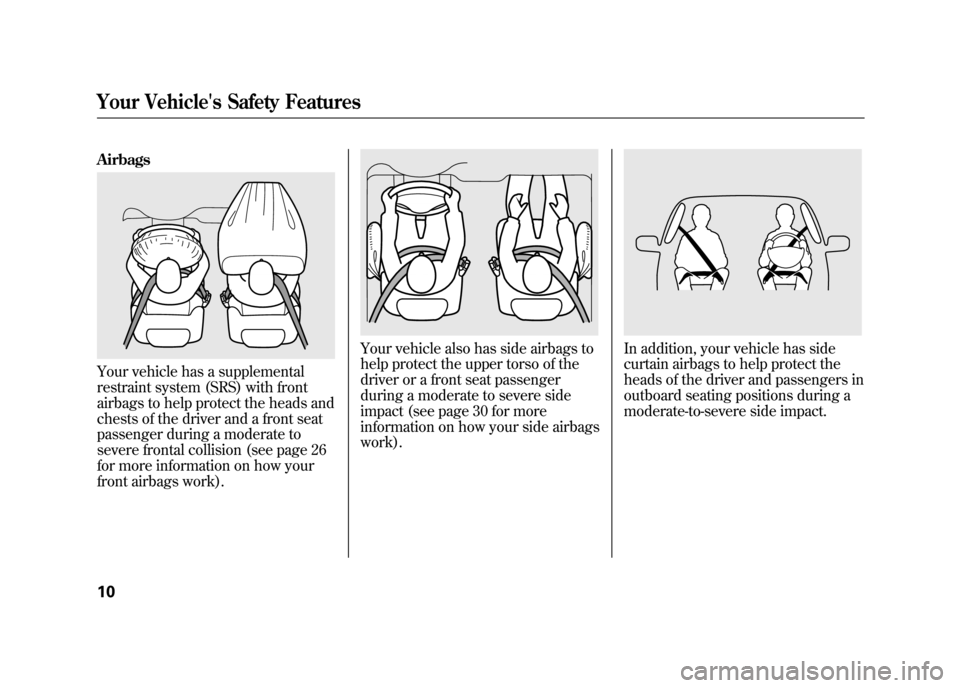
AirbagsYour vehicle has a supplemental
restraint system (SRS) with front
airbags to help protect the heads and
chests of the driver and a front seat
passenger during a moderate to
severe frontal collision (see page 26
for more information on how your
front airbags work).
Your vehicle also has side airbags to
help protect the upper torso of the
driver or a front seat passenger
during a moderate to severe side
impact (see page 30 for more
information on how your side airbags
work).
In addition, your vehicle has side
curtain airbags to help protect the
heads of the driver and passengers in
outboard seating positions during a
moderate-to-severe side impact.
Your Vehicle's Safety Features1011/06/16 17:42:51 12 ACURA RDX MMC North America Owner's M 50 31STK650 enu
Page 17 of 518

The side curtain airbags equipped in
this vehicle are also designed to help
reduce the likelihood of partial and
complete ejection of vehicle
occupants through side windows in
crashes, particularly rollover crashes
(see page 31 for additional
information on how your side curtain
airbags work).The most important things you need
to know about your airbags are:
●Airbags do not replace seat belts.They are designed to supplement
the seat belts.●Airbags offer no protection in rear
impacts, or minor frontal or sidecollisions.●Airbags can pose serious hazards.To do their job, airbags must
inflate with tremendous force. So
while airbags help save lives, they
can cause minor injuries or more
serious or even fatal injuries if
occupants are not properly
restrained or sitting properly.
What you should do:
Always wear
your seat belt properly, and sit
upright and as far back from the
steering wheel as possible while
allowing full control of the vehicle. A
front passenger should move their
seat as far back from the dashboard
as possible.
The rest of this section gives more
detailed information about how you
can maximize your safety.
Remember, however, that no safety
system can prevent all injuries or
deaths that can occur in a severe
crash, even when seat belts are
properly worn and the airbags
deploy.
Your Vehicle's Safety Features
11
Driver and Passenger Safety
11/06/16 17:42:51 12 ACURA RDX MMC North America Owner's M 50 31STK650 enu
Page 18 of 518
Introduction
The following pages provide
instructions on how to properly
protect the driver, adult passengers,
and teenage children who are large
enough and mature enough to drive
or ride in the front.
See pages 36-56 for important
guidelines on how to properly protect
infants, small children, and larger
children who ride in your vehicle.
1. Close and Lock the Doors
After everyone has entered the
vehicle, be sure the doors and the
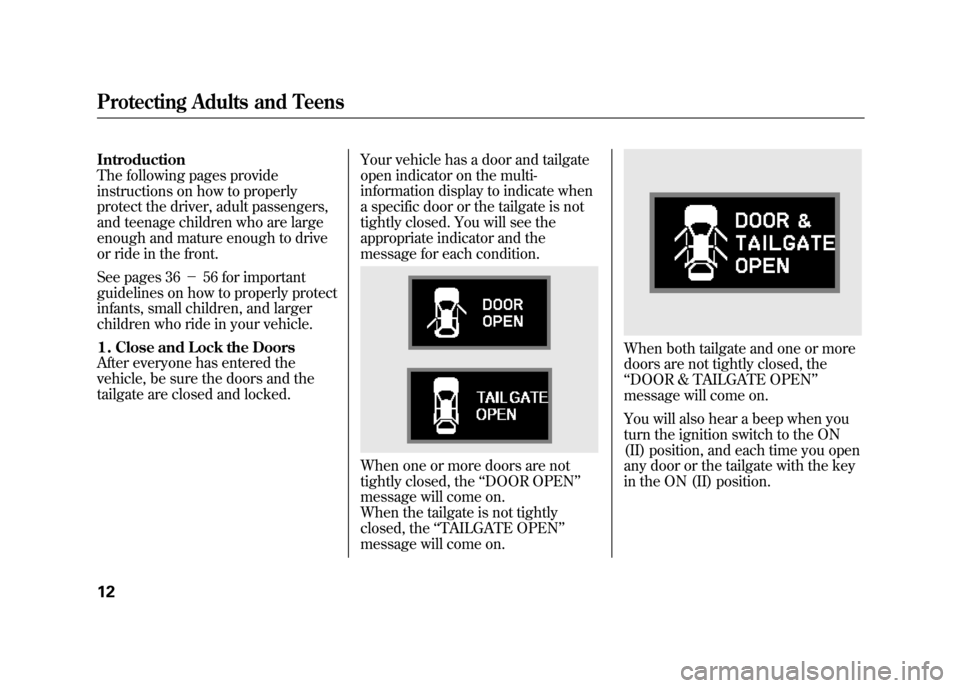
tailgate are closed and locked. Your vehicle has a door and tailgate
open indicator on the multi-
information display to indicate when
a specific door or the tailgate is not
tightly closed. You will see the
appropriate indicator and the
message for each condition.
When one or more doors are not
tightly closed, the
‘‘DOOR OPEN ’’
message will come on.
When the tailgate is not tightly
closed, the ‘‘TAILGATE OPEN ’’
message will come on.
When both tailgate and one or more
doors are not tightly closed, the
‘‘ DOOR & TAILGATE OPEN ’’
message will come on.
You will also hear a beep when you
turn the ignition switch to the ON
(II) position, and each time you open
any door or the tailgate with the key
in the ON (II) position.
Protecting Adults and Teens1211/06/16 17:42:51 12 ACURA RDX MMC North America Owner's M 50 31STK650 enu
Page 19 of 518
Locking the doors and the tailgate
reduces the chance of someone
being thrown out of the vehicle
during a crash, and it helps prevent
passengers from accidentally
opening a door or the tailgate and
falling out.
Locking the doors and the tailgate
also helps prevent an outsider from
unexpectedly opening a door or the
tailgate when you come to a stop.
See page 126 for how to lock the
doors and the tailgate.
This vehicle has auto door locking/
unlocking features. See pages 103
and 111 for how to set them.2. Adjust the Front Seats
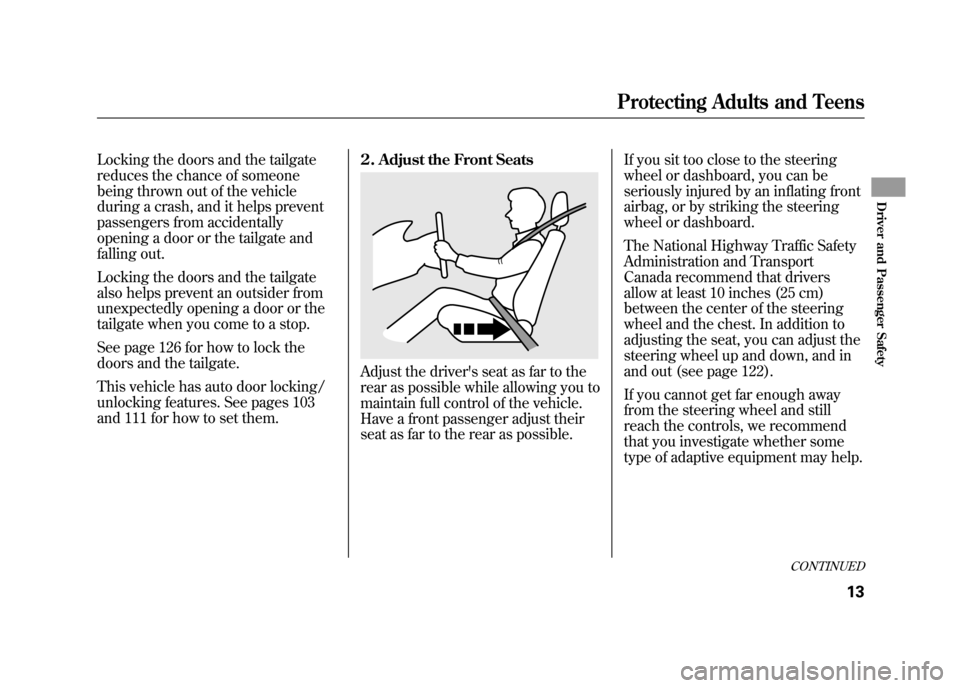
Adjust the driver's seat as far to the
rear as possible while allowing you to
maintain full control of the vehicle.
Have a front passenger adjust their
seat as far to the rear as possible.If you sit too close to the steering
wheel or dashboard, you can be
seriously injured by an inflating front
airbag, or by striking the steering
wheel or dashboard.
The National Highway Traffic Safety
Administration and Transport
Canada recommend that drivers
allow at least 10 inches (25 cm)
between the center of the steering
wheel and the chest. In addition to
adjusting the seat, you can adjust the
steering wheel up and down, and in
and out (see page 122).
If you cannot get far enough away
from the steering wheel and still
reach the controls, we recommend
that you investigate whether some
type of adaptive equipment may help.
CONTINUED
Protecting Adults and Teens
13
Driver and Passenger Safety
11/06/16 17:42:51 12 ACURA RDX MMC North America Owner's M 50 31STK650 enu
Page 20 of 518
Sitting too close to a front
airbag can result in serious
injury or death if the front
airbags inflate.
Always sit as far back from the
front airbags as possible.
See page 134 for how to adjust the
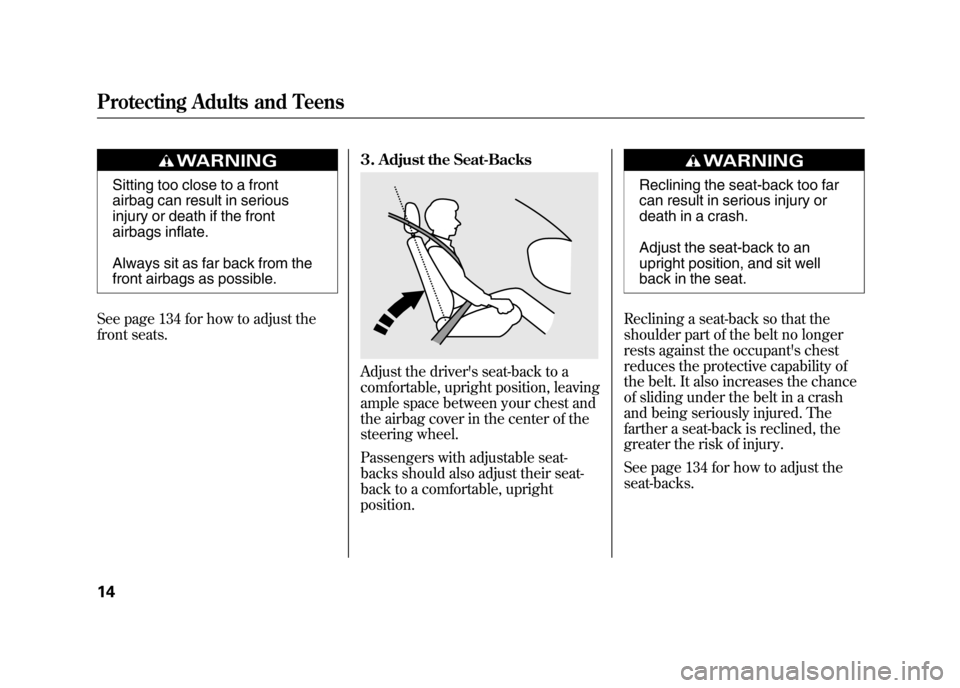
front seats. 3. Adjust the Seat-Backs
Adjust the driver's seat-back to a
comfortable, upright position, leaving
ample space between your chest and
the airbag cover in the center of the
steering wheel.
Passengers with adjustable seat-
backs should also adjust their seat-
back to a comfortable, upright
position.
Reclining the seat-back too far
can result in serious injury or
death in a crash.
Adjust the seat-back to an
upright position, and sit well
back in the seat.
Reclining a seat-back so that the
shoulder part of the belt no longer
rests against the occupant's chest
reduces the protective capability of
the belt. It also increases the chance
of sliding under the belt in a crash
and being seriously injured. The
farther a seat-back is reclined, the
greater the risk of injury.
See page 134 for how to adjust the
seat-backs.
Protecting Adults and Teens1411/06/16 17:42:51 12 ACURA RDX MMC North America Owner's M 50 31STK650 enu