maintenance Acura RL 2000 3.5 Owner's Guide
[x] Cancel search | Manufacturer: ACURA, Model Year: 2000, Model line: RL, Model: Acura RL 2000Pages: 330, PDF Size: 4.53 MB
Page 216 of 330
Owne
r Maintenanc e Check s
You should check the following items at the specified intervals. If
you are unsure of how to perform any check, turn to the page given. Engine oil level — Check every
time you fill the fuel tank. See
page 169.
Engine coolant level — Check the
radiator reserve tank every time
you fill the fuel tank. See page 170.
Windshield washer fluid — Check the level in the reservoir monthly.If weather conditions cause you to
use the washers frequently, check
the reservoir each time you stop
for fuel. See page 225 . Automatic transmission — Check
the fluid level monthly. See page
226.
Brakes — Check the fluid level
monthly. See page 22 8 . Tires —
Check the tire pressure
monthly. Examine the tread for
wear and foreign objects. See page
241.
Lights — Check the operation of
the headlights, parking lights,
taillights, high-mount brake light,
turn signals, brake lights, and license plate lights monthly. See
page 248.
Maintenance
Page 219 of 330
Engin
e Oi l
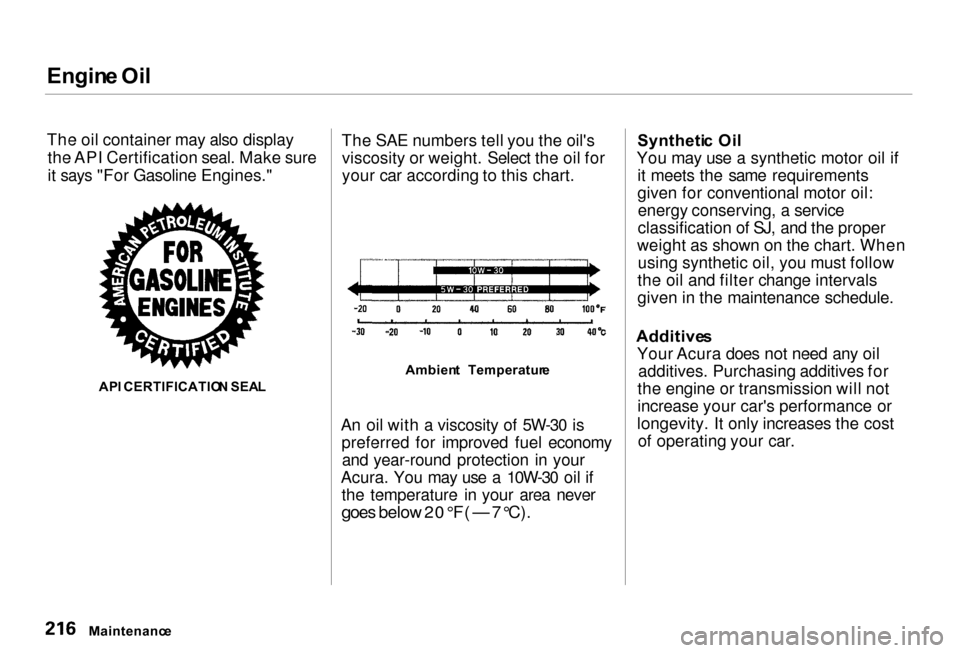
The oil container may also display the API Certification seal. Make sure
it says "For Gasoline Engines."
API CERTIFICATIO N SEA L The SAE numbers tell you the oil's
viscosity or weight. Select the oil for
your car according to this chart.
An oil with a viscosity of 5W-30 is preferred for improved fuel economyand year-round protection in your
Acura. You may use a 10W-30 oil if the temperature in your area never
goes below 20°F( — 7°C).
Syntheti
c Oi l
You may use a synthetic motor oil if it meets the same requirements
given for conventional motor oil:energy conserving, a service
classification of SJ, and the proper
weight as shown on the chart. When using synthetic oil, you must follow
the oil and filter change intervals
given in the maintenance schedule.
Additive s
Your Acura does not need any oil additives. Purchasing additives for
the engine or transmission will not
increase your car's performance or
longevity. It only increases the cost of operating your car.
Maintenanc e Ambien
t Temperatur e
Page 220 of 330
Engin
e Oi l
Changin g th e Oi l an d Filte r
Always change the oil and filter according to the time and distance (miles/kilometers) recommenda-
tions in the maintenance schedule.
The oil and filter collect contami- nants that can damage your engine if
they are not removed regularly.
Changing the oil and filter requires
special tools and access from
underneath the car. The car should
be raised on a service station-type hydraulic lift for this service. Unless
you have the knowledge and proper equipment, you should have this
maintenance done by a skilled
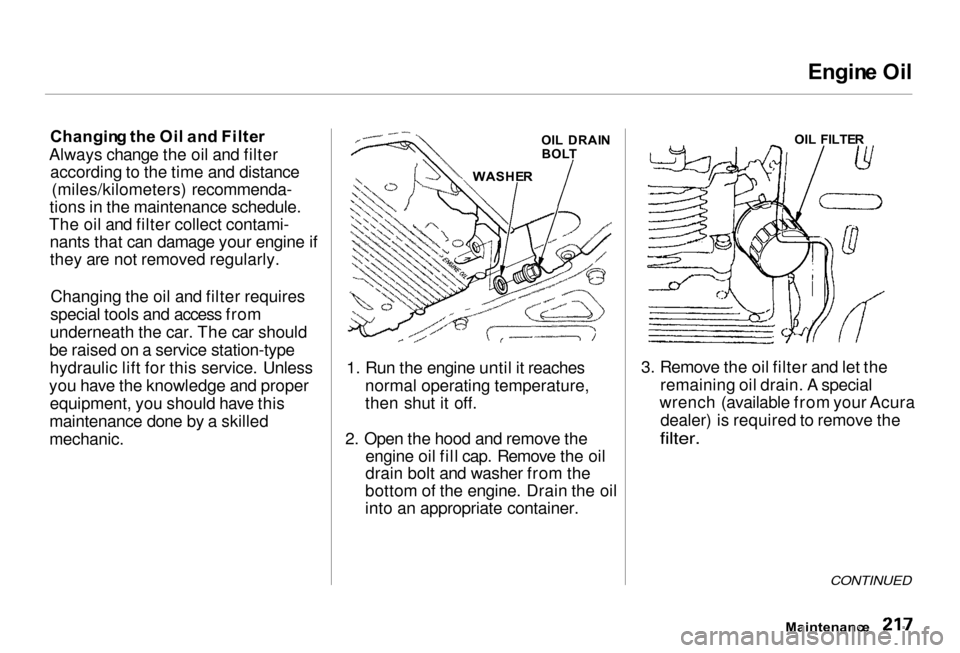
mechanic. 1. Run the engine until it reaches
normal operating temperature,
then shut it off.
2. Ope
n the hood and remove the
engine oil fill cap. Remove the oil
drain bolt and washer from the
bottom of the engine. Drain the oil
into an appropriate container.
3. Remov
e the oil filter and let the
remaining oil drain. A special
wrench (available from your Acura dealer) is required to remove the
filter.
CONTINUED
Maintenanc e
WASHE
R
OI
L DRAI N
BOL T OI
L
FILTE
R
Page 224 of 330
Coolin
g Syste m
Replacin g Engin e Coolan t
The cooling system should be completely drained and refilled with
new coolant according to the time and distance recommendations in
the maintenance schedule. Only use Genuine Honda Antifreeze/Coolant.
Draining the coolant requires access
to the underside of the car. Unless
you have the tools and knowledge,
you should have this maintenance done by a skilled mechanic.
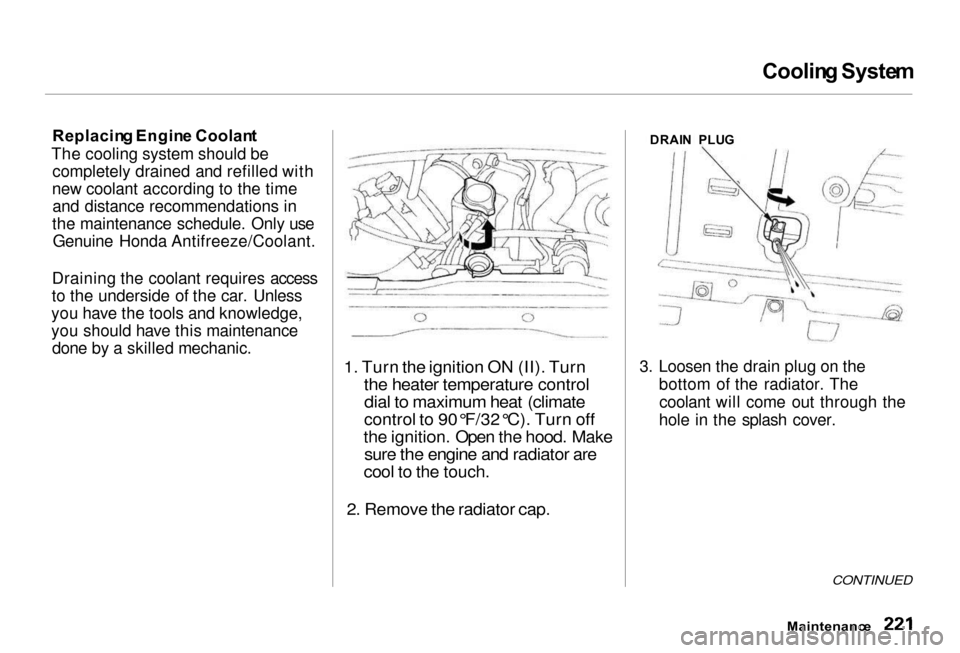
1. Turn the ignition ON (II). Turn
the heater temperature controldial to maximum heat (climate
control to 90°F/32°C). Turn off
the ignition. Open the hood. Make
sure the engine and radiator are
cool to the touch.
2. Remove the radiator cap.
DRAI
N PLU G
3. Loosen the drain plug on the bottom of the radiator. Thecoolant will come out through the
hole in the splash cover.
CONTINUED
Maintenanc e
Page 228 of 330
Windshiel
d Washer s
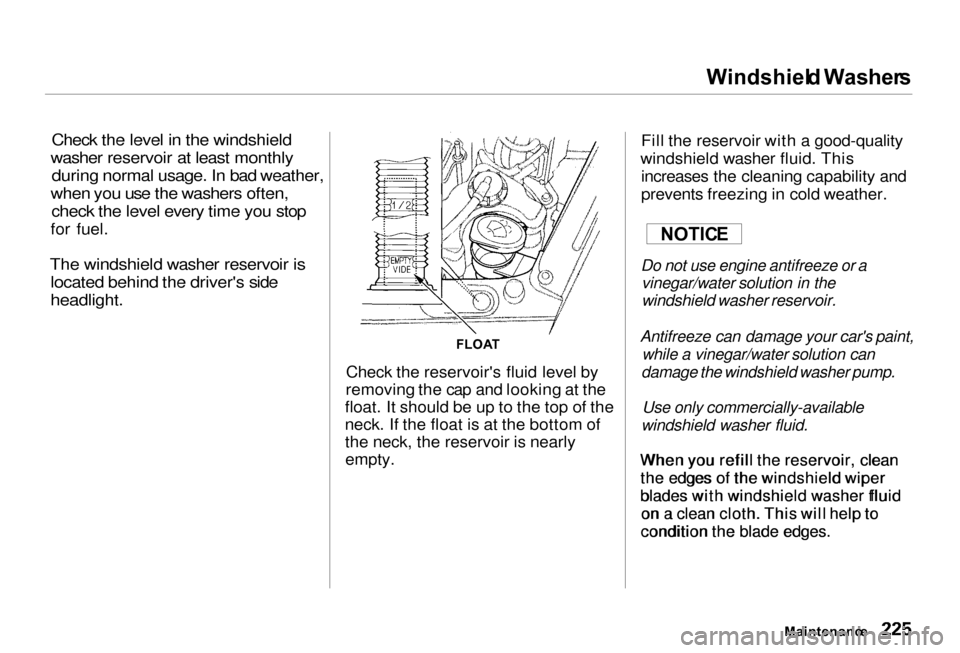
Check the level in the windshield
washer reservoir at least monthly during normal usage. In bad weather,
when you use the washers often, check the level every time you stop
for fuel.
The windshield washer reservoir is located behind the driver's side
headlight.
Check the reservoir's fluid level by
removing the cap and looking at the
float. It should be up to the top of the
neck. If the float is at the bottom of
the neck, the reservoir is nearly empty. Fill the reservoir with a good-quality
windshield washer fluid. This increases the cleaning capability and
prevents freezing in cold weather.
Do not use engine antifreeze or a
vinegar/water solution in the
windshield washer reservoir.
Antifreeze can damage your car's paint,
while a vinegar/water solution can
damage the windshield washer pump.
Use only commercially-available
windshield washer fluid.
When you refill the reservoir, clean the edges of the windshield wiper
blades with windshield washer fluid on a clean cloth. This will help to
condition the blade edges.
Maintenance
FLOA
T NOTIC
E
When you refill the reservoir, clean
the edges of the windshield wiper
blades with windshield washer fluid
on a clean cloth. This will help to
condition the blade edges.
Page 229 of 330
Automati
c Transmissio n Flui d
Check the fluid level with the engine
at normal operating temperature.
1. Park the car on level ground. Shut off the engine.
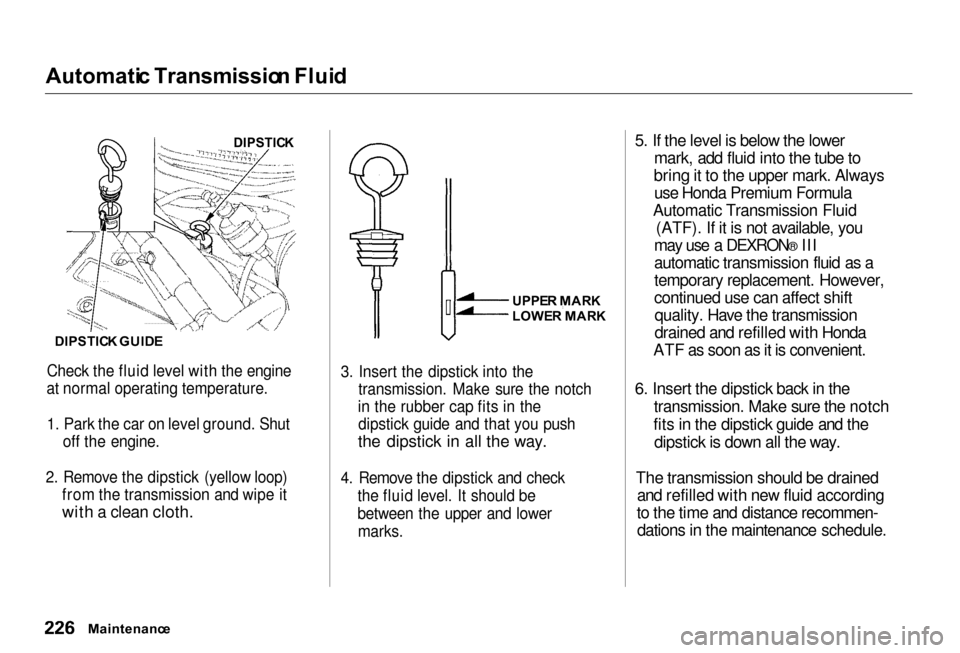
2. Remove the dipstick (yellow loop) from the transmission and wipe it
with a clean cloth.
3. Insert the dipstick into the transmission. Make sure the notch
in the rubber cap fits in the dipstick guide and that you push
the dipstick in all the way.
4. Remove the dipstick and check
the fluid level. It should be
between the upper and lowermarks.
5. If the level is below the lower
mark, add fluid into the tube to
bring it to the upper mark. Always use Honda Premium Formula
Automatic Transmission Fluid (ATF). If it is not available, you
may use a DEXRON® III
automatic transmission fluid as a
temporary replacement. However,
continued use can affect shift quality. Have the transmission
drained and refilled with Honda
ATF as soon as it is convenient.
6. Insert the dipstick back in the transmission. Make sure the notch
fits in the dipstick guide and the dipstick is down all the way.
The transmission should be drained and refilled with new fluid according
to the time and distance recommen- dations in the maintenance schedule.
Maintenanc e UPPE
R MAR K
LOWE R MAR K
DIPSTIC
K
DIPSTIC K GUID E
Page 230 of 330
Differentia
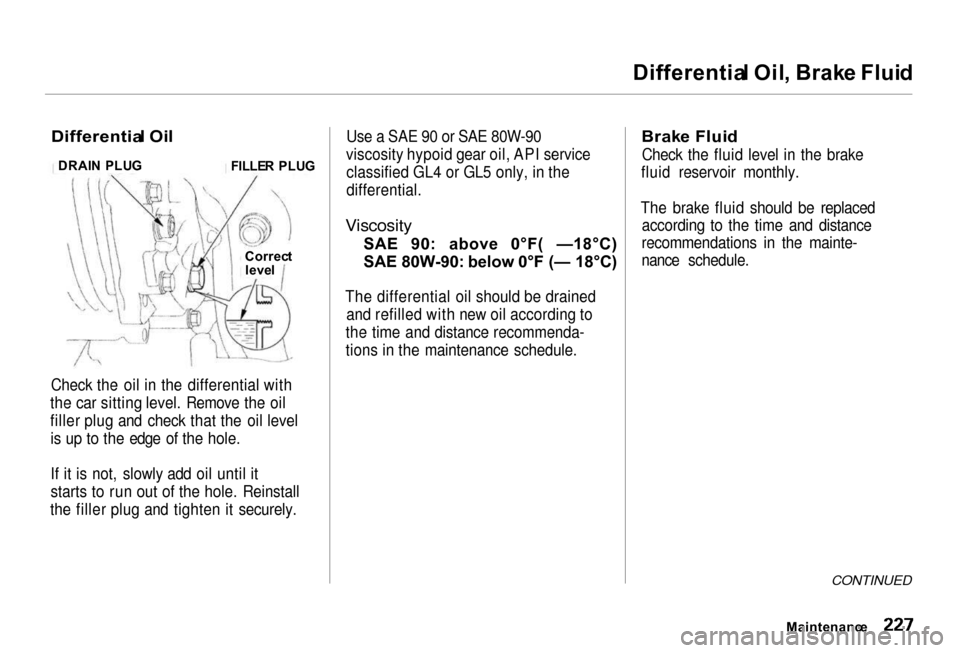
l Oil , Brak e Flui dCheck the oil in the differential with
the car sitting level. Remove the oil
filler plug and check that the oil level is up to the edge of the hole.
If it is not, slowly add oil until it
starts to run out of the hole. Reinstall
the filler plug and tighten it securely. Use a SAE 90 or SAE 80W-90
viscosity hypoid gear oil, API service classified GL4 or GL5 only, in the
differential.
Viscosity
SAE 90: above 0°F( —18°C)
SAE 80W-90: below 0°F (— 18°C)
The differential oil should be drained and refilled with new oil according to
the time and distance recommenda-
tions in the maintenance schedule.
Brak e Flui d
Check the fluid level in the brake
fluid reservoir monthly.
The brake fluid should be replaced according to the time and distance
recommendations in the mainte-
nance schedule.
CONTINUED
Maintenanc e
Correc
t
leve l
Differentia
l Oi l
FILLER PLU G
DRAI
N PLU G
Page 232 of 330

Powe
r Steering , Hoo d Latch , Ai r Cleane r Elemen t
Always use Genuine Honda Power Steering Fluid. If it is not available,
you may use another power steering fluid as an emergency replacement.However, continued use can causeincreased wear and poor steering in
cold weather. Have the powersteering system flushed and refilled
with Honda PSF as soon as possible.
A low power steering fluid level can indicate a leak in the system. Check
the fluid level frequently and have
the system inspected as soon as
possible.
Turning the steering wheel to full left
or right lock and holding it there can
damage the power steering pump.
Hoo d Latc h
Clean the hood latch assembly with a
mild cleaner, then lubricate it with a
multipurpose grease. Lubricate all
the moving parts (as shown),
including the pivot. Follow the time
and distance recommendations in
the Maintenance Schedule. If you are not sure how to clean and grease
the latch, contact your Acura dealer.
Ai
r Cleane r Elemen t
The air cleaner element should be cleaned or replaced according to the
time and distance recommendations
in the maintenance schedule.
Cleaning (Severe Conditions)
Clean the air cleaner element by
blowing compressed air through it in
the opposite direction to normal air
flow. If you do not have actcess to
compressed air (such as a service station), ask your Acura dealer to do
this service.
Follow the replacement procedure
for removal and reinstallation.
CONTINUED
Maintenanc e
PIVOT
S
LATC H
ASSEMBL Y
NOTIC E
Page 234 of 330
Spar
k Plug s
The spark plugs in your car are a special platinum-tipped design for
longer life. The spark plugs should
be replaced according to the time
and distance recommendations in
the maintenance schedule. Replacemen
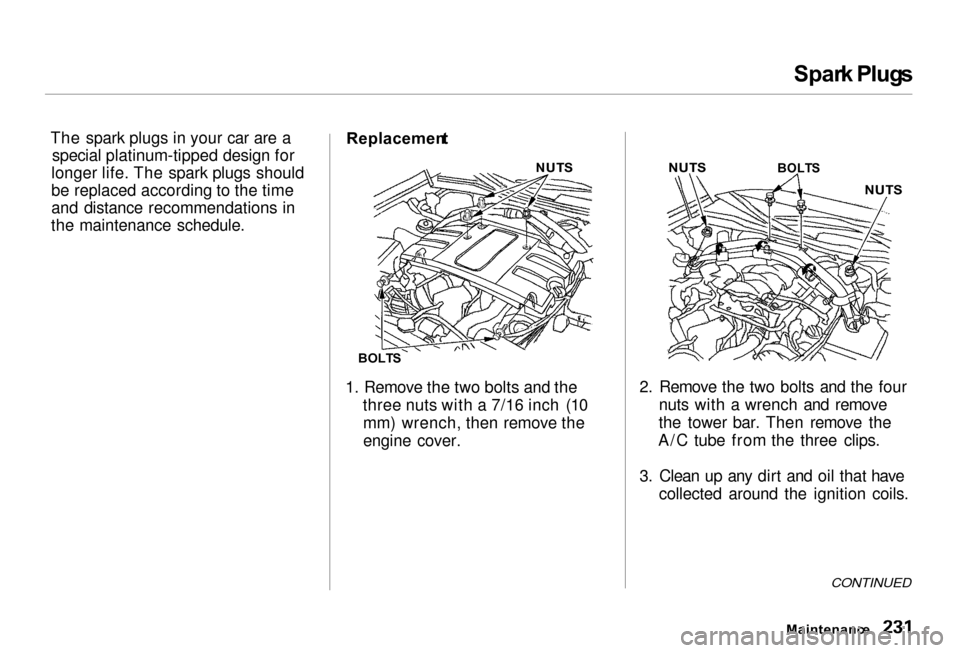
t
1. Remove the two bolts and the three nuts with a 7/16 inch (10mm) wrench, then remove the
engine cover. 2. Remove the two bolts and the four
nuts with a wrench and remove
the tower bar. Then remove the
A/C tube from the three clips.
3. Clean up any dirt and oil that have collected around the ignition coils.
CONTINUED
Maintenanc e
NUT
S
BOLT S
NUT
S
BOLTS
NUTS
Page 238 of 330

Batter
y
Check the battery terminals for
corrosion (a white or yellowish
powder). To remove it, cover the
terminals with a solution of baking
soda and water. It will bubble up and
turn brown. When this stops, wash it
off with plain water. Dry off the
battery with a cloth or paper towel. Coat the terminals with grease to
help prevent future corrosion.
If the terminals are severely cor-
roded, clean them with baking soda
and water. Then use a wrench to
loosen and remove the cables from the terminals. Always disconnect the
negative (
—) cable first and recon-
nect it last. Clean the battery termi-
nals with a terminal cleaning tool or
wire brush. Reconnect and tighten
the cables, then coat the terminals
with grease. If you need to connect the battery to
a charger, disconnect both cables to
prevent damage to the car's
electrical system.
CONTINUED
Maintenanc e
The battery gives off explosive
hydrogen gas during normal
operation.
A spark or flame can cause the battery to explode with enough
force to kill or seriously hurt you.
Wear protective clothing and a
face shield, or have a skilled mechanic do the battery
maintenance.