automatic transmission Acura RL 2000 3.5 Owner's Manual
[x] Cancel search | Manufacturer: ACURA, Model Year: 2000, Model line: RL, Model: Acura RL 2000Pages: 330, PDF Size: 4.53 MB
Page 77 of 330
Steerin
g Whee l Control s
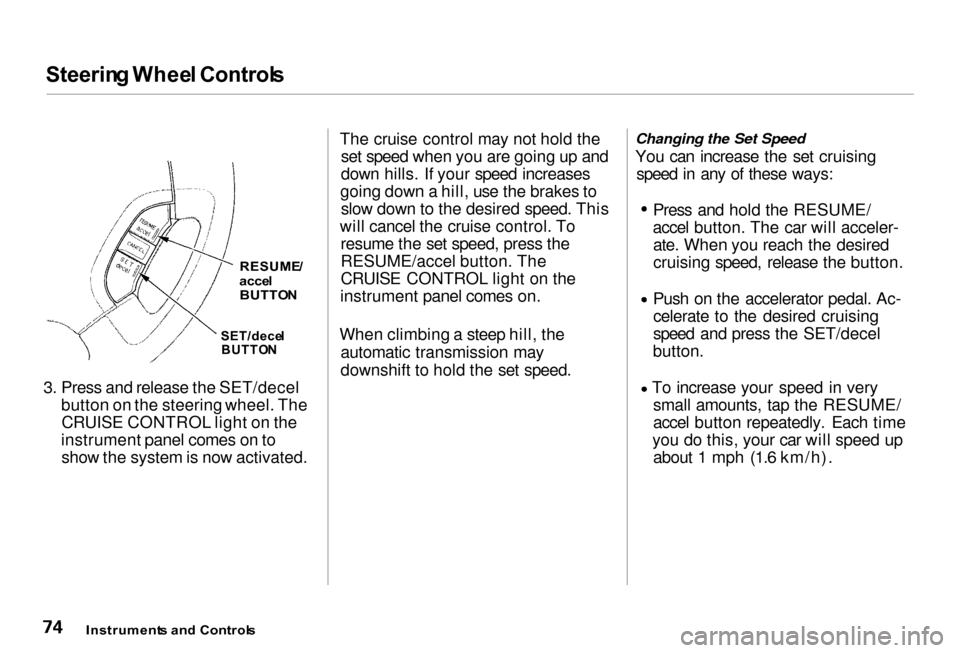
3. Press and release the SET/decel button on the steering wheel. TheCRUISE CONTROL light on the
instrument panel comes on to show the system is now activated. The cruise control may not hold the
set speed when you are going up and
down hills. If your speed increases
going down a hill, use the brakes to slow down to the desired speed. This
will cancel the cruise control. To resume the set speed, press the
RESUME/accel button. The
CRUISE CONTROL light on the
instrument panel comes on.
When climbing a steep hill, the automatic transmission may
downshift to hold the set speed. Changing the Set Speed
You can increase the set cruising
speed in any of these ways: Press and hold the RESUME/
accel button. The car will acceler- ate. When you reach the desired
cruising speed, release the button. Push on the accelerator pedal. Ac-
celerate to the desired cruising
speed and press the SET/decel
button. To increase your speed in very
small amounts, tap the RESUME/
accel button repeatedly. Each time
you do this, your car will speed up about 1 mph (1.6 km/h).
Instrument s an d Control s
RESUME
/
acce l
BUTTO N
SET/dece l
BUTTO N
Page 180 of 330
Drivin
g
This section gives you tips on starting the engine under various
conditions, and how to operate the
automatic transmission. It also
includes important information on
parking your car, the braking system,
the Vehicle Stability Assist System, and facts you need if you are
planning to tow a trailer. Preparing to Drive......................... 178
Starting the Engine........................ 179
Starting in Cold Weather at High Altitude ..................... 179
Automatic Transmission............... 180 Shift Lever Position Indicator.. 180
Shift Lever Positions................. 180
Engine Speed Limiter............... 182
Shift Lock Release..................... 183
Parking............................................ 184
The Braking System...................... 185 Brake Wear Indicators.............. 185
Brake System Design................ 186
Anti-lock Brakes........................ 186 Important Safety
Reminders.......................... 187
ABS Indicator......................... 187
Vehicle Stability Assist System.... 189 Driving in Bad Weather................ 192
Towing a Trailer............................ 194
Driving
Page 185 of 330
Automati
c Transmissio n
Driv e (D 4) — Use this position for
your normal driving. The transmis- sion automatically selects a suitable
gear for your speed and acceleration.
You may notice the transmission shifting up at higher speeds when
the engine is cold. This helps the engine warm up faster.
Driv e (D 3) —This position is similar
to D4, except only the first three
gears are selected. Use D3 when
towing a trailer in hilly terrain, or to
provide engine braking when going down a steep hill. D3 can also keep
the transmission from cycling
between third and fourth gears in stop-and-go driving.
For faster acceleration when in D3 or
D4, you can get the transmission to
automatically downshift by pushing
the accelerator pedal to the floor.
The transmission will shift down one or two gears, depending on your
speed.
Secon
d (2 ) — This position locks
the transmission in second gear. It does not downshift to first gear
when you come to a stop. Second
gives you more power when climbing, and increased engine braking when
going down steep hills. Use second
gear when starting out on a slippery surface or in deep snow. It will help
reduce wheelspin.
Firs t (1 ) — To shift from Second to
First, push down on the shift lever.
With the lever in this position, the transmission locks in First gear. By upshifting and downshifting through1, 2, D3 and D4, you can operate this
transmission much like a manual
transmission without a clutch pedal. Engin
e Spee d Limite r
If you exceed the maximum speed
for the gear you are in, the engine speed will enter into the tachometer's
red zone. If this occurs, you may feel
the engine cut in and out. This is caused by a limiter in the engine's
computer controls. The engine will
run normally when you reduce the
RPM below the red zone.
Drivin g
Page 202 of 330

Towin
g a Traile r
Drivin g Safel y Wit h a Traile r
The added weight, length, and height of a trailer will affect your
vehicle's handling and performance, so driving with a trailer requires
some special driving skills and
techniques.
For your safety and the safety of
others, take time to practice driving
maneuvers before heading for the open road, and follow the guidelines
discussed below.
Towing Speeds and Gears
Driving slower than normal in all driving situations, and obey posted
speed limits for vehicles with trailers.
Use the D4 position when towing a
trailer on level roads. D3 is the
proper shift lever position to use
when towing a trailer in hilly terrain. (See "Driving on Hills" in the next
column for additional gear
information.) Making Turns and Braking
Make turns more slowly and wider
than normal. The trailer tracks a smaller arc than your vehicle, and it
can hit or run over something the
vehicle misses. Allow more time and distance for braking. Do not brake or
turn suddenly as this could cause the
trailer to jackknife or turn over.
Driving on Hills
When climbing hills, closely watch
your temperature gauge. If it nears the red (Hot) mark, turn the airconditioning off, reduce speed and, if
necessary, pull to the side of the
road to let the engine cool.
If the automatic transmission shifts
frequently between 3rd and 4th
gears while going up a hill, shift to
D3.
If you must stop when facing uphill,
use the foot brake or parking brake. Do not try to hold the vehicle in
place by pressing on the accelerator, as this can cause the automatic
transmission to overheat.
When driving down hills, reduce
your speed and shift down to 2nd gear. Do not "ride" the brakes, andremember it will take longer to slowdown and stop when towing a trailer.
CONTINUED
Drivin g
Page 204 of 330
Maintenanc
e
This section explains why it is important to keep your car well
maintained and to follow basic
maintenance safety precautions.
This section also includes Maintenance Schedules for normal
driving and severe driving conditions,
a Maintenance Record, and instruc-
tions for simple maintenance tasks
you may want to take care of
yourself.
If you have the skills and tools to per-
form more complex maintenance tasks on your Acura, you may want
to purchase the Service Manual. See
page 315 for information on how to obtain a copy, or see your Acura
dealer.
Maintenance Safety....................... 202
Important Safety Precautions.. 203
Maintenance Schedule.................. 204
Required Maintenance Record.... 211
Owner Maintenance Checks........ 213
Fluid Locations............................... 214
Engine Oil....................................... 215 Adding Oil................................... 215
Recommended Oil..................... 215
Synthetic Oil............................... 216
Additives..................................... 216 Changing the Oil and Filter...... 217
Cooling System.............................. 219 Adding Engine Coolant............. 219Replacing Engine Coolant........ 221
Windshield Washers..................... 225
Automatic Transmission Fluid..... 226
Differential Oil............................... 227
Brake Fluid..................................... 227
Brake System............................. 228
Power Steering............................... 228
Hood Latch..................................... 229
Air Cleaner Element...................... 229 Spark Plugs..................................... 231 Replacement............................... 231
Specifications............................. 234 Battery............................................ 234
Wiper Blades.................................. 237
Air Conditioning System............... 239
Air Conditioning Filter.................. 240
Drive Belts...................................... 240
Timing Belt..................................... 241 Tires................................................ 241 Inflation....................................... 241
Inspection................................... 243
Maintenance............................... 244
Tire Rotation.............................. 244
Replacing Tires and Wheels.... 245
Wheels and Tires....................... 246
Winter Driving........................... 246
Snow Tires.............................. 247
Tire Chains............................. 247
Lights.............................................. 248 Replacing Bulbs......................... 250
Storing Your Car............................ 259
Maintenance
Page 216 of 330
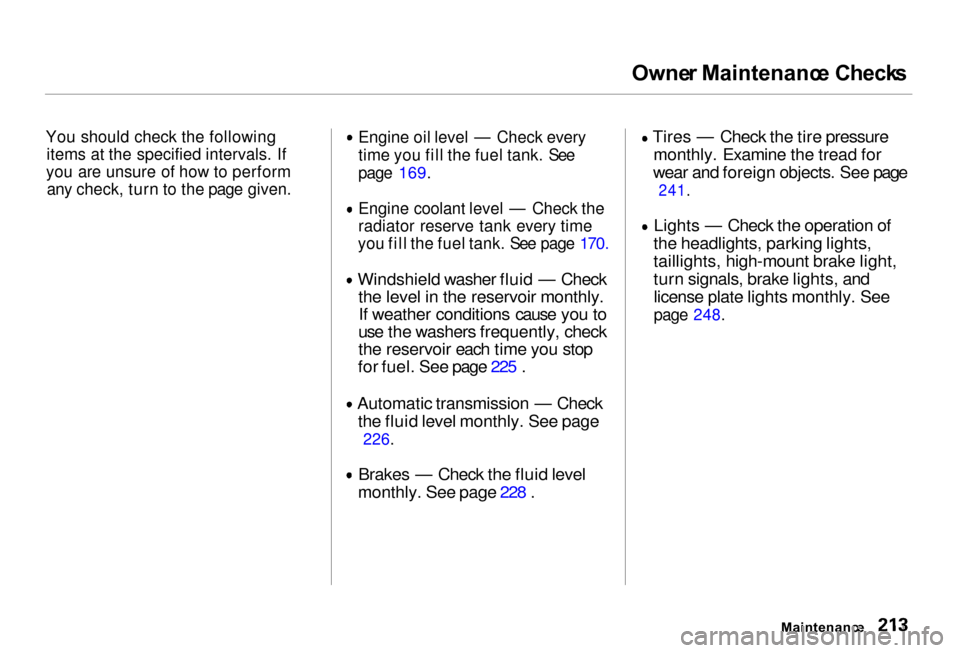
Owne
r Maintenanc e Check s
You should check the following items at the specified intervals. If
you are unsure of how to perform any check, turn to the page given. Engine oil level — Check every
time you fill the fuel tank. See
page 169.
Engine coolant level — Check the
radiator reserve tank every time
you fill the fuel tank. See page 170.
Windshield washer fluid — Check the level in the reservoir monthly.If weather conditions cause you to
use the washers frequently, check
the reservoir each time you stop
for fuel. See page 225 . Automatic transmission — Check
the fluid level monthly. See page
226.
Brakes — Check the fluid level
monthly. See page 22 8 . Tires —
Check the tire pressure
monthly. Examine the tread for
wear and foreign objects. See page
241.
Lights — Check the operation of
the headlights, parking lights,
taillights, high-mount brake light,
turn signals, brake lights, and license plate lights monthly. See
page 248.
Maintenance
Page 229 of 330
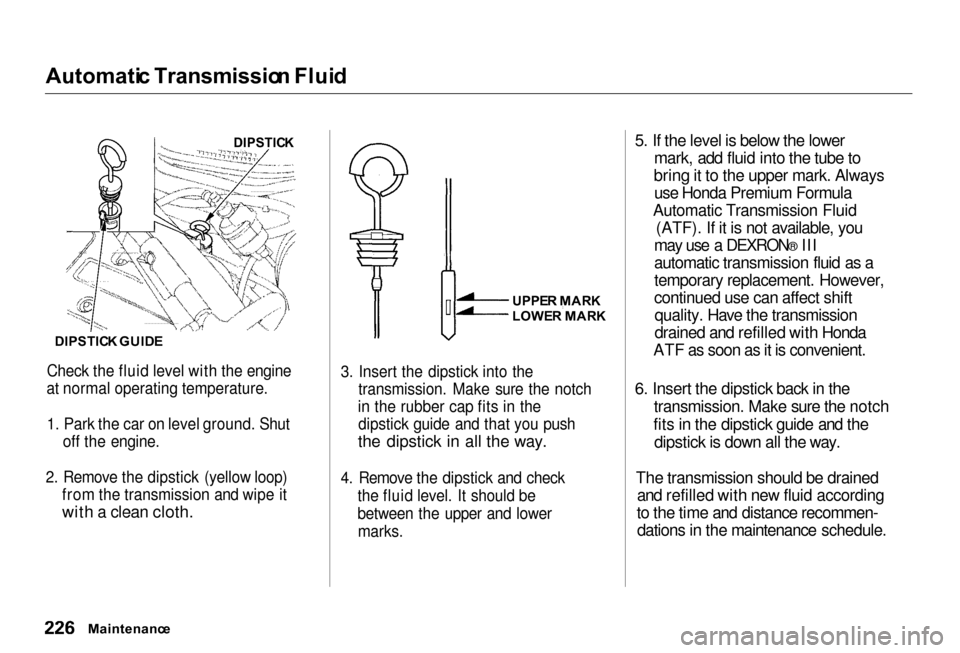
Automati
c Transmissio n Flui d
Check the fluid level with the engine
at normal operating temperature.
1. Park the car on level ground. Shut off the engine.
2. Remove the dipstick (yellow loop) from the transmission and wipe it
with a clean cloth.
3. Insert the dipstick into the transmission. Make sure the notch
in the rubber cap fits in the dipstick guide and that you push
the dipstick in all the way.
4. Remove the dipstick and check
the fluid level. It should be
between the upper and lowermarks.
5. If the level is below the lower
mark, add fluid into the tube to
bring it to the upper mark. Always use Honda Premium Formula
Automatic Transmission Fluid (ATF). If it is not available, you
may use a DEXRON® III
automatic transmission fluid as a
temporary replacement. However,
continued use can affect shift quality. Have the transmission
drained and refilled with Honda
ATF as soon as it is convenient.
6. Insert the dipstick back in the transmission. Make sure the notch
fits in the dipstick guide and the dipstick is down all the way.
The transmission should be drained and refilled with new fluid according
to the time and distance recommen- dations in the maintenance schedule.
Maintenanc e UPPE
R MAR K
LOWE R MAR K
DIPSTIC
K
DIPSTIC K GUID E
Page 320 of 330
Inde
x
Accessories and Modifications.... 174 Accessories................................. 174
Additional Safety Precautions.. 175Modifications............................. 175
ACCESSORY (Ignition Key Position)........................................ 80
Accessory Power Socket.............. 114
Adding Automatic Transmission
Fluid........................................ 226
Brake Fluid................................. 227
Differential Oil........................... 227
Engine Coolant........................... 219
Engine Oil................................... 215
Power Steering Fluid................. 228
Windshield Washer Fluid......... 225
Additional Information About Your Airbags............................ 48
Additional Safety Precautions.... 48
Airbag Service.............................. 48
Additional Information About Your Front Airbags................. 43
How the SRS Indicator Works... 45
How Your Front Airbags
Work.......................................... 43
SRS Components......................... 43
Additional Information About Your Seat Belts........................ 40
Automatic Seat Belt Tensioners................................ 41
Lap/Shoulder Belt....................... 40
Seat Belt Maintenance................ 42
Seat Belt System Components... 40
Additional Information About
Your Side Airbags.................... 46
How The Side Airbag Indicator Light Works............................. 47
How Your Side Airbags Work.... 46
Additives, Engine Oil..................... 216
Adjustments Head Restraints........................... 95
Mirrors.......................................... 98
Seats.............................................. 93
Steering Wheel............................ 71
Airbag (SRS).......................... 9, 43, 46
Air Cleaner Element...................... 229
Air Conditioning Filter.................. 240
Air Conditioning System............... 120
Maintenance............................... 239
Usage.................................. 122, 127
Air Outlet
s (Vents)........................ 120
Air Pressure, Tires........................ 242
Alarm, Anti-theft............................ 162
Alcohol in Gasoline........................ 303
Aluminum Wheels, Cleaning........ 263
Antifreeze....................................... 219
Anti-lock Brakes (ABS)
Indicator Light..................... 56, 187
Operation.................................... 18
6
Anti-theft, Audio System............... 162
Anti-theft Steering Column
Lock............................................... 80
Anti-theft System........................... 163
Appearance Care........................... 261
Armrest............................................. 96
Ashtrays.......................................... 116 Audio Controls, Remote................ 161
Audio System................................. 134
Automatic Climate Control System......................................... 120
Automatic Lighting.......................... 64
Automatic Seat Belt Tensioners.................................... 41
CONTINUED
Page 321 of 330
Inde
x
Automatic Speed Control................ 73
Automatic Transmission............... 180
Capacity, Fluid........................... 298
Checking Fluid Level................ 226
Shifting........................................ 180
Shift Lever Position Indicator.. 180
Shift Lever Positions................. 180
Shift Lock Release..................... 183
Battery
Charging System
Indicator............................ 54, 283
Jump Starting............................. 278
Maintenance............................... 234
Specifications............................. 299
Before Driving............................... 165
Belts, Seat..................................... 8, 40
Beverage Holder............................ 111
Body Repair.................................... 267
Brakes
Anti-lock System (ABS)............ 186
Break-in, New Linings .............. 166
Fluid............................................ 227
Light, Burned-out...................... 254 Parking........................................ 108
System Indicator.................. 54, 285
Wear Indicators......................... 185
Brakes, ABS Operation.................................... 186System Indicator.................. 56, 187
Braking System.............................
. 185
Break-in, New Car......................... 166
Brightness Control, Instruments... 66
Brights, Headlights......................... 63
Bulb Replacement Back-up Lights........................... 254
Brake Lights............................... 254
Ceiling Lights............................. 257
Courtesy Lights......................... 257
Fog Lights.................................. 251 Front Side Marker Lights......... 253
Headlights.................................. 250
High-mount Brake Light.......... 255
License Plate Lights.................. 256
Specifications............................. 299
Trunk Light................................ 258
Turn Signal Lights..................... 253
Bulbs, Halogen............................... 250
Cables, Jump Starting With.......... 278
Cancel Button................................... 75
Capacities Chart............................. 298
Carbon Monoxide Hazard.............. 49
Carrying, Cargo............................. 174
Cassette Player
Care............................................. 154
Operation........................... 139, 151
CAUTION, Explanation of............... ii
CD Changer................. 142, 155, 157
Ceiling Lights................................. 117
Certification Label......................... 296
Chains............................................. 247
Change Oil
How to......................................... 217
When to....................................... 206
Changing a Flat Tire..................... 271
Changing Engine Coolant............. 221
Charging System Indicator.... 54, 283
Checking Automatic Transmission
Fluid........................................ 226
Battery Condition...................... 234
Brake Fluid................................. 227
Page 322 of 330
Inde
x
Differential Oil........................... 227
Drive Belts.................................. 240
Engine Coolant........................... 170
Engine Oil................................... 169
Fuses........................................... 288 Power Steering Fluid................. 228
Checklist, Before Driving............. 178
Childproof Door Locks................... 85
Cigarette Lighter........................... 115
Cleaner, Air.................................... 229
Cleaning Aluminum Wheels..................... 263
Carpeting.................................... 264
Exterior....................................... 262
Fabric.......................................... 264
Interior........................................ 264
Leather........................................ 264
Seat Belts.................................... 264
Vinyl............................................ 264
Windows..................................... 265
Wood Trim................................. 265
Climate Control System................ 120
Clock, Setting the.......................... 108
Code, Audio System...................... 162
CO in the Exhaust......................... 305
Coin Box......................................... 112 Cold Weather, Starting in............. 179
Compact Spare............................... 270
Console Compartment.................. 112
Consumer Information*................ 310
Controls, Instruments and.............. 51
Coolant
Adding......................................... 219
Checking..................................... 170
Proper Solution.......................... 219
Replacing.................................... 221
Temperature Gauge.................... 60
Corrosion Protection..................... 266
Courtesy Lights............................. 118 Crankcase Emissions Control System......................................... 305
Cruise Control Operation............... 73
Customer Relations Office........... 310
DANGER, Explanation of................. ii
Dashboard.................................... 2, 52
Daytime Running Lights................. 65
Dead Battery, What to Do............ 278
Defects, Reporting Safety............. 313
Defogger, Rear Window................. 71
Defrosting the Windows....... 126, 131
DEXRON
®
III Automatic
Transmission Fluid.................... 226
Differential Oil ............................... 227
Dimensions..................................... 298
Dimming the Headlights................ 63
Dipstick
Automatic Transmission........... 226
Engine Oil................................... 169
Directional Signals........................... 66
Disabled, Towing Your Car If...... 292
Disc Brake Wear Indicators......... 185
Disposal of Used Oil...................... 218
Doors
Locking and Unlocking............... 81
Lockout Prevention..................... 82
Monitor Light............................... 57
Power Door Locks....................... 81
DOT Tire Quality Grading........... 301
Drive Belts...................................... 240
Driver and Passenger Safety............ 5
CONTINUED