belt Acura RL 2001 3.5 Owner's Guide
[x] Cancel search | Manufacturer: ACURA, Model Year: 2001, Model line: RL, Model: Acura RL 2001Pages: 333, PDF Size: 4.28 MB
Page 28 of 333

Protecting Children
2. The child seat should be of the
proper type and size to fit the child.
Infants: Children up to about one
year old should be restrained in a
rear-facing, reclining child seat. Only
a rear-facing seat provides the
proper support to protect an infant's
head, neck, and back. See page 28 for additional information on
protecting infants. Small Children: A child who is too
large for a rear-facing child seat, and
who can sit up without support,
should be restrained in a forward-
facing child seat. See page 3 2 for
additional information on protecting
small children.
3. The child seat should fit the
vehicle seating position (or
positions) where it will be used.
Due to variations in the design of
child seats, vehicle seats, and seat
belts, all child seats will not fit all
vehicle seating positions.
However, Acura is confident that one
or more child seat models can fit and
be properly installed in all recommended seating positions in
your car.
Before purchasing a child seat, we
recommend that parents test the
child seat in the specific vehicle
seating position (or positions) where
they intend to use the seat. If a
previously purchased child seat does not fit, you may need to buy a
different one that will fit.
CONTINUED
Driver and Passenger Safety
Page 29 of 333

Protecting Children
Placing a Child Seat
This page briefly summarizes Acura's recommendations on where to place
rear-facing and forward facing childseats in your car.
Front Passenger's Seat
Infants: Never in the front seat, due
to the front airbag hazard.
Small children: Not recommended,
due to the front airbag hazard. If a
small child must ride in front,
move the vehicle seat to the rear-
most position and secure a front-
facing child seat with the seat belt (see page 32).
Back Seats
Infants: Recommended positions.
Secure a rear-facing child seat
with the seat belt (see page 28) .
Small children: Recommended
positions. Secure a front-facingchild seat with the seat belt (see
page 32).
Driver and Passenger Safety
Airbags Pose Serious Risks to Children
The passenger's front airbag inflates with enough force to killor seriously injure an infant in a
rear-facing child seat.
A small child in a forward-facing child seat is also at risk. If the
vehicle seat is too far forward, or the child's head is thrown
forward during a collision, an inflating front airbag can kill orseriously injure the child.
If a small child must ride in the
front, follow the instructions
provided in this section.
Page 30 of 333

Protecting Children
Installing a Child Seat
After selecting a proper child seat, and a good position to install the seat,
there are three main steps in
installing the seat:
1. Secure the child seat to the car
with a seat belt. All child seats
must be secured to the car with
the lap part of a lap/shoulder belt.
A child whose seat is not properly secured to the car can be
endangered in a crash. See pages 29 and 33 for instructions on how
to secure child seats in this car.
2. Make sure the child seat is firmly secured. After installing a child
seat, push and pull the seat
forward and from side to side to
verify that it is secure. To provide security during normal
driving maneuvers as well as during
a collision, we recommend that
parents secure a child seat as firmly
as possible.
However, a child seat does not need
to be "rock solid." In some vehicles or seating positions, it may be
difficult to install a child seat so that
it does not move at all. Some side-to- side or back-and-forth movement can
be expected and should not reduce
the child seat's effectiveness.
If the child seat is not secure, try
installing it in a different seating
position, or use a different style of child seat that can be firmly secured
in the desired seating position.
3. Secure the child in the child seat.
Make sure the child is properlystrapped in the child seat
according to the child seat maker's
instructions. A child who is not
properly secured in a child seat can be thrown out of the seat in a
crash and be seriously injured.
Storing a Child Seat
When you are not using a child seat, either remove it and store it in a safe
place, or make sure it is properly secured. An unsecured child seat can
be thrown around the car during a crash or sudden stop and injure
someone.
Driver and Passenger Safety
Page 32 of 333
Protecting Children
Rear-Facing Child Seat Installation
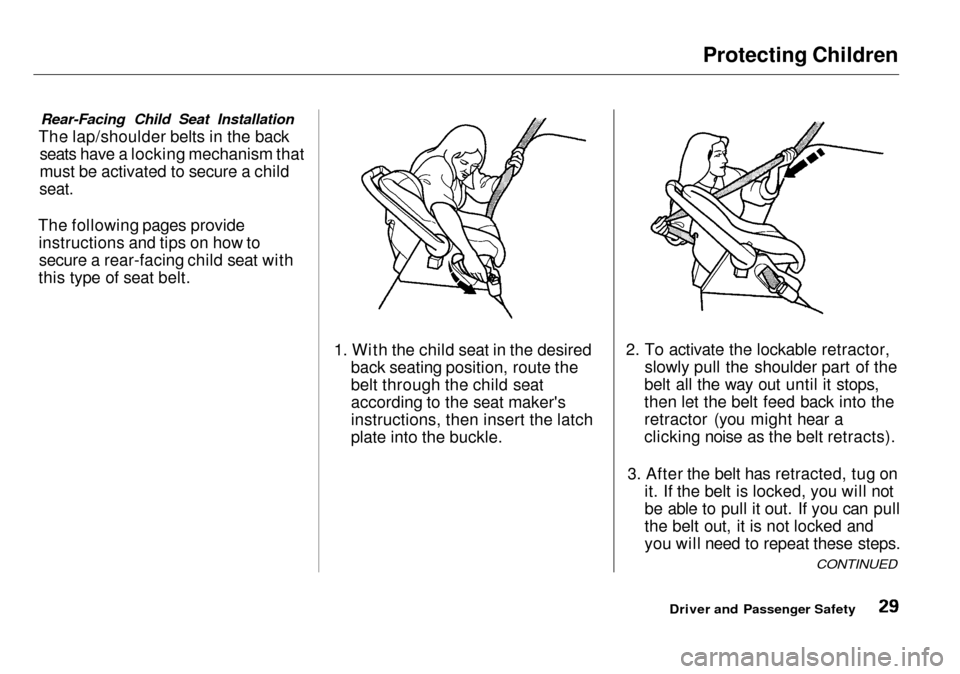
The lap/shoulder belts in the back seats have a locking mechanism that
must be activated to secure a child
seat.
The following pages provide instructions and tips on how tosecure a rear-facing child seat with
this type of seat belt.
1. With the child seat in the desiredback seating position, route the
belt through the child seat
according to the seat maker's
instructions, then insert the latch
plate into the buckle. 2. To activate the lockable retractor,
slowly pull the shoulder part of the
belt all the way out until it stops,
then let the belt feed back into the
retractor (you might hear a
clicking noise as the belt retracts).
3. After the belt has retracted, tug on it. If the belt is locked, you will not
be able to pull it out. If you can pull
the belt out, it is not locked and
you will need to repeat these steps.
Driver and Passenger Safety
CONTINUED
Page 33 of 333
Protecting Children
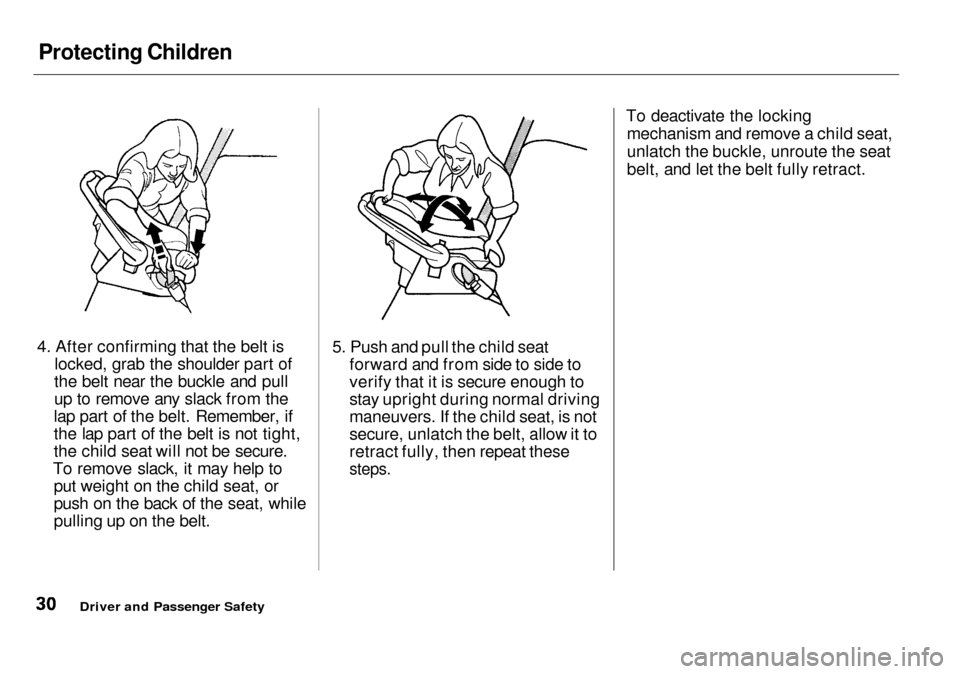
4. After confirming that the belt is locked, grab the shoulder part of
the belt near the buckle and pull
up to remove any slack from the
lap part of the belt. Remember, if
the lap part of the belt is not tight,
the child seat will not be secure.
To remove slack, it may help to put weight on the child seat, or
push on the back of the seat, while
pulling up on the belt. 5. Push and pull the child seat
forward and from side to side to
verify that it is secure enough to
stay upright during normal driving
maneuvers. If the child seat, is not
secure, unlatch the belt, allow it to
retract fully, then repeat these
steps.
To deactivate the locking
mechanism and remove a child seat,
unlatch the buckle, unroute the seat
belt, and let the belt fully retract.
Driver and Passenger Safety
Page 34 of 333
Protecting Children
Rear-Facing Child Seat Installation
Tips
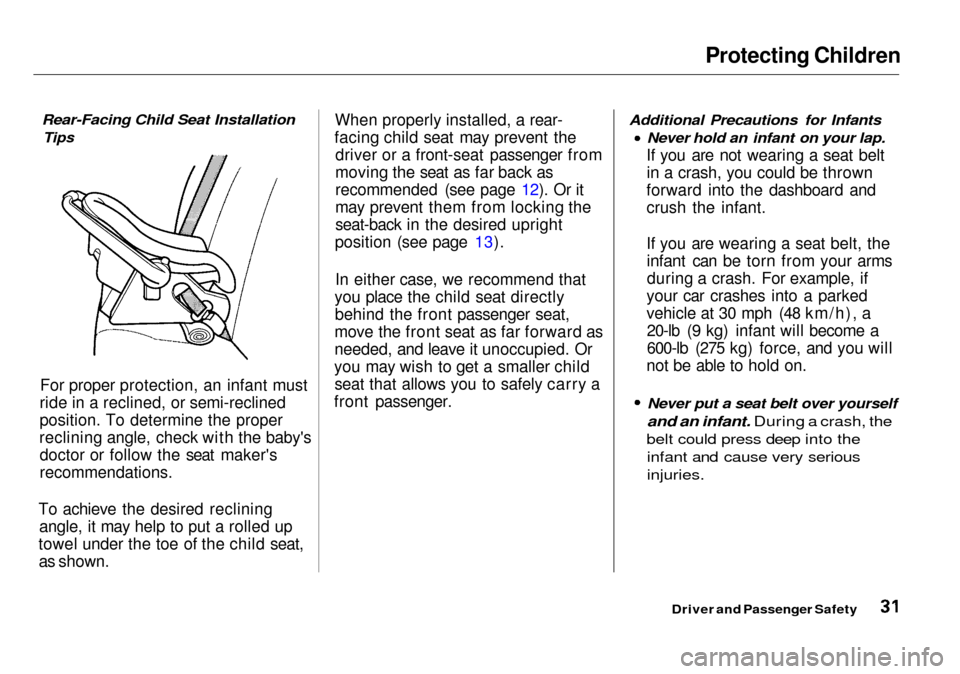
For proper protection, an infant must
ride in a reclined, or semi-reclined
position. To determine the proper
reclining angle, check with the baby's doctor or follow the seat maker's
recommendations.
To achieve the desired reclining angle, it may help to put a rolled up
towel under the toe of the child seat, as shown. When properly installed, a rear-
facing child seat may prevent the driver or a front-seat passenger from
moving the seat as far back as
recommended (see page 12). Or it
may prevent them from locking the
seat-back in the desired upright
position (see page 13).
In either case, we recommend that
you place the child seat directly behind the front passenger seat,
move the front seat as far forward as
needed, and leave it unoccupied. Or
you may wish to get a smaller child seat that allows you to safely carry a
front passenger.
Additional Precautions for Infants
Never hold an infant on your lap.
If you are not wearing a seat belt in a crash, you could be thrown
forward into the dashboard and
crush the infant.
If you are wearing a seat belt, the infant can be torn from your arms
during a crash. For example, if
your car crashes into a parked
vehicle at 30 mph (48 km/h), a 20-lb (9 kg) infant will become a
600-lb (275 kg) force, and you will
not be able to hold on.
Never put a seat belt over yourself
and an infant. During a crash, the
belt could press deep into the infant and cause very serious
injuries.
Driver and Passenger Safety
Page 36 of 333
Protecting Children
Child Seat Installation
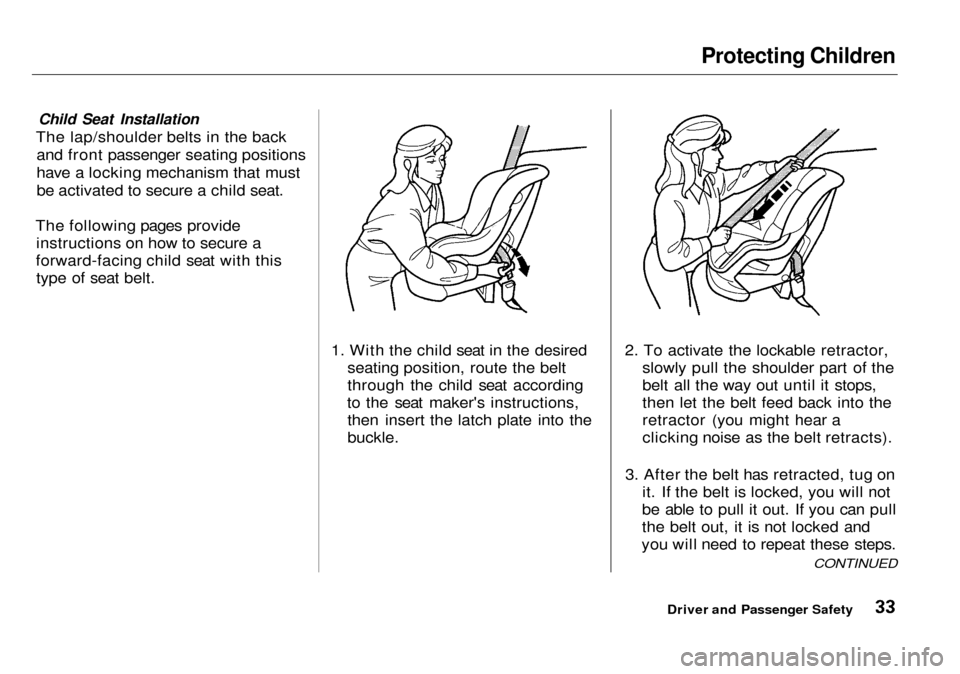
The lap/shoulder belts in the back and front passenger seating positions
have a locking mechanism that must
be activated to secure a child seat.
The following pages provide instructions on how to secure a
forward-facing child seat with this type of seat belt.
1. With the child seat in the desiredseating position, route the belt
through the child seat according
to the seat maker's instructions, then insert the latch plate into the
buckle. 2. To activate the lockable retractor,
slowly pull the shoulder part of the
belt all the way out until it stops,
then let the belt feed back into the
retractor (you might hear a
clicking noise as the belt retracts).
3. After the belt has retracted, tug on it. If the belt is locked, you will not
be able to pull it out. If you can pull
the belt out, it is not locked and
you will need to repeat these steps.
Driver and Passenger Safety
CONTINUED
Page 37 of 333
Protecting Children
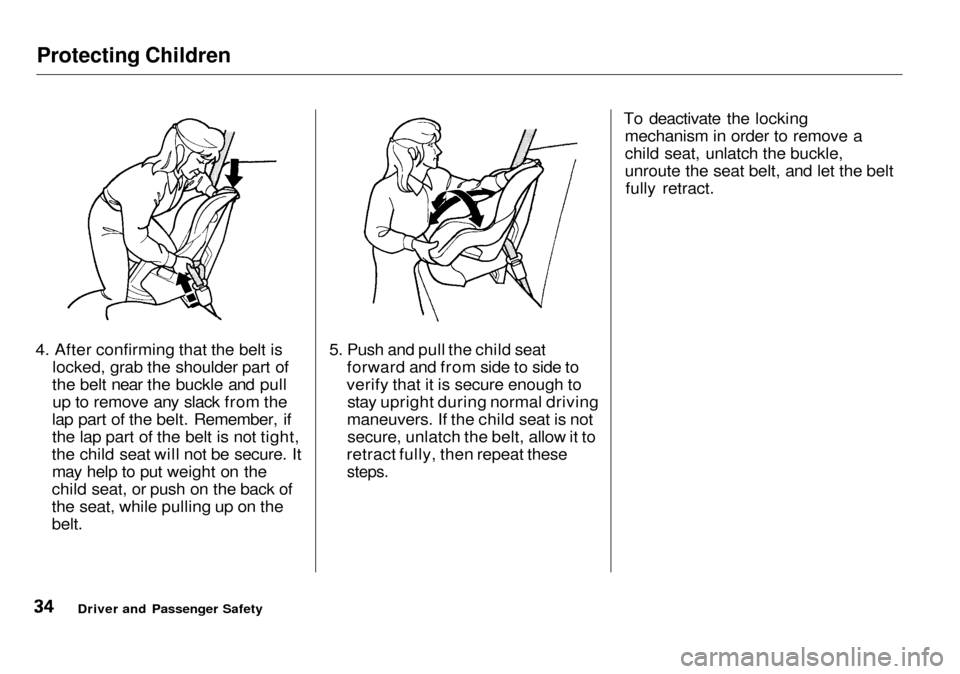
4. After confirming that the belt is locked, grab the shoulder part of
the belt near the buckle and pull up to remove any slack from the
lap part of the belt. Remember, if
the lap part of the belt is not tight,
the child seat will not be secure. It may help to put weight on the
child seat, or push on the back of
the seat, while pulling up on the
belt. 5. Push and pull the child seat
forward and from side to side to
verify that it is secure enough to stay upright during normal driving
maneuvers. If the child seat is not secure, unlatch the belt, allow it to
retract fully, then repeat these
steps.
To deactivate the locking
mechanism in order to remove a
child seat, unlatch the buckle,
unroute the seat belt, and let the beltfully retract.
Driver and Passenger Safety
Page 38 of 333
Protecting Children
Additional Precautions for Small
Children
Never hold a small child on your
lap. If you are not wearing a seat
belt in a crash, you could be
thrown forward into the dashboard and crush the child.
If you are wearing a seat belt, the
child can be torn from your arms
during a crash. For example, if
your car crashes into a parked
vehicle at 30 mph (48 km/h), a 30-lb (14 kg) child will become a
900-lb (410 kg) force, and you will
not be able to hold on.
Never put a seat belt over yourself
and a child. During a crash, the
belt could press deep into the child and cause very serious injuries. Protecting Larger Children
When a child reaches the recommended weight or height limit
for a forward-facing child seat, the child should sit in the back seat and
wear a lap/shoulder belt.
If a child is too short for the shoulder
part of the belt to properly fit, we
recommend that the child use a
booster seat until the child is tall enough to use the seat belt without a
booster.
The following pages give instructions on how to check properseat belt fit, what kind of booster
seat to use if one is needed, and
important precautions for a child
who must sit in the front seat.
CONTINUED
Driver and Passenger Safety
Allowing a larger child to sit
improperly in the front seat can
result in injury or death if the
passenger's front airbag inflates.
If a larger child must sit in front,
make sure the child moves the
seat as far back as possible
and wears the seat belt properly.
Page 39 of 333
Protecting Children
Checking Seat Belt Fit
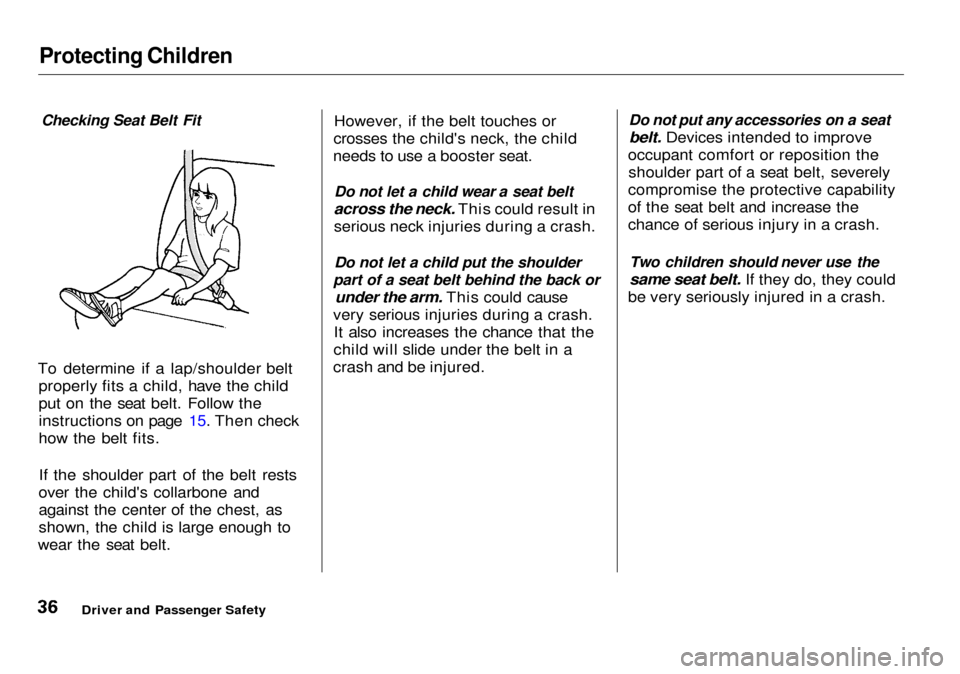
To determine if a lap/shoulder belt properly fits a child, have the child
put on the seat belt. Follow the
instructions on page 15. Then check
how the belt fits.
If the shoulder part of the belt rests
over the child's collarbone and
against the center of the chest, as
shown, the child is large enough to
wear the seat belt. However, if the belt touches or
crosses the child's neck, the child
needs to use a booster seat.
Do not let a child wear a seat belt
across the neck. This could result in
serious neck injuries during a crash.
Do not let a child put the shoulder
part of a seat belt behind the back or
under the arm. This could cause
very serious injuries during a crash. It also increases the chance that the
child will slide under the belt in a
crash and be injured.
Do not put any accessories on a seat
belt. Devices intended to improve
occupant comfort or reposition the shoulder part of a seat belt, severely
compromise the protective capability
of the seat belt and increase the
chance of serious injury in a crash.
Two children should never use the
same seat belt. If they do, they could
be very seriously injured in a crash.
Driver and Passenger Safety