oil change Acura RL 2001 3.5 Owner's Manual
[x] Cancel search | Manufacturer: ACURA, Model Year: 2001, Model line: RL, Model: Acura RL 2001Pages: 333, PDF Size: 4.28 MB
Page 52 of 333

Carbon Monoxide Hazard
Your car's exhaust contains carbon monoxide gas. You should have no
problem with carbon monoxide
entering the car in normal driving if
you maintain your car properly. Have the exhaust system inspected
for leaks whenever:
The car is raised for an oil change. You notice a change in the sound
of the exhaust. The car was in an accident that
may have damaged the underside. High levels of carbon monoxide can
collect rapidly in enclosed areas,
such as a garage. Do not run the
engine with the garage door closed.
Even with the door open, run the
engine only long enough to move the
vehicle out of the garage. With the trunk lid open, air flow can
pull exhaust gas into your car'sinterior and create a hazardous
condition. If you must drive with the
trunk lid open, open all the windows and set the climate control system asshown below.
If you must sit in your parked car,
even in an unconfined area, with the engine running, adjust the climate
control system as follows:
1. Select the Fresh Air mode. 2. Select the mode.
3. Set the fan speed to high.
4. Set the temperature control to a
comfortable setting.
Driver and Passenger Safety
Carbon monoxide gas is toxic.
Breathing it can cause
unconsciousness and even kill
you.
Avoid any enclosed areas or activities that expose you to
carbon monoxide.
Page 107 of 333

Seat Heaters, Ski Sleeve
The HI or LO indicator lights and remains lit until you turn it off by
pushing the opposite side of theswitch lightly. The indicator will turn
off.
In HI, the heater turns off when the
seat gets warm, and turns back on
after the seat's temperature drops. It
continues to cycle as long as you
leave it set on HI. The HI indicator
remains lit as a reminder that you
have the heater on.
In LO, the heater runs continuously.It does not cycle with temperature
changes.
Because of the sensors for the side
airbag system, there is no heater in
the passenger's seat-back. Follow these precautions whenever
you use the seat heaters: Use the HI setting only to heat the
seats quickly. Select the LO
setting when the seats feel warm.
The HI setting draws large amounts of current from the
battery. Do not use the seat heaters, even
on the LO setting, if the engine is
left idling for an extended period.
They can weaken the battery, causing hard starting.
Ski Sleeve
The ski sleeve allows you to carry skis or other long objects safely
without soiling or damaging the
interior of your car. It attaches to the
trunk pass-through.
KNOB
To use the ski sleeve: 1. Pull down the rear seat armrest. Open the trunk pass-through
cover by sliding the knob down-
ward and pulling on the cover.
Instruments and Controls
LID
Page 171 of 333

Break-in Period, Gasoline
Break-in Period
Help assure your car's future
reliability and performance by paying
extra attention to how you drive
during the first 600 miles (1,000 km).
During this period: Avoid full-throttle starts and rapid
acceleration.
Avoid hard braking. New brakes
need to be broken-in by moderate
use for the first 200 miles (300
km).
Do not change the oil until the
recommended time or mileage
interval shown in the maintenance
schedule.
You should follow these same re- commendations with an overhauled
or exchanged engine, or when the
brakes are relined.
Gasoline
Your Acura is designed to operate on premium unleaded gasoline with a
pump octane number of 91 or higher.
If you are unable to find premium unleaded gasoline, you may substi-
tute an unleaded regular gasoline.
The engine will compensate for the lower octane, but you may notice aslight decrease in power as a result.
We recommend gasolines containing detergent additives that help prevent
fuel system and engine deposits.
Using gasoline containing lead will
damage your car's emissions
controls. This contributes to air
pollution. In Canada, some gasolines contain
an octane-enhancing additive called
MMT. If you use such gasolines,
your emissions control system performance may deteriorate and
the Malfunction Indicator Lamp on
your instrument panel may turn on. If this happens, contact your
authorized Acura dealer for service.
Before Driving
Page 197 of 333
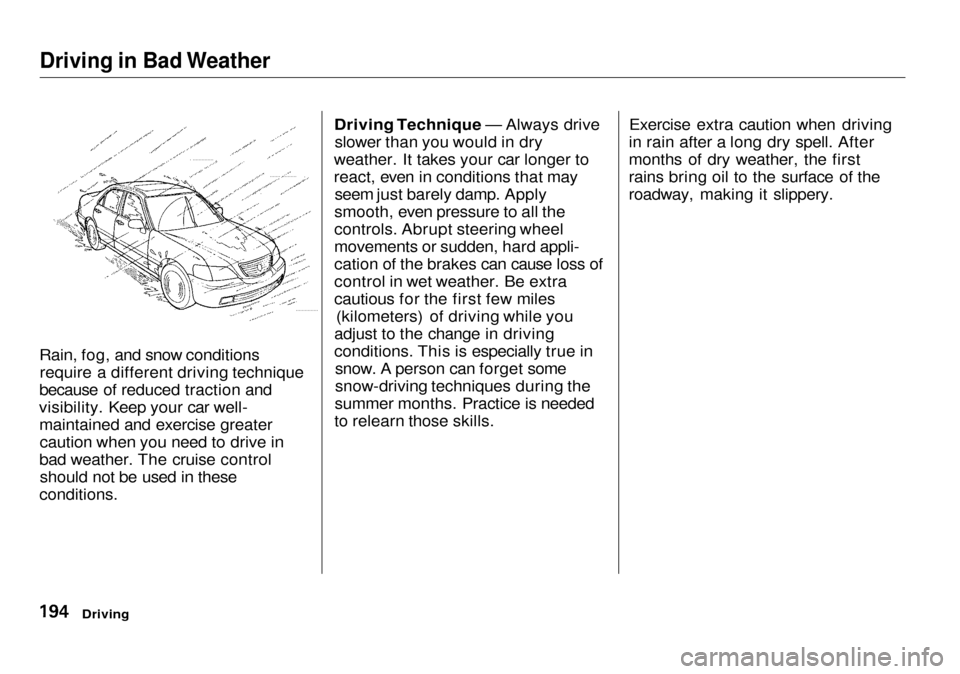
Driving in Bad Weather
Rain, fog, and snow conditions require a different driving technique
because of reduced traction and
visibility. Keep your car well- maintained and exercise greatercaution when you need to drive in
bad weather. The cruise control should not be used in these
conditions. Driving Technique — Always drive
slower than you would in dry
weather. It takes your car longer to
react, even in conditions that may seem just barely damp. Apply
smooth, even pressure to all the
controls. Abrupt steering wheel
movements or sudden, hard appli-
cation of the brakes can cause loss of
control in wet weather. Be extra
cautious for the first few miles (kilometers) of driving while you
adjust to the change in driving
conditions. This is especially true in snow. A person can forget some
snow-driving techniques during the
summer months. Practice is needed
to relearn those skills. Exercise extra caution when driving
in rain after a long dry spell. After
months of dry weather, the first
rains bring oil to the surface of the
roadway, making it slippery.
Driving
Page 221 of 333
Engine Oil
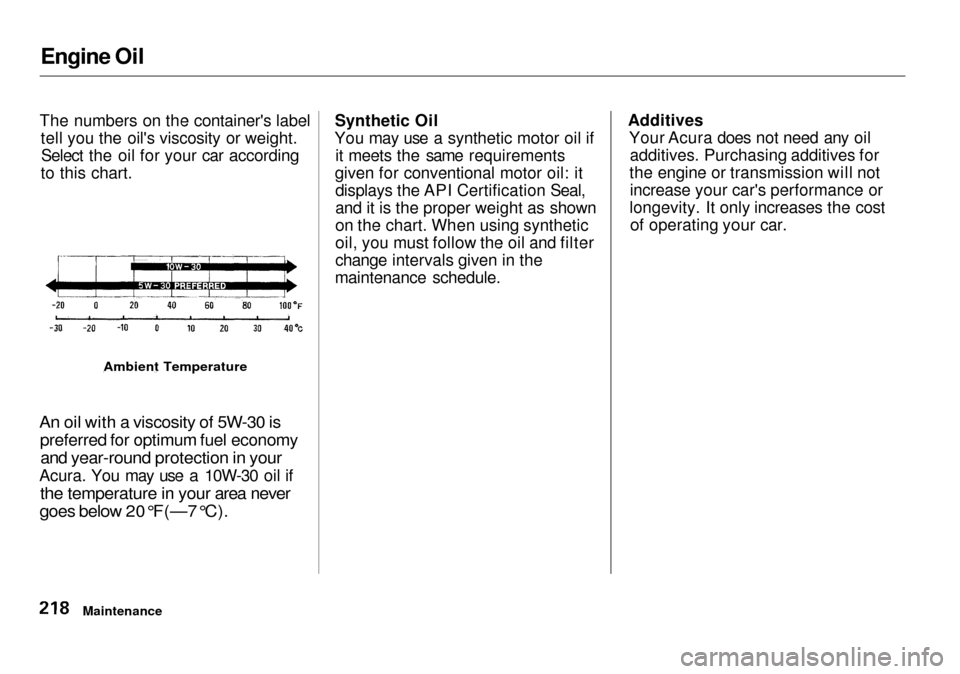
The numbers on the container's label tell you the oil's viscosity or weight.Select the oil for your car according
to this chart.
An oil with a viscosity of 5W-30 is
preferred for optimum fuel economy
and year-round protection in your
Acura. You may use a 10W-30 oil if
the temperature in your area never
goes below 20°F(—7°C).
Synthetic Oil
You may use a synthetic motor oil if it meets the same requirements
given for conventional motor oil: it displays the API Certification Seal,
and it is the proper weight as shown
on the chart. When using synthetic
oil, you must follow the oil and filter
change intervals given in the
maintenance schedule. Additives
Your Acura does not need any oiladditives. Purchasing additives for
the engine or transmission will not increase your car's performance or
longevity. It only increases the cost of operating your car.
Maintenance
Ambient Temperature
Page 222 of 333
Engine Oil
Changing the Oil and Filter
Always change the oil and filter according to the time and distance (miles/kilometers) recommenda-
tions in the maintenance schedule.
The oil and filter collect contami- nants that can damage your engine if
they are not removed regularly.
Changing the oil and filter requires
special tools and access from
underneath the car. The car should
be raised on a service station-type
hydraulic lift for this service. Unless
you have the knowledge and proper equipment, you should have this
maintenance done by a skilled
mechanic.
1. Run the engine until it reaches
normal operating temperature,
then shut it off.
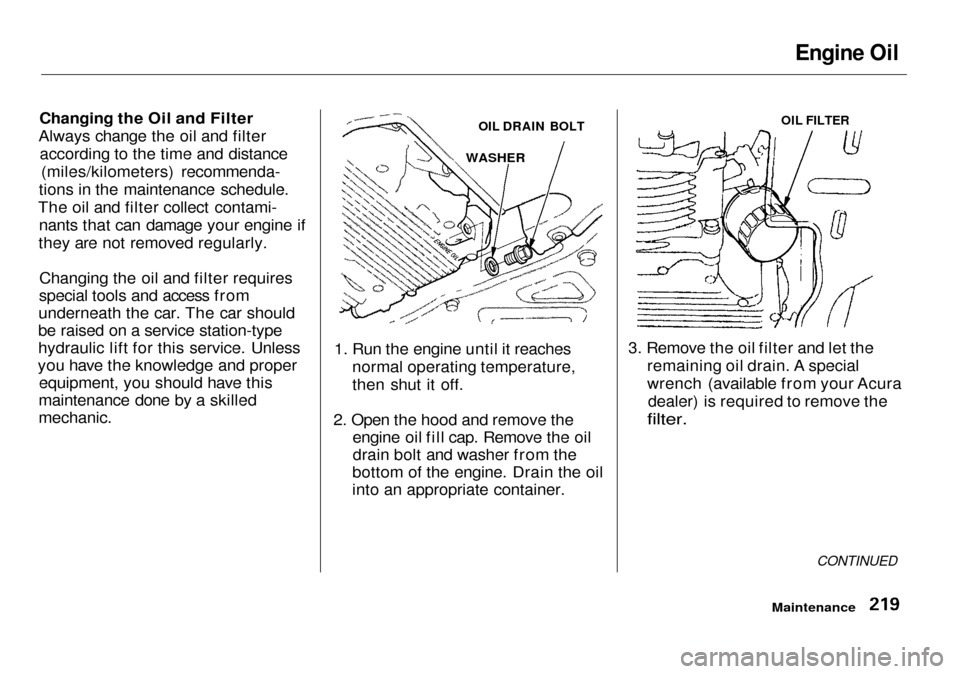
2. Open the hood and remove the
engine oil fill cap. Remove the oil
drain bolt and washer from the
bottom of the engine. Drain the oil
into an appropriate container.
3. Remove the oil filter and let the
remaining oil drain. A special
wrench (available from your Acura
dealer) is required to remove the
filter.
CONTINUED
Maintenance
OIL DRAIN BOLT
WASHER
OIL FILTER
Page 223 of 333

Engine Oil
4. Install a new oil filter according to
instructions that come with it.
5. Put a new washer on the drain bolt,
then reinstall the drain bolt.
Tighten it to:
33 lbf.ft (44 N.m , 4.5 kgf.m)
6. Refill the engine with the recom-
mended oil.
Engine oil change capacity
(including filter):
4.9 US qt (4.6 , 4.0 Imp qt)
7. Replace the engine oil fill cap.
Start the engine. The oil pressure
indicator light should go out within
five seconds. If it does not, turn off
the engine and reinspect your
work.
8. Let the engine run for several
minutes and check the drain bolt
and oil filter for leaks.
9. Turn off the engine, let it sit for
several minutes, then check the oil
level. If necessary, add oil to bring the level to the upper mark on the
dipstick.
Improper disposal of engine oil can be
harmful to the environment. If you
change your own oil, please dispose ofthe used oil properly. Put it in a sealed
container and take it to a recycling center. Do not discard it in a trash bin
or dump it on the ground.
Maintenance
NOTICE
Page 255 of 333

Lights
Replacing a High Beam Headlight
Bulb
The low beam headlight bulbs are a type of high voltage discharge tube.
High voltage can remain in the
circuit even with the light switch off
and the key removed. Because of
this, you should not attempt to examine or change a low beam
headlight bulb yourself. If a low
beam headlight bulb fails, take the
car to your dealer to have it replaced. Halogen bulbs are used for the high
beam headlight bulbs. When replacing a high beam headlight bulb,
handle it by its base and protect the
glass from contact with your skin or
hard objects. If you touch the glass, clean it with denatured alcohol and a
clean cloth.
Halogen bulbs get very hot when lit. Oil,
perspiration, or a scratch on the glass
can cause the bulb to overheat and
shatter.
1. Open the hood.
2. Remove the electrical connector
from the bulb by pulling the connector straight back.
3. Remove the rubber weather seal
by pulling on the tab.
Maintenance
NOTICE
Page 264 of 333

Storing Your Car
If you need to park your car for an extended period (more than one
month), there are several things you should do to prepare it for storage.
Proper preparation helps prevent deterioration and makes it easier to
get your car back on the road. If
possible, store your car indoors. Fill the fuel tank.
Change the engine oil and filter
(see page 219).
Wash and dry the exterior
completely.
Clean the interior. Make sure the
carpeting, floor mats, etc. are
completely dry.
Leave the parking brake off. Put
the transmission in Park. Block the rear wheels.
If the car is to be stored for a
longer period, it should be supported on jackstands so the
tires are off the ground.
Leave one window open slightly (if
the car is being stored indoors).
Disconnect the battery.
Support the front wiper blade
arms with a folded towel or rag so
they do not touch the windshield. To minimize sticking, apply a
silicone spray lubricant to all door
and trunk seals. Also, apply a vehicle body wax to the painted
surfaces that mate with the door
and trunk seals. Cover the car with a "breathable"
cover, one made from a porous
material such as cotton. Nonporous materials, such as
plastic sheeting, trap moisture,
which can damage the paint. If possible, run the engine for a
while periodically (preferably once
a month).
If you store your car for 12 months or longer, have your Acura dealer
perform the inspections called for in
the 24 months/30,000 miles (48,000
km) maintenance schedule (Normal Conditions) as soon as you take it
out of storage (see page 208). The
replacements called for in the
maintenance schedule are not
needed unless the car has actually
reached that time or mileage.
Maintenance
Page 325 of 333

Index
Bulb Replacement
Back-up Lights........................... 256
Brake Lights............................... 256
Ceiling Lights............................. 259
Courtesy Lights......................... 259
Fog Lights.................................. 253
Front Side Marker Lights......... 255
Headlights.................................. 252
High-mount Brake Light.......... 257
License Plate Lights.................. 258
Specifications............................. 303
Trunk Light................................ 260
Tum Signal Lights..................... 255
Bulbs, Halogen............................... 252
Cancel Button................................... 75
Capacities Chart............................. 302
Carbon Monoxide Hazard.............. 49
Carrying, Cargo............................. 176
Cassette Player
Care............................................. 156
Operation............................ 141, 153
CAUTION, Explanation of............... ii
CD Changer................... 144, 157, 159
Ceiling Lights................................. 118
Certification Label......................... 300
Chains............................................. 249
Changing Oil
How to......................................... 219
When to....................................... 208
Changing a Flat Tire..................... 273
Changing Engine Coolant............. 223
Charging System Indicator.... 54, 287
Checklist, Before Driving............. 180
Child Safety...................................... 20
Child Seats........................................ 24
Tether Anchorage Point............. 39
Childproof Door Locks................... 85
Cigarette Lighter........................... 116
Cleaner. Air.................................... 231
Cleaning
Aluminum Wheels..................... 265
Carpeting.................................... 266
Exterior....................................... 264
Fabric.......................................... 266
Interior........................................ 266
Leather........................................ 266
Seat Belts.................................... 266
Vinyl............................................ 266
Windows..................................... 267
Wood Trim................................. 267
Climate Control System................ 122
Clock, Setting the.......................... 109
Code, Audio System...................... 164
CO in the Exhaust......................... 308
Coin Box......................................... 113
Cold Weather, Starting in............. 181
Compact Spare............................... 272
Console Compartment.................. 113
Consumer Information*................ 314
Controls, Instruments and.............. 51Coolant Adding......................................... 221
Checking..................................... 172
Proper Solution.......................... 221
Replacing.................................... 223
Temperature Gauge.................... 60
CoiTosion Protection..................... 269 Courtesy Lights............................. 119
Crankcase Emissions Control
System......................................... 308
Cruise Control Operation............... 73
Customer Relations Office........... 314