ABS Acura TL 2000 3.2 User Guide
[x] Cancel search | Manufacturer: ACURA, Model Year: 2000, Model line: TL, Model: Acura TL 2000Pages: 311, PDF Size: 3.05 MB
Page 195 of 311
Maintenance Schedule for Normal Conditions
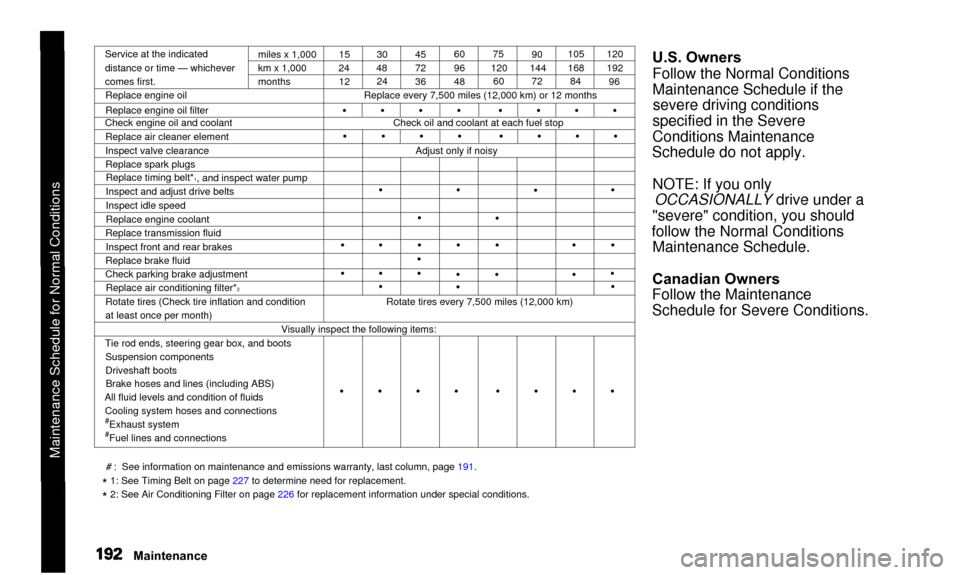
Service at the indicated
distance or time — whichever
comes first.miles x 1,000
km x 1,000
months
Replace engine oil
Replace engine oil filter
Check engine oil and coolant
Replace air cleaner element
Inspect valve clearance
Replace spark plugsReplace timing belt*
1, and inspect water pump
Inspect and adjust drive belts
Inspect idle speed
Replace engine coolant
Replace transmission fluid
Inspect front and rear brakes
Replace brake fluid
Check parking brake adjustment Replace air conditioning filter*
2Rotate tires (Check tire inflation and condition
at least once per month) 15
24
12 30
48 24 45
72
36 60
96
4875
120 60 90
144 72 105
168
84 120
192
96
Replace every 7,500 miles (12,000 km) or 12 months
Check oil and coolant at each fuel stop
•
•
Adjust only if noisy
•
•
•
• •
•
•
• •
•
•
• •
•
• •
•
• •
•
• •
Rotate tires every 7,500 miles (12,000 km)
Visually inspect the following items:
Tie rod ends, steering gear box, and boots Suspension components
Driveshaft bootsBrake hoses and lines (including ABS)
All fluid levels and condition of fluids Cooling system hoses and connections
#Exhaust system#Fuel lines and connections
U.S. Owners
Follow the Normal Conditions
Maintenance Schedule if thesevere driving conditions
specified in the Severe
Conditions Maintenance
Schedule do not apply.
NOTE: If you only OCCASIONALLY drive under a
"severe" condition, you should
follow the Normal Conditions Maintenance Schedule.
Canadian Owners
Follow the Maintenance
Schedule for Severe Conditions.
# : See information on maintenance and emissions warranty, last column, page\
191.
* 1: See Timing Belt on page 227 to determine need for replacement.
* 2: See Air Conditioning Filter on page 226 for replacement information under special conditions.
Maintenance
• • • • • •\
• •
• • • • • •\
• •
• • • • • •\
• •
Page 196 of 311
Service at the indicated distance or time, whichever comes first. Do the\
items in A, B, C as required for each distance/time inter")
Maintenance Schedule for Normal Conditions (listed by distance/time)Service at the indicated distance or time, whichever comes first. Do the\
items in A, B, C as required for each distance/time interval. Follow thisschedule if the severe driving conditions described in the Severe Condit\
ions Schedule on the next page do not apply.
Canadian owners: Follow the schedule for Severe Conditions.
NOTE:• Check engine oil and coolant at each fuel stop.• Check and adjust valve clearance, cold engine, if noisy. # : See information on maintenance and emissions warranty, last
column, page 191.
* 1 : See Timing Belt on page 227 to determine need for replacement.
* 2 : See Air Conditioning Filter on page 226 for replacement information under special conditions.
Maintenance
7,500 mi/12,000 km/1 yr15,000 mi/24,000 km/-
22,500 mi/36,000 km/1½, yrs
30,000 mi/48,000 km/2 yrs
37,500 mi/60,000 km/2½ yrs 45,000 mi/72,000 km/3 yrs
52,500 mi/84,000 km/3½ yrs
60,000 mi/96,000 km/4 yrs
67,500 mi/108,000 km/4½yrs
75,000 mi/120,000 km/5 yrs
82,500 mi/132,000 km/5½ yrs
90,000 mi/144,000 km/6 yrs
97,500 mi/156,000 km/6½ yrs
105,000 mi/168,000 km/7 yrs
112,500 mi/180,000 km/7½ yrs
120,000 mi/192,000 km/8 yrs Do items in A.
Do items in A, B.Do items in A.
Do items in A, B, C.
Do items in A.
Replace coolant. Replace brake fluid.
Do items in A, B.
Do items in A.
Do items in A, B, C.
Do items in A. Replace coolant. Do items in A, B.
Do items in A.
Replace brake fluid. Replace transmissionfluid. Do items in A, B, C.
Do items in A.
Replace timing belt*1, inspect water pump. Replace coolant. lnspect valve clearance. Check idle speed. Replace spark plugs.Do items in A, B.
Do items in A.
Do items in A, B, C.
A Replace engine oil.
Rotate tires (follow pattern on paqe 231 ).
B Replace engine oil filter.
Inspect front and rear brakes.
Check parking brake adjustment.
Inspect tie rod ends, steering gear box and boots.
Inspect suspension components.
Inspect driveshaft boots.
Inspect brake hoses and lines (including ABS).
Check all fluid levels, condition of fluids, and check for leaks.
# Inspect cooling system hoses and connections.
# Inspect exhaust system.
Inspect fuel lines and connections.
C Replace air cleaner element.
Inspect and adjust drive belts.
Replace air conditioning filter.*
2
Page 197 of 311
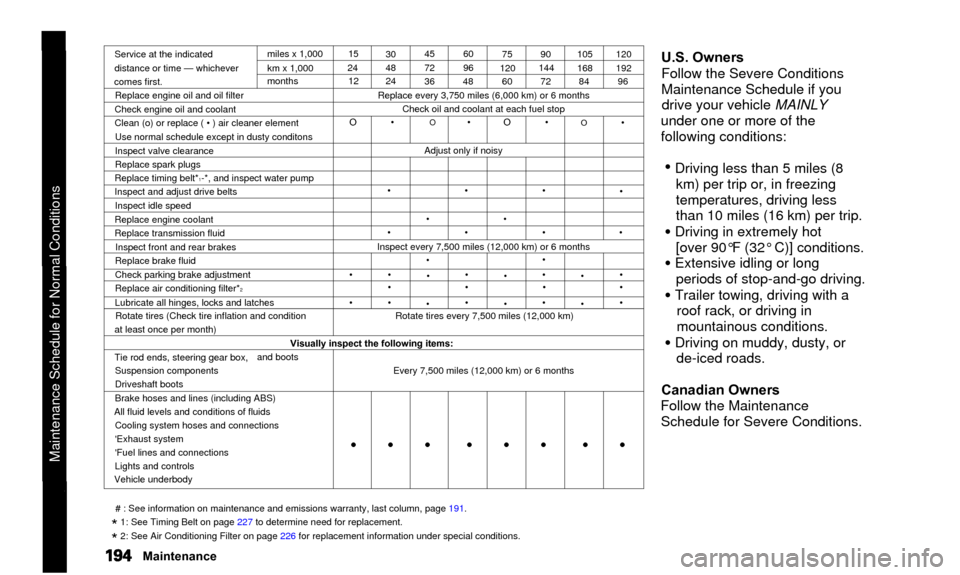
Service at the indicated
distance or time — whichever
comes first. miles x 1,000
km x 1,000
months
Replace engine oil and oil filter
Check engine oil and coolant
Clean (o) or replace ( • ) air cleaner element Use normal schedule except in dusty conditons
Inspect valve clearance
Replace spark plugs
Replace timing belt*
1-*, and inspect water pump
Inspect and adjust drive belts
Inspect idle speed
Replace engine coolant
Replace transmission fluid Inspect front and rear brakes
Replace brake fluid
Check parking brake adjustment
Replace air conditioning filter*
2Lubricate all hinges, locks and latches Rotate tires (Check tire inflation and condition
at least once per month) 15
24 12 30
48
24 45
72
3660
96
48 75
120 60 90
144
72 105
168
84 120
192
96
Replace every 3,750 miles (6,000 km) or 6 months Check oil and coolant at each fuel stop
O •
O • O •
Adjust only if noisy
•
•
•
•
•
•
•
•
O •
•
•
Inspect every 7,500 miles (12,000 km) or 6 months
•
• •
•
•
•
•
••
•
••
•
•
• •
•
•
••
•
•
Rotate tires every 7,500 miles (12,000 km)
Visually inspect the following items:
Tie rod ends, steering gear box, Suspension components
Driveshaft boots and boots
Brake hoses and lines (including ABS)
All fluid levels and conditions of fluids Cooling system hoses and connections
'Exhaust system
'Fuel lines and connections
Lights and controls
Vehicle underbody Every 7,500 miles (12,000 km) or 6 months
U.S. Owners
Follow the Severe Conditions
Maintenance Schedule if you
drive your vehicle MAINLY
under one or more of the
following conditions:
• Driving less than 5 miles (8 km) per trip or, in freezing
temperatures, driving less
than 10 miles (16 km) per trip.
• Driving in extremely hot[over 90°F (32° C)] conditions.
• Extensive idling or long periods of stop-and-go driving.
• Trailer towing, driving with a roof rack, or driving in
mountainous conditions.
• Driving on muddy, dusty, orde-iced roads.
Canadian Owners
Follow the Maintenance Schedule for Severe Conditions.
# : See information on maintenance and emissions warranty, last column, \
page 191.
* 1: See Timing Belt on page 227 to determine need for replacement.
* 2: See Air Conditioning Filter on page 226 for replacement information under special conditions.
Maintenance
Maintenance Schedule for Normal Conditions• • • • • • • \
•
Page 199 of 311
NOTE:• Check engine oil and coolant at each fuel stop.• Check and adjust valve clearance, cold engine, if noisy.# : See information on maintenance and emissions warranty, last
column, page 191.
* 1: See Timing Belt on page 227 to determine need for replacement.
* 2: See Air Conditioning Filter on page 226 for replacement
information under special conditions.
Maintenance
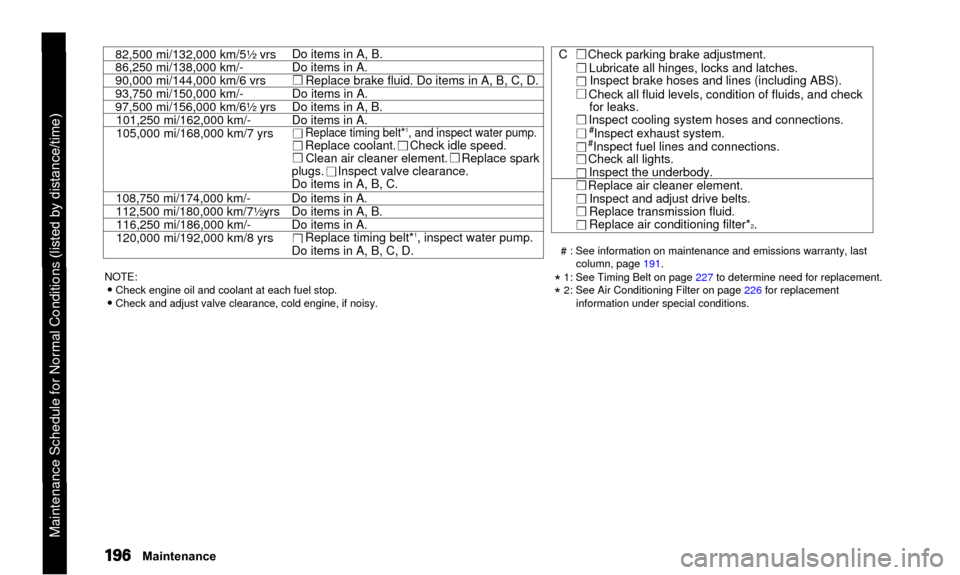
82,500 mi/132,000 km/5½ vrs
86,250 mi/138,000 km/-
90,000 mi/144,000 km/6 vrs
93,750 mi/150,000 km/-
97,500 mi/156,000 km/6½ yrs101,250 mi/162,000 km/-
105,000 mi/168,000 km/7 yrs
108,750 mi/174,000 km/-
112,500 mi/180,000 km/7½yrs 116,250 mi/186,000 km/-
120,000 mi/192,000 km/8 yrs Do items in A, B.
Do items in A.
Replace brake fluid. Do items in A, B, C, D. Do items in A.
Do items in A, B.
Do items in A.
Replace timing belt*1, and inspect water pump. Replace coolant. Check idle speed. Clean air cleaner element. Replace spark
plugs. Inspect valve clearance.
Do items in A, B, C.
Do items in A.
Do items in A, B.
Do items in A.
Replace timing belt*
1, inspect water pump.
Do items in A, B, C, D.
C Check parking brake adjustment.
Lubricate all hinges, locks and latches.• Inspect brake hoses and lines (including ABS).
Check all fluid levels, condition of fluids, and check for leaks.
Inspect cooling system hoses and connections.
#Inspect exhaust system.
•' #Inspect fuel lines and connections.
Check all lights.
Inspect the underbody. Replace air cleaner element.
• Inspect and adjust drive belts.
• Replace transmission fluid.
• Replace air conditioning filter*
2.
Maintenance Schedule for Normal Conditions (listed by distance/time)
Page 227 of 311

Wiper Blades
BLADE
4. Remove the blade from its holderby grasping the tabbed end of the
blade. Pull firmly until the tabs
come out of the holder.
BLADE
REINFORCEMENT
5. Examine the new wiper blades. If they have no plastic or metal rein-
forcement along the back edge,
remove the metal reinforcement
strips from the old wiper blade and
install them in the slots along the
edge of the new blade. 6. Slide the new wiper blade into the
holder until the tabs lock.
7. Slide the wiper blade assembly onto the wiper arm. Make sure it
locks in place.
8. Lower the wiper arm down against the windshield.
9. Turn the ignition switch ON (II) and return the windshield wipers
to their park position.
Maintenance
Page 235 of 311

Tires
Installing improper tires on your
car can affect handling and
stability. This can cause a crash in which you can be seriously
hurt or killed.
Always use the size and type of
tires recommended in this owner's manual.
It is best to replace all four tires at
the same time. If that is not possible or necessary, then replace the two
front tires or the two rear tires as a
pair. Replacing just one tire can seriously affect your car's handling. The ABS works by comparing the
speed of the wheels. When replacing
tires, use the same size originally supplied with the car. Tire size and
construction can affect wheel speed
and may cause the system to work inconsistently.
If you ever need to replace a wheel,
make sure you use an identical style
aluminum alloy wheel that originally
came on your Acura. Replacement
wheels are available at your Acura dealer. Wheels and TiresWheel:
16x61/2JJ
Tire: P205/60R16 91V
See page 284 for information about
DOT Tire Quality Grading.
Maintenance
Page 244 of 311

Lights
1. Remove the lens by carefullyprying on the edge of the lens with
a fingernail file or a small flat-tipscrewdriver. Do not pry on the
edge of the housing around the
lens.
Door light: Pry on the top middle of the lens.
Ceiling light: Pry on the front edge of the lensnear both sides.
Spotlights:
Pry on the front edge in front of
both spotlights.CEILING LIGHT
2. Remove the bulb by pulling it straight out of its metal tabs.
3. Push the new bulb into the metal tabs. Snap the lens back in place.
SPOTLIGHT
CONTINUED
Maintenance
Page 245 of 311

Lights
DOOR LIGHT SUN VISOR LIGHT
TRUNK LIGHT
1. Open the trunk. Pull down the trunk light cover.
2. Remove the bulb by pulling it straight out of its metal tabs.
3. Push the new bulb into the metal tabs.
4. Push the cover back in place.
Maintenance Replacing the Trunk Light Bulb
Page 253 of 311

Corrosion Protection
Two factors normally contribute tocausing corrosion in your car:
1. Moisture trapped in body cavities. Dirt and road salt that collects in
hollows on the underside of the car stays damp, promoting
corrosion in that area.
2. Removal of paint and protective coatings from the exterior and
underside of the car. Many corrosion-preventive measures
are built into your Acura. You can
help keep your car from corroding
by performing some simple periodic
maintenance:
• Repair chips and scratches in the paint as soon as you discover them.
• Inspect and clean out the drainholes in the bottom of the doorsand body.
• Check the floor coverings for dampness. Carpeting and floor
mats may remain damp for a long
time, especially in winter. This dampness can eventually cause
the floor panels to corrode.
• Use a high-pressure spray to clean the underside of your car. This isespecially important in areas that
use road salt in winter. It is also a
good idea in humid climates and areas subject to salt air. Cars
equipped with ABS have a sensor
and wiring at each wheel. Be
careful not to damage them.
• Have the corrosion-preventive
coatings on the underside of your
car inspected and repaired
periodically.
Appearance Care
Page 275 of 311

Fuses
All the electrical circuits in your carhave fuses to protect them from a short circuit or overload. These
fuses are located in three fuse boxes.INTERIOR
The interior fuse boxes are located on each side of the dashboard. To
open an interior fuse box, open the
car door. Pull the bottom of the
cover open, then take it out of itsside hinges by pulling it toward you.
UNDER-HOOD
The under-hood fuse box is located in the back of the engine compart-
ment on the passenger's side. To
open it, push the tabs as shown.
Taking Care of the Unexpected
TAB