Gas Acura TL 2006 Owner's Manual
[x] Cancel search | Manufacturer: ACURA, Model Year: 2006, Model line: TL, Model: Acura TL 2006Pages: 295, PDF Size: 3.89 MB
Page 1 of 295

2006 TL Online Reference Owner's Manual
Use these links (and links throughout this manual) to navigate through this reference.
For a printed owner's manual, click on authorized manuals or go to www.helminc.com.
Contents
Owner's Identification Form
Introduction ........................................................................\
............................................................................. i
A Few Wo r
ds About Safety ........................................................................\
.................................................. ii
Driver and Passenger Safety ........................................................................\
...............................................7
Proper use and care of your vehicle's seat belts, and Supplemental Restraint System.
Instruments and Cont r
ols........................................................................\
...................................................57
Instrument panel indica tor and gauge, and how to use dashboard and steering column controls.
Comfort and Convenience Features........................................................................\
...............................119
How t o
op era
te the climate control system, the audio system, and other convenience features.
Before Driving ........................................................................\
...................................................... .
............. .
175
What gasoline to use, how to break-in your new vehicle, and how to load luggage and other cargo.
Driving........................................................................\
.................................................................................. 187
The proper way to start
the engine, shift the transmission, and park, plus towing a trailer.
Maintenance........................................................................\
.........................................................................207
T h
e Ma int
enance Schedule shows you when you need to take your vehicle to the dealer.
Taking Care of the Unexpected........................................................................\
.......................................243
This section covers several problems motorists someti mes experience, and how to handle them.
Technical Information........................................................................\
.......................................................267
ID numbers, dimensions, capaciti es, and techni
cal information.
Warranty and Customer Relations (U.S. and Canada)......................................................................279
A summary of th
e warr anties coverin
g your new Honda, and how to contact us.
Authorized Manuals (U.S. only)........................................................................\
.......................................283
How t o
order manuals an
d other technical literature.
Index ........................................................................\
......................................................................................... I
Service Inf ormat
ion Summary
A summary of informat
ion you need when you pull up to the fuel pump.
Your Vehicle at a Glance........................................................................\
.......................................................4
Page 54 of 295

Your vehicle’s exhaust contains
carbon monoxide gas. You should
have no problem with carbon
monoxide entering the vehicle in
normal driving if you maintain your
vehicle properly.High levels of carbon monoxide can
collect rapidly in enclosed areas,
such as a garage. Do not run the
engine with the garage door closed.
Even with the door open, run the
engine only long enough to move the
vehicle out of the garage.If you must sit in your parked vehicle,
even in an unconf ined area, with the
engine running, adjust the climate
control system as f ollows:
The vehicle is raised f or an oil
change.
You notice a change in the sound
of the exhaust.
The vehicle was in an accident
that may have damaged the
underside.
Have the exhaust system inspected
f or leaks whenever:
With the trunk lid open, airf low can
pull exhaust gas into your vehicle’s
interior and create a hazardous
condition. If you must drive with the
trunk open, open all the windows,
and set the climate control system as
shown below.
Select the f resh air mode.
Select the mode.
Set the f an speed to high.
Set the temperature control to a
comfortable setting.
1.
2.
3.
4.
Carbon Monoxide Hazard
Driver and Passenger Saf ety
53
Carbon monoxide gas is toxic.
Breathing it can cause
unconsciousness and even kill
you.
Avoid any enclosed areas or
activities that expose you to
carbon monoxide.
Page 94 of 295
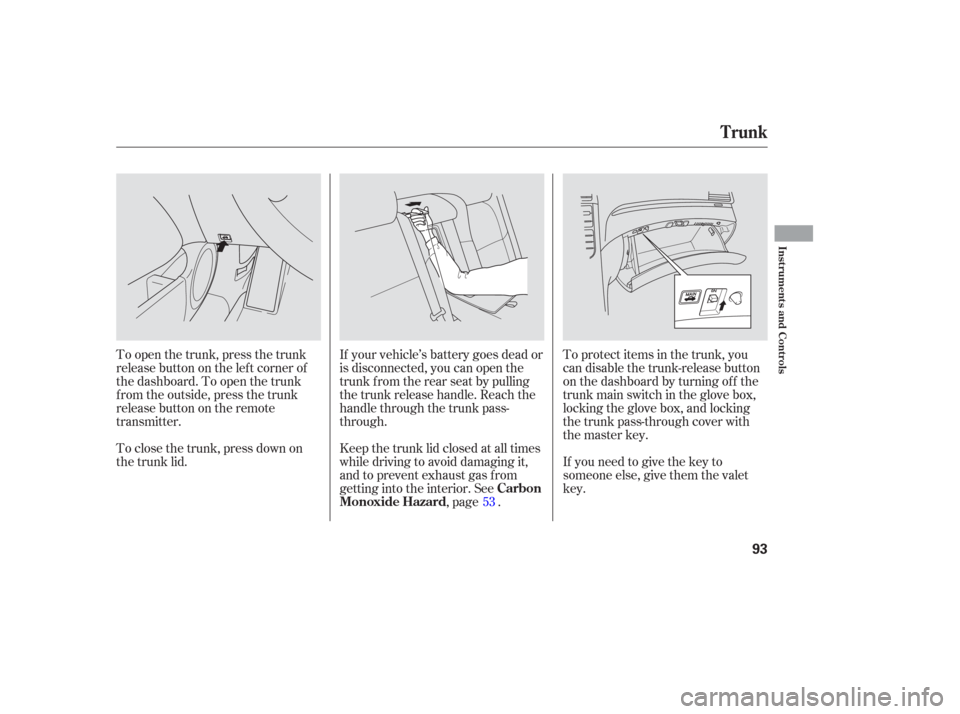
To open the trunk, press the trunk
releasebuttonontheleftcornerof
the dashboard. To open the trunk
f rom the outside, press the trunk
release button on the remote
transmitter.
To close the trunk, press down on
the trunk lid.If your vehicle’s battery goes dead or
is disconnected, you can open the
trunk f rom the rear seat by pulling
the trunk release handle. Reach the
handle through the trunk pass-
through.
Keep the trunk lid closed at all times
while driving to avoid damaging it,
and to prevent exhaust gas from
getting into the interior. See
,page . To protect items in the trunk, you
can disable the trunk-release button
on the dashboard by turning off the
trunk main switch in the glove box,
locking the glove box, and locking
the trunk pass-through cover with
the master key.
If you need to give the key to
someone else, give them the valet
key.
53
Trunk
Carbon
Monoxide Hazard
Inst rument s and Cont rols
93
Page 176 of 295

Bef ore you begin driving your
vehicle, you should know what
gasoline to use and how to check the
levels of important f luids. You also
need to know how to properly store
luggage or packages. The
inf ormation in this section will help
you. If you plan to add any
accessories to your vehicle, please
read the information in this section
first..............................
Break-in Period .176
.................
Fuel Recommendation .176
.........
Service Station Procedures .177
....................................
Ref ueling .177
Opening and Closing the .......................................
Hood .178
...................................
Oil Check .179
.............
Engine Coolant Check .180
...............................
Fuel Economy .180
...
Accessories and Modif ications .181
.............................
Carrying Cargo .183
Bef ore Driving
Bef ore Driving
175
Page 177 of 295
Help assure your vehicle’s f uture
reliability and perf ormance by paying
extra attention to how you drive
during the f irst 600 miles (1,000 km).
During this period:In addition, in order to maintain good
perf ormance, f uel economy, and
emissions control, we strongly
recommend, in areas where it is
available, the use of gasoline that
does NOT contain manganese-based
f uel additives such as MMT.
Use of gasoline with these additives
may adversely af f ect perf ormance,
and cause the malfunction indicator
lamp on your instrument panel to
come on. If this happens, contact
your dealer f or service.
You should also f ollow these
recommendations with an
overhauled or exchanged engine, or
when the brakes are replaced. Do not change the oil until the
multi-inf ormation display indicates
it is needed. Avoidhardbrakingforthefirst
200 miles (300 km). Avoid full-throttle starts and rapid
acceleration. Your vehicle is designed to operate
on premium unleaded gasoline with a
pump octane of 91 or higher. Use of
a lower octane gasoline can cause
occasional metallic knocking noises
in the engine and will result in
decreased engine perf ormance. Use
of a gasoline with a pump octane less
than 87 can lead to engine damage.
We recommend quality gasolines
containing detergent additives that
help prevent f uel system and engine
deposits.
Break-in Period
Fuel Recommendation
Break-in Period, Fuel Recommendation
176
Page 178 of 295
CONT INUED
Park with the driver’s side closest
to the service station pump.
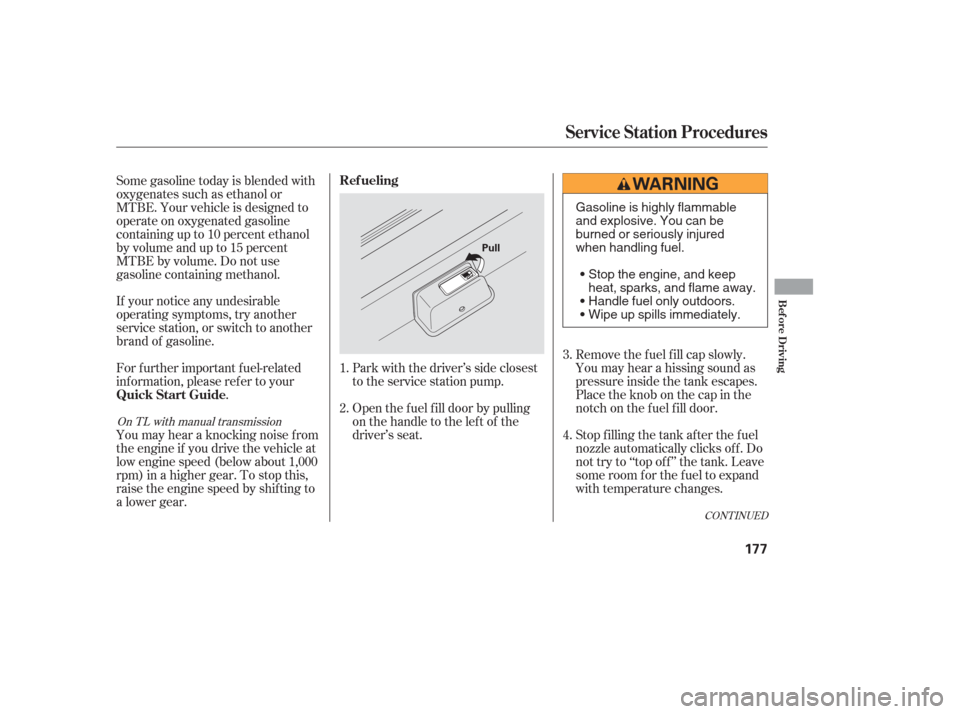
Open the f uel f ill door by pulling
onthehandletotheleftof the
driver’s seat.
For f urther important f uel-related
inf ormation, please ref er to your
.
Stop f illing the tank af ter the f uel
nozzle automatically clicks of f . Do
not try to ‘‘top of f ’’ the tank. Leave
some room f or the f uel to expand
with temperature changes. Remove the f uel f ill cap slowly.
You may hear a hissing sound as
pressure inside the tank escapes.
Place the knob on the cap in the
notch on the f uel f ill door.
If your notice any undesirable
operating symptoms, try another
service station, or switch to another
brand of gasoline.
You may hear a knocking noise from
the engine if you drive the vehicle at
low engine speed (below about 1,000
rpm) in a higher gear. To stop this,
raise the engine speed by shif ting to
a lower gear. Some gasoline today is blended with
oxygenates such as ethanol or
MTBE. Your vehicle is designed to
operate on oxygenated gasoline
containing up to 10 percent ethanol
by volume and up to 15 percent
MTBE by volume. Do not use
gasoline containing methanol.
1.
2.3.
4.
On TL with manual transmission
Service Station Procedures
Ref ueling
Quick Start Guide
Bef ore Driving
177
Pull
Gasoline is highly flammable
and explosive. You can be
burned or seriously injured
when handling fuel. Stop the engine, and keep
heat, sparks, and flame away.
Handle fuel only outdoors.
Wipe up spills immediately.
Page 186 of 295
Distribute cargo evenly on the
f loor of the trunk, placing the
heaviest items on the bottom and
as far forward as possible.
Store or secure all items that could
be thrown around and hurt
someone during a crash.
Keep the glove box closed while
driving. If it is open, a passenger
could injure their knees during a
crash or sudden stop. Be sure items placed on the f loor
behind the f ront seats cannot roll
under the seats and interf ere with
the pedals or seat operation. Do not put any items on top of the
trunk panel. They can block your
view and be thrown around the
vehicle during a crash.
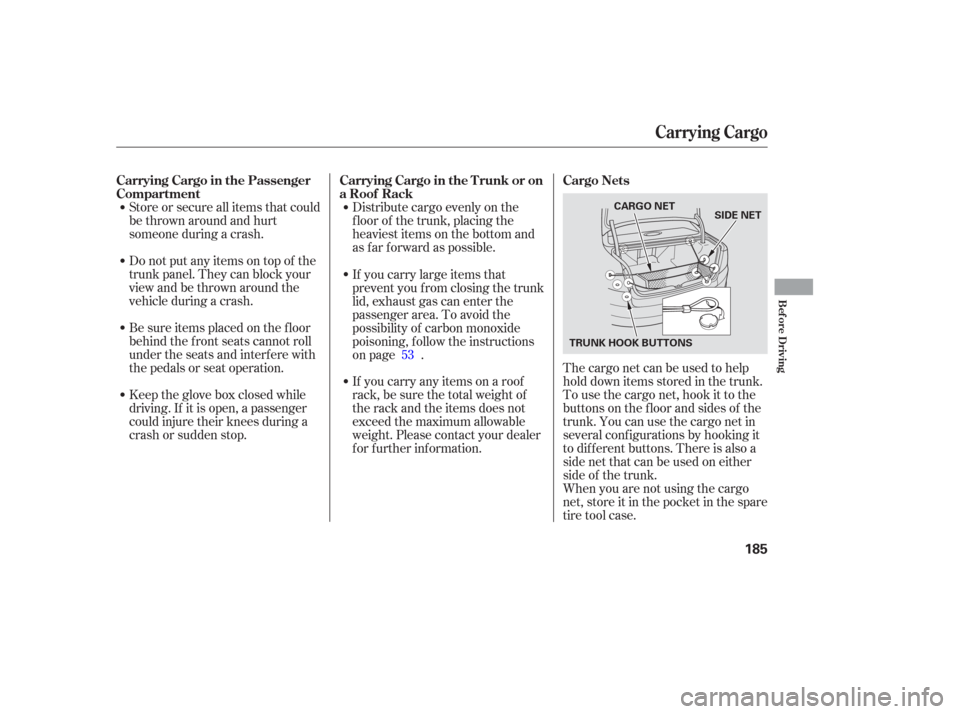
The cargo net can be used to help
hold down items stored in the trunk.
To use the cargo net, hook it to the
buttons on the f loor and sides of the
trunk. You can use the cargo net in
several conf igurations by hooking it
to dif f erent buttons. There is also a
side net that can be used on either
side of the trunk.
When you are not using the cargo
net, store it in the pocket in the spare
tire tool case.
If you carry large items that
prevent you f rom closing the trunk
lid, exhaust gas can enter the
passenger area. To avoid the
possibility of carbon monoxide
poisoning, f ollow the instructions
on page .
If you carry any items on a roof
rack,besurethetotalweightof
the rack and the items does not
exceed the maximum allowable
weight. Please contact your dealer
for further information.
53
Carrying Cargo
Carrying Cargo in the Trunk or on
a Roof Rack
Cargo Nets
Carrying Cargo in the Passenger
Compartment
Bef ore Driving
185
CARGO NET
SIDE NET
TRUNK HOOK BUTTONS
Page 209 of 295

To eliminate potential hazards, read
the instructions bef ore you begin,
and make sure you have the tools
and skills required.Make sure your vehicle is parked
on level ground, the parking brake
is set, and the engine is of f .
To clean parts, use a commercially
available degreaser or parts
cleaner, not gasoline.
To reduce the possibility of f ire or
explosion, keep cigarettes, sparks,
and flames away from the battery
and all f uel-related parts. Wear eye protection and
protective clothing when working
with the battery or compressed air.
Be sure there is
adequate ventilation whenever you
operate the engine.
Let the
engine and exhaust system cool
bef ore touching any parts. Do
not run the engine unless
instructed to do so.
Some of the most important saf ety
precautions are given here. However,
we cannot warn you of every
conceivable hazard that can arise in
perf orming maintenance. Only you
can decide whether or not you
should perf orm a given task.
All service items not detailed in this
section should be perf ormed by a
certif ied technician or other qualif ied
mechanic.
Maintenance Saf ety
Important Saf ety Precautions
Potential Vehicle HazardsCarbon Monoxide poison f rom
engine exhaust.
Burns f rom hot parts. Injury f rom moving parts.
208
Improperly maintaining this
vehicle or failing to correct a
problem before driving can
cause a crash in which you can
be seriously hurt or killed.
Always follow the inspection
and maintenance
recommendations in this owner’s
manual.
Failure to properly follow
maintenance instructions and
precautions can cause you to
be seriously hurt or killed.
Always follow the procedures
and precautions in this owner’s
manual.
Page 219 of 295

Oil is a major contributor to your
engine’s perf ormance and longevity.
Always use a premium-grade 5W-20
detergent oil displaying the API
Certif ication Seal. This seal indicates
the oil is energy conserving, and that
it meets the American Petroleum
Institute’s latest requirements.
Unscrew and remove the engine oil
fill cap on top of the valve cover.
Pour in the oil slowly and caref ully so
you do not spill. Clean up any spills
immediately. Spilled oil could
damage components in the engine
compartment. Install the engine oil
f ill cap, and tighten it securely. Wait
a f ew minutes, and recheck the oil
level (see page ). Do not f ill
above the upper mark; you could
damage the engine. Honda motor oil is the pref erred
5W-20 lubricant f or your vehicle. It is
highly recommended that you use
Honda motor oil in your vehicle f or
optimum engine protection. make
sure the API certif ication seal says
‘‘For Gasoline Engines.’’
The oil viscosity or weight is
provided on the container’s label.
5W-20 oil is f ormulated f or year-
round protection of your vehicle to
improve cold weather starting and
f uel economy.
179
A dding Engine Oil
Recommended Engine Oil
218
ENGINE OIL
FILL CAP
API CERTIFICATION SEAL Ambient Temperature
Page 221 of 295

Let the engine run f or several
minutes, then check the drain bolt
and oil f ilter f or leaks. Reinstall the engine oil f ill cap.
Start the engine. The oil pressure
indicator should go out within 5
seconds. If it does not, turn of f the
engine and check your work.
Engine oil change capacity
(including f ilter): Refill the engine with the
recommended oil. Put a new washer on the drain bolt,
then reinstall the drain bolt.
Tighten the drain bolt to: Install a new oil f ilter according to
the instructions that come with it.
Remove the oil f ilter, and let the
remaining oil drain. A special
wrench (available from your
dealer) is required. Turn of f the engine and let it sit
f or several minutes, then check
the oil level on the dipstick. If
necessary, add more oil.
Make sure the oil f ilter gasket is
not stuck to the engine block. If it
is, remove it bef ore installing a
new oil f ilter.
3. 7.
8.
9.
5.
6. 4.
Changing the Oil and Filter
220
OIL FILTER
4.5 US qt (4.3)
29 lbf·ft (39 N·m , 4.0 kgf·m)
Improper disposal of engine oil can be
harmf ul to the environment. If you
change your own oil, please dispose of
the used oil properly. Put it in a sealed
container, and take it to a recycling
center. Do not discard it in a trash bin
or dump it on the ground.