Pin Acura TSX 2004 User Guide
[x] Cancel search | Manufacturer: ACURA, Model Year: 2004, Model line: TSX, Model: Acura TSX 2004Pages: 364, PDF Size: 5.35 MB
Page 216 of 364

this defeats the
purpose of the ABS. Let the ABS
work f or you by always keeping f irm,
steady pressure on the brake pedal
as you steer away from the hazard.
This is sometimes ref erred to as
You will f eel a pulsation in the brake
pedal when the ABS activates, and
you may hear some noise. This is
normal; it is the ABS rapidly
pumping the brakes.
Activation varies with the amount of
traction your tires have. On dry
pavement, you will need to press on
thebrakepedalveryhardbeforeyou
activate the ABS. However, you may
feel the ABS activate immediately if
you are trying to stop on snow or ice.
The hydraulic system that operates
the brakes has two separate circuits.
Each circuit works diagonally across
the car (the lef t-f ront brake is
connected with the right-rear brake,
etc.). If one circuit should develop a
problem, you will still have braking
at two wheels.
Your car has an Anti-lock Brake
System (ABS) as standard
equipment. ABS helps to prevent the
wheels f rom locking up and skidding
during hard braking, allowing you to
retain steering control.
When the f ront tires skid, you lose
steering control; the car continues
straightaheadeventhoughyouturn
the steering wheel. The ABS helps to
prevent lock-up and helps you retain
steering control by pumping the
brakes rapidly; much f aster than a
person can do it.
The ABS also balances the f ront-to
rear braking distribution according
to car loading.
‘‘stomp and steer.’’
CONT INUED
A nti-lock Brakes
You should never pump the
brake pedal;
Brake System Design
The Braking System
Driving213
Front
Page 217 of 364

such as trying to take a
corner too f ast or making a sudden
lane change. Always drive at a safe,
prudent speed f or the road and
weather conditions.
Always steer moderately
when you are braking hard. Severe
or sharp steering wheel movement
can still cause your car to veer into
oncoming traffic or off the road. it
only helps with steering control
during braking. You should always
maintain a saf e f ollowing distance
f rom other vehicles. on loose or
uneven surf aces, such as gravel or
snow, than a car without anti-lock.
Slow down and allow a greater
distance between cars under those
conditions.
The ABS is self -checking. If anything
goes wrong, the ABS indicator on
the instrument panel comes on (see
page ). This means the anti-lock
f unction of the braking system has
shut down. The brakes still work like
a conventional system without anti-
lock, providing normal stopping
ability. You should have the dealer
inspect your car as soon as possible.61
Import ant Saf et y Reminders
A BS Indicat or
A BS will not prevent a skid that
results f rom changing direction
abruptly,
A BS cannot prevent a loss of
stability. A BS does not reduce the time or
distance it takes to stop the car;A car with ABS may require a
longer distance to stop
The Braking System
Driving214
ABS INDICATOR
Page 227 of 364

All states and Canadian provinces
require some type of trailer lights.
Check requirements f or the areas
where you plan to tow.
You can get an optional trailer
lighting connector f or your car f rom
your Acura dealer.
If you use a converter, you can get
the connector and pins that mate
with the connector in your car f rom
your Acura dealer.Since lighting and wiring vary in
trailer type and brand, you should
also have a qualif ied mechanic install
a suitable connector between the car
and the trailer.
Always consult your Acura dealer
bef ore connecting the trailer lights
to your car’s lighting system.
Applicable
Light
Taillight
Brake Light
Back-up
Light
Right Turn
Signal
Left Turn
Signal
GroundWiring
Color
Red/Black
White/Black
Green/Black
Green/
Yellow
Green/Blue
Black
Ref er to the f ollowing table f or the
wiring color code.
Wiring Color Code f or Lighting
T railer L ights
Towing a Trailer
Driving224
Page 271 of 364

Remove the blade f rom its holder
by grasping the tabbed end of the
blade. Pull f irmly until the tabs
come out of the holder.Examine the new wiper blades. If
they have no plastic or metal rein-
f orcement along the back edge,
remove the metal reinf orcement
strips f rom the old wiper blade and
install them in the slots along the
edge of the new blade.Slide the new wiper blade into the
holder until the tabs lock.
Lower the wiper arm down against
the windshield. Slide the wiper blade assembly
onto the wiper arm. Make sure it
locks in place.
Lower the passenger’s side f irst,
then the driver’s side.
3. 4. 5.
6.
7.
Wiper Blades
Maint enance268
BLADE BLADE
REINFORCEMENT
Page 276 of 364

Use a gauge to measure the air
pressure at least once a month. Even
tires that are in good condition may
lose one to two psi (10 to 20 kPa, 0.1
to 0.2 kgf /cm ) per month.
Remember to check the spare tire at
thesametimeyoucheckallthe
other tires.
Check the pressure in the tires when
they are cold. This means the car
has been parked f or at least three
hours. If you have to drive the car
bef ore checking the tire pressure,
the tires can still be considered
‘‘cold’’ if you drive less than 1 mile
(1.6 km).
Keeping the tires properly inf lated
provides the best combination of
handling, tread lif e, and riding
comf ort. Underinf lated tires wear
unevenly, adversely af f ect handling
and f uel economy, and are more
likely to f ail f rom being overheated.
Overinf lated tires can make your car
ride more harshly, are more prone to
damage f rom road hazards, and wear
unevenly.
We recommend that you visually
check your tires every day. If you
think a tire might be low, check it
immediately with a tire gauge.
To saf ely operate your car, your tires
must be the proper type and size, in
good condition with adequate tread,
and correctly inf lated. The f ollowing
pages give more detailed inf ormation
on how and when to check air
pressure, how to inspect your tires
for damage and wear, and what to do
when your tires need to be replaced.
Add or release air, if needed, to
match the recommended cold tire
pressures on page .274
CONT INUED
Inf lation
Tires
Maint enance273
Using tires that are excessively
worn or improperly inflated can
cause a crash in which you can
be seriously hurt or killed.
Follow all instructions in this
owner’s manual regarding tire
inflation and maintenance.
Page 279 of 364

When shopping f or replacement
tires, you may find that some tires
are ‘‘directional.’’ This means they
are designed to rotate only in one
direction. If you use directional tires,they should be rotated only front-to-
back.
Make sure the installer balances the
wheels when you have new tires
installed. This increases riding
comf ort and tire lif e. Your car’s
original tires were dynamic or ‘‘spin’’
balanced at the f actory. For best
results, have the installer perf orm a
dynamic balance. The tires that came with your car
were selected to match the perform-
ance capabilities of the car while
providing the best combination of
handling, ride comf ort, and long lif e.
Youshouldreplacethemwithradial
tires of the same size, load range,
speed rating, and maximum cold tire
pressure rating (as shown on the
tire’s sidewall). Mixing radial and
bias-ply tires on your car can reduce
its braking ability, traction, and
steering accuracy.
To help increase tire lif e and
distribute wear more evenly, you
should have the tires rotated every
10,000 miles (16,000 km). Move the
tires to the positions shown in the
chart each time they are rotated. Tire Rotation
Replacing T ires and Wheels
Maint enance
Tires
276
(For Non-directional
Tires and Wheels)Front Front
(For Directional
Tires and Wheels)Improper wheel weights can damage
your car’s aluminum wheels. Use only
genuine Acura wheel weights f or
balancing.
Page 299 of 364

When you have washed and rinsed
the whole exterior, dry it with a
chamois or sof t towel. Letting it
air-dry will cause dulling and water
spots.
Fill a bucket with cool water. Mix
in a mild detergent, such as
dishwashing liquid or a product
made especially f or car washing.
Only use the solvents and cleaners
recommendedinthisOwner’s
Manual. Frequent washing helps preserve
your car’s beauty. Dirt and grit can
scratch the paint, while tree sap and
bird droppings can permanently ruin
the f inish.
Wash your car in a shady area, not in
direct sunlight. If the car is parked in
the sun, move it into the shade and
let the exterior cool down bef ore you
start. Rinse the car thoroughly with cool
water to remove loose dirt.
As you dry the car, inspect it f or
chips and scratches that could allow
corrosion to start. Repair them with
touch-up paint (see page ).
Wash the car using the water and
detergent solution and a sof t-
bristle brush, sponge, or sof t cloth.
Start at the top and work your way
down. Rinse f requently.
Check the body f or road tar, tree
sap, etc. Remove these stains with
tar remover or turpentine. Rinse it
of f immediately so it does not
harm the f inish. Remember to re-
wax these areas, even if the rest of
the car does not need waxing. 297
Exterior Care
Appearance Care
Washing
296
Chemical solvents and strong cleaners
can damage the paint, metal, and
plastic on your car.
Page 303 of 364

Dirt build-up in the loops of the seat
belt anchors can cause the belts to
retract slowly. Wipe the insides of
the loops with a clean cloth
dampened in mild soap and warm
water or isopropyl alcohol.Clean the windows, inside and out,
with a commercially-available glass
cleaner. You can also use a mixture
of one part white vinegar to ten parts
water. This will remove the haze that
builds up on the inside of the
windows. Use a sof t cloth or paper
towels to clean all glass and clear
plastic surf aces.If you want to use an air f reshener/
deodorizer in the interior of your car,
it is best to use a solid type. Some
liquid air f resheners contain chemi-
cals that may cause parts of the
interior trim and f abric to crack or
discolor.
If youusealiquidairfreshener,
make sure you f asten it securely so it
does not spill as you drive.
Interior Care
Appearance Care
Windows
A ir Fresheners
300
The rear window def ogger and
antenna wires are bonded to the inside
of the glass. Wiping vigorously up-and-
down can dislodge and break these
wires. When cleaning the rear window,
use gentle pressure and wipe side-to-
side.
Page 308 of 364
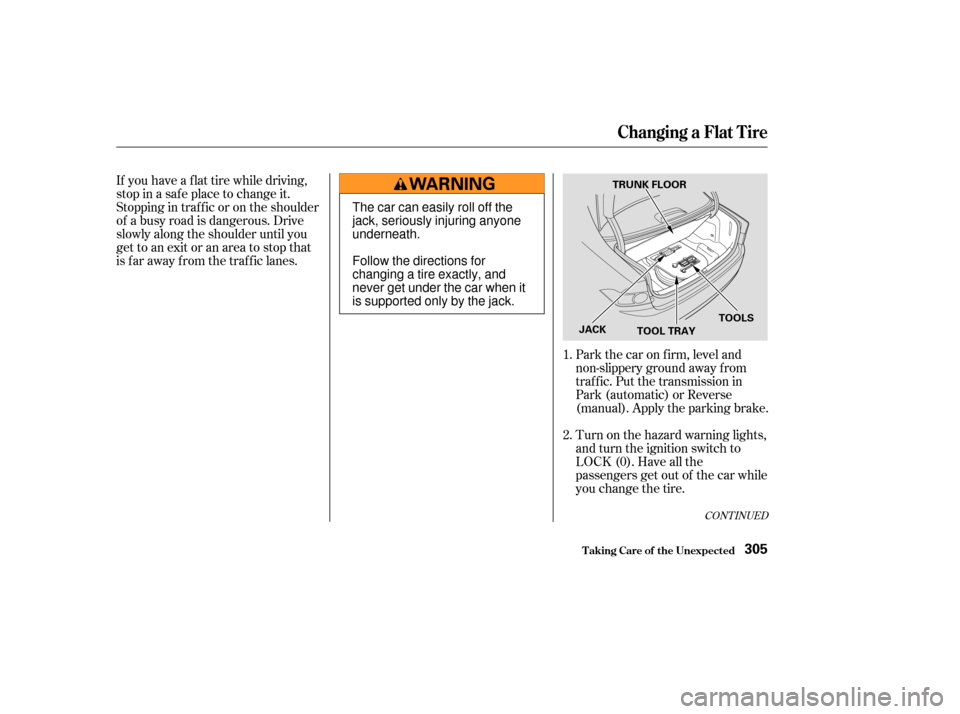
If you have a f lat tire while driving,
stop in a saf e place to change it.
Stopping in traf f ic or on the shoulder
of a busy road is dangerous. Drive
slowly along the shoulder until you
gettoanexitoranareatostopthat
is far away from the traffic lanes.Park the car on f irm, level and
non-slippery ground away f rom
traffic. Put the transmission in
Park (automatic) or Reverse
(manual). Apply the parking brake.
Turn on the hazard warning lights,
and turn the ignition switch to
LOCK (0). Have all the
passengers get out of the car while
you change the tire.
2. 1.
CONT INUED
Changing a Flat T ire
T aking Care of t he Unexpect ed305
TRUNK FLOOR
JACK TOOLS
TOOL TRAY
The car can easily roll off the
jack, seriously injuring anyone
underneath.
Follow the directions for
changing a tire exactly, and
never get under the car when it
is supported only by the jack.
Page 313 of 364

Diagnosing why your engine won’t
start f alls into two areas, depending
on what you hear when you turn the
key to START (III):You hear nothing, or almost
nothing. The engine’s starter
motor does not operate at all, or
operates very slowly.
You can hear the starter motor
operating normally, or the starter
motor sounds like it is spinning
f aster than normal, but the engine
does not start up and run. When you turn the ignition switch to
START (III), you do not hear the
normal noise of the engine trying to
start. You may hear a clicking sound
or series of clicks, or nothing at all.
Check these things:
Check the transmission interlock.
If you have a manual transmission,
the clutch pedal must be pushed
all the way to the f loor or the
starter will not operate. With an
automatic transmission, it must be
in Park or Neutral.
Turn the ignition switch to ON (II).
Turn on the headlights and check
their brightness. If the headlights
are very dim or don’t light at all,
the battery is discharged. See on page .
Store the tools and the jack in the
tool tray, and place the tool tray
back in the trunk.
Store the wheel cover or center
cap in the trunk. Make sure it does
not get scratched or damaged.
Lower the trunk f loor, then close
the trunk lid.
18.
19.
312
T aking Care of t he Unexpect ed
Changing a Flat Tire, If Your Engine Won’t Start
If Your Engine Won’t Start Nothing Happens or the StarterMotor Operates Very Slowly
Jump Starting
310
Loose items can fly around the
interior in a crash and could
seriously injure the occupants.
Store the wheel, jack, and tools
securely before driving.