automatic transmission Acura TSX 2013 Owner's Guide
[x] Cancel search | Manufacturer: ACURA, Model Year: 2013, Model line: TSX, Model: Acura TSX 2013Pages: 325, PDF Size: 8.61 MB
Page 243 of 325

242
uuMaintenance Under the Hood uTransmission Fluid
Maintenance
Transmission FluidCheck the fluid level when the engine is at normal operating temperature.
1.Park on level ground, and start the engine.
2. Wait until the radiator fan starts and then
turn off the engine.
u Perform step 3 after waiting for about 60
seconds (less than 90 seconds).
3. Remove the dipstick (yellow loop) from the
transmission and wipe it with a clean cloth.
4. Insert the dipstick all the way back into the
transmission securely, as shown in the
image.
5. Remove the dipstick and check the fluid
level.
u It should be between the upper and
lower marks in the HOT range.
6. If the level is below the lower mark, add
fluid into the dipstick hole to bring it to the
level between the upper and lower marks,
and have your vehicle checked by a dealer
immediately.■
Automatic Transmission Fluid
Specified fluid: Acura ATF DW-1 (automatic transmission fluid)
1Automatic Transmission Fluid
NOTICEDo not mix Acura ATF DW-1 with other
transmission fluids.
Using a transmission fluid other than Acura ATF
DW-1 may adversely affect the operation and
durability of your vehicle’s transmission, and damage
the transmission.
Any damage caused by using a transmission fluid that
is not equivalent to Acura ATF DW-1 is not covered
by Acura’s new vehicle warranty.NOTICEPour the fluid slowly and carefully so you do not spill
any. Clean up any spills immediately; they can
damage components in the engine compartment.
Upper Mark
Lower Mark
HOT
Range Upper
Lower
Marks
Rubber
Cap
Guide
4-cylinder models6-cylinder models
Page 278 of 325

277
Continued
Handling the Unexpected
If a Tire Goes FlatChanging a Flat TireIf a tire goes flat while driving, grasp the steering wheel firmly, and brake gradually
to reduce speed. Then, stop in a safe place. Replace the flat tire with a compact
spare tire. Go to a dealer as soon as possible to have the full-size tire repaired or
replaced.
1.Park the vehicle on firm, level, and non-slippery surface and apply the parking
brake.
2. Move the shift lever in
(P
.
2. Move the shift lever in
(R
.
3. Set the parking brake.
4. Turn on the hazard warning lights and turn the ignition switch to LOCK
(0
.
1Changing a Flat Tire
Periodically check the tire pressure of the compact
spare. It should be set to the specified pressure.
Specified Pressure: 60 psi (420 kPa, 4.2 kgf/cm
2)
When driving with the compact spare tire, keep the
vehicle speed under 50 mph (80 km/h). Replace with
a full-size tire as soon as possible.
The compact spare tire and wheel in your vehicle are
specifically for this model.
Do not use them with another vehicle.
Do not use another type of compact spare tire or
wheel with your vehicle.
Do not mount tire chains on a compact spare tire.
If a chain-mounted front tire goes flat, remove one of
the full-size rear tires and replace it with the compact
spare tire. Remove the flat front tire and replace it will
the full-size tire that was removed from the rear.
Mount the tire chains on the front tire.
Do not use a puncture-repairing agent on a flat tire,
as it can damage the tire pressure sensor.
Automatic transmission modelsManual transmission modelsAll models
Page 286 of 325

Continued
285
uuJump Starting u
Handling the Unexpected
5.Connect the other end of the second
jumper cable:
Engine mounting bolt
Transmission mounting bolt
Engine hanger
Do not connect this jumper cable to any
other part.
6. If your vehicle is connected to another
vehicle, start the assisting vehicle’s engine
and increase its rpm slightly.
7. Attempt to start your vehicle’s engine. If it
turns over slowly, check that the jumper
cables have good metal-to-metal contact.
1Jump Starting
Battery performance degrades in cold conditions and
may prevent the engine from starting.
6-cylinder modelsBooster Battery4-cylinder models with
automatic transmission
4-cylinder models with automatic transmission4-cylinder models with manual transmission6-cylinder models
4-cylinder models with
manual transmission
Page 288 of 325

287
Handling the Unexpected
Shift Lever Does Not MoveFollow the procedure below if you cannot move the shift lever out of the
(P
position.
1.Set the parking brake.
2. Remove the key from the ignition switch.
3. Wrap a cloth around the tip of a small flat-
tip screwdriver. Put it into the shift lock
release slot as shown in the image, and
remove the cover.
4. Insert the key into the shift lock release slot.
5. While pushing on the key down, press the
shift lever release button and place the shift
lever into
(N
.
u The lock is now released. Have the shift
lever checked by a dealer as soon as
possible.
■
Releasing the Lock
Automatic transmission models
Slot
Cover
Release Button Shift Lock
Release Slot
Page 305 of 325
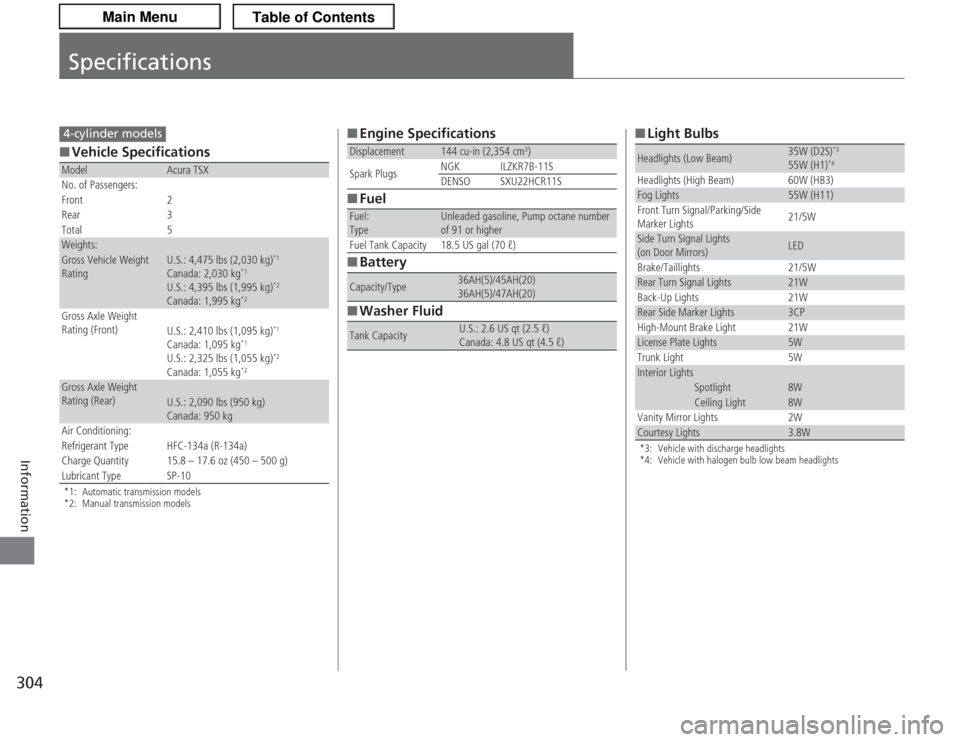
304Information
Specifications■Vehicle Specifications*1: Automatic transmission models
*2: Manual transmission modelsModel
Acura TSX
No. of Passengers:
Front 2
Rear 3
Total 5
Weights:Gross Vehicle Weight
Rating
U.S.: 4,475 lbs (2,030 kg)
*1
Canada: 2,030 kg
*1
U.S.: 4,395 lbs (1,995 kg)
*2
Canada: 1,995 kg
*2
Gross Axle Weight
Rating (Front)
U.S.: 2,410 lbs (1,095 kg)
*1
Canada: 1,095 kg
*1
U.S.: 2,325 lbs (1,055 kg)
*2
Canada: 1,055 kg
*2
Gross Axle Weight
Rating (Rear)
U.S.: 2,090 lbs (950 kg)
Canada: 950 kg
Air Conditioning:
Refrigerant Type HFC-134a (R-134a)
Charge Quantity 15.8 – 17.6 oz (450 – 500 g)
Lubricant Type SP-10
4-cylinder models
■ Engine Specifications
■ Fuel
■ Battery
■ Washer FluidDisplacement
144 cu-in (2,354 cm
3)
Spark Plugs NGK ILZKR7B-11S
DENSO SXU22HCR11S
Fuel:
Type
Unleaded gasoline, Pump octane number
of 91 or higher
Fuel Tank Capacity 18.5 US gal (70 ℓ)
Capacity/Type
36AH(5)/45AH(20)
36AH(5)/47AH(20)
Tank Capacity
U.S.: 2.6 US qt (2.5 ℓ)
Canada: 4.8 US qt (4.5 ℓ)
■ Light Bulbs*3: Vehicle with discharge headlights
*4: Vehicle with halogen bulb low beam headlightsHeadlights (Low Beam)
35W (D2S)
*3
55W (H1)
*4
Headlights (High Beam) 60W (HB3)Fog Lights
55W (H11)
Front Turn Signal/Parking/Side
Marker Lights 21/5W
Side Turn Signal Lights
(on Door Mirrors)
LED
Brake/Taillights 21/5W
Rear Turn Signal Lights
21W
Back-Up Lights 21W
Rear Side Marker Lights
3CP
High-Mount Brake Light 21W
License Plate Lights
5W
Trunk Light 5W
Interior Lights
Spotlight
8W
Ceiling Light
8W
Vanity Mirror Lights 2W
Courtesy Lights
3.8W
Page 306 of 325

305
uuSpecifications u
Continued
Information
■Brake/Clutch Fluid
■ Transmission Fluid*1: Automatic transmission models
*2: Manual transmission modelsSpecified
Honda Heavy Duty Brake Fluid DOT 3
Specified
*1
Acura ATF DW-1
(automatic
transmission fluid)
2.6 US qt (2.5 ℓ)
(Change)
Specified
*2
Acura Manual
Transmission Fluid 2.0 US qt (1.9 ℓ)
(Change)
■
Engine Oil
■ Engine Coolant*1: Automatic transmission models
*2: Manual transmission modelsRecommended
·Acura Genuine Motor Oil 0W-20
·API Premium-grade 0W-20 detergent oil
Capacity Change 4.0 US qt (3.8 ℓ)
Change
including
filter
4.2 US qt (4.0 ℓ)
Specified
Honda Long-Life Antifreeze/Coolant Type2
Ratio 50/50 with distilled water
Capacity
*1
1.64 US gal (6.2 ℓ)
(change including the remaining
0.196 US gal (0.74 ℓ) in the reserve tank)
Capacity
*2
1.66 US gal (6.3 ℓ)
(change including the remaining
0.196 US gal (0.74 ℓ) in the reserve tank)
■ TireRegular
Size
P225/50R17 93V
Pressure
psi (kPa [kgf/cm
2])
33 (230 [2.3])
Compact
Spare Size
T135/80D16 101M
Pressure
psi (kPa [kgf/cm
2]) 60 (420 [4.2])
Wheel Size
Regular
17 x 7.5J
Compact Spare
16 x 4T
Page 308 of 325

307
uuSpecifications u
Information
■Brake/Clutch Fluid
■ Transmission FluidSpecified
Honda Heavy Duty Brake Fluid DOT 3
Specified
Acura ATF DW-1
(automatic
transmission fluid)
3.5 US qt (3.3 ℓ)
(Change)
■ Engine Oil
■ Engine CoolantRecommended
·Acura Genuine Motor Oil 0W-20
·API Premium-grade 0W-20 detergent oil
Capacity Change 4.2 US qt (4.0 ℓ)
Change
including
filter
4.5 US qt (4.3 ℓ)
Specified
Honda Long-Life Antifreeze/Coolant Type2
Ratio 50/50 with distilled water
Capacity
1.77 US gal (6.7 ℓ)
(change including the remaining
0.196 US gal (0.74 ℓ) in the reserve tank)
■ TireRegular
Size
P235/45R18 94V
Pressure
psi (kPa [kgf/cm
2])
33 (230 [2.3])
Compact
Spare Size
T135/80D16 101M
Pressure
psi (kPa [kgf/cm
2]) 60 (420 [4.2])
Wheel Size
Regular
18 x 8J
Compact Spare
16 x 4T
Page 309 of 325

308Information
Identification NumbersVehicle Identification Number (VIN)Your vehicle has a 17-digit vehicle identification number (VIN) used to register your
vehicle for warranty purposes, and for licensing and insuring your vehicle. See the
image below for the VIN locations.Engine Number and Transmission NumberSee the image below for the locations of your vehicle’s engine number and
transmission number.
Vehicle Identification Number
Engine Number
Certification Label/
Vehicle Identification
Number
Manual Transmission
Number Automatic Transmission
Number
6-cylinder models4-cylinder modelsEngine Number
Automatic Transmission
Number
Page 312 of 325

311
Continued
Information
Emissions TestingTesting of Readiness CodesYour vehicle uses “readiness codes,” as part of its onboard self diagnostic system.
Some states refer to these codes during testing to see if your vehicle’s emissions
components are working properly.
The codes may not be read if you go through the testing just after the battery has
gone dead or been disconnected.
To check if they are set, turn the ignition switch to ON
(w
, without starting the
engine. The malfunction indicator lamp will come on for several seconds. If it then
goes off, the readiness codes are set. If it blinks five times, the readiness codes are
not set.
If you are required to have your vehicle tested before the readiness codes are ready,
prepare the vehicle for retesting by doing the following:
1. Fill the gas tank to approximately 3/4 full.
2. Park the vehicle and leave the engine off for 6 hours or more.
3. Make sure the ambient temperature is between 40 °F and 95 °F (4 °C and 35 °C).
4. Start the engine without touching the accelerator pedal, and let it idle for 20
seconds.
5. Keep the vehicle in
(P
(automatic transmission) or
(N
(manual transmission).
Increase the engine speed to 2,000 rpm, and hold it there until the temperature
gauge rises to at least 1/4 of the scale (about 3 minutes).
6. Let the engine idle with your foot off the accelerator for 20 seconds.
1Testing of Readiness Codes
The readiness codes are erased when the battery is
disconnected, and set again only after several days of
driving under a variety of conditions.
If a testing facility determines that the readiness
codes are not set, you may be requested to return at
a later date to complete the test.
If the testing faci lity determines the readiness codes
are still not set, see a dealer.
Page 318 of 325

Index
317
Index
Index
AABS (Anti-lock Brake System).................. 212
Accessories and Modifications ................ 219
Accessory Power Sockets ......................... 129
Active Head Restraints ............................. 122
Additives Coolant .................................................. 240
Engine Oil ............................................... 234
Washer ................................................... 246
Additives, Engine Oil ............................... 234
Adjusting
Armrest .................................................. 124
Front Seats.............................................. 116
Head Restraints ....................................... 118
Headlights .............................................. 247
Mirrors.................................................... 114
Rear Seats ............................................... 123
Steering Wheel ....................................... 113
Temperature ............................................. 78
Air Conditioning System (Climate Control System) .................................................... 133
Changing the Mode................................ 133
Defrosting the Windshield and Windows .............................................. 134
Dust and Pollen Filter .............................. 270
Recirculation/Fresh Air Mode................... 133
Sensor .................................................... 136
Synchronized Mode ................................ 135
Using Automatic Climate Control............ 133
Air Pressure .............................. 260, 305, 307 Airbags
........................................................ 33
Advanced Airbags ..................................... 39
After a Collision ......................................... 37
Airbag Care ............................................... 47
Event Data Recorder .................................. 19
Front Airbags (SRS) .................................... 36
Indicator ........................................ 44, 67, 70
Passenger Airbag Off Indicator .................. 45
Sensors ...................................................... 33
Side Airbag Cutoff System ......................... 42
Side Airbag Off Indicator ........................... 46
Side Airbags .............................................. 40
Side Curtain Airbags .................................. 43
AM/FM Radio ............................................ 143
Anti-lock Brake System (ABS) .................. 212
Indicator .................................................... 66
Armrest ..................................................... 124
Audio System ............................................ 138
Adjusting the Sound ................................ 142
Auxiliary Input Jack .................................. 140
Error Messages ........................................ 158
General Information ................................ 161
MP3/WMA/AAC ...................................... 153
Recommended CDs ................................. 162
Recommended Devices ............................ 164
Remote Controls ..................................... 160
Security Code .......................................... 140
Theft Protection ....................................... 140
USB Adapter Cable .................................. 139
USB Flash Drives ...................................... 164
Authorized Manuals ................................. 315 Auto Door Lock/Unlock
.............................. 94
Customize ........................................... 81, 83
Automatic Lighting .................................. 106
Automatic Transmission ........................... 194
Creeping ................................................. 194
Fluid ........................................................ 242
Kickdown ................................................ 194
Operating the Shift Lever................... 13, 196
Sequential Shift Mode ............................. 197
Shift Lever Does Not Move ...................... 287
Shifting ................................................... 195
Auxiliary Input Jack .................................. 140
Average Fuel Economy .............................. 78
Average Speed ........................................... 79
BBattery...................................................... 268
Charging System Indicator................. 65, 290
Jump Starting .......................................... 284
Maintenance (Checking the Battery) ........ 268
Maintenance (Replacing) ......................... 269
Belts (Seat) .................................................. 26
Beverage Holders ..................................... 128
Bluetooth® Audio..................................... 156
Bluetooth® HandsFreeLink® ..................... 167
Booster Seats (For Children) ...................... 59
Brake System ............................................ 210
Anti-lock Brake System (ABS)................... 212
Brake Assist System ................................. 213
Fluid ........................................................ 244