heating Alfa Romeo 147 2010 Owner handbook (in English)
[x] Cancel search | Manufacturer: ALFA ROMEO, Model Year: 2010, Model line: 147, Model: Alfa Romeo 147 2010Pages: 291, PDF Size: 5.52 MB
Page 106 of 291
GETTING TO KNOW YOUR CAR
104
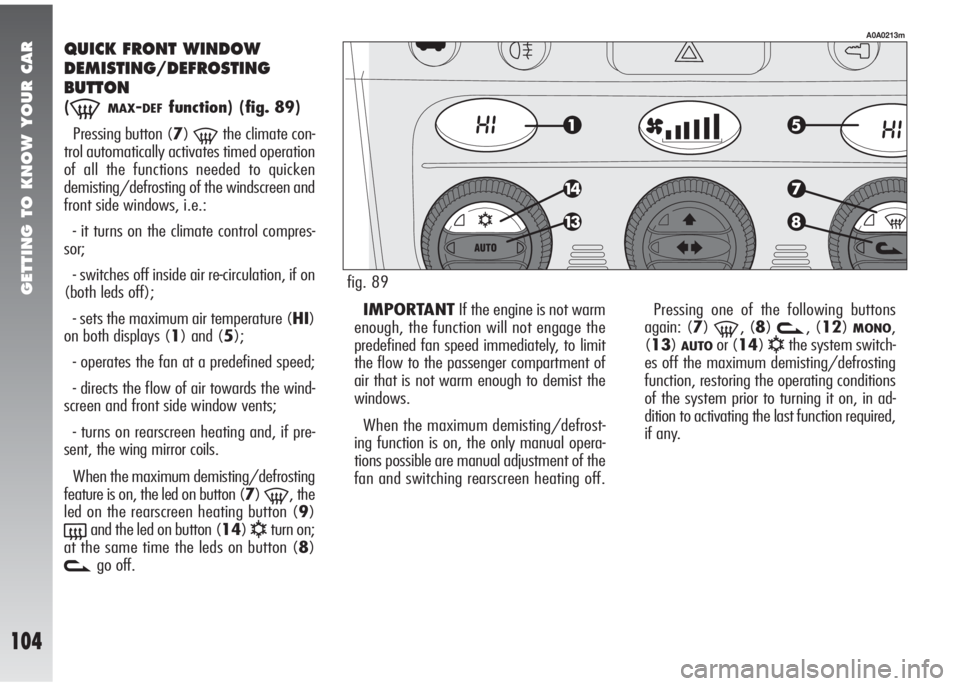
QUICK FRONT WINDOW
DEMISTING/DEFROSTING
BUTTON
(-MAX-DEFfunction)(fig. 89)
Pressing button (7)
-the climate con-
trol automatically activates timed operation
of all the functions needed to quicken
demisting/defrosting of the windscreen and
front side windows, i.e.:
- it turns on the climate control compres-
sor;
- switches off inside air re-circulation, if on
(both leds off);
- sets the maximum air temperature (HI)
on both displays (1) and (5);
- operates the fan at a predefined speed;
- directs the flow of air towards the wind-
screen and front side window vents;
- turns on rearscreen heating and, if pre-
sent, the wing mirror coils.
When the maximum demisting/defrosting
feature is on, the led on button (7)
-, the
led on the rearscreen heating button (9)
(and the led on button (14)√turn on;
at the same time the leds on button (8)
vgo off.IMPORTANTIf the engine is not warm
enough, the function will not engage the
predefined fan speed immediately, to limit
the flow to the passenger compartment of
air that is not warm enough to demist the
windows.
When the maximum demisting/defrost-
ing function is on, the only manual opera-
tions possible are manual adjustment of the
fan and switching rearscreen heating off.Pressing one of the following buttons
again: (7)
-, (8)v, (12)MONO,
(13)
AUTOor (14)√the system switch-
es off the maximum demisting/defrosting
function, restoring the operating conditions
of the system prior to turning it on, in ad-
dition to activating the last function required,
if any.
A0A0213m
fig. 89
Page 107 of 291
GETTING TO KNOW YOUR CAR
105
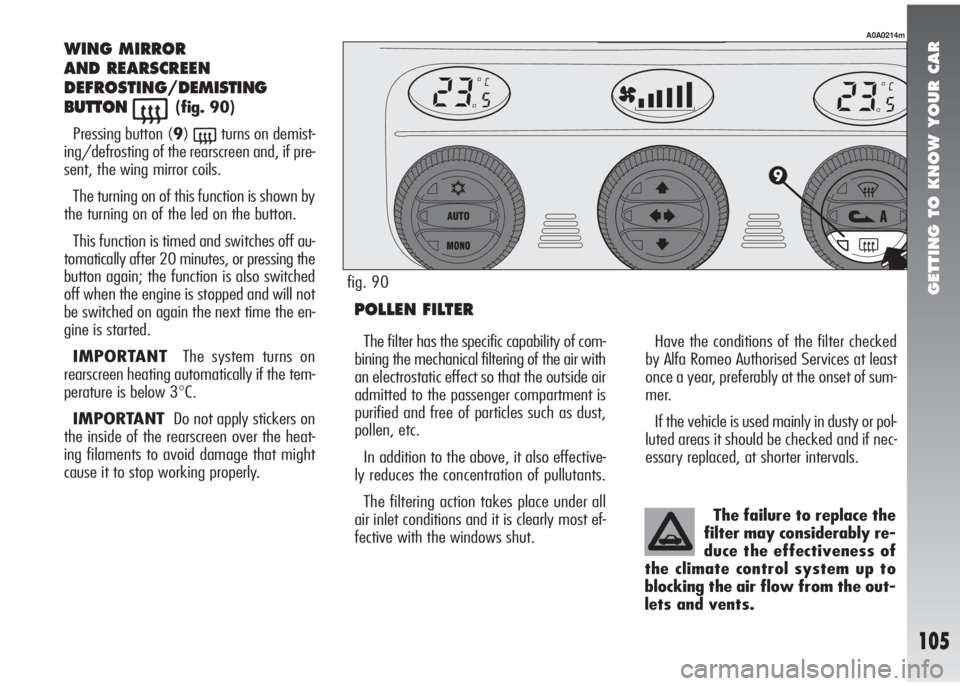
WING MIRROR
AND REARSCREEN
DEFROSTING/DEMISTING
BUTTON
((fig. 90)
Pressing button (9)
(turns on demist-
ing/defrosting of the rearscreen and, if pre-
sent, the wing mirror coils.
The turning on of this function is shown by
the turning on of the led on the button.
This function is timed and switches off au-
tomatically after 20 minutes, or pressing the
button again; the function is also switched
off when the engine is stopped and will not
be switched on again the next time the en-
gine is started.
IMPORTANTThe system turns on
rearscreen heating automatically if the tem-
perature is below 3
°C.
IMPORTANTDo not apply stickers on
the inside of the rearscreen over the heat-
ing filaments to avoid damage that might
cause it to stop working properly.
POLLEN FILTER
Have the conditions of the filter checked
by Alfa Romeo Authorised Services at least
once a year, preferably at the onset of sum-
mer.
If the vehicle is used mainly in dusty or pol-
luted areas it should be checked and if nec-
essary replaced, at shorter intervals.
A0A0214m
The filter has the specific capability of com-
bining the mechanical filtering of the air with
an electrostatic effect so that the outside air
admitted to the passenger compartment is
purified and free of particles such as dust,
pollen, etc.
In addition to the above, it also effective-
ly reduces the concentration of pullutants.
The filtering action takes place under all
air inlet conditions and it is clearly most ef-
fective with the windows shut.The failure to replace the
filter may considerably re-
duce the effectiveness of
the climate control system up to
blocking the air flow from the out-
lets and vents.
fig. 90
Page 117 of 291
GETTING TO KNOW YOUR CAR
115
WARNINGS
– With the car stopped and a gear en-
gaged always keep the brake pedal pressed
until deciding to move off;
– during prolonged halts with the engine
running it is advisable to keep the gearbox in
neutral;
– when the car is parked facing uphill, do
not use the moving off manoeuvre to keep
the car still; use the brake pedal and press
the accelerator pedal only when deciding to
move off;
– use second gear onlywhen more con-
trol is needed for moving off manoeuvres at
low speed;
– if, in reverse gear, first gear is engaged
or vice versa, shift gear only when the car
is stopped completely and with the brake
pedal pressed.
Though highly unadvisable, if when trav-
elling downhill for some unexpected reason
the car is set to neutral (N), when the en-
gagement of a gear is requested the system
automatically engages the best gear in re-
lation to the speed of the car to allow the
correct transmission of torque to the wheels.When travelling downhill with a gear en-
gaged and the accelerator released (if the
vehicle is moving), beyond a pre-established
speed, the system engages the clutch au-
tomatically to give the car adequate engine
braking.
For safety reasons the Selespeed system
activates the buzzer when:
– clutch overheating occurs while the ve-
hicle is being started; in this case it is nec-
essary to “force” starting avoiding hesita-
tion or, if the car is on a slope, release the
accelerator and use the brake pedalto stop
the car;
– the car moves in the opposite direction
to the gear engaged, (e.g.: it moves for-
wards with reverse gear engaged; in this sit-
uation it is necessary to stop the car and en-
gage the correct gear, keeping the brake
pedal pressed.
Still due to safety reasons, with the car sta-
tionary, the engine running and gear (1),
(2) or (R) engaged, the system activates
the buzzer and automatically shifts to neu-
tral (N) when:
– no action is made on the accelerator
and/or brake pedals for at least 3 minutes;
– the brake is pressed for over 10 minutes;
– the driver’s door is opened and the ac-
celerator and brake are not touched for at
least 1 second.
STOPPING THE CAR
To stop the car, simply release the accel-
erator pedal and, if necessary press the
brake pedal.
Regardless of the gear engaged and the
operating mode activated (MANUALor
CITY) the system automatically disengages
the clutch and shifts to a lower gear.
If deciding to move off again without hav-
ing stopped the car completely, the most
suitable ratio will be available for acceler-
ating again.
Stopping the car the system automatical-
ly engages first gear (1).
Page 120 of 291
GETTING TO KNOW YOUR CAR
118
BUZZER WARNINGS
The buzzer is activated when:
– reverse gear is engaged (R);
– the car is parked with the gearbox in
neutral (N); signal that can be noted turn-
ing the ignition key to STOP;
– clutch overheating occurs when moving
off;
– the car moves in the opposite direction
to the gear engaged (e.g.: the car moves
downwards with reverse gear engaged);
– in the event of gearbox failure;
– the system has shifted automatically
to neutral (N) when:
•an attempt is made to start the engine
with a gear engaged and the brake ped-
al is not pressed completely;
•no action is made on the accelerator
and/or brake pedal for at least 3 min-
utes;
•the brake is pressed for over 10 min-
utes;
•the driver’s door is opened and no ac-
tion is made on the accelerator and
brake for at least 1 second;
•a gearbox failure has been detected.
PARKING THE CAR
To park the car safely it is absolutely
necessaryto engage first gear (1) or re-
verse (R) and also the hand brake if the
road is on a slope.
Turning off the engine with the car on an
uphill slope and a gear engaged, it is ab-
solutely necessaryto wait for the re-
configurable multifunction display showing
the gear engaged to go off before releasing
the brake pedal, so that the clutch is com-
pletely inserted.
If the gearbox is in neutral (N) and want-
ing to engage a parking gear, the system
should be activated and with the foot on the
brake pedal it is necessary to engage 1st
gear (1) or (R).
TOWING THE CAR
IMPORTANTFor towing the car follow
local regulations. Make sure that the gear-
box is in neutral (N) (checking that the car
moves if pushed) and tow as for a car with
normal mechanical gearbox following the in-
structions given in the chapter “In an emer-
gency”.
Should it be impossible to set to neutral,
do not tow the vehicle but contact Alfa
Romeo Authorised Services.
While towing the car do
not start the engine.
WARNING
In the event of a gearbox
fault to any component,
contact Alfa Romeo Authorised
Services as soon as possible to
have the system checked over.
WARNING
Page 178 of 291
CORRECT USE OF THE CAR
176
IMPORTANTThe electric devices
that absorb a high amount of energy (cli-
mate control, rearscreen heating etc.) are
cut off automatically during starting.
If the engine does not start at the first
attempt, move the ignition key to STOP
before repeating starting.
If starting is difficult (with the Alfa
Romeo CODE system working properly),
do not insist with prolonged attempts.
Only use an auxiliary battery if the cause
is due to low battery charge. Never use a
battery charger to start the engine.WARMING THE ENGINE
– Drive off slowly, at medium revs with-
out accelerating abruptly.
– Do not drive at full performance for the
initial kilometres of the journey. Wait until
the engine coolant temperature reaches
50-60 °C.
SWITCHING OFF
– Release the accelerator pedal and wait
until the engine reaches idle speed.
– Turn the ignition key to the STOPpo-
sition and switch off the engine.
IMPORTANTAfter a tiring journey it is
advisable to let the engine “get its breath
back” allowing it to idle a while to lower the
temperature in the engine compartment.
Page 182 of 291

CORRECT USE OF THE CAR
180
DRIVING WITH RAIN
Rain and wet roads can be dangerous.
If the road is wet, the traction between
wheel and asphalt is greatly reduced, thus
increasing the stopping distance and de-
creasing road holding.
Here are a few suggestions in the case of
rain:
– Reduce speed and keep further back
from the vehicle in front.
– Heavy rain also reduces visibility. In
these cases, turn on the headlights even dur-
ing the day to make yourself more visible
to others.
– Do not drive over puddles at high speed
and hold the steering wheel firmly: you may
lose control of the car (aquaplaning).
– Position the ventilation controls for
demisting (as described in the chapter (“Get-
ting to know your car”), to prevent visibili-
ty from worsening.
– Routinely check the conditions of the
windscreen wiper blades.
DRIVING IN FOG
– If fog is very thick, avoid travelling
where possible. If travelling with mist,
ground fog or the possibility of fog banks:
– Drive at moderate speed.
– Also in the day turn on the dipped-beam
headlights, rear fog guards and front fog
lights. Do not use the main-beam headlights.
IMPORTANTIf visibility in some parts
improves, switch off the rear fog guards; the
intense light disturbs the occupants of ve-
hicles behind.
– Remember that fog also involves wet
asphalt, thus greater difficulty in all types of
manoeuvres and longer stopping distances.
– Keep well away from the vehicle in
front.
– Where possible avoid sudden changes
in speed.
– Possibly avoid overtaking other vehicles.
– If the vehicle is forced to stop (faults,
impossibility to continue due to poor visi-
bility, etc.), firstly try to pull off the road.
Then turn on the hazard warning lights and,
if possible the dipped-beam headlights.
Rhythmically sound the horn if you note an-
other car coming.
MOUNTAIN DRIVING
– When travelling down hill use the en-
gine braking by engaging lower gears to pre-
vent the brakes from overheating.
– Never coast down hill with the engine
off or in neutral and especially not with the
ignition key removed.
– Drive at a moderate speed and avoid
cutting corners.
– Remember that overtaking up hill is
slower and therefore requires a greater
length of clear road. If you are being over-
taken on a hill, move over to enable the oth-
er vehicle to pass in safety.
Page 184 of 291
CORRECT USE OF THE CAR
182
Tyres
Check the pressure of the tyres routinely at
an interval of no more than 4 weeks: if the
pressure is too low consumption levels in-
crease as resistance to rolling is higher. It
should be underscored that in these condi-
tions tyre wear increases and vehicle per-
formance is lower, therefore also its safety.
Useless loads
Never travel with an overload in the boot.
The weight of the vehicle (especially in ur-
ban traffic), and its geometry heavily affect
consumption levels and stability.
Luggage/ski racks
Remove the luggage rack or ski rack from
the roof as soon as they are no longer used.
These accessories lower air penetration and
adversely affect consumption levels. When
needing to carry particularly voluminous ob-
jects, preferably use a trailer.Electric services
Use electric devices only for the amount of
time needed. Rearscreen heating, addition-
al headlights, windscreen wipers and heater
fan need a considerable amount of energy
therefore, increasing the requirement of cur-
rent increases fuel consumption (up to
+25% in the urban cycle).
Climate control system
The climate control system is a further load
bearing heavily on the engine inducing high-
er consumption levels (up to +20% on av-
erage). Outside temperature permitting,
preferably use the air vents.
Aerodynamic items
The use of non-certified aerodynamic items
may adversely affect air drag and con-
sumption levels.DRIVING STYLE
Starting
Do not warm the engine with the car at a
standstill or at idle or high speed: under
these conditions the engine warms up much
more slowly, increasing electrical consump-
tion and emissions. It is therefore advisable
to move off immediately, slowly, avoiding
high speeds. This way the engine will warm
faster.
Pointless manoeuvres
Avoid accelerating when waiting at traffic
lights or before switching off the engine. This
and also double declutching is absolutely
pointless on modern cars and also increase
consumption and pollution.
Gear shifting
As soon as the conditions of the traffic and
road allow, use a higher gear. Using a low
gear to obtain brilliant performance increases
consumption. In the same way improper use
of a high gear increases consumption, emis-
sions and engine wear.
Page 194 of 291
IN AN EMERGENCY
192
IT IS NECESSARY
TO KNOW THAT:
The sealer included in the quick repairing
kit, good for temperatures between –30°C
e +80°C, is not adequate for permanent fix-
ing.
The liquid inside the tyre can be easily re-
moved with water.
The sealer has no expire date.
It is not possible to fix
cracks on the tyre sides
and permanent sealing of cracks on
the tread within 25 mm from the
tyre side is not guaranteed.
WARNING
Do not use the quick re-
pairing kit if the tyre is
damaged due to driving with the
wheel flattened. That it is why it
is necessary to check accurately the
tyre sides.
WARNING
Do not operate the com-
pressor for more than 20
minutes: risk of overheating!
WARNING
In case of damages to the
wheel rim (the deformation
is such that there is an air leakage)
or the tyre outside the limit areas
previously indicated, fixing is not
possible. Do not remove foreign
bodies (screws or nails) which have
penetrated the tyre.
WARNING
Warning! The bottle (C-fig.
12) contains propylene gly-
col. This substance is toxic: do not
swallow it and avoid contact with
the eyes, the skin and the clothes.
In case of contact, rinse with abun-
dant water. If any allergy reaction
should take place call a medical doc-
tor. Keep the bottle cylinder in the
appropriate compartment away
from heat and children.
WARNING
Page 215 of 291
IN AN EMERGENCY
213
15
7.5
7.5
15
15
15
20
20
30
30
20
15
7.5
7.5
20
20
15
7.5
15
7.5 F32
F11
F51
F39
F39
F52
F33
F34
F40
F43
F44
F45
F41
F35
F38
F5
F39
F8
F9
F49 52
53
52
52
52
52
52
52
52
52
52
52
52
52
52
53
52
53
53
52
SERVICES FIGURE FUSE AMPERES
Key-operated +30
Selespeed transmission
Selespeed transmission
Radio
Navigator
Rearscreen wiper
Left rear power window
Right rear power window
Rearscreen heating
Windscreen - rearscreen washer (two-way pump)
Cigar lighter
Seats with electric heating
Heated wing mirrors - heated nozzles
Cruise control
Central door locking
Headlight washer
Services + 30
Primary services (electronic injection)
Secondary services (electronic injection)
Secondary services
Page 239 of 291
VEHICLE MAINTENANCE
237
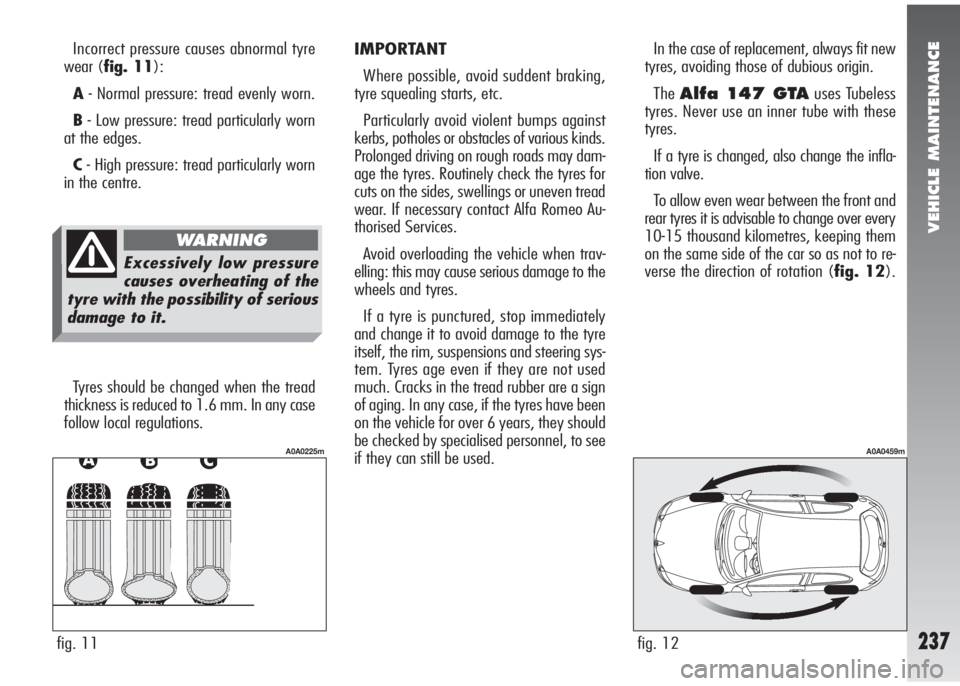
Incorrect pressure causes abnormal tyre
wear (fig. 11):
A- Normal pressure: tread evenly worn.
B- Low pressure: tread particularly worn
at the edges.
C- High pressure: tread particularly worn
in the centre.
Tyres should be changed when the tread
thickness is reduced to 1.6 mm. In any case
follow local regulations.
fig. 11
A0A0225m
IMPORTANT
Where possible, avoid suddent braking,
tyre squealing starts, etc.
Particularly avoid violent bumps against
kerbs, potholes or obstacles of various kinds.
Prolonged driving on rough roads may dam-
age the tyres. Routinely check the tyres for
cuts on the sides, swellings or uneven tread
wear. If necessary contact Alfa Romeo Au-
thorised Services.
Avoid overloading the vehicle when trav-
elling: this may cause serious damage to the
wheels and tyres.
If a tyre is punctured, stop immediately
and change it to avoid damage to the tyre
itself, the rim, suspensions and steering sys-
tem. Tyres age even if they are not used
much. Cracks in the tread rubber are a sign
of aging. In any case, if the tyres have been
on the vehicle for over 6 years, they should
be checked by specialised personnel, to see
if they can still be used.In the case of replacement, always fit new
tyres, avoiding those of dubious origin.
The
Alfa 147 GTAuses Tubeless
tyres. Never use an inner tube with these
tyres.
If a tyre is changed, also change the infla-
tion valve.
To allow even wear between the front and
rear tyres it is advisable to change over every
10-15 thousand kilometres, keeping them
on the same side of the car so as not to re-
verse the direction of rotation (fig. 12).
fig. 12
A0A0459m
Excessively low pressure
causes overheating of the
tyre with the possibility of serious
damage to it.
WARNING