belt Alfa Romeo 156 2005 Owner handbook (in English)
[x] Cancel search | Manufacturer: ALFA ROMEO, Model Year: 2005, Model line: 156, Model: Alfa Romeo 156 2005Pages: 357, PDF Size: 5.04 MB
Page 40 of 357
GETTING TO KNOW YOUR CAR38
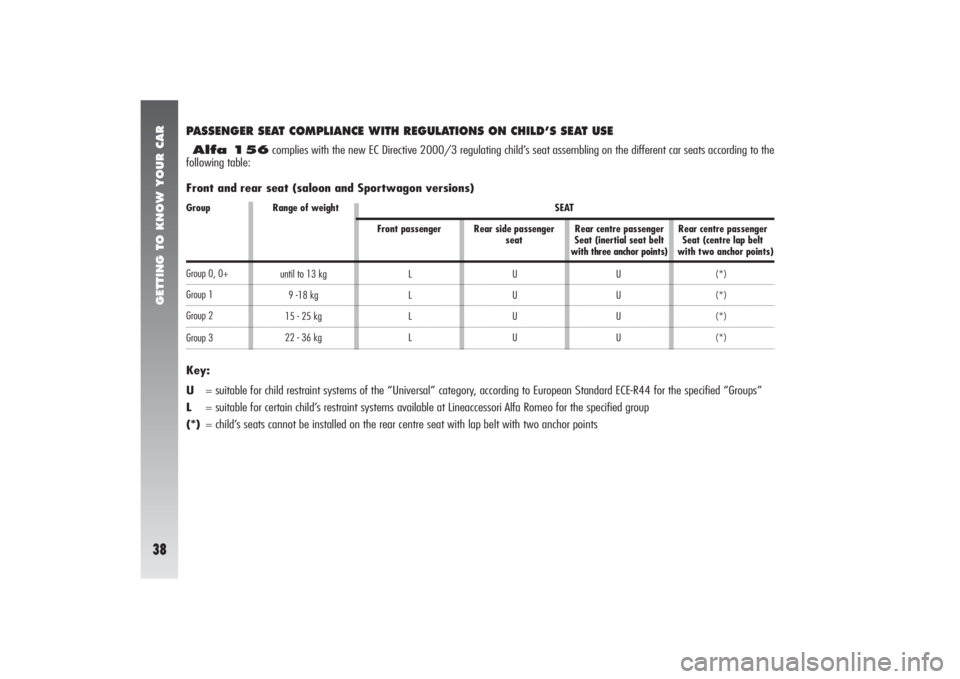
Group 0, 0+Group 1Group 2Group 3 PASSENGER SEAT COMPLIANCE WITH REGULATIONS ON CHILD’S SEAT USEAlfa 156complies with the new EC Directive 2000/3 regulating child’s seat assembling on the different car seats according to the
following table:
Front and rear seat (saloon and Sportwagon versions)
Key:
U= suitable for child restraint systems of the “Universal” category, according to European Standard ECE-R44 for the specified “Groups”
L= suitable for certain child’s restraint systems available at Lineaccessori Alfa Romeo for the specified group
(*)= child’s seats cannot be installed on the rear centre seat with lap belt with two anchor points
U
U
U
U(*)
(*)
(*)
(*) U
U
U
U L
L
L
L until to 13 kg
9 -18 kg
15 - 25 kg
22 - 36 kg
Group Range of weight SEAT
Front passenger Rear side passenger Rear centre passenger Rear centre passenger
seat Seat (inertial seat belt Seat (centre lap belt
with three anchor points) with two anchor points)
Page 41 of 357
GETTING TO KNOW YOUR CAR39
4)Always pull the tape to check that the
belts are buckled.
5)All restraint systems are strictly for one
child only: never use for two children at the
same time.
6)Always make sure that the belts do not
rest on the child’s neck.
7)During the journey, do not allow the
child to stay in abnormal positions or release
the belts.
8)Do not carry children in your arms, not
even small babies. No-one, however strong,
can keep hold of them in a crash.
9)In the case of accidents, replace the
child’s seat with a new one.
PRESETTING FOR INSTALLING
THE “ISOFIX TYPE” CHILD
RESTRAINT SYSTEMThe car is created preset for mounting the
Isofix type child restraint system. Isofix is
a new European standardised system for car-
rying children. Isofix type child restraint sys-
tem is an additional option that does not
prevent from using traditional child restraint
systems. Isofix type child restraint system
covers three weight groups: 0, 0+ and 1.
Due to its different anchoring system, the
Isofix type child’s seat should be anchored
using only the proper brackets provided for
the purpose in the car.
It is possible to mount both the traditional
restraint system and the Isofix type one, one
on the left and the other on the right, for ex-
ample.
Since sizes are different, it is possible to
install max two Isofix type child's seats us-
ing the proper couplings on the rear seat
or three traditional child's seats using the
seat belts. On the front passenger seat it is
possible to mount only traditional child's
seats. Below is a summary of the safety
rules to be observed when carry-
ing children:
1)The recommended position for in-
stalling a child’s seat is on the rear seat, as
it is the most protected in the event of a
crash.
2)If the passenger’s air bag is deactivated
always check that deactivation has taken
place through the special warning light
F
.
3)Carefully follow the instructions pro-
vided with the child’s seat, which the sup-
plier is obliged to attach. Keep them in the
car together with the documents and this
booklet. Do not use used seats without the
instructions for use.
If a passenger’s air bag is
installed, children should
never travel on the front seat.
WARNING
Page 43 of 357

GETTING TO KNOW YOUR CAR41
For proper installation proceed as follows:
– check whether the release lever (B-
fig. 61) is at rest position (inward)
– find the presetting brackets (A), then
position the child’s seat with the fastening
devices (C) aligned with the brackets
– push the child restraint system until hear-
ing the locking clicks.As the child grows up, passing to weight
group 1the child’s seat should be mounted
facing forwards (running direction).
Installation of the seat for
weight group 1
For proper installation proceed as follows:
– check whether the release lever (B-
fig. 62) is at rest position (inward);
– find the presetting brackets (A), then
position the child’s seat with the fastening
devices (C) aligned with the brackets;
– push the child restraint system until hear-
ing the locking clicks.
If the Isofix type seat is positioned facing
backwards, the passenger’s seat must be
positioned completely back until touching
the child’s seat back. Installation of the seat for
the 0 and 0+ groups
For children of the 0, 0+weight group,
the child’s seat is facing backwards (babies
up to 13 kg) and the child is restrained by
the child’s seat belts (D-fig. 61).
fig. 61
A0B0400m
fig. 62
A0B0401m
Page 44 of 357
GETTING TO KNOW YOUR CAR42
FRONT AND SIDE
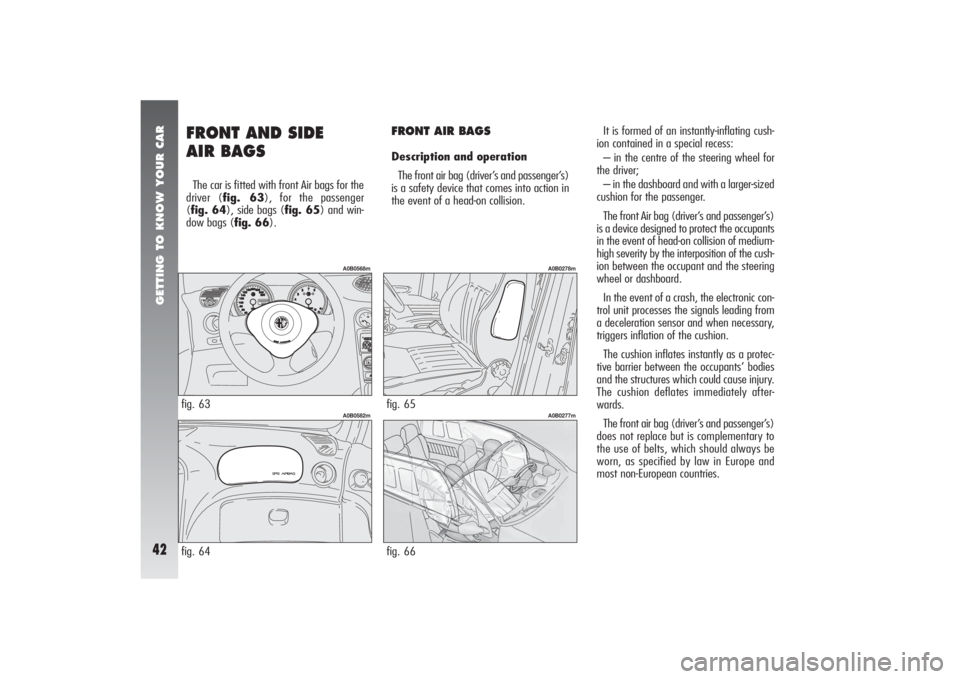
AIR BAGS The car is fitted with front Air bags for the
driver (fig. 63), for the passenger
(fig. 64), side bags (fig. 65) and win-
dow bags (fig. 66).
FRONT AIR BAGSDescription and operation
The front air bag (driver’s and passenger’s)
is a safety device that comes into action in
the event of a head-on collision.It is formed of an instantly-inflating cush-
ion contained in a special recess:
– in the centre of the steering wheel for
the driver;
– in the dashboard and with a larger-sized
cushion for the passenger.
The front Air bag (driver’s and passenger’s)
is a device designed to protect the occupants
in the event of head-on collision of medium-
high severity by the interposition of the cush-
ion between the occupant and the steering
wheel or dashboard.
In the event of a crash, the electronic con-
trol unit processes the signals leading from
a deceleration sensor and when necessary,
triggers inflation of the cushion.
The cushion inflates instantly as a protec-
tive barrier between the occupants’ bodies
and the structures which could cause injury.
The cushion deflates immediately after-
wards.
The front air bag (driver’s and passenger’s)
does not replace but is complementary to
the use of belts, which should always be
worn, as specified by law in Europe and
most non-European countries.
fig. 63
A0B0568m
fig. 64
A0B0582m
fig. 65
A0B0278m
fig. 66
A0B0277m
Page 45 of 357
GETTING TO KNOW YOUR CAR43
In the event of a crash a person that is not
wearing the seat belt moves forwards and
may come into contact with the cushion
while it is still opening. Under these cir-
cumstances the protection offered by the
cushion is reduced.
Front air bags are designed to protect car’s
occupants in front crashes and therefore non-
activation in other types of collisions (side
collisions, rear-end shunts, roll-overs, etc…)
is not a system malfunction.
In collisions against highly deformable or
mobile objects (road signposts, heaps of ice
or snow, etc.), rear collisions (hit from be-
hind by another vehicle), side collisions,
wedging under other vehicles or protective
barriers (for example under a lorry or guard
rail) cutting in of the air bag is not activated
as it does not offer any more protection than
the seat belts therefore activation would be
inappropriate.
Therefore the failure to be triggered does
not mean that the system is not working
properly.
PASSENGER’S FRONT
AIR BAGThe passenger’s front air bag has been de-
signed to improve the protection of a per-
son wearing a seat belt.
Its volume at maximum inflation fills most
of the space between the dashboard and the
passenger.
SERIOUS DANGER:
The car is fitted
with front passenger’s air bag.
Never place cradle child’s seats on
the front passenger seat of cars
equipped with passenger air bag
since the air bag activation could
cause serious injuries, even mortal.
In the case of need, always deac-
tivate the passenger’s air bag
when a child’s seat is placed on the
front seat. The front passenger
seat shall be adjusted in the most
backward position to prevent any
contact between child’s seat and
dashboard. Even if not ruled by
law, for better protection of adults
you are recommended to reactivate
the air bag immediately as soon as
child transport is no longer neces-
sary.
WARNING
Please don’t apply stickers
or other objects to the
steering wheel, to the air-bag
cover on the passenger's side or on
the side roof lining to the uphol-
stery on the roof side. Don’t place
objects on the dashboard passen-
ger’s side (such as mobile phones)
because they could tamper with the
correct opening of the passenger’s
air-bag and than cause serious in-
juries to the vehicle occupants.
WARNING
Page 47 of 357
GETTING TO KNOW YOUR CAR45
The bags inflate instantaneously, setting
themselves between the body of the front
passengers and the car door. The bags de-
flate immediately afterwards.
In the event of minor side crashes (for
which the restraining action of the seat belts
is sufficient), the air bags are not deployed.
Also in this case it is of vital importance to
wear the seat belts since in case of side
crash they guarantee proper positioning of
the occupant and prevent the occupant to
be pitched out of the car in case of violent
crashes.
Therefore the side air bags do not replace
but are complementary to the use of belts,
which you are recommended to always
wear, as specified by law in Europe and most
non-European countries.
Operation of the side air bags and window
bags is not disabled by the front air bag de-
activation switch, as described in the previ-
ous paragraphs.WARNINGThe front and/or side air
bags may be activated if the car is subjected
to heavy shocks or accidents that involve the
underbody area, such as for example violent
bumps against steps, pavements or fixed ob-
stacles on the ground, falling into big holes
or bumpy roads.WARNINGThe triggering of air bags re-
leases a small amount of powder. This pow-
der is not harmful and does not indicate a
start of fire; also the surfaces of the de-
ployed bag and the car interior may be cov-
ered with dusty residue: this may irritate the
skin and eyes. In the event of exposure,
wash with neutral soap and water. WARNINGIn the event of side crash,
you can obtain the best protection by the
system keeping a correct position on the
seat, thus allowing correct window bag un-
folding.
The airbag system has a validity of 14
years for the pyrotechnic charge and 10
years for the coil contact (see the plate lo-
cated on the front left door near the lock).
Contact Alfa Romeo Authorized Services
for replacement as these dates approach.
Never rest head, arms and
elbows on the door, on the
windows and in the window bag
area to prevent possible injuries
during the inflation phase.
WARNING
Never lean head, arms and
elbows out of the window.
WARNING
Page 49 of 357
GETTING TO KNOW YOUR CAR47
You are reminded that
when the ignition key is
engaged and in the MAR position,
the Air bags can be triggered also
on a stationary vehicle, if it is
bumped by another moving vehi-
cle. Therefore, even with the car
stationary, never allow children on
the front seat. You are also re-
minded that with the car station-
ary, without the key engaged and
turned, the Air bags are not trig-
gered in the event of an impact; in
this case the failure to trigger the
air bags should not be considered
a system failure.
WARNING
Turning the ignition key to
MAR the
F
warning light
(with the passenger’s front Air bag
deactivation switch at ON) turns
on for about 4 seconds, and then
flashes for another 4 seconds to
remind that the passenger’s Air
bag and corresponding side Air
bags will be activated in the event
of a crash, then it goes off.
WARNING
Do not wash the seat back
with pressurised water or
steam (by hand or at automatic
seat washing stations).
WARNING
The front Air bags are de-
signed to be triggered for
heavier crashes than the preten-
sioners. It is therefore normal for
the pretensioners only to be trig-
gered for crashes within the two
activation thresholds.
WARNING
Do not hook rigid objects to
the coat hooks and to the
support handles.
WARNING
The air bag does not re-
place the seat belts, but in-
creases their effectiveness. Addi-
tionally, as the front air bags are
not triggered for head-on collision
at low speed, side crashes, crashes
from behind or overturning, in
these cases the occupants are pro-
tected only by the seat belts, which
must, therefore, always be fas-
tened.
WARNING
Page 98 of 357

GETTING TO KNOW YOUR CAR96
<
SEAT BELTS NOT FASTENEDThe warning light on the check panel will turn on for some seconds when, with the ignition key at
MAR, the driver’s seat belt is not fastened properly.
Warning lightMessage
on displayv
LOW OIL PRESSUREWhen the ignition key is turned to MAR, the warning light on the check panel comes on but
must go out as soon as the engine is started.
w
LOW BATTERY CHARGEWhen the ignition key is turned to MAR, the warning light on the check panel comes on, but must
go out as soon as the engine is started (a slight delay is permitted when the engine is running at
idle). It if stays on, contact Alfa Romeo Authorized Services immediately.
If the warning light
v
comes on when travelling (together with
the message + symbol shown on the display), switch the engine off im-
mediately and contact Alfa Romeo Authorized Services.WARNING
Page 194 of 357
CORRECT USE OF THE CAR
192
SAFE DRIVINGIn designing your Alfa 156, Alfa
Romeo has worked thoroughly to achieve a
vehicle able to offer top levels of safety to
its passengers. However, the behaviour of
the driver is still a decisive factor for road
safety.
Below you will find a few simple rules for
travelling safely under different conditions.
You are certainly familiar with many of them
but it is still helpful to read them all care-
fully.BEFORE DRIVING OFF– Make sure the lights and headlights are
working properly.
– Adjust the seat, steering wheel and
rearview mirrors, in order to obtain a correct
position for driving.
– Adjust the seat back upright and keep
your head as close as possible to the head
restraint.– Carefully adjust the headrests so that
the head and not the neck rests on them.
Check that nothing (mats, etc.) can get un-
der the foot pedals.
– Make sure that any child restraint sys-
tem (seats, cradles, etc.) are correctly fas-
tened on the rear seat.
– Place any objects in the boot with care
to prevent abrupt braking from throwing
them forwards.
– Avoid heavy meals before a journey. A
light meal will help to keep reflexes ready.
Above all avoid alcohol.
Routinely remember to check:
– tyre pressure and conditions;
– engine oil level;
– engine coolant level and system condi-
tions;
– brake fluid level;
– power steering oil level;
– windscreen washer fluid level.
WHEN TRAVELLING– The first rule for safe driving is care.
– Care also means being able to predict
the actions of other road users.
– Strictly respect the traffic regulations in
all countries, especially the speed limits.
– Ensure that both yourself and your pas-
sengers are wearing their seat belts, that
children are carried with the appropriate
seats and that any animals are in appropri-
ate compartments.
– Long distances should be trackled in
good health.
Driving under the influence
of drugs and/or some
medicines is highly dangerous for
oneself and for others.
WARNING
Page 195 of 357
CORRECT USE OF THE CAR
193
– Do not drive for long periods without a
break. During breaks get out of the vehicle
and move around a bit to shake off the
drowsiness.
– Make sure the air in the passenger com-
partment is changed constantly.
– Never coast the vehicle downhill with
the engine switched off as this eliminates
the engine braking and power steering ef-
fect thus requiring a greater effort on the
pedal and steering wheel.
NIGHT DRIVINGHere are some suggestions for night dri-
ving.
– Drive with particular care: night driving
involves a greater degree of concentration.
– Reduce speed, especially on unlit roads.
– At the first signs of drowsiness stop the
car: continuing the journey is dangerous for
yourself and others. Continue driving only
after sufficient rest.
– Maintain a greater distance from the ve-
hicle in front than in the day: it is more dif-
ficult to judge the speed of the vehicle when
only the lights can be seen.
– Ensure that the headlights are correctly
aligned: if they are too low, visibility is re-
duced and eyesight is tired. If they are too
high they may cause disturbance to other
road users.
– Use the main beams only outside built-
up areas and only when you are certain that
other drivers are not disturbed by their use.
– When meeting vehicles coming in the
opposite direction, switch off the main
beams and drive with the dipped-beam
headlights on.
– Keep headlights and lights clean.
– Outside built-up areas take care of ani-
mal crossings.
Always fasten the front
and rear seat belts includ-
ing those of any child’s seat. Trav-
elling without seat belts increases
the risks of serious injury or even
death in the event of an accident.
WARNING
Take care when fitting ad-
ditional spoilers, alloy
wheels and wheel caps: they might
reduce ventilation of the brakes,
thus their efficiency, during abrupt
and repeated braking, or long
downhill slopes.
WARNING
Never drive with objects
on the floor in front of the
driver’s seat: they might get stuck
under the pedals making it impos-
sible to accelerate or brake.
WARNING
Make sure any mats are
appropriate in size: even a
slight inconvenience to the braking
system may require a higher pedal
stroke than normal.
WARNING
Water, ice and salt on the
roads may deposit on the
brake discs, reducing the effec-
tiveness of the brakes the first
time they are used.
WARNING