ABS Alfa Romeo 156 2006 Owner handbook (in English)
[x] Cancel search | Manufacturer: ALFA ROMEO, Model Year: 2006, Model line: 156, Model: Alfa Romeo 156 2006Pages: 357, PDF Size: 5.04 MB
Page 161 of 357
GETTING TO KNOW YOUR CAR
159
If the indicator light re-
mains flashing, contact the
Alfa Romeo Authorized
Service Centers as soon as possi-
ble to remove the fault.
If a fault is indicated when the engine is
started, this means that the gearbox control
system had detected and memorised a fault
during the journey prior to switching the en-
gine off. In this case, too, contact Alfa
Romeo Authorized Services to have the au-
tomatic gearbox checked over.It is possible to engage reverse gear.
ACOUSTIC WARNINGThis comes into operation for about 18 sec-
onds when:
– the driver’s door is open and/or the en-
gine is off with the selector lever in a posi-
tion other than P;
– position R(reverse) is engaged.PUSH STARTINGStarting the car by pushing or towing is not
possible. In the event of an emergency,
when the battery is flat, start the car with
a suitable emergency battery, following the
instructions given in the chapter “In an emer-
gency”.
When driving with a faulty
gearbox, drive with the ut-
most care considering the restricted
performance levels (in terms of ac-
celeration and speed) the car can
offer.
WARNING
When travelling with a
faulty gearbox, the reverse
lock might not work: absolutely
never move the lever to position
R with the car on the move.
WARNING
Page 168 of 357
GETTING TO KNOW YOUR CAR
166
ACCESSORIES
PURCHASED
BY THE OWNERIf, after purchasing your car, you want to
install electric accessories that require per-
manent power supply (burglar alarm, voice
function, radionavigator with satellite bur-
glar alarm, etc.) or other accessories that af-
fect the vehicle’s electric load, contact Alfa
Romeo Authorized Services, whose qualified
staff is able to recommend the most suitable
equipment of the Lineaccessori Alfa Romeo,
and also assess the electric absorption of the
same, checking if the vehicle can withstand
the required load or if a battery of greater
power must be used.
TELEPHONE
PROVISION(on request for versions/
markets where applicable)
On request for versions/markets where
applicable, the car may be fitted with a pro-
vision for the installation of a cellular tele-
phone.
This provision comprises:
– sound system two-function aerial + cel-
lular phone;
– supply and connection cables with spe-
cific connector for voice kit connection.
The voice kit must be pur-
chased separately by the
customer, since it has to be
compatible with the customer’s
own cellular phone.
For the installation of the
cellular phone and connec-
tion to the provision in the
car, contact only Alfa Romeo Au-
thorized Services; this will guar-
antee first-rate results with no
possibility of any inconvenience
that may compromise the safety of
the vehicle.
fig. 154
A0B0252m
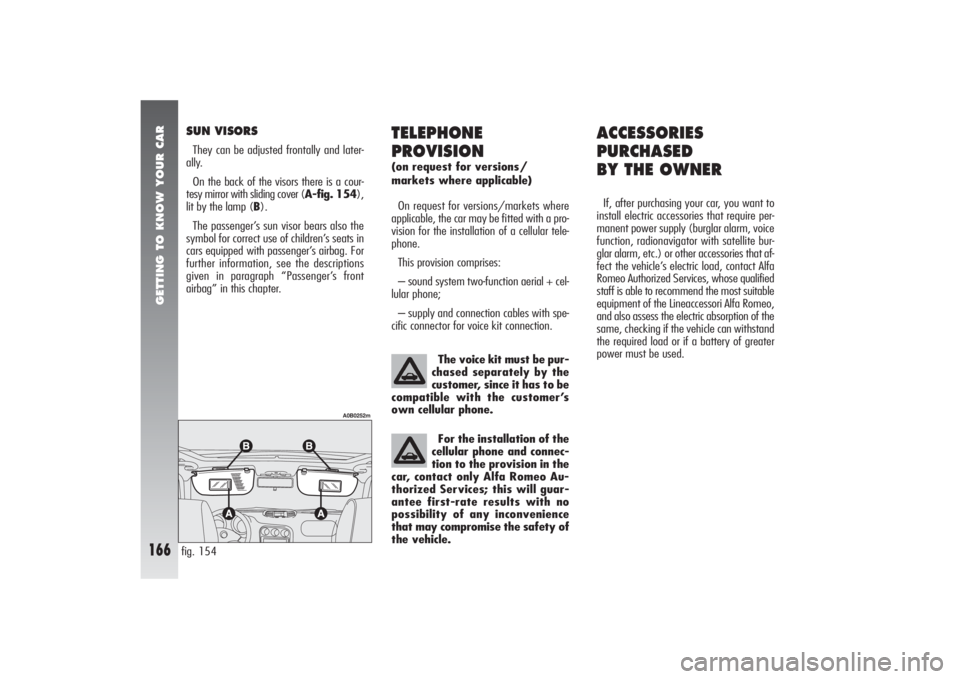
SUN VISORSThey can be adjusted frontally and later-
ally.
On the back of the visors there is a cour-
tesy mirror with sliding cover (A-fig. 154),
lit by the lamp (B).
The passenger’s sun visor bears also the
symbol for correct use of children’s seats in
cars equipped with passenger’s airbag. For
further information, see the descriptions
given in paragraph “Passenger’s front
airbag” in this chapter.
Page 169 of 357
GETTING TO KNOW YOUR CAR
167
RADIO
TRANSMITTERS
AND CELLPHONESCellphones and other radio transmitters
(e.g. CB radios) cannot be used inside the
vehicle, unless you use a separate aerial
mounted outside the vehicle.
The transmission and reception efficiency
of this equipment may also be affected by
the shielding effect of the vehicle’s body.
SUNROOF(optional for versions/markets
where applicable)
The sunroof can only be operated when
the ignition key is in the MARposition.Do not open the sunroof
when snow or ice are on
the roof as this may dam-
age it.
The use of cellphones, CB
radios or similar inside the
passenger compartment (without
an outside aerial) produces electro-
magnetic RF fields; if these are am-
plified by the resonance inside the
passenger compartment, they may
not only result in a potential health
hazard, or poor functioning of the
electronic systems such as engine
control units, ABS/EBD control
units, etc., fitted to the vehicle, but
also put the safety of your vehicle
in jeopardy.
WARNING
Improper use of the sunroof
can be dangerous. Before
and while operating it, always
make sure that the passengers are
not exposed to the risk of harm
caused either directly by the sunroof
in motion or by personal items
drawn or knocked by it.
WARNING
When leaving the vehicle,
the ignition key should al-
ways be removed to avoid acci-
dents involving the sunroof which
could be inadvertently operated by
any passenger remaining in the ve-
hicle.
WARNING
Page 179 of 357
GETTING TO KNOW YOUR CAR
177
DIPPED BEAM HEADLIGHT
AIMING FOR LEFT-HAND/
RIGHT-HAND DRIVING(only for versions with gas
discharge headlights)
As regards cars equipped with gas dis-
charge headlights (xenon lamps)(optional
for versions/markets where applicable) with
very great lighting power, when passing
from a country with right-hand driving to one
with left-hand driving, or vice versa, it is nec-
essary to modify the orientation of the
dipped beam headlights, to optimize the il-
lumination of the road edge and avoid daz-
zling the vehicles coming from the opposite
direction.
To have this operation
carried out, contact Alfa
Romeo Authorized Ser-
vices.
When you go back to your
country of origin, remem-
ber to have the dipped beam head-
light orientation modified again.
WARNING
In the event of a failure, though being un-
able to rely on the antilock effect, there is
absolutely no adverse effect on vehicle brak-
ing performance in terms of braking capac-
ity.
If you have never used a car with ABS be-
fore, you are advised to learn how to use
it with a few preliminary trials on a slippery
surface, naturally under safety conditions
and fully adhering to the Highway Code of
the country concerned. You are also advised
to carefully read the following information.
The advantage of the ABS compared with
the conventional system is that it makes it
possible to maintain maximum vehicle han-
dling performance also in the case of hard
braking under grip limit conditions, avoiding
wheel lock.
Do not however expect the braking dis-
tance always to be reduced with the ABS
system: for example, on soft surfaces such
as gravel or fresh snow on slippery surfaces,
the distance might increase.
ABSThe car is fitted with an ABS system which
prevents wheel lock when braking, better
exploits wheel grip and keeps the vehicle
controllable within the limits of the available
grip also during emergency braking.
The driver can feel that the ABS is opera-
tional by a light pulsing of the brake pedal,
accompanied by noise.
This should not interpreted as malfunc-
tioning of the brakes, but it is the signal to
the driver that the ABS system is working:
it is the warning that the car is travelling at
the limit of grip an that, therefore, it is nec-
essary to adapt the speed to the type of road
on which you are travelling.
The ABS system is an additional part of the
basic braking system; in the event of a fault
it is disabled, leaving the braking system
in the same conditions as a car without ABS.
Page 180 of 357

GETTING TO KNOW YOUR CAR
178
Braking on corners always requires the ut-
most caution, even with the help of the ABS.
The most important piece of advice, how-
ever, is the following:Following these instructions you will be
in a condition to obtain peak braking per-
formance at all times.
WARNINGCars fitted with ABS must
only be fitted with wheel rims, tyres and
brake linings of the type and brand approved
by the Manufacturer.
The braking system is completed by the
electronic control braking distribution system
called EBD(Electronic Braking Force Dis-
tributor) which distributes the braking action
through the ABSsystem control unit and
sensors.
In the event of a system
fault, with lighting up of
the
>
warning light on the instru-
ment cluster (together with the
message + symbol shown by the
display), have the vehicle checked
immediately by Alfa Romeo Au-
thorized Services, driving slowly
to be able to regain full system
performance.
WARNING
When the ABS cuts in and
you feel the pedal pulse, do
not reduce the pressure, but keep
the brake pedal firmly pressed
with no fear; this way you will
stop in the shortest possible space,
compatibly with the conditions of
the road surface.
WARNING
The car is fitted with an
electronic brake distributor
(EBD). If the
>
and
x
warning
lights, where required, come on at
the same time (together with the
message + symbol shown by the
display) when the engine is run-
ning, there is an EBD system fault;
in this case, violent braking may
lock the rear wheels too early, with
the possibility of skidding. Drive
extremely carefully to the nearest
Alfa Romeo Authorized Services to
have the system checked over.
WARNING
In order to be able to exploit as far as pos-
sible the possibility of the antilock system
in the case of need, it is wise to follow a few
pieces of advice:
The ABS exploits the avail-
able grip in full, but it can-
not increase it; therefore, caution
is required on slippery surfaces,
without running unnecessary risks.
WARNING
If the ABS cuts in, it means
that the grip limit between
the tyres and the road surface has
been reached: it is necessary to
slow down and adapt driving to
the grip available.
WARNING
Page 181 of 357
GETTING TO KNOW YOUR CAR
179
If the
x
low brake fluid
warning light comes on (to-
gether with the message + symbol
shown by the display), stop the car
immediately and contact the near-
est Alfa Romeo Authorized Ser-
vices. Indeed, any leak of fluid
from the hydraulic system com-
promises the effectiveness of both
the conventional brake system and
the system with antilock system.
WARNING
The turning on of the
>
warning light (together
with the message + symbol shown
by the display) with the engine
running normally indicates an ABS
system fault. In this case the brak-
ing system preserves its effec-
tiveness, without however making
use of the antilock device. Under
these circumstances, the EBD sys-
tem may fail to give top perfor-
mance. In this case, too, you are
recommended to contact Alfa
Romeo Authorized Services imme-
diately, driving in such a way as to
avoid abrupt braking, to have the
system checked.
WARNING
VDC AND ASR
SYSTEMS(where required)VDC SYSTEM (VEHICLE
DYNAMICS CONTROL):
GENERALThe VDC is an electronic vehicle stability
control system which, acting on the torque
and braking the wheels in a differentiated
manner, helps to bring the car back to the
correct course in the event of loss of grip.
While travelling the car is subjected to lat-
eral and longitudinal forces that may be
controlled by the driver up to when the
tyres offer adequate road-holding; when
this falls below the minimum level, the car
starts to deviate from the course required
by the driver.
Above all on rough surfaces (such as cob-
bles, or due to the presence of water, ice
or soil), changes in speed (when accelerat-
ing or braking) and/or course (bends or the
need to avoid obstacles) can cause the tyres
to lose grip.When the sensors detect the conditions
that would lead to skidding, the VDC system
acts on the engine and brakes generating
a stabilising torque.
The system performance
levels, in terms of active
safety, should not induce the dri-
ver to run pointless and unjustified
risks. Driving conduct should al-
ways be suited to the conditions of
the road surface, vision and traf-
fic. The responsibility for road
safety is always and anyway the
vehicle driver’s concern.
The VDC system helps the driver
to keep control of the car in the
event of loss of tyre grip.
The forces induced by the VDC sys-
tem to control the lack of stability
of the car always and anyway de-
pend on the grip between the tyre
and the road surface.
WARNING
Page 182 of 357

GETTING TO KNOW YOUR CAR
180
The heart of the VDC system is the VDC
control unit which with the data supplied by
the sensors installed on the car, calculates
the centrifugal forces generated when the
car is cornering. The yawing sensor detects
the rotations of the car around its own ver-
tical axis. The centrifugal forces generated
when the car is cornering are detected by
a highly sensitive lateral acceleration sensor.
The stabilising action of the VDC system is
based on calculations made by the
system’s electronic control unit which
processes the signals received from the
steering wheel rotation, lateral acceleration
and individual wheel rotation sensors. These
signals allow the control unit to recognise
the manoeuvre the driver intends to do
when turning the steering wheel.
The control unit processes the information
received from the sensors and is therefore
capable of detecting the position of the car
and comparing it with the trajectory the dri-
ver would like to follow instant by instant.
In the event of a discrepancy, the control
unit chooses and commands the most suit-
able action to bring the car back to the re-
quired course within a fraction of a second:
braking one or more wheels at a different
braking force and, if necessary it reduces the
power transmitted by the engine. The corrective actions are changed and con-
trolled continuously until the car returns to
the required course.
The action of the VDC system considerably
increases the active safety of the vehicle un-
der many critical situations and it is partic-
ularly useful also when the road surface grip
conditions change.
For the VDC, ASR and ABS
systems to work correctly,
the tyres must be of the same
brand and type on all wheels, in
perfect conditions and above all of
the specified type, brand and size.
WARNING
During use of the compact
spare wheel, the VDC sys-
tem continues working. It should be
borne in mind that the spare wheel
is smaller than a normal tyre,
therefore its grip is lower than that
of the other tyres of the car.
WARNING
VDC SYSTEM OPERATIONThe VDC system turns on automatically
when the car is started and cannot be
switched off. It is however possible to cut
off operation of the ASR system pressing the
corresponding button on the centre console.
The main components of the VDC system
are:
– an electronic control unit which
processes the signals received from the var-
ious sensors and brings about the most ap-
propriate strategy;
– a sensor that detects the position of the
steering wheel;
– four sensors that detect the rotation
speed of each wheel;
– a sensor that detects rotation of the car
around the vertical axis;
– a sensor that detects lateral acceleration
(centrifugal force).
Page 185 of 357
GETTING TO KNOW YOUR CAR
183
SOUND SYSTEM(where applicable)
The fixed sound system, with cassette
player (radio with cassette player) or CD
player with parametric sound equalizer (ra-
dio with CD player) has been designed to
suit the specific characteristics of the pas-
senger compartment, with a personalised
design that matches the style of the dash-
board. The sound system instructions for use
are described in the attached supplement.
SOUND SYSTEM
PRESETTING SYSTEM(for versions/markets where
applicable)
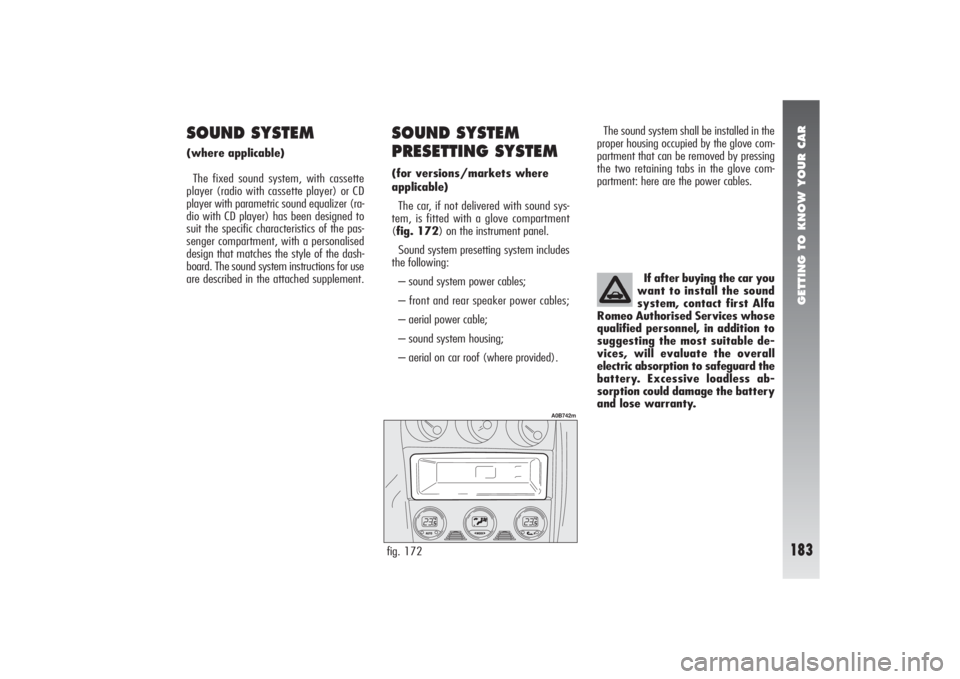
The car, if not delivered with sound sys-
tem, is fitted with a glove compartment
(fig. 172) on the instrument panel.
Sound system presetting system includes
the following:
– sound system power cables;
– front and rear speaker power cables;
– aerial power cable;
– sound system housing;
– aerial on car roof (where provided).The sound system shall be installed in the
proper housing occupied by the glove com-
partment that can be removed by pressing
the two retaining tabs in the glove com-
partment: here are the power cables.
If after buying the car you
want to install the sound
system, contact first Alfa
Romeo Authorised Services whose
qualified personnel, in addition to
suggesting the most suitable de-
vices, will evaluate the overall
electric absorption to safeguard the
battery. Excessive loadless ab-
sorption could damage the battery
and lose warranty.fig. 172
A0B742m
Page 191 of 357

CORRECT USE OF THE CAR
189
PROCEDURE FOR PETROL
ENGINESWARNINGIt is important not to press
the accelerator until the engine has started.
1) Make sure the handbrake is engaged.
2)Move the gear lever to neutral.
3)Fully depress the clutch pedal so that
the starter motor is not forced to crank the
toothed wheels of the gearbox.
4)Ensure that the systems and electrical
devices, especially if they absorb high quan-
tities of energy (e.g. heated rear wind-
screen) are switched off.
5)Turn the ignition to the AV Vposition
and release it as soon as the engine starts.
6)If the engine does not start, return the
key to the STOPposition and repeat the
operation.
WARNINGIf it is difficult to start the en-
gine do not insist with extended attempts
which may damage the catalyzer but con-
tact Alfa Romeo Authorized Services. The ignition switch is fitted with a safety
device which obliges the driver to return the
ignition key to the STOPposition before re-
peating the starting operation if the engine
does not start immediately.
Similarly, when the engine is running, the
device prevents the key being moved from
the MARto the AV Vposition.
STARTING
THE ENGINEWARNINGThe car is fitted with an elec-
tronic engine lock device. If the engine fails
to start see “Alfa Romeo CODE system”.
C C
O O
R R
R R
E E
C C
T T
U U
S S
E E
O O
F F
T T
H H
E E
C C
A A
R R
In addition to the notes
and specifications given be-
low we recommend that,
during the initial period, you do not
drive to full vehicle performance
(for example excessive accelera-
tion, long journeys at top speed,
hard braking, etc.).
To avoid useless con-
sumption of power and
possible draining the bat-
tery, never leave the ignition key
in the MAR position when the en-
gine is not running.
Running the engine in con-
fined areas is extremely
dangerous. The engine consumes
oxygen and produces carbon
monoxide which is a highly toxic
and lethal gas.
WARNING
Page 193 of 357
CORRECT USE OF THE CAR
191
EMERGENCY STARTINGIf the Alfa Romeo CODE system does not
recognise the code transmitted by the igni-
tion key (Alfa Romeo CODE
Y
warning
light on the instrument cluster on glowing
steadily) emergency starting may be carried
out using the code of the CODE card.
For the correct procedure see the chapter
“In an emergency”.
PARKINGWhen the vehicle is parked, proceed as fol-
lows:
– Switch off the engine.
– Engage the handbrake.
– Engage first gear if the car is facing up-
hill or reverse if the car is facing downhill.
– Turn the front wheels so that the car will
immediately come to a half if the handbrake
slips. Starting by pushing, tow-
ing or running downhill
must absolutely be
avoided. These manoeuvres may
cause fuel to flow into the catalyst
and damage it irreparably.
To avoid useless con-
sumption of power and
possible draining the bat-
tery, never leave the ignition key
in the MAR position when the en-
gine is not running.
For vehicles equipped
with turbocharger in par-
ticular and for other vehi-
cles in general, revving the engine
before switching off should be
avoided.
Revving the engine serves no pur-
pose and consumes fuel for no rea-
son. It may also cause damage to
the bearings on the rotor of the
turbocharger.
WARNINGIf the engine turns off with
the car on the move, the next time it is
started, the Alfa Romeo CODE warning lightY
may turn on. In this case, check that
switching off and starting the engine again
with the car stationary, the warning light
stays off. If not, contact Alfa Romeo Au-
thorized Services.
Remember that the servo-
brake and power steering
are not activated until the engine
is started, therefore considerably
greater effort is required on the
brake pedal and steering wheel.
WARNING
Never leave children unat-
tended in the car. Always
remove the key from the ignition
when leaving the car and take it
with you.
WARNING