fuel Alfa Romeo 156 2006 Owner handbook (in English)
[x] Cancel search | Manufacturer: ALFA ROMEO, Model Year: 2006, Model line: 156, Model: Alfa Romeo 156 2006Pages: 357, PDF Size: 5.04 MB
Page 102 of 357

GETTING TO KNOW YOUR CAR
100
Warning light Message
on displaym
GLOW PLUGS (JTD engines)When the ignition key is turned to MAR, the dial warning light comes on and go out when the
glow plugs have reached the pre-established temperature.
Start the engine as soon as the warning light has gone out.
WARNINGWith a high environment temperature, the warning light may turn on for an imper-
ceptible length of time. For versions/markets where applicable, the warning light flashes for approx.
30 seconds after starting the engine, which means that there is a fault in the glow plug warming
system, contact Alfa Romeo Authorized Services.
c
WATER IN THE FUEL OIL FILTER (JTD engines)The warning light switches on with fixed light when driving, to indicate the presence of water in
the fuel oil filter.
The presence of water in the fuel circuit may cause serious damage to
the entire injection system and cause irregular engine operation. If warn-
ing light
c
comes on the dial, contact Alfa Romeo Authorized Services
as soon as possible to have the system relieved. Should the above warning in-
dication come one immediately after topping up, water has probably been poured
into the tank: turn the engine off immediately and contact Alfa Romeo Autho-
rized Services.
Page 103 of 357

GETTING TO KNOW YOUR CAR
101
Warning light Message
on display
INERTIAL FUEL CUT-OFF SWITCHThe message + symbol are shown on the display when the fuel cut-off switch comes into operation.ENGINE OIL SENSOR FAILURE (JTD versions)The message + symbol are shown on the display when there is a failure in the engine oil level
sensor. Contact Alfa Romeo Authorized Services as soon as possible to have the fault eliminated.
If, after the message has been displayed, you can smell fuel or notice
leaks from the supply system, do not re-engage the switch to avoid
the risk of fire.
WARNING
Page 106 of 357

GETTING TO KNOW YOUR CAR
104
Warning light Message
on display
SPEED LIMIT EXCEEDED The message + symbol turns on, together with the sound of the buzzer, on the display when the
vehicle exceeds the speed limit set previously (see “Speed limit” in this section).
ç
FUEL RESERVEThe warning light comes on when about 7 litres of fuel are left in the tank, and when the car
range is below 50 km.REDUCED RANGE This message is displayed when the car range is below 50 km.SCHEDULED MAINTENANCEThis message appears on the display 2,000 kilometres from the deadline given in the Scheduled
Maintenance Programme (every 20,000 km) and it is shown again at timed intervals, turning the
ignition key to MARevery 200 km.
Page 139 of 357

GETTING TO KNOW YOUR CAR
137
Inspect the care carefully to make sure that
there are no fuel leaks, for instance in the
engine compartment, under the vehicle or
near the tank area.
If no leaks are found and the vehicle can
be restarted again, press button (A) to ac-
tivate the fuel supply system.
After a collision, remember to turn the ig-
nition key to STOP so as not to run the bat-
tery down.
INERTIAL FUEL CUT-OFF
SWITCH
(fig. 119)
This is an automatic safety switch which is
triggered in the event of crash to interrupt
the flow of fuel.
The intervention of the inertial switch is in-
dicated by a message + symbol on the In-
focenter display (see “Infocenter Display”
in this chapter) and by the door unlocking.
fig. 119
A0B0574m
fig. 120
A0B0044m
OPENING THE FUEL FLAP(fig. 120)
The fuel flap is released from inside the car
raising the front part of the lever (A).
If a smell of fuel is noted
following an accident, or
the fuel system is leaking, to avoid
the risk of fire do not reset the
switch.
WARNING
Page 140 of 357

GETTING TO KNOW YOUR CAR
138
HEADLIGHT CORRECTOR (fig. 121)
If the car is fitted with xenon headlights,
beam aiming is electronic and therefore con-
trol (A) on the mask near the steering col-
umn is not present.
The headlights should be aimed correctly
depending on the vehicle load.
The control (A) on the plate at the side of
the steering column can be moved to four
positions corresponding to the vehicle loads
given below:
position 0: 1 or 2 people occupying front
seats, full fuel tank, on-board equipment pre-
sent;
position 1: 5 people on-board;fig. 121
A0B0240m
HAND BRAKE
(fig. 122)
The hand brake lever is located between
the two front seats.
To operate the brake when the vehicle is
“stationary”, pull the lever (A) upwards un-
til the required braking action is obtained.
When the ignition key is in the MARpo-
sition, the
x
warning light will come on on
the instrument panel.
fig. 122
A0B0288m
position 2: 5 people on-board, luggage
compartment full (50 kg approximately);
position 3: Driver and 300 kg in luggage
compartment.
Check the positioning of
the headlight beams every
time you change the load to be car-
ried.
WARNING
Page 157 of 357

GETTING TO KNOW YOUR CAR
155
N - Neutral
This is the neutral position to be used when
the car has to be pushed or towed.D - Automatic forward gear
This is the position to be used always un-
der “normal” driving conditions, for exam-
ple on the motorway and urban roads and
when wanting to minimise fuel consumption
(combined with the CITYdriving mode).
When the lever is in this position, the gear-
box automatically selects the four available
speeds. It is also the position to be used
for the ICEdriving mode.Shifting to lower gear
(Kick down)
In the event of the need to accelerate
heavily (e.g. for overtaking) pressing the
accelerator fully home beyond the stiff point
will cause automatic kick down to a shorter
ratio, engine speed conditions permitting.
Releasing the accelerator pedal as soon as
the stiff point has been passed, the gearbox
shifts to the optimum ratio in relation to the
driving mode, throttle opening position and
selector lever position.
The Kick-down function is advised only for
overtaking or fast accelerating to avoid in-
creasing fuel consumption.
Kick-down is cut off automatically in the
ICEdriving mode.
With the engine idling,
when moving the lever to
position N the car tends to move
even if it is on level ground: keep
the brake pedal pressed when the
lever is in position N.
WARNING
With the engine idling and
the lever in position D the
vehicle tends to move: always
keep the brake pedal pressed un-
til moving off.
WARNING
Page 158 of 357
GETTING TO KNOW YOUR CAR
156
SPORT(button (A-fig. 139)
pressed):
This is selected when wanting to avail of
the vehicle’s peak performance for sporty
driving or on demanding routes.
Driving in the SPORTmode increases fuel
consumption.
WARNINGThe CITYor SPORTdri-
ving modes can be selected under any con-
dition (vehicle stationary or on the move).
WARNINGWhen the car is started with
a cold engine, the system selects the
SPORTdriving mode, even if the CITY
mode has been selected, until the engine
reaches normal operating temperature.
C/S
ICE( button (B-fig. 133) pressed):
This driving mode is recommended when
the road surface offers poor grip (snow, ice,
etc.). Moving off takes place in 2
ndgear.
The ICEdriving mode is available only with
the selector lever at D.
Moving the lever from D, the ICEmode
is automatically cut off.
WARNINGThe ICEdriving mode can
be engaged pressing the corresponding but-
ton also with the car on the move, provided
that the speed is below 45 km/h.
ICE
SELECTING THE DRIVING
MODESThe automatic gearbox for this car is con-
trolled electronically and includes the selec-
tion of three different driving modes, thereby
giving the best response in terms of driving
comfort, consumption levels, sporty perfor-
mance and travelling safety.
The three driving modes CITY, SPORT
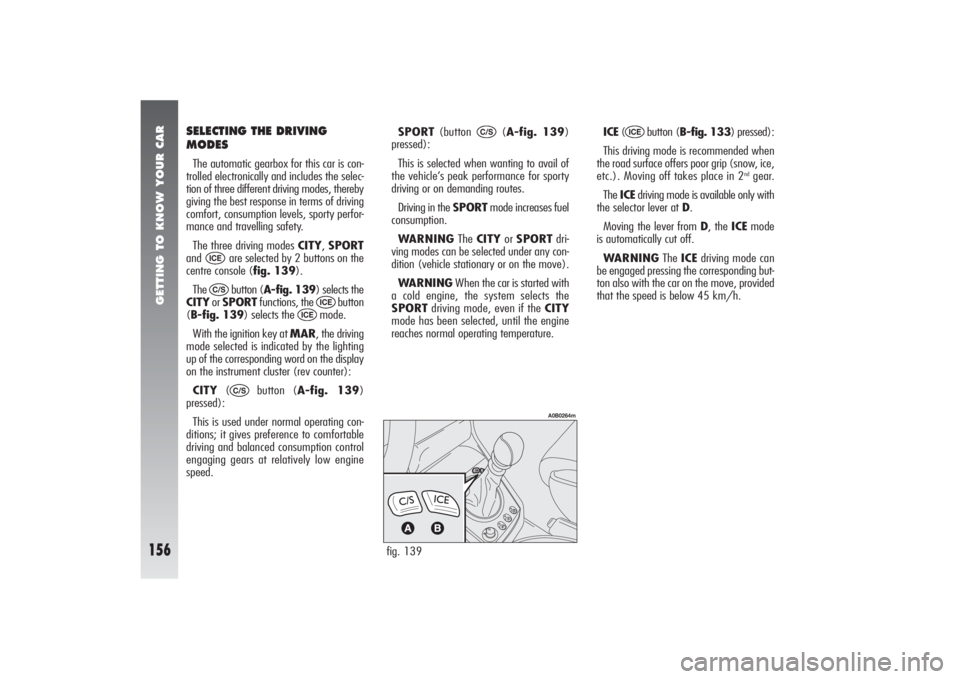
and are selected by 2 buttons on the
centre console (fig. 139).
The button (A-fig. 139) selects the
CITYor SPORTfunctions, the button
(B-fig. 139) selects the mode.
With the ignition key at MAR, the driving
mode selected is indicated by the lighting
up of the corresponding word on the display
on the instrument cluster (rev counter):
CITY( button (A-fig. 139)
pressed):
This is used under normal operating con-
ditions; it gives preference to comfortable
driving and balanced consumption control
engaging gears at relatively low engine
speed.
C/S
ICE
ICE
C/SICE
fig. 139
A0B0264m
Page 177 of 357

GETTING TO KNOW YOUR CAR
175
COMPENSATION FOR TILT(fig. 169)
If the car is fitted with xenon headlights,
beam aiming is electronic and therefore con-
trol (A) on the mask near the steering col-
umn is not present.
When the vehicle is loaded, the beam from
the headlights is raised due to the back-
wards tilt of the vehicle.
In this case the headlights must be ad-
justed using control (A) located on the plate
at the side of the steering column.This control has four positions corre-
sponding to various vehicle loads given be-
low:
– position 0: 1 or 2 people occupying
front seats, full fuel tank, on-board equip-
ment present;
– position 1: 5 people on-board;
– position 2: 5 people on-board, luggage
compartment full (50 kg approximately);
– position 3: driver and 300 kg in lug-
gage compartment.fig. 169
A0B0240m
Check the positioning of
the headlight beams every
time you change the load to be car-
ried.
WARNING
ADJUSTING THE FRONT
FOGLIGHTS (for versions/markets where
applicable)
To adjust the height of the beam of the
front foglights, act on adjusting screw (A-
fig. 170).fig. 170
A0B0239m
Contact Alfa Romeo Au-
thorized Services to have
the headlights correctly ad-
justed.
Page 187 of 357
GETTING TO KNOW YOUR CAR
185
REFUELLING PETROL ENGINESIn order to prevent the vehicle being filled
with leaded petrol, the diameter of the filler
neck is smaller than the nozzle used on
pumps delivering leaded petrol.At low temperatures, the degree of fluid-
ity of fuel oil may become insufficient due
to the formation of paraffins leading to dan-
ger of clogging the fuel oil filter.
Therefore, to avoid inconveniences, sum-
mer and winter fuel oils are normally dis-
tributed depending on the season.
However, during the intermediate season,
characterised by a large difference between
outside temperatures (0°C to 15°C), the
quality of the fuel oil distributed to the
pumps may not be adequate.
In this case, and above all if the use of the
car involves stopping and then starting again
at low temperatures (e.g. mountains),
make sure the car is filled with winter fuel
oil; if not, you are advised to mix the fuel
oil with a DIESEL MIXadditive in the pro-
portions stated on the can, pouring first the
antifreeze and then the fuel oil into the tank.
TheDIESEL MIXantifreeze should be
mixed with the fuel oil before reactions due
to cold take place. Adding it too late will
prove pointless. The anti-pollution devices
present on the vehicle im-
pose the use of four-star
unleaded fuel with an octane num-
ber (R.O.N.) above 95.
Under no circumstances
should conventional leaded
petrol be used, as this
would irreparably damage the cat-
alyst. If the tank is accidentally
filled with leaded fuel, even in
minute quantities, DO NOT START
THE ENGINE. Do not attempt to di-
lute the petrol with lead free fuel.
Drain the entire fuel circuit and
tank.
If the catalyst is not
working properly, harmful
emissions reach the ex-
haust, resulting in environment pol-
lution.The car must be refuelled
only with fuel oil for motor
vehicles, in conformity with
European specification EN590. The
use of other products or mixtures
may damage the engine irrepara-
bly, resulting in invalidation of the
warranty for the damage caused.
If the tank is accidentally filled
with another type of fuel, do not
start the engine but drain the tank.
If the engine has been run even for
a brief period, the tank must be
drained together with the entire
fuel circuit.
JTD ENGINES
Page 188 of 357

GETTING TO KNOW YOUR CAR
186
FUEL CAP
(fig. 176)
The fuel flap is released from inside the
car, raising the front part of the lever (A).
The fuel cap (A-fig. 177) has a catch
to prevent misplacing it (B) that fastens it
to the flap (C).
WARNINGThe fuel tank is sealed her-
metically and pressure may build up inside.
Any noise of rushing air when the cap is re-
moved is perfectly normal.
fig. 176
A0B0044m
fig. 177
A0B0045m
In case of need, replace
the fuel cap only with an
original one; otherwise,
the efficiency of the petrol vapour
recovery system could be badly af-
fected.
EMERGENCY FLAP OPENING
DEVICEIf the lever (A-fig. 176) fails to work,
it is still possible to open the flap by pulling
the cord (A-fig. 178) on the right-hand
side of the luggage compartment.fig. 178
A0B0388m
WARNINGFor your safety, make sure
that the fuelling pump nozzle is inserted cor-
rectly into the housing, before starting the
engine.
Do not get near the fuel
filler with naked flames or
lit cigarettes: danger of fire. Also
avoid going too near the filler with
the face to avoid inhaling harmful
vapours.
WARNING