fuel Alfa Romeo 156 2006 Owner handbook (in English)
[x] Cancel search | Manufacturer: ALFA ROMEO, Model Year: 2006, Model line: 156, Model: Alfa Romeo 156 2006Pages: 357, PDF Size: 5.04 MB
Page 190 of 357

GETTING TO KNOW YOUR CAR
188
EMISSION REDUCING DEVICES
(petrol engines)Trivalent catalytic converter
(catalytic silencer)
The exhaust system is fitted with a cat-
alyzer formed of alloys of noble metals. It
is housed in a stainless steel container which
is able to resist the high operating temper-
atures.
The catalyzer converts the unburnt hydro-
carbons, carbon monoxide and nitrogen ox-
ides present in the exhaust gas (even if in
small quantities thanks to the electronic in-
jection and ignition system) into harmless
compounds.Lambda probe
A sensor (lambda probe) measures the
content of oxygen present in the exhaust
gas. The signal transmitted by the lambda
probe is use by the injection and ignition
electronic control unit to adjust the air-fuel
mixture.
Anti-evaporation system
As it is impossible, even when the engine
is switched off, to prevent the formation of
fuel vapours, a system has been devised
which imprisons the vapours in a special ac-
tivated carbon container.
During operation of the engine, these
vapours are sucked up and sent to com-
bustion.
EMISSION REDUCING DEVICES
(JTD engines )Oxidising catalytic converter
Converts the polluting substances present
in the exhaust gases (carbon monoxide, un-
burned hydrocarbons and particulate) into
harmless substances, thus reducing the
fumes and smell that are typical of diesel
engines.
The catalytic converter consists of a stain-
less steel case that houses a ceramic hon-
eycomb body coated with noble metal used
as a catalyst.
Exhaust gas recirculation system
(E.G.R.)
This system recycles, i.e. re-uses, a vary-
ing percentage of the exhaust gases, de-
pending on engine operating conditions.
It is used, when necessary, to control ni-
tric oxides.
Due to the high tempera-
tures reached during oper-
ation of the catalytic converter, the
vehicle should not be parked over
inflammable materials (paper, fuel
oils, grass, dry leaves, etc.).
WARNING
Page 193 of 357
CORRECT USE OF THE CAR
191
EMERGENCY STARTINGIf the Alfa Romeo CODE system does not
recognise the code transmitted by the igni-
tion key (Alfa Romeo CODE
Y
warning
light on the instrument cluster on glowing
steadily) emergency starting may be carried
out using the code of the CODE card.
For the correct procedure see the chapter
“In an emergency”.
PARKINGWhen the vehicle is parked, proceed as fol-
lows:
– Switch off the engine.
– Engage the handbrake.
– Engage first gear if the car is facing up-
hill or reverse if the car is facing downhill.
– Turn the front wheels so that the car will
immediately come to a half if the handbrake
slips. Starting by pushing, tow-
ing or running downhill
must absolutely be
avoided. These manoeuvres may
cause fuel to flow into the catalyst
and damage it irreparably.
To avoid useless con-
sumption of power and
possible draining the bat-
tery, never leave the ignition key
in the MAR position when the en-
gine is not running.
For vehicles equipped
with turbocharger in par-
ticular and for other vehi-
cles in general, revving the engine
before switching off should be
avoided.
Revving the engine serves no pur-
pose and consumes fuel for no rea-
son. It may also cause damage to
the bearings on the rotor of the
turbocharger.
WARNINGIf the engine turns off with
the car on the move, the next time it is
started, the Alfa Romeo CODE warning lightY
may turn on. In this case, check that
switching off and starting the engine again
with the car stationary, the warning light
stays off. If not, contact Alfa Romeo Au-
thorized Services.
Remember that the servo-
brake and power steering
are not activated until the engine
is started, therefore considerably
greater effort is required on the
brake pedal and steering wheel.
WARNING
Never leave children unat-
tended in the car. Always
remove the key from the ignition
when leaving the car and take it
with you.
WARNING
Page 197 of 357
CORRECT USE OF THE CAR
195
DRIVING ON SNOW AND ICEHere are few suggestions for driving in
these conditions:
– Keep your speed down.
– On a snowy road, fit winter tyres or
snow chains; see the related paragraphs in
this section.
– Use exhaust brake where possible and
avoid abrupt braking.
– Avoid abrupt acceleration and changes
of direction.
– During cold weather even apparently dry
roads may be covered with occasional
patches of ice. Pay great attention therefore
when driving on roads which are in the
shade, or where rocks or trees line the road
and on which ice may persist.
– Keep further back from the vehicle in
front.
DRIVING WITH ABSThe ABS is a part of the braking system
which essentially offers two advantages:
1)It prevents wheel lock-up and conse-
quent skidding in emergency stops, partic-
ularly when the road does not offer much
grip;
2)It makes it possible to brake and steer
at the same time so you can avoid unex-
pected obstacles and direct the car where
you want while braking. The extent to which
this can be done will depend on the physi-
cal limits of the tyre’s sideways grip.
To make the most of the ABS:
– In emergency braking or when grip is
low, a slight pulsing can be felt on the brake
pedal: this means that the ABS has come
into action. Do not release the pedal, but
continue pressing it to give continuity to the
braking action.
– The ABS prevents the wheels from lock-
ing but it does not increase the physical lim-
its of grip between the asphalt and the road.
Therefore, also with a car fitted with ABS,
keep within a safety distance from the ve-
hicle in front and limit speed when ap-
proaching bends.
The ABS serves to increase car controlla-
bilty not to go faster.
REDUCING RUNNING
COSTS AND
ENVIRONMENT
POLLUTIONSome suggestions which may help you to
keep the running costs of your vehicle down
and lower the amount of toxic emissions re-
leased into the atmosphere are given below.GENERAL CONSIDERATIONSVehicle maintenance
The overalll state of the vehicle is an im-
portant factor which has a marked influence
over fuel consumption and driving comfort
and on the life span of your vehicle. For this
reason care should be taken to maintain
your vehicle by carrying out the necessary
checks and regulations in accordance with
specifications given in the “Scheduled Main-
tenance Programme” (see sections... spark
plugs, air cleaner, timing).
Page 198 of 357
CORRECT USE OF THE CAR
196
Tyres
Tyres should be checked at least every four
4 weeks: if the pressure is too low, fuel con-
sumption increases as the resistance to the
rolling movement of the tyre is higher. In
this state, tyre wear is increased
and vehicle handling suffers which will af-
fect safety.
Unnecessary loads
Do not travel with too much luggage stowed
in the boot. The weight of the vehicle (es-
pecially when driving in town) and its trim
greatly affects consumption and stability.
Luggage/ski rack
Remove luggage or ski racks from the roof
of the vehicle as soon as they are no longer
needed. These accessories reduce the aero-
dynamic penetration of the vehicle and will
increase consumption. When transporting
particularly large objects, use a trailer where
possible.Electrical devices
Use the electric devices for the necessary
time only. The heated rear window, supple-
mentary lights, windscreen wipers, heating
system blower require large amounts of en-
ergy and, increasing the request for power
also increases fuel consumption (up to
+25% when driving in built-up areas).
Air conditioner
The air conditioner is an additional load
which greatly affects the engine leading to
higher consumption (on average up to
+20%). When the temperature outside the
vehicle permits it, use the air vents where
possible.
Spoilers
The use of aerodynamic optional extras
which are not certified for the specific use
on the vehicle, may reduce the aerodynamic
penetration of the vehicle and increase con-
sumption.
STYLE OF DRIVINGStarting
Do not warm the engine when the vehicle
is stationary or at high or low revs: in this
way the engine will warm up gradually in-
creasing consumption and emissions. You
should drive off slowly straight away avoid-
ing high revs so that the engine will warm
up more quickly.
Unnecessary actions
Avoid revving the engine when stopped at
traffic lights or before switching off the en-
gine and avoid doubling the clutch as these
actions have no purpose on modern vehicles
and serve only to increase consumption and
pollution.
Gear selection
As soon as the traffic and road conditions
allow it, shift to a higher gear. Using a lower
gear to liven up acceleration greatly in-
creases consumption. In the same way, im-
proper use of the higher gears will increase
consumption, emissions and wear and tear
on the engine.
Page 199 of 357

CORRECT USE OF THE CAR
197
Top speeds
Fuel consumption increases considerably
as speed increases. For example, when ac-
celerating from 90 to 120 kph, fuel con-
sumption increases by about +30%. Your
speed should be kept as even as possible
and superfluous braking and acceleration
avoided as this increases both consumption
and emissions. A “soft” way of driving
should be adopted by attempting to antici-
pate manoeuvres to avoid imminent danger
and to keep a safe distance from the vehi-
cle in front in order to avoid braking sharply.
Acceleration
Accelerating violently increasing the revs
will greatly affect consumption and emis-
sions: acceleration should be gradual and
should not exceed the maximum torque.
CONDITIONS OF USECold starting
Short journeys and frequent cold starting
will not enable the engine to reach optimal
running temperature. It follows therefore
that consumption will be higher (from +15%
to +30% in built-up areas) as will the pro-
duction of toxic emissions.
Traffic and road conditions
Heavy traffic and higher consumption are
synonymous; for example, when driving
slowly with frequent use of lower gears or
in large towns where there are numerous
traffic lights.
Winding roads, mountain roads and
bumpy roads also have a negative effect on
consumption.
Enforced halts
During prolonged hold-ups (traffic lights,
level crossings) the engine should be
switched off.
ECONOMY AND
ENVIRONMENT-
FRIENDLY DRIVINGEnvironment protection is one of the prin-
ciples that guided the development of your
Alfa 156.
It is not merely by chance that its antipol-
lution devices obtain results far beyond those
specified by current regulations.
The environment, however, still needs the
utmost care from all of us.
By following few simple rules it is possible
to avoid damage to the environment and
very often at the same time to limit fuel con-
sumption. On this subject we are giving
some helpful suggestions to be added to
those marked with the
#, in various points
of this manual.
Kindly read them all carefully.
Page 200 of 357
CORRECT USE OF THE CAR
198
PROTECTING EMISSION
REDUCING DEVICESCorrect operation of the antipollution de-
vices not only guarantees respect for the en-
vironment but also influences car perfor-
mance. Keeping these devices in good con-
dition is therefore the first rule for both en-
vironment-friendly and economy driving.
The first precaution is to closely follow the
“Scheduled Maintenance Programme ”. For
petrol engines only use unleaded petrol (95
RON) (specification EN228), for diesel en-
gines only use fuel oil for motor vehicles
(specification EN590).
If difficulty with starting is experienced do
not insist with extended attempts. Especially
avoid bump, tow or coast starts: these may
all damage the catalyst. Only use an auxil-
iary battery to start the car in an emergency.If the engine is “not running smoothly”
when the vehicle is travelling, reduce the re-
quest for performance to a minimum and
contact Alfa Romeo Authorized Services as
soon as possible.
When the fuel reserve warning light comes
on fill up as soon as possible. A low fuel level
may cause an irregular supply to the engine
with inevitable increase of the exhaust gas
temperature; this would result in serious
damage to the catalyst.
Never run the engine, even as a test, with
one or more spark plugs disconnected. Do
not warm the engine at idle speed before
moving off, unless the outside temperature
is very low and, in this case too, for no more
than 30 seconds.
Do not install other heat
guards and do not remove
the existing ones on the catalyst
and exhaust pipe.
WARNING
Do not spray anything on
the catalyst, lambda sen-
sor and exhaust pipe.
WARNING
The failure to follow these
rules may cause a fire
hazard.
WARNING
During normal service the
catalyst reaches high tem-
peratures. Do not therefore park
the car over inflammable materials
(grass, dry leaves, pine needles,
etc.): fire hazard.
WARNING
Page 209 of 357

IN AN EMERGENCY
207
STARTING BY INERTIA
IN THE EVENT OF A
PUNCTUREWARNINGIf the car is equipped with
“Fix&Go kit for tyre quick repair”, see the
instructions contained in the following
chapter.GENERAL INSTRUCTIONSWheel changing and correct use of the jack
and compact spare wheel call for some pre-
cautions as mentioned below. Never push, tow or coast
start the vehicle. This could
cause fuel to flow into the
catalyst damaging it irreversibly.
Remember that the engine
brake and power steering
are not operational until the engine
is started, therefore, much greater
effort than usual is needed on the
brake pedal and steering wheel.
WARNING
Signal the presence of the
stationary vehicle accord-
ing to the current regulations: haz-
ard warning lights, reflecting tri-
angle, etc.
Any passengers should leave the
car and wait for the wheel to be
changed out of harm of the traffic.
If parked on a slope or uneven road
surfaces, place wedges or other
suitable devices under the wheels
to prevent the car from rolling.
Never start the engine when the
car is raised on the jack.
When towing a trailer, always
remove the trailer before lifting
the car.
WARNING
Page 239 of 357
IN AN EMERGENCY
237
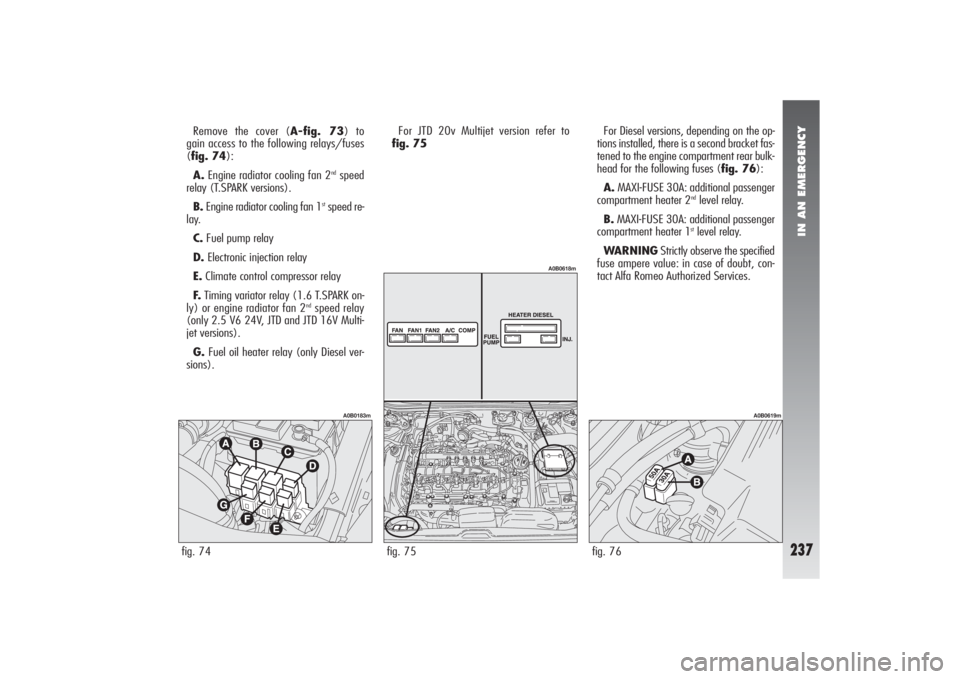
Remove the cover (A-fig. 73) to
gain access to the following relays/fuses
(fig. 74):
A.Engine radiator cooling fan 2
ndspeed
relay (T.SPARK versions).
B.Engine radiator cooling fan 1
stspeed re-
lay.
C.Fuel pump relay
D.Electronic injection relay
E.Climate control compressor relay
F.Timing variator relay (1.6 T.SPARK on-
ly) or engine radiator fan 2
ndspeed relay
(only 2.5 V6 24V, JTD and JTD 16V Multi-
jet versions).
G.Fuel oil heater relay (only Diesel ver-
sions).For JTD 20v Multijet version refer to
fig. 75For Diesel versions, depending on the op-
tions installed, there is a second bracket fas-
tened to the engine compartment rear bulk-
head for the following fuses (fig. 76):
A.MAXI-FUSE 30A: additional passenger
compartment heater 2
ndlevel relay.
B.MAXI-FUSE 30A: additional passenger
compartment heater 1stlevel relay.
WARNINGStrictly observe the specified
fuse ampere value: in case of doubt, con-
tact Alfa Romeo Authorized Services.
fig. 74
A0B0183m
fig. 76
A0B0619m
fig. 75
A0B0618m
Page 242 of 357
IN AN EMERGENCY
240
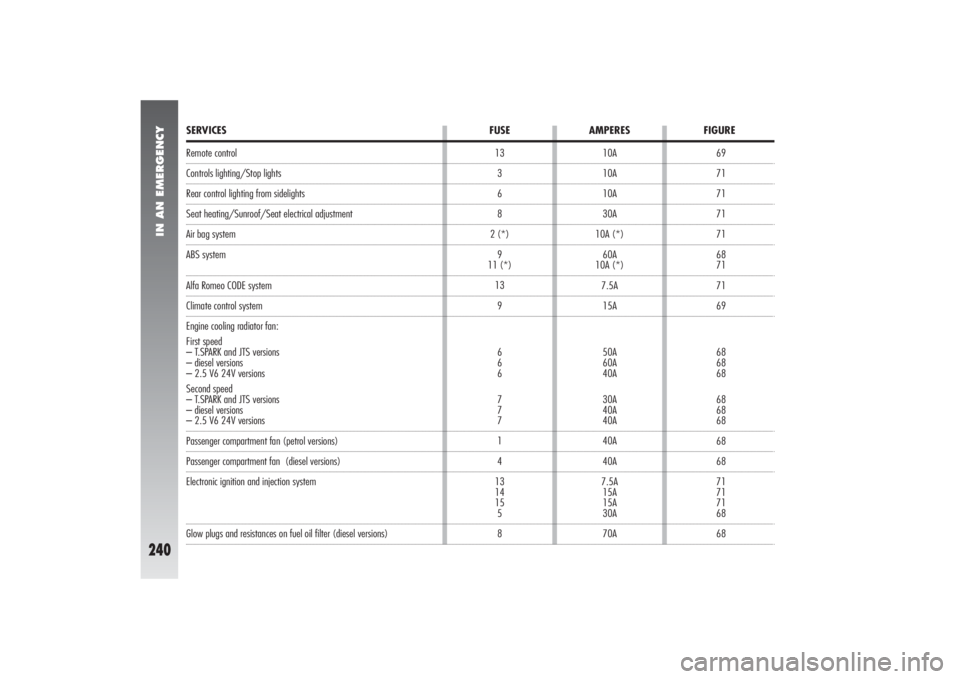
Remote controlControls lighting/Stop lightsRear control lighting from sidelightsSeat heating/Sunroof/Seat electrical adjustmentAir bag system
ABS systemAlfa Romeo CODE systemClimate control system
Engine cooling radiator fan:
First speed
– T.SPARK and JTS versions
– diesel versions
– 2.5 V6 24V versions
Second speed
– T.SPARK and JTS versions
– diesel versions– 2.5 V6 24V versionsPassenger compartment fan (petrol versions)Passenger compartment fan (diesel versions)
Electronic ignition and injection system Glow plugs and resistances on fuel oil filter (diesel versions)69
71
71
71
71
68
71
71
69
68
68
68
68
68
68
68
68
71
71
71
68
68 10A
10A
10A
30A
10A (*)
60A
10A (*)
7.5A
15A
50A
60A
40A
30A
40A
40A
40A
40A
7.5A
15A
15A
30A
70A 13
3
6
8
2 (*)
9
11 (*)
13
9
6
6
6
7
7
7
1
4
13
14
15
5
8SERVICES FUSE AMPERES FIGURE
Page 243 of 357
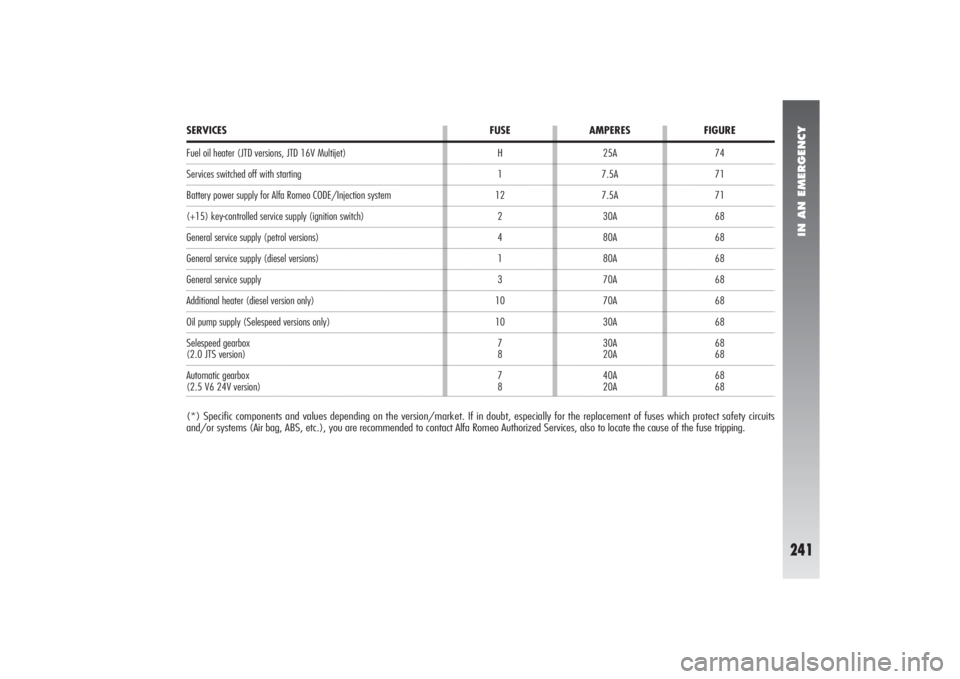
Fuel oil heater (JTD versions, JTD 16V Multijet)Services switched off with startingBattery power supply for Alfa Romeo CODE/Injection system(+15) key-controlled service supply (ignition switch)General service supply (petrol versions)General service supply (diesel versions)General service supplyAdditional heater (diesel version only)Oil pump supply (Selespeed versions only)
Selespeed gearbox(2.0 JTS version)
Automatic gearbox(2.5 V6 24V version)(*) Specific components and values depending on the version/market. If in doubt, especially for the replacement of fuses which protect safety circuits
and/or systems (Air bag, ABS, etc.), you are recommended to contact Alfa Romeo Authorized Services, also to locate the cause of the fuse tripping.
IN AN EMERGENCY
241
74
71
71
68
68
68
68
68
68
68
68
68
68 25A
7.5A
7.5A
30A
80A
80A
70A
70A
30A
30A
20A
40A
20A H
1
12
2
4
1
3
10
10
7
8
7
8
SERVICES FUSE AMPERES FIGURE