heating Alfa Romeo 156 2006 Owner handbook (in English)
[x] Cancel search | Manufacturer: ALFA ROMEO, Model Year: 2006, Model line: 156, Model: Alfa Romeo 156 2006Pages: 357, PDF Size: 5.04 MB
Page 124 of 357

GETTING TO KNOW YOUR CAR
122
LO function
(highest cooling power - fig. 104)
It is switched on by setting a temperature
lower than 16.5°C on the display; this set-
ting is shown by both displays.
This function can be switched on when you
wish to cool the passenger compartment as
quickly as possible, by taking the greatest
advantage from the system potential.
The function cuts off air heating, switches
on both internal air recirculation (to prevent
hot air from entering the compartment) and
the climate control compressor, brings air
distribution to E
and 5
thfan speed.
With the function switched on, however,
all the manual settings can be made.
To switch the function off, you only need
to turn the ring of a knob (1) or (6) of the
temperature set to a value greater than
16.5°C; the opposite display will show
16.5°C.
fig. 104
A0B0065m
By pressing button (14)
AUTO
the display
indicates a temperature of 16.5°C and falls
within an operating condition with automatic
temperature control.
Page 128 of 357

GETTING TO KNOW YOUR CAR
126
AIR DISTRIBUTION SELECTION
BUTTON
(fig. 108)
By pressing button MODE(8) repeat-
edly, you can manually choose one of the
five possible modes for air distribution:
E
Flow of air to the dashboard centre
and side outlets and rear outlets.
ZE
Splitting of the air flow between the
vents to the lower part of the pas-
senger compartment (warmest air)
and the dashboard centre and side
outlets and the rear outlet (coolest
air). This air flow distribution is par-
ticularly useful in spring and autumn,
when the sun is shining.
Z
Air flow towards the front and rear
lower part of the passenger compart-
ment. Due to the natural tendency of
heat to spread upwards, this type of
distribution allows heating of the pas-
senger compartment in the shortest
time, also giving a prompt feeling of
warmth to the coldest parts of the
body.
Q
Splitting of the air flow between the
windscreen and side window defrost-
ing/demisting vents and the lower
part of the passenger compartment.
This type of air distribution allows sat-
isfactory heating of the passenger
compartment while preventing pos-
sible misting of the windows.
Q
Air flow to the windscreen and front
side window vents to demist or de-
frost them.
To resume automatic air distribution con-
trol after a manual selection, press button
(14) AUTO
.
fig. 108
A0B0069m
Z
Page 132 of 357

GETTING TO KNOW YOUR CAR
130
With the outside temper-
ature below 2°C the cli-
mate control compressor is unable
to work. It is therefore inadvisable
to use the inside air recirculation
function v
with low outside tem-
perature as windows may mist
over quickly.WARNING
The inside air recirculation
function makes it possible
to reach the required “heating” or
“cooling” conditions faster. It is
however inadvisable to use it on
rainy/cold days as it would con-
siderably increase the possibility of
the windows misting inside, espe-
cially if the climate control system
is off.
WARNING
It is advisable to turn on the
inside air recirculation sys-
tem in queues or tunnels to avoid
admitting polluted air from outside.
The prolonged use of this function
should however be avoided, espe-
cially with several persons on
board, to avoid the possibility of the
windows misting inside.
WARNING
In certain weather condi-
tions (e.g. outside temper-
ature around 0°C) and with auto-
matic air recirculation control on,
mist may form on the windows. In
this case press the inside air re-
circulation button (7)
v
, to
switch off recirculation (leds on
button off) and if necessary in-
crease the flow of air to the wind-
screen.
WARNING
Page 134 of 357
GETTING TO KNOW YOUR CAR
132
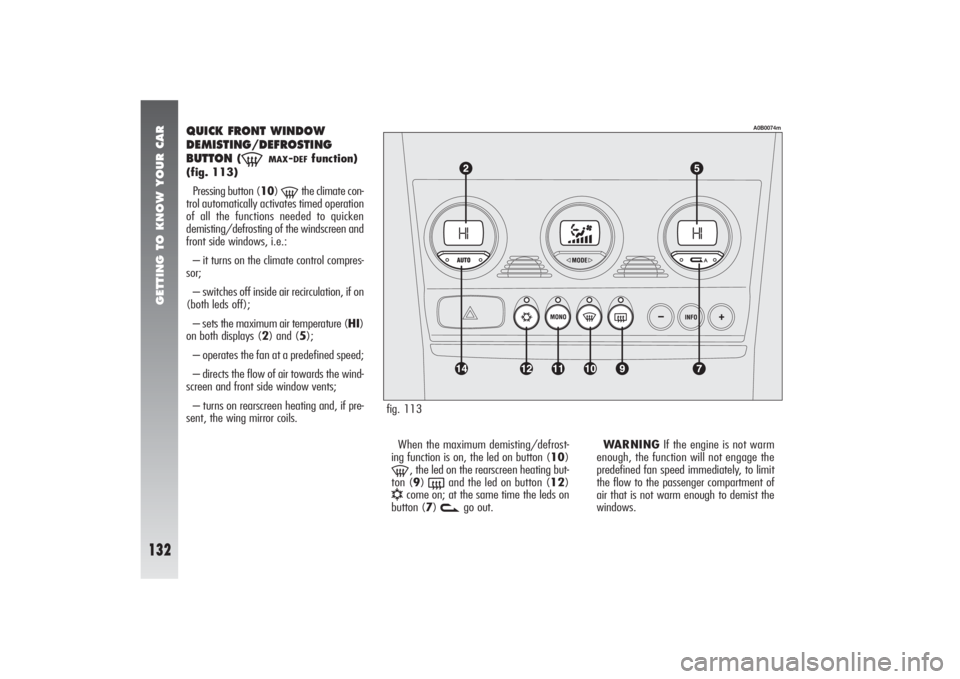
fig. 113
A0B0074m
QUICK FRONT WINDOW
DEMISTING/DEFROSTING
BUTTON
(-
MAX
-DEF
function)
(fig. 113)
Pressing button (10)
-
the climate con-
trol automatically activates timed operation
of all the functions needed to quicken
demisting/defrosting of the windscreen and
front side windows, i.e.:
– it turns on the climate control compres-
sor;
– switches off inside air recirculation, if on
(both leds off);
– sets the maximum air temperature (HI)
on both displays (2) and (5);
– operates the fan at a predefined speed;
– directs the flow of air towards the wind-
screen and front side window vents;
– turns on rearscreen heating and, if pre-
sent, the wing mirror coils.
When the maximum demisting/defrost-
ing function is on, the led on button (10)
-
, the led on the rearscreen heating but-
ton (9)
(
and the led on button (12)
√
come on; at the same time the leds on
button (7)
v
go out.WARNINGIf the engine is not warm
enough, the function will not engage the
predefined fan speed immediately, to limit
the flow to the passenger compartment of
air that is not warm enough to demist the
windows.
Page 135 of 357
GETTING TO KNOW YOUR CAR
133
When the maximum demisting/defrost-
ing function is on, the only manual opera-
tions possible are manual adjustment of the
fan and switching rearscreen heating off.
Pressing one of the following buttons:
(10)
-
, (7)
v
, (11)
MONO
, (14)
AUTO
or (12)
√
the system switches off
the maximum demisting/defrosting func-
tion, resuming the system operating condi-
tions prior to turning it on, in addition to
activating the last function required, if any.
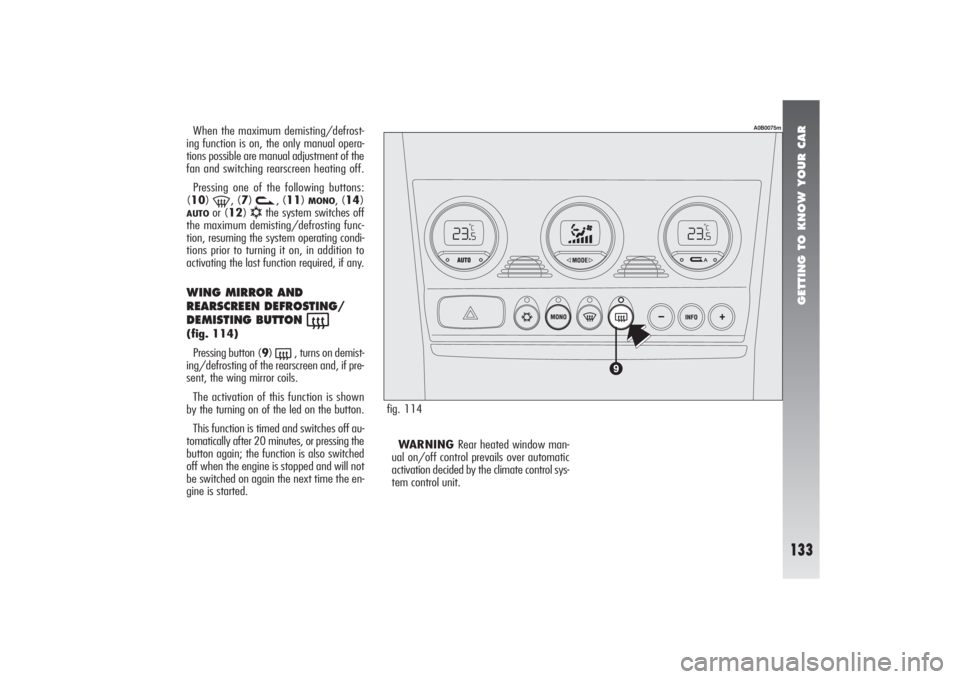
WING MIRROR AND
REARSCREEN DEFROSTING/
DEMISTING BUTTON
(
(fig. 114)
Pressing button (9)
(
, turns on demist-
ing/defrosting of the rearscreen and, if pre-
sent, the wing mirror coils.
The activation of this function is shown
by the turning on of the led on the button.
This function is timed and switches off au-
tomatically after 20 minutes, or pressing the
button again; the function is also switched
off when the engine is stopped and will not
be switched on again the next time the en-
gine is started.WARNING Rear heated window man-
ual on/off control prevails over automatic
activation decided by the climate control sys-
tem control unit.
fig. 114
A0B0075m
Page 136 of 357

GETTING TO KNOW YOUR CAR
134
This function is timed and switches off au-
tomatically after 20 minutes, or pressing the
button again; the function is also switched
off when the engine is stopped and will not
be switched on again the next time the en-
gine is started.
WARNINGThe system turns on
rearscreen heating automatically if the tem-
perature is below 3°C.
WARNINGDo not apply stickers on the
inside of the rearscreen over the heating fil-
aments to avoid damage that might cause
it to stop working properly.
WARNINGWhen reconnecting the neg-
ative battery cable after having disconnected
it, wait for 2 minutes before turning the key
to enable the climate control system to re-
set actuator strokes properly.
POLLEN FILTER This filter has the specific capability of com-
bining the mechanical filtering of the air with
an electrostatic effect so that the outside air
admitted to the passenger compartment is
purified and free from particles such as dust,
pollen, etc.
In addition to the above, it also effectively
reduces the concentration of pollutants.
The filtering action takes place under all
air inlet conditions and it is clearly most ef-
fective with the windows shut.
Have the conditions of the filter checked by
Alfa Romeo Authorized Services at least once
a year, preferably on the onset of summer.If the vehicle is used mainly in polluted
or dusty areas it should be checked and if
necessary replaced, at shorter intervals.
Failure to replace the fil-
ter may considerably re-
duce the effectiveness of
the climate control system up to
blocking the air flow from the out-
lets and vents.
Page 149 of 357

GETTING TO KNOW YOUR CAR
147
STOPPING THE CARTo stop the vehicle, simply release the ac-
celerator pedal and, if necessary, operate
the brake pedal.
Regardless of the gear engaged and of the
operating mode activated (MANUALor
CITY), the system automatically disen-
gages the clutch and downshifts gear.
If you intend to move off again without
having completely stopped the car, this way
the most suitable gear ratio for re-acceler-
ating will be available.
Stopping the vehicle, the system auto-
matically engages first gear (1). Though strongly inadvisable, if due to un-
foreseen circumstances when driving down-
hill the car is allowed to travel with the gear-
box in neutral (N), when the engagement
of a gear is requested, the system auto-
matically engages the best gear to allow
transmission of the torque to the wheels in
relation to the speed of the car.
Downhill with the gear engaged and the
accelerator released (if the vehicle is trav-
elling), if a certain pre-established speed is
exceeded, the system automatically en-
gages the clutch to provide adequate engine
braking.
Due to safety reasons, the Selespeed sys-
tem activates the buzzer when:
– clutch overheating occurs during vehicle
starting; in this case, it is necessary to
“force” moving off avoiding hesitations or
to release the accelerator and use the brake
pedal to park the vehicle if the car is on a
slope;
– the car moves in the opposite direction
to the gear engaged, (e.g.: vehicle moving
forward with reverse engaged); in this sit-
uation it is necessary to stop the vehicle and
keeping the brake pedal pressed, engage
the gear correctly.Still for safety reasons, when the vehicle
is stationary, with the engine started and
gear (1), (2) or (R) engaged, the system
activates the buzzer and shifts to neutral
(N) automatically when:
– there is no action on the accelerator
and/or brake pedal for at least 3 minutes;
– the brake pedal is pressed for over 10
minutes;
– the driver’s door is opened and the ac-
celerator and brake pedal are not pressed
for at least 1 second.
Page 153 of 357

GETTING TO KNOW YOUR CAR
151
SIGNALLING WITH THE BUZZERThe buzzer is activated when:
– reverse gear (R) is engaged;
– the vehicle is parked with the gearbox
at neutral (N); this can be seen turning the
ignition key to STOP;
– clutch overheating takes place during
pick-up;
– the car moves in the opposite direction
to the gear engaged (e.g.: the car tends to
do downhill with reverse gear engaged);
– in the event of gearbox failure;
– the system has automatically engaged
neutral (N) after:•
there is no action on the accelerator
and/or brake pedal for at least 3 min-
utes;
•
the brake pedal is pressed for over 10
minutes;
•
the driver’s door is opened and the ac-
celerator and brake pedal are not
pressed for at least 1 second;
•
detection of a gearbox fault.
PARKING THE VEHICLETo park the car safely it is absolutely
necessaryto engage first gear (1) or re-
verse (R) and, when on a sloping road, also
engage the hand-brake.
Turning the engine off with the car facing
uphill and a gear engaged, it is absolutely
necessaryto wait for the display on the
rev counter to go off before releasing the
brake pedal, so that the clutch has innested
completely.
If the gearbox is in neutral (N) and you
want to engage a parking gear, it is neces-
sary to activate the system and engage the
gear (1) or reverse (R) with your foot on
the brake pedal.
TOWING THE VEHICLEWARNINGFor towing the vehicle, ad-
here to local regulations. Make sure that the
gearbox is in neutral (N) (checking that the
car moves when pushed) and proceed as for
towing a normal car with mechanical gear-
box following the instructions given in the
chapter “In an emergency”.
Should it be impossible to set to neutral,
do not tow the vehicle; contact Alfa Romeo
Authorised Services.
Do not start the engine
when towing the vehicle.
WARNING
Page 192 of 357

CORRECT USE OF THE CAR
190
WARNINGOn the 2.0 JTS version,
keep the brake pedal pressed when starting
the engine. As the brake pedal stiffens if it
is pressed repeatedly with the engine off. In
this situation, to allow the engine to be
started, it is necessary to increase the pres-
sure exerted on the pedal itself.PROCEDURE FOR JTD VERSIONS1)Make sure the handbrake is engaged.
2)Move the gearshift lever to neutral.
3)Turn the ignition key to the MARpo-
sition. The warning light
m
on the instru-
ment cluster will turn on.
4)Wait for the
m
warning light to go
off, which will depend on how warm the en-
gine is. With the engine very hot the warn-
ing light may stay on for such a short time
that it is not noticed.
5)Fully depress the clutch pedal.
6)Turn the ignition key to AV Vas soon
as the
m
warning light goes off. Waiting
too long would make the glow plug heating
work pointless.WARNINGThe electric devices that ab-
sorb much energy (air conditioner,
rearscreen heating, etc.) are disengaged au-
tomatically during engine starting.
If the engine does not start at the first at-
tempt, move the ignition key back to the
STOPposition before repeating starting.
If starting is difficult (with the Alfa Romeo
CODE system efficient), do not insist with
prolonged attempts.
Only use an auxiliary battery if it is noted
that the cause is due to low charge of the
car’s battery. Never use a battery charger to
start the engine (see “If the battery is flat”
in the chapter “In an emergency”).
WARMING THE ENGINE– Drive off slowly, at medium revs with-
out accelerating abruptly.
– Do not drive at full performance for the
initial kilometers of the journey, Wait until
the engine coolant temperature is between
50 and 60°C.SWITCHING OFF– Release the accelerator pedal and wait
until the engine reaches idle speed.
– Turn the ignition key to the STOPpo-
sition and switch off the engine.
WARNINGAfter a taxing drive it is bet-
ter to allow the engine to “catch its breath”
before turning it off by letting it idle to al-
low the temperature in the engine com-
partment to fall.
Page 196 of 357
CORRECT USE OF THE CAR
194
DRIVING IN THE RAINRain and wet roads can be dangerous.
If the road is wet, the traction between
wheel and asphalt is greatly reduced, thus
increasing the stopping distance and de-
creasing road holding.
Here are few suggestions in the case of
rain:
– Reduce speed and keep further back
from the vehicle in front.
– If it is raining particularly heavily, visi-
bility is also reduced. In these cases, switch
on the dipped headlights even if it is still day-
light so you can be seen more easily.
– Do not drive through puddles at speed
and hold on tightly to the wheel if you do: a
puddle taken at high speed might cause you
to lose control of the car (“aquaplaning”).
– Position the ventilation controls for
demisting (see chapter “Getting to know
your car”), to prevent visibility from wors-
ening.
– Routinely check the conditions of the
windscreen wiper blades.
DRIVING IN THE FOG– If fog is very thick, avoid travelling
where possible. If travelling with mist,
ground fog or the possibility of fog banks:
– Drive at moderate speed.
– Also in the day turn on the dipped-beam
headlights, rear fog guards and front fog
lights. Do not use the main beam headlights.
WARNINGOn stretches of road with
good visibility, switch off your rear foglights;
the brightness of these lights could annoy
the people travelling in the cars behind.
– Remember that fog also involves wet
asphalt, thus greater difficulty in all types of
manoeuvres and longer stopping distances.
– Keep well away from the vehicle in
front.
– Where possible avoid sudden changes
in speed.
– Possibly avoid overtaking other vehicles.
– If the vehicle is forced to stop (faults,
impossibility to continue due to poor visi-
bility, etc.), firstly try to pull off the road.
Then turn on the hazard warning lights and,
if possible the dipped beam headlights. Ry-
thmically sound the horn if you note another
car coming.
MOUNTAIN DRIVING– When driving downhill, use the engine
braking by engaging a low gear, to prevent
the brakes from overheating.
– Never coast downhill with the engine off
or in neutral and especially not with the ig-
nition key removed.
– Drive at moderate speed and avoid “cut-
ting” corners.
– Remember that overtaking up hill is
slower and therefore requires a greater
length of clear road. If you are being over-
taken on a hill, move over to enable the
other vehicle to pass in safety.