warning lights Alfa Romeo 156 2006 Owner handbook (in English)
[x] Cancel search | Manufacturer: ALFA ROMEO, Model Year: 2006, Model line: 156, Model: Alfa Romeo 156 2006Pages: 357, PDF Size: 5.04 MB
Page 178 of 357

GETTING TO KNOW YOUR CAR
176
The electromechanical system to auto-
matically keep constant trim makes the
headlight tilt compensating device unnec-
essary.
The xenon lamps have very long life which
makes possible fault very unlikely.
If necessary, have the sys-
tem checked and repairs (if
any) made only by Alfa Romeo Au-
thorized Services.
WARNING
GAS DISCHARGE HEADLIGHTS(optional for versions/markets
where applicable)
The gas (xenon) discharge headlights op-
erate with a voltaic arc, in an ambient sat-
urated with pressure xenon, instead of the
glow filament.
The resulting illumination is sensibly higher
to that of conventional lamps, both for light
quality (clearer light) and for the width and
positioning of the illuminated area.
The advantages of better illumination can
be perceived (due to less eyesight fatigue
and greater orientation capacity for the dri-
ver, which in turn means higher driving
safety) especially in case of bad weather,
fog and/or insufficient road signs, thanks
to the better illumination of the side parts
of the visual field, normally obscured.The large increase of the side part illumi-
nation increases driving safety since it allows
the driver to better see the other users on
the edge of the road (pedestrians, cyclists
and bikers).
The triggering of the voltaic arc requires a
very high voltage, while subsequent power
supply can take place at a low voltage.
The headlights achieve their top luminos-
ity approx. 15 seconds after they are
switched on.
The intense light produced by this type of
headlights requires the use of an automatic
system to keep headlight trim constant and
avoid dazzling the vehicles coming from the
opposite direction in case of braking, accel-
eration or when carrying loads.
Page 179 of 357
GETTING TO KNOW YOUR CAR
177
DIPPED BEAM HEADLIGHT
AIMING FOR LEFT-HAND/
RIGHT-HAND DRIVING(only for versions with gas
discharge headlights)
As regards cars equipped with gas dis-
charge headlights (xenon lamps)(optional
for versions/markets where applicable) with
very great lighting power, when passing
from a country with right-hand driving to one
with left-hand driving, or vice versa, it is nec-
essary to modify the orientation of the
dipped beam headlights, to optimize the il-
lumination of the road edge and avoid daz-
zling the vehicles coming from the opposite
direction.
To have this operation
carried out, contact Alfa
Romeo Authorized Ser-
vices.
When you go back to your
country of origin, remem-
ber to have the dipped beam head-
light orientation modified again.
WARNING
In the event of a failure, though being un-
able to rely on the antilock effect, there is
absolutely no adverse effect on vehicle brak-
ing performance in terms of braking capac-
ity.
If you have never used a car with ABS be-
fore, you are advised to learn how to use
it with a few preliminary trials on a slippery
surface, naturally under safety conditions
and fully adhering to the Highway Code of
the country concerned. You are also advised
to carefully read the following information.
The advantage of the ABS compared with
the conventional system is that it makes it
possible to maintain maximum vehicle han-
dling performance also in the case of hard
braking under grip limit conditions, avoiding
wheel lock.
Do not however expect the braking dis-
tance always to be reduced with the ABS
system: for example, on soft surfaces such
as gravel or fresh snow on slippery surfaces,
the distance might increase.
ABSThe car is fitted with an ABS system which
prevents wheel lock when braking, better
exploits wheel grip and keeps the vehicle
controllable within the limits of the available
grip also during emergency braking.
The driver can feel that the ABS is opera-
tional by a light pulsing of the brake pedal,
accompanied by noise.
This should not interpreted as malfunc-
tioning of the brakes, but it is the signal to
the driver that the ABS system is working:
it is the warning that the car is travelling at
the limit of grip an that, therefore, it is nec-
essary to adapt the speed to the type of road
on which you are travelling.
The ABS system is an additional part of the
basic braking system; in the event of a fault
it is disabled, leaving the braking system
in the same conditions as a car without ABS.
Page 180 of 357

GETTING TO KNOW YOUR CAR
178
Braking on corners always requires the ut-
most caution, even with the help of the ABS.
The most important piece of advice, how-
ever, is the following:Following these instructions you will be
in a condition to obtain peak braking per-
formance at all times.
WARNINGCars fitted with ABS must
only be fitted with wheel rims, tyres and
brake linings of the type and brand approved
by the Manufacturer.
The braking system is completed by the
electronic control braking distribution system
called EBD(Electronic Braking Force Dis-
tributor) which distributes the braking action
through the ABSsystem control unit and
sensors.
In the event of a system
fault, with lighting up of
the
>
warning light on the instru-
ment cluster (together with the
message + symbol shown by the
display), have the vehicle checked
immediately by Alfa Romeo Au-
thorized Services, driving slowly
to be able to regain full system
performance.
WARNING
When the ABS cuts in and
you feel the pedal pulse, do
not reduce the pressure, but keep
the brake pedal firmly pressed
with no fear; this way you will
stop in the shortest possible space,
compatibly with the conditions of
the road surface.
WARNING
The car is fitted with an
electronic brake distributor
(EBD). If the
>
and
x
warning
lights, where required, come on at
the same time (together with the
message + symbol shown by the
display) when the engine is run-
ning, there is an EBD system fault;
in this case, violent braking may
lock the rear wheels too early, with
the possibility of skidding. Drive
extremely carefully to the nearest
Alfa Romeo Authorized Services to
have the system checked over.
WARNING
In order to be able to exploit as far as pos-
sible the possibility of the antilock system
in the case of need, it is wise to follow a few
pieces of advice:
The ABS exploits the avail-
able grip in full, but it can-
not increase it; therefore, caution
is required on slippery surfaces,
without running unnecessary risks.
WARNING
If the ABS cuts in, it means
that the grip limit between
the tyres and the road surface has
been reached: it is necessary to
slow down and adapt driving to
the grip available.
WARNING
Page 184 of 357
GETTING TO KNOW YOUR CAR
182
EOBD SYSTEMThe EOBD (European On Board Diagnosis)
system fitted in the car conforms with the
98/69/EC (EURO 3) Directive and the
2001/1/EC Directive, level B (EURO4) for
2.0 JTS, 2.0 JTS Selespeed and JTD 20V
Multijet versions.
This system continuously monitors the
components of the vehicle related to emis-
sions; it also indicates, when the warning
light
U
comes on on the instrument panel
(together with the message + symbol
shown by the display) that the components
in question are in poor conditions.
The objective is the following:
– to keep under control the efficiency of
the system;
– to indicate when a malfunction causes
an increase in the emissions beyond the
threshold established by European regula-
tions;
– to indicate the need to replace the de-
teriorated components.
The system also has a diagnostic connec-
tor, which can be interfaced with adequate in-
struments, that enables the error codes stored
in the control unit to be read, together with
a series of specific parameters concerning the
operation and diagnosis of the engine.This check can also be made by the traf-
fic control agents.
If, when the ignition key
is turned to MAR, the
U
warning light does not
come on or if, when driving, it
lights up and emits a fixed light or
a flashing one (together with the
message + symbol shown by the
display), contact an Alfa Romeo
Authorized Service Station as soon
as possible. The operation of the
U
warning light can also be
checked by means of special equip-
ment available to the traffic con-
trol officers. Comply with the reg-
ulations in force in country where
you drive your car.
WARNINGAfter the problem has beel
resolved, to completely check the system,
the Alfa Romeo Authorized Services must
carry out tests on a test bench and, if nec-
essary, road tests that could be long.
WARNING LIGHT ON
INSTRUMENT PANELWhen the ignition key is turned to MAR,
the dial warning light
á
comes on but must
go out after a few seconds.
If the warning light does not go out, or if it
stays on (together with the message + sym-
bol on the display and the coming on of the
ASR button led) when the vehicle is running,
contact Alfa Romeo Authorized Services.
The flashing of the warning lamp when the
vehicle is running indicates the actuation of
the VDC system.
VDC system failure warning
In the event of a failure the VDC system
disengages automatically and the
á
warn-
ing light on the instrument cluster turns on
glowing steadily (together with the message
+ symbol shown on the display and the com-
ing on of the ASR button led).
In the event of a VDC system failure the
car behaves like a vehicle not fitted with this
system: in any case it is advisable to con-
tact Alfa Romeo Authorized Services as soon
as possible.
Page 194 of 357
CORRECT USE OF THE CAR
192
SAFE DRIVINGIn designing your Alfa 156, Alfa
Romeo has worked thoroughly to achieve a
vehicle able to offer top levels of safety to
its passengers. However, the behaviour of
the driver is still a decisive factor for road
safety.
Below you will find a few simple rules for
travelling safely under different conditions.
You are certainly familiar with many of them
but it is still helpful to read them all care-
fully.BEFORE DRIVING OFF– Make sure the lights and headlights are
working properly.
– Adjust the seat, steering wheel and
rearview mirrors, in order to obtain a correct
position for driving.
– Adjust the seat back upright and keep
your head as close as possible to the head
restraint.– Carefully adjust the headrests so that
the head and not the neck rests on them.
Check that nothing (mats, etc.) can get un-
der the foot pedals.
– Make sure that any child restraint sys-
tem (seats, cradles, etc.) are correctly fas-
tened on the rear seat.
– Place any objects in the boot with care
to prevent abrupt braking from throwing
them forwards.
– Avoid heavy meals before a journey. A
light meal will help to keep reflexes ready.
Above all avoid alcohol.
Routinely remember to check:
– tyre pressure and conditions;
– engine oil level;
– engine coolant level and system condi-
tions;
– brake fluid level;
– power steering oil level;
– windscreen washer fluid level.
WHEN TRAVELLING– The first rule for safe driving is care.
– Care also means being able to predict
the actions of other road users.
– Strictly respect the traffic regulations in
all countries, especially the speed limits.
– Ensure that both yourself and your pas-
sengers are wearing their seat belts, that
children are carried with the appropriate
seats and that any animals are in appropri-
ate compartments.
– Long distances should be trackled in
good health.
Driving under the influence
of drugs and/or some
medicines is highly dangerous for
oneself and for others.
WARNING
Page 195 of 357
CORRECT USE OF THE CAR
193
– Do not drive for long periods without a
break. During breaks get out of the vehicle
and move around a bit to shake off the
drowsiness.
– Make sure the air in the passenger com-
partment is changed constantly.
– Never coast the vehicle downhill with
the engine switched off as this eliminates
the engine braking and power steering ef-
fect thus requiring a greater effort on the
pedal and steering wheel.
NIGHT DRIVINGHere are some suggestions for night dri-
ving.
– Drive with particular care: night driving
involves a greater degree of concentration.
– Reduce speed, especially on unlit roads.
– At the first signs of drowsiness stop the
car: continuing the journey is dangerous for
yourself and others. Continue driving only
after sufficient rest.
– Maintain a greater distance from the ve-
hicle in front than in the day: it is more dif-
ficult to judge the speed of the vehicle when
only the lights can be seen.
– Ensure that the headlights are correctly
aligned: if they are too low, visibility is re-
duced and eyesight is tired. If they are too
high they may cause disturbance to other
road users.
– Use the main beams only outside built-
up areas and only when you are certain that
other drivers are not disturbed by their use.
– When meeting vehicles coming in the
opposite direction, switch off the main
beams and drive with the dipped-beam
headlights on.
– Keep headlights and lights clean.
– Outside built-up areas take care of ani-
mal crossings.
Always fasten the front
and rear seat belts includ-
ing those of any child’s seat. Trav-
elling without seat belts increases
the risks of serious injury or even
death in the event of an accident.
WARNING
Take care when fitting ad-
ditional spoilers, alloy
wheels and wheel caps: they might
reduce ventilation of the brakes,
thus their efficiency, during abrupt
and repeated braking, or long
downhill slopes.
WARNING
Never drive with objects
on the floor in front of the
driver’s seat: they might get stuck
under the pedals making it impos-
sible to accelerate or brake.
WARNING
Make sure any mats are
appropriate in size: even a
slight inconvenience to the braking
system may require a higher pedal
stroke than normal.
WARNING
Water, ice and salt on the
roads may deposit on the
brake discs, reducing the effec-
tiveness of the brakes the first
time they are used.
WARNING
Page 196 of 357
CORRECT USE OF THE CAR
194
DRIVING IN THE RAINRain and wet roads can be dangerous.
If the road is wet, the traction between
wheel and asphalt is greatly reduced, thus
increasing the stopping distance and de-
creasing road holding.
Here are few suggestions in the case of
rain:
– Reduce speed and keep further back
from the vehicle in front.
– If it is raining particularly heavily, visi-
bility is also reduced. In these cases, switch
on the dipped headlights even if it is still day-
light so you can be seen more easily.
– Do not drive through puddles at speed
and hold on tightly to the wheel if you do: a
puddle taken at high speed might cause you
to lose control of the car (“aquaplaning”).
– Position the ventilation controls for
demisting (see chapter “Getting to know
your car”), to prevent visibility from wors-
ening.
– Routinely check the conditions of the
windscreen wiper blades.
DRIVING IN THE FOG– If fog is very thick, avoid travelling
where possible. If travelling with mist,
ground fog or the possibility of fog banks:
– Drive at moderate speed.
– Also in the day turn on the dipped-beam
headlights, rear fog guards and front fog
lights. Do not use the main beam headlights.
WARNINGOn stretches of road with
good visibility, switch off your rear foglights;
the brightness of these lights could annoy
the people travelling in the cars behind.
– Remember that fog also involves wet
asphalt, thus greater difficulty in all types of
manoeuvres and longer stopping distances.
– Keep well away from the vehicle in
front.
– Where possible avoid sudden changes
in speed.
– Possibly avoid overtaking other vehicles.
– If the vehicle is forced to stop (faults,
impossibility to continue due to poor visi-
bility, etc.), firstly try to pull off the road.
Then turn on the hazard warning lights and,
if possible the dipped beam headlights. Ry-
thmically sound the horn if you note another
car coming.
MOUNTAIN DRIVING– When driving downhill, use the engine
braking by engaging a low gear, to prevent
the brakes from overheating.
– Never coast downhill with the engine off
or in neutral and especially not with the ig-
nition key removed.
– Drive at moderate speed and avoid “cut-
ting” corners.
– Remember that overtaking up hill is
slower and therefore requires a greater
length of clear road. If you are being over-
taken on a hill, move over to enable the
other vehicle to pass in safety.
Page 207 of 357

IN AN EMERGENCY
205
3)Fully depress the accelerator pedal and
keep it pressed. The warning light
U
will
come on for eight seconds approximately
and will then go out; now release the ac-
celerator pedal.
4)The warning light
U
begins to flash:
after it has flashed for the same number of
times as the first digit on the code of the
card, press completely and hold down the
accelerator pedal until the warning light
U
comes on (for 4 seconds) and then goes out
again; now release the accelerator pedal.
5)The warning light
U
will begin to
flash: after it has flashed for the same num-
ber of times as the second digit on the code
of the card, press completely and hold down
the accelerator pedal.
6)Repeat this procedure in the same way
for the other digits on the CODE card code.
7)After entering the last figure, keep the
accelerator pedal pressed. The warning light
U
turns on (for four seconds) and then goes
off; now release the accelerator pedal.8)A quick flash of the warning light
U
(for appr. 4 seconds) confirms that the op-
eration has taken place correctly.
9)Start the car turning the ignition key
from theMAR position to the AVV posi-
tion without returning the key to theSTOP
position.
Conversely, if the warning light
U
stays
on, turn the ignition key to STOPand re-
peat the procedure starting from point 1.
WARNINGAfter emergency starting it
is advisable to turn to an Alfa Romeo Au-
thorized Service, because the procedure de-
scribed must be repeated each time the en-
gine is started.
EMERGENCY
STARTINGIf the Alfa Romeo CODE system is not able
to deactivate the engine inhibitor, warning
lights
Y
and
U
remain lit and the engine
cannot be started. To start the engine it is
necessary to follow the emergency starting
procedure.
WARNINGYou are advised to careful-
ly read the entire procedure before carry-
ing it out.
If a mistake is made during the emergency
procedure, the ignition key should be turned
to STOPand the operations must be re-
peated from the start (point 1).
1)Read the 5-figure electronic code on
the CODE card.
2)Turn the ignition key to theMAR po-
sition.
I I
N N
A A
N N
E E
M M
E E
R R
G G
E E
N N
C C
Y Y
Page 209 of 357

IN AN EMERGENCY
207
STARTING BY INERTIA
IN THE EVENT OF A
PUNCTUREWARNINGIf the car is equipped with
“Fix&Go kit for tyre quick repair”, see the
instructions contained in the following
chapter.GENERAL INSTRUCTIONSWheel changing and correct use of the jack
and compact spare wheel call for some pre-
cautions as mentioned below. Never push, tow or coast
start the vehicle. This could
cause fuel to flow into the
catalyst damaging it irreversibly.
Remember that the engine
brake and power steering
are not operational until the engine
is started, therefore, much greater
effort than usual is needed on the
brake pedal and steering wheel.
WARNING
Signal the presence of the
stationary vehicle accord-
ing to the current regulations: haz-
ard warning lights, reflecting tri-
angle, etc.
Any passengers should leave the
car and wait for the wheel to be
changed out of harm of the traffic.
If parked on a slope or uneven road
surfaces, place wedges or other
suitable devices under the wheels
to prevent the car from rolling.
Never start the engine when the
car is raised on the jack.
When towing a trailer, always
remove the trailer before lifting
the car.
WARNING
Page 219 of 357
IN AN EMERGENCY
217
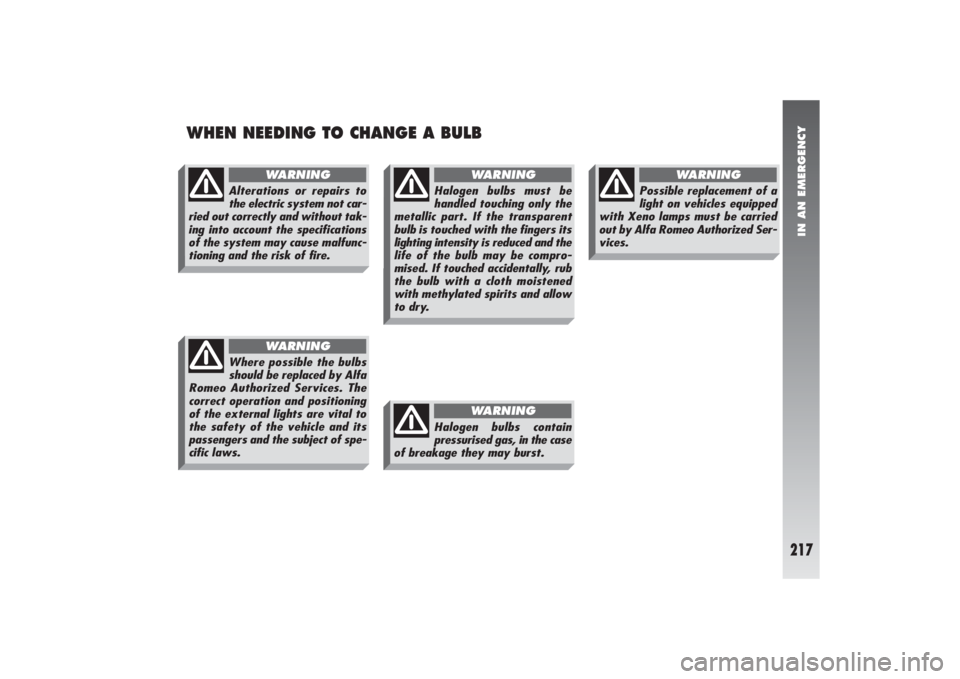
WHEN NEEDING TO CHANGE A BULB
Alterations or repairs to
the electric system not car-
ried out correctly and without tak-
ing into account the specifications
of the system may cause malfunc-
tioning and the risk of fire.
WARNING
Where possible the bulbs
should be replaced by Alfa
Romeo Authorized Services. The
correct operation and positioning
of the external lights are vital to
the safety of the vehicle and its
passengers and the subject of spe-
cific laws.
WARNING
Halogen bulbs must be
handled touching only the
metallic part. If the transparent
bulb is touched with the fingers its
lighting intensity is reduced and the
life of the bulb may be compro-
mised. If touched accidentally, rub
the bulb with a cloth moistened
with methylated spirits and allow
to dry.
WARNING
Halogen bulbs contain
pressurised gas, in the case
of breakage they may burst.
WARNING
Possible replacement of a
light on vehicles equipped
with Xeno lamps must be carried
out by Alfa Romeo Authorized Ser-
vices.
WARNING