key battery Alfa Romeo 166 2006 Owner handbook (in English)
[x] Cancel search | Manufacturer: ALFA ROMEO, Model Year: 2006, Model line: 166, Model: Alfa Romeo 166 2006Pages: 272, PDF Size: 4.17 MB
Page 139 of 272
138
PARKING
When the vehicle is parked, proceed as
follows:
– Switch off the engine.
– Engage the handbrake.
– Engage first gear if parking the car
uphill or reverse if parking the car on a s-
loping road. On cars with automatic gear-
box set the gear lever to P.
– Turn the front wheels so that the vehi-
cle will immediately come to a halt if the
handbrake slips.
NIGHT DRIVING
Night driving involves a greater degree
of concentration, both physical and ner-
vous. Some suggestions concerning night
driving follow:
– Drive with particular care, reducing
speed if necessary especially on unlit
roads.
– Maintain a greater distance from the
vehicle in front than during the day as it
is more difficult to judge the speed of a
vehicle when only the lights can be seen.
– If you become drowsy stop the car
and rest. continuing the journey when
sleepy is dangerous for yourself and for
others.
–Ensure that the headlights are correct-
ly aligned: if they are too low visibility is
reduced and if they are too high they
may cause disturbance to other users.
– use the main-beam outside built-up
areas and only when you are certain that
other drivers are not disturbed by their
use.
– When meeting vehicles coming in the
opposite direction, switch off the main-
beam and drive with the dipped-beam
headlights on.
– Keep the headlights and light units
clean at all times. – Do not coast the vehicle down hill
with the engine switched off as this elimi-
nates the engine braking effect thus re-
quiring a greater effort on the brake ped-
al, on the power steering and consider-
ably more effort on the steering wheel.
– If it is necessary to stop the vehicle
following a malfunction, park off the
road, switch on the hazard warning lights
and set up the warning triangle to alert
other road users of the presence of your
vehicle. At all times comply with the cur-
rent road traffic regulations.To avoid useless con-
sumption of power and
possible draining of the
battery, never leave the ignition
key in the MAR position when
the engine is not running.Ensure that both yourself
and your passengers are
wearing their seat belts. Travelling
without seat belts greatly in-
creases the risks of serious injury
or even death in the event of an
accident.
WARNING
Never leave children un-
attended in the vehicle.
Always remove the key from the
ignition when leaving the vehicle
and take it with you.
WARNING
Page 156 of 272
155 VEHICLE INACTIVITY
If the vehicle is to be left inactive for
long periods the following precautions
should be noted:
– House the vehicle under a cover in a
dry and possibly ventilated place.
– Engage a gear.
– Release the handbrake.
– Clean and protect the paintwork by
applying silicon wax.
– Cover the rubber windscreen wiper
blades with talcum powder and raise
them off the glass.
– Open the windows slightly.
– Cover the vehicle with a cloth or per-
forated plastic cover. Do not use compact
plastic covers which prevent the humidity
on the surface of the vehicle from evapo-
rating.
– Inflate the tyres to a pressure of 0.5
bars above normal. If possible rest the
tyres on wooden planks and periodically
check the pressure.– Switch off the alarm system (if fit-
ted) with the remote control, then deacti-
vate it with the emergency key.
– Disconnect the terminals from the
battery poles (negative pole first) and
check the battery charge. When the vehi-
cle is in storage, this check should be car-
ried out once a month. If the no-load volt-
age is less than 12.5V, recharge the bat-
tery.
REMOVING FROM STORAGE
Before using your vehicle after a long
period of inactivity the following opera-
tions should first be carried out:
– Do not dust the outside of the vehi-
cle.
– Visually check that there are no
leaks (oil, brake and clutch fluid, engine
coolant etc.).
– Replace the engine oil and filter.
– Check:
Gearbox-differential oil level
Brake-clutch fluid level
Level of engine coolant fluid.– Check the air cleaner and replace if
necessary.
– Check tyre pressure and ensure that
they are not damaged, cracked or cut. If
they are they must be replaced.
– Check the state of the drive belts in
the engine bay.
– Connect the cables of the battery af-
ter checking that the charge is adequate.
– Re-activate the alarm system, if fit-
ted, using the emergency key.
– With the gear lever in neutral start
the engine and allow the engine to run
for a few seconds whilst repeatedly
pumping the clutch pedal.
Page 195 of 272
194 IN THE EVENT
OF A FLAT BATTERY
STARTING WITH AN
AUXILIARY BATTERY
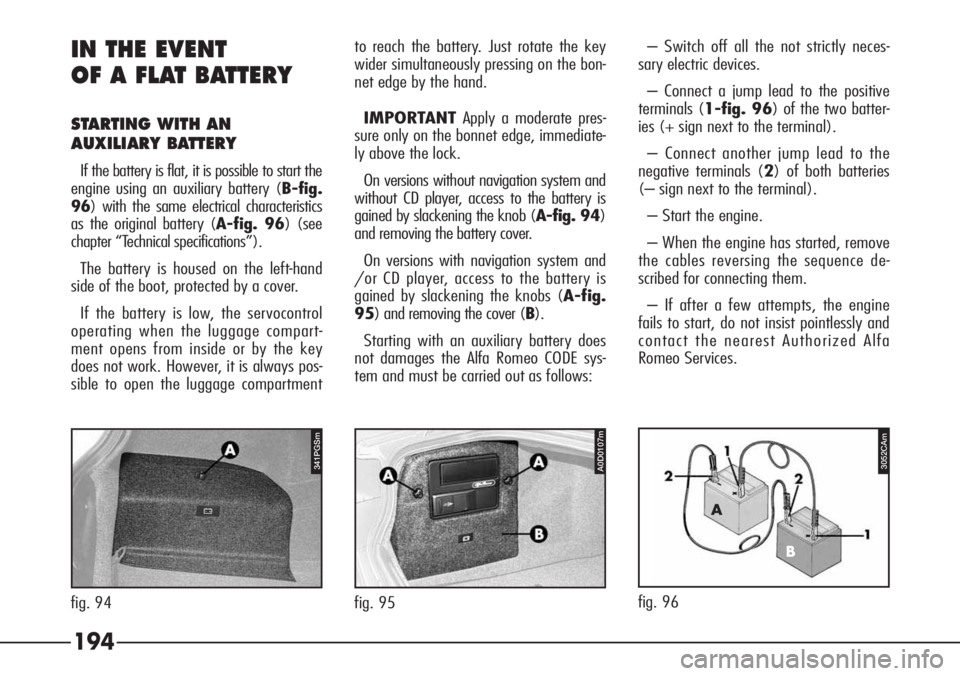
If the battery is flat, it is possible to start the
engine using an auxiliary battery (B-fig.
96) with the same electrical characteristics
as the original battery (A-fig. 96) (see
chapter “Technical specifications”).
The battery is housed on the left-hand
side of the boot, protected by a cover.
If the battery is low, the servocontrol
operating when the luggage compart-
ment opens from inside or by the key
does not work. However, it is always pos-
sible to open the luggage compartmentto reach the battery. Just rotate the key
wider simultaneously pressing on the bon-
net edge by the hand.
IMPORTANTApply a moderate pres-
sure only on the bonnet edge, immediate-
ly above the lock.
On versions without navigation system and
without CD player, access to the battery is
gained by slackening the knob (A-fig. 94)
and removing the battery cover.
On versions with navigation system and
/or CD player, access to the battery is
gained by slackening the knobs (A-fig.
95) and removing the cover (B).
Starting with an auxiliary battery does
not damages the Alfa Romeo CODE sys-
tem and must be carried out as follows:– Switch off all the not strictly neces-
sary electric devices.
– Connect a jump lead to the positive
terminals (1-fig. 96) of the two batter-
ies (+ sign next to the terminal).
– Connect another jump lead to the
negative terminals (2) of both batteries
(– sign next to the terminal).
– Start the engine.
– When the engine has started, remove
the cables reversing the sequence de-
scribed for connecting them.
– If after a few attempts, the engine
fails to start, do not insist pointlessly and
contact the nearest Authorized Alfa
Romeo Services.
fig. 96
A
B
fig. 94
A0D0107m3052CAm
fig. 95
341PGSm
Page 196 of 272

195
To avoid damaging the
vehicle’s electrical sys-
tem follow the manu-
facturer’s system instructions ac-
companying the jump leads. The
jump leads must be of a suffi-
cient cross-section and long
enough to ensure that the two
vehicles do not touch.
Never use a quick bat-
tery charger to start
the engine in an emer-
gency as this could damage the
electronic systems of your vehi-
cle, particularly the control units
which manage the starting and
supply functions.
The battery terminal
connecting and discon-
necting operations gen-
erate current that may cause
problems to the car’s electronic
systems. Therefore, this opera-
tion should be carried out by
skilled personnel.
At the end of the operation refit the bat-
tery cover.
IMPORTANT If the battery was com-
pletely drained, it may be necessary to
carry out the Alfa Romeo I.C.S. “self-
teaching” operation as follows:
– Let the engine idle to allow the bat-
tery to recharge and make sure it will
start next time.
– Switch the engine off.
– Turn the ignition key to MARand
leave it in this position for 30 seconds to
1 minute, then turn it to STOPfor about
5 to 10 seconds, after which the engine
can be started.
This starting procedure
must be carried out by
qualified personnel as incorrect op-
erations may provoke electrical
discharge of great intensity. The
liquid contained in the battery is
toxic and corrosive. Avoid contact
with skin and eyes.
Keep naked flame, and lighted cig-
arettes away from the battery. Do
not cause sparks.
WARNING
Page 208 of 272
207
IMPORTANT - Engine oil
Change the engine oil more frequently
than stated in the Scheduled Mainte-
nance Programme if the car is used pre-
vailingly in one of the following particular-
ly harsh conditions:
– trailer or caravan towing
– dusty roads
– short, repeated journeys (less than 7-
8 km) with an outside temperature of be-
low freezing point.
– engine idling frequently or driving
long distances at low speed (e.g. taxi or
door-to-door deliveries) or in the case of
prolonged inactivity.
IMPORTANT - Air cleaner
Using the car on dusty roads, change
the air cleaner more frequently than stat-
ed in the Scheduled Maintenance Pro-
gramme.
For any doubts about the intervals be-
tween engine oil and air cleaner changes
in relation to how the car is used, contact
Authorised Alfa Romeo Services.IMPORTANT - Fuel oil filter
The variety of the degree of purity of
the fuel oil in commerce may make it
necessary to change the fuel oil filter
more frequently than stated in the Sched-
uled Maintenance Programme. If the en-
gine is “sobbing” it is a sign that the fil-
ter needs changing.
IMPORTANT - Pollen filter
If the car is used frequently in dusty or
heavily polluted environments, you are
recommended to change the activated
carbon filtering element more frequently;
in particular, it should be changed if a
lower flow of air admitted to the passen-
ger compartment is noted.IMPORTANT - Batteries
You are recommended to have the bat-
tery charge conditions checked, prefer-
ably at the onset of winter, to avoid the
possibility of freezing the electrolyte.
This check should be carried out more
frequently if the car is used prevailingly
for short journeys, or if it is fitted with
services that absorb high amounts of cur-
rent permanently with the ignition key
off, especially if installed in the after mar-
ket.
In the case of use of the car in hot cli-
mates or particularly harsh conditions, it
is wise to check the level of the battery
fluid (electrolyte) at more frequent inter-
vals than stated in the Scheduled Mainte-
nance Programme.
IMPORTANT - Remote control
If when pressing the remote control but-
ton of the key, the operating led on the
key flashes briefly only once, the battery
need replacing with other of the same
type.
Page 222 of 272
221
CHARGING THE BATTERY
IMPORTANT The description of the
battery charging procedure is described
only for informative purposes. This opera-
tion should be carried out by Authorized
Alfa Romeo Services.
Charging should be slow at a low amp
rating for about 24 hours. Charging for a
longer time may damage the battery.
Charge the battery as follows:
– If the car is fitted with an alarm sys-
tem, turn off the alarm with the remote
control and deactivate the system turning
the emergency key to “OFF” (see “Elec-
tronic alarm” in the chapter “Getting to
know your car”).– Disconnect the terminals of the elec-
tric system from the battery poles.
– Connect the charger cables to the bat-
tery.
– Turn on the charger.
– After charging turn off the charger be-
fore disconnecting it from the battery.
– Re-connect the terminals to the bat-
tery poles correctly.
– Turn the ignition key to MARand
leave it in this position for 30 seconds to
1 minute, then turn to STOPfor about 5
to 10 seconds, after which the engine
can be started.
– Remember to reactivate the alarm
system (if present) turning the emer-
gency switch to “ON”.
The wrong electric and
electronic accessory in-
stallation may cause se-
vere vehicle damages.When doing any work on
the battery or near it, al-
ways wear special protective gog-
gles.
Working with the fluid
level too low damages
the battery irreparably, even
breaking the body and completely
leaking the acid contained.
WARNING
WARNING
Page 223 of 272
222
– Before doing any work on the electric
system, disconnect the battery negative
terminal.
If after purchasing the car, you wish to
install electrical accessories which need a
permanent electrical supply (alarm,
hands-free phone, radio-navigator with
satellite anti-theft function, etc.) contact
Authorised Alfa Romeo Services whose
qualified personnel, in addition to sug-
gesting the most suitable devices from
Lineaccessori will be able to evaluate the
total electrical absorption, checking
whether the car’s electric system is able
to support the load required or whether a
battery with higher capacity is necessary.
In fact, these devices continue to absorb
current with the ignition key off (car
parked, engine off) and may gradually
drain the battery. IMPORTANT A battery kept at below
50% of its capacity is damaged by sul-
phation, the capacity is reduced and start-
ing is difficult, there is also more possibili-
ty of freezing (this can occur at –10°C).
In the event of a prolonged stop, refer to
“Vehicle inactivity”.
USEFUL HINTS TO EXTEND
THE LIFE OF YOUR BATTERY
To avoid quickly draining the battery
and to preserve its operating conditions
over the course of time, carefully follow
the instructions below.
– The terminals must always be tight-
ened.
– As far as possible avoid keeping ser-
vices on for a long time with the engine
stopped (radio, hazard warning lights,
parking lights, etc.).
– When leaving the vehicle parked in a
garage, make sure that the doors, bon-
net, boot and interior lids are properly
shut to prevent lights from staying on.
The fluid contained in the
battery is poisonous and
corrosive. Avoid contact with the
skin or eyes. The battery should be
charged in a ventilated place away
from naked flames or possible
sources of sparks: danger of ex-
plosion and fire.
WARNING
Never attempt to charge
a frozen battery before
thawing it, the danger of explosion
exists. If it has frozen, always
check that the inside elements are
not broken (risk of short circuit)
and that the body is not cracked,
with the risk of acid coming out
which is poisonous and corrosive.
WARNING
Page 224 of 272
223
– If electrical welding is to be carried
out on the body of the vehicle the elec-
tronic control units must be disconnected
or removed if the work involves the pro-
duction of high temperatures.The total absorption of these accessories
(standard and installed later) must be
0.6 mA x Ah (of the battery), as shown
in the table below:
BatteryMaximum permissible loadless absorption
100 Ah 60 mA
You are also reminded that services with
high current absorption activated by the
user, such as bottle warmers, vacuum
cleaners, cellular telephone, mini refriger-
ator, etc. accelerate the battery drainage
process if they are powered with the en-
gine not running.
IMPORTANT It should also be noted
that improper branches on connectors of
the electric wiring for installing additional
equipment is dangerous, particularly if
safety devices are involved.
ELECTRONIC
CONTROL UNITS
With normal use of the vehicle no par-
ticular precautions need to be taken.
If interventions are to be carried out on
the electrical system or emergency start-
ing the following must be heeded:
– Always switch off the engine before
disconnecting the battery from the electri-
cal system.
– If battery charging is necessary dis-
connect it from the electric system.
– When starting in an emergency only
an auxiliary battery must be used and not
a battery charger.
– Check that the polarity is correct and
that the connections between the battery
and the electrical system are sound.
– Before connecting or disconnecting
the terminals of the electronic units en-
sure that the ignition key is not in the
MARposition.
– Do not check for current in the cables
by short-circuiting the ends.
If additional systems are
to be installed on the ve-
hicle the danger of incorrectly tak-
ing branches from the electrical
wires cannot be emphasized too
strongly especially if devices es-
sential to the safety of the vehi-
cle and its occupants are involved
(ignition, injection, ABS ...). The in-
correct installation of radio sys-
tems, electronic theft alarms, ra-
diotelephones etc. can interfere
with the electronic control units and
compromises the warranty cover.
For these interventions we re-com-
mend that you contact Alfa Romeo
Authorized Services.The loadless
absorption of all the accessories in-
stalled in the after market must
not exceed 20 mA (reading with
the vehicle stationary).
WARNING