transmission fluid Alfa Romeo 4C 2014 Owner handbook (in English)
[x] Cancel search | Manufacturer: ALFA ROMEO, Model Year: 2014, Model line: 4C, Model: Alfa Romeo 4C 2014Pages: 190, PDF Size: 7.87 MB
Page 49 of 190
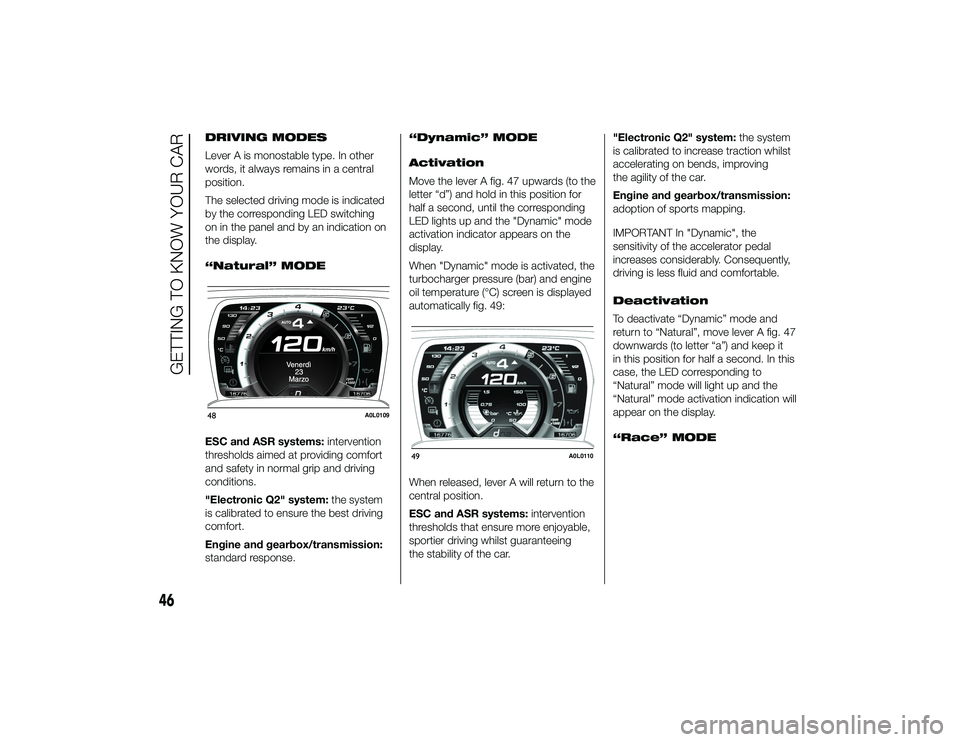
DRIVING MODES
Lever A is monostable type. In other
words, it always remains in a central
position.
The selected driving mode is indicated
by the corresponding LED switching
on in the panel and by an indication on
the display.
“Natural” MODE
ESC and ASR systems:intervention
thresholds aimed at providing comfort
and safety in normal grip and driving
conditions.
"Electronic Q2" system: the system
is calibrated to ensure the best driving
comfort.
Engine and gearbox/transmission:
standard response. “Dynamic” MODE
Activation
Move the lever A fig. 47 upwards (to the
letter “d”) and hold in this position for
half a second, until the corresponding
LED lights up and the "Dynamic" mode
activation indicator appears on the
display.
When "Dynamic" mode is activated, the
turbocharger pressure (bar) and engine
oil temperature (°C) screen is displayed
automatically fig. 49:
When released, lever A will return to the
central position.
ESC and ASR systems:
intervention
thresholds that ensure more enjoyable,
sportier driving whilst guaranteeing
the stability of the car. "Electronic Q2" system:
the system
is calibrated to increase traction whilst
accelerating on bends, improving
the agility of the car.
Engine and gearbox/transmission:
adoption of sports mapping.
IMPORTANT In "Dynamic", the
sensitivity of the accelerator pedal
increases considerably. Consequently,
driving is less fluid and comfortable.
Deactivation
To deactivate “Dynamic” mode and
return to “Natural”, move lever A fig. 47
downwards (to letter “a”) and keep it
in this position for half a second. In this
case, the LED corresponding to
“Natural” mode will light up and the
“Natural” mode activation indication will
appear on the display.
“Race” MODE48
A0L0109
49
A0L0110
46
GETTING TO KNOW YOUR CAR
24-9-2013 11:49 Pagina 46
Page 50 of 190
Activation
Move the lever A fig. 47 upwards (to the
letter “d”) and hold in this position for
5 seconds, until the "Race" mode
activation indicator appears on the
display. When "Race" mode is
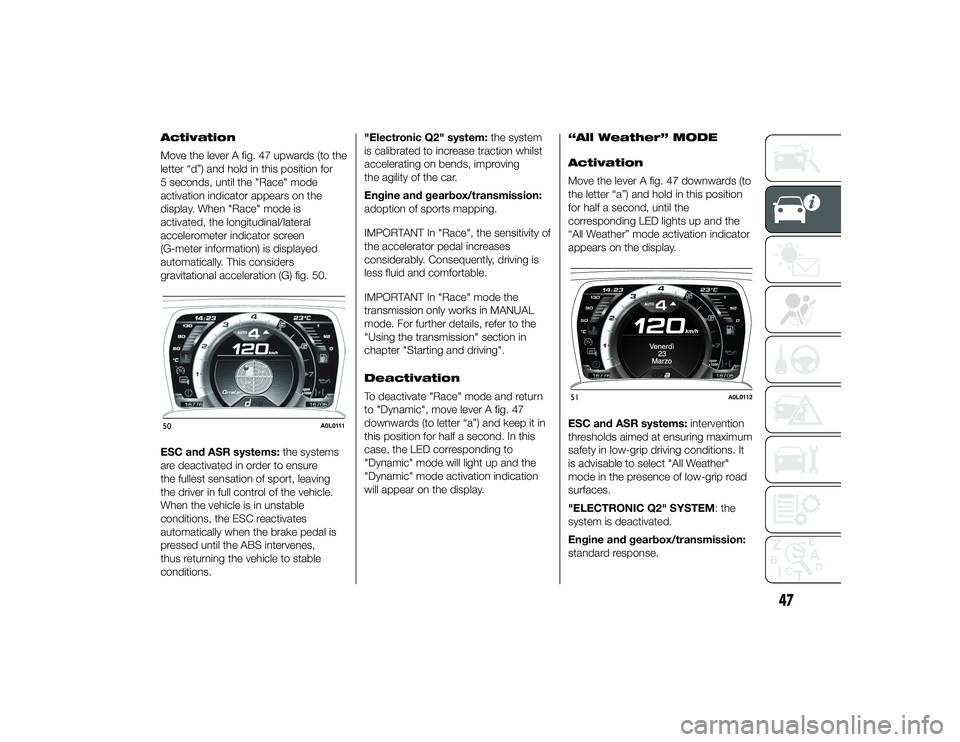
activated, the longitudinal/lateral
accelerometer indicator screen
(G-meter information) is displayed
automatically. This considers
gravitational acceleration (G) fig. 50.
ESC and ASR systems:the systems
are deactivated in order to ensure
the fullest sensation of sport, leaving
the driver in full control of the vehicle.
When the vehicle is in unstable
conditions, the ESC reactivates
automatically when the brake pedal is
pressed until the ABS intervenes,
thus returning the vehicle to stable
conditions. "Electronic Q2" system:
the system
is calibrated to increase traction whilst
accelerating on bends, improving
the agility of the car.
Engine and gearbox/transmission:
adoption of sports mapping.
IMPORTANT In "Race", the sensitivity of
the accelerator pedal increases
considerably. Consequently, driving is
less fluid and comfortable.
IMPORTANT In "Race" mode the
transmission only works in MANUAL
mode. For further details, refer to the
"Using the transmission" section in
chapter "Starting and driving".
Deactivation
To deactivate "Race" mode and return
to "Dynamic", move lever A fig. 47
downwards (to letter “a”) and keep it in
this position for half a second. In this
case, the LED corresponding to
"Dynamic" mode will light up and the
"Dynamic" mode activation indication
will appear on the display. “All Weather” MODE
Activation
Move the lever A fig. 47 downwards (to
the letter “a”) and hold in this position
for half a second, until the
corresponding LED lights up and the
“All Weather” mode activation indicator
appears on the display.
ESC and ASR systems:
intervention
thresholds aimed at ensuring maximum
safety in low-grip driving conditions. It
is advisable to select "All Weather"
mode in the presence of low-grip road
surfaces.
"ELECTRONIC Q2" SYSTEM: the
system is deactivated.
Engine and gearbox/transmission:
standard response.50
A0L0111
51
A0L0112
47
24-9-2013 11:49 Pagina 47
Page 65 of 190

SPEEDOMETER (SPEED
INDICATOR)
Indicator J shows the speed of the car.
REV COUNTER
Light C shows the engine revs.
FUEL LEVEL GAUGE
Gauge G shows the amount of fuel in
the tank.
The switching on of the
digital
warning light indicates that 4–5 litres of
fuel are left in the tank; in this situation,
refuel as soon as possible.
Do not travel with the fuel tank almost
empty: any gaps in fuel delivery could
damage the catalytic converter.
ENGINE COOLANT
TEMPERATURE
INDICATOR
Indicator A shows the temperature of
the engine coolant and starts supplying
indications when the fluid temperature
exceeds approximately 50°C.
The
digital warning light may switch
on (together with a message on the
display) to indicate that the coolant
temperature is too high; in this case,
stop the engine and contact a
dedicated Alfa Romeo Dealership. GEAR SHIFT INDICATOR
The GSI (Gear Shift Indicator) system
advises the driver to change gear
through a specific indication E fig. 59
on the instrument panel.
Through the GSI, the driver is notified
that changing gear will allow a
reduction in fuel consumption.
Therefore, for driving oriented towards
reducing fuel consumption, it is
advisable to stick to “Natural” or “All
Weather” mode and to follow the
suggestions of the Gear Shift Indicator,
where traffic conditions permit.
When the (
) icon is displayed on the
instrument panel, the GSI suggests
switching to a higher gear, while when
the (
) icon is displayed, the GSI
suggests changing to a lower gear.
IMPORTANT The GSI is not active
when the transmission is operating in
AUTO mode.
IMPORTANT The indication in the
instrument panel remains on until the
driver shifts gear or the driving
conditions go back to a situation where
gearshifting is not required to improve
consumption.
SETUP MENUCONTROL BUTTONS
SET/
: press briefly to access the
menu and/or go to next screen or
confirm the selection. Hold down to
return to the standard screen fig. 61.
: to scroll up through the displayed
screen and the related options or to
increase the displayed value.: to scroll down through the
displayed menu and the related options
or to decrease the value displayed.
IMPORTANT The
and
buttons
activate different functions according to
the following situations:
❒ within the menu, they allow you to
scroll up and down through the
options;
61
A0L0125
62
KNOWING THE INSTRUMENT PANEL
24-9-2013 11:49 Pagina 62
Page 117 of 190

STARTING THE
ENGINEContact the dedicated Alfa Romeo
Dealership immediately if
warning
light stays on constantly on the
instrument panel.
JUMP STARTING
If the battery is flat, start the engine
using an auxiliary battery with the same
capacity or a little higher than the flat
one.
11)
91)
Proceed as follows to start the car:
❒ connect the positive terminals (+ sign
near the terminal) of the two batteries
with a jump lead fig. 79; ❒
with a second lead, connect the
negative terminal(−)oftheauxiliary
battery to an earthing point
on
the engine or the gearbox/
transmission of the car to be started;
❒ start the engine; when the engine has
started, remove the leads, reversing
the order above.
If after a few attempts the engine does
not start, do not persist but contact
the dedicated Alfa Romeo Dealership.
IMPORTANT Do not connect the
negative terminals of the two batteries
directly! If the auxiliary battery is
installed on another car, check that
there is no accidental contact between
metallic parts of the two cars.
BUMP STARTING
Never, under any circumstances, jump
start the engine by pushing, towing
or coasting downhill.
IMPORTANT
11) Never use a fast battery charger to start the engine as this could
damage the electronic systems
and the ignition and engine supply
control units.
WARNING
91) This procedure must beperformed by qualified personnel
as incorrect actions may cause
high-intensity electrical discharge.
Furthermore, battery fluid is
poisonous and corrosive: avoid
contact with skin and eyes. Keep
naked flames and lit cigarettes
away from the battery and do not
cause sparks.
79
A0L0116
114
IN AN EMERGENCY
24-9-2013 11:50 Pagina 114
Page 139 of 190
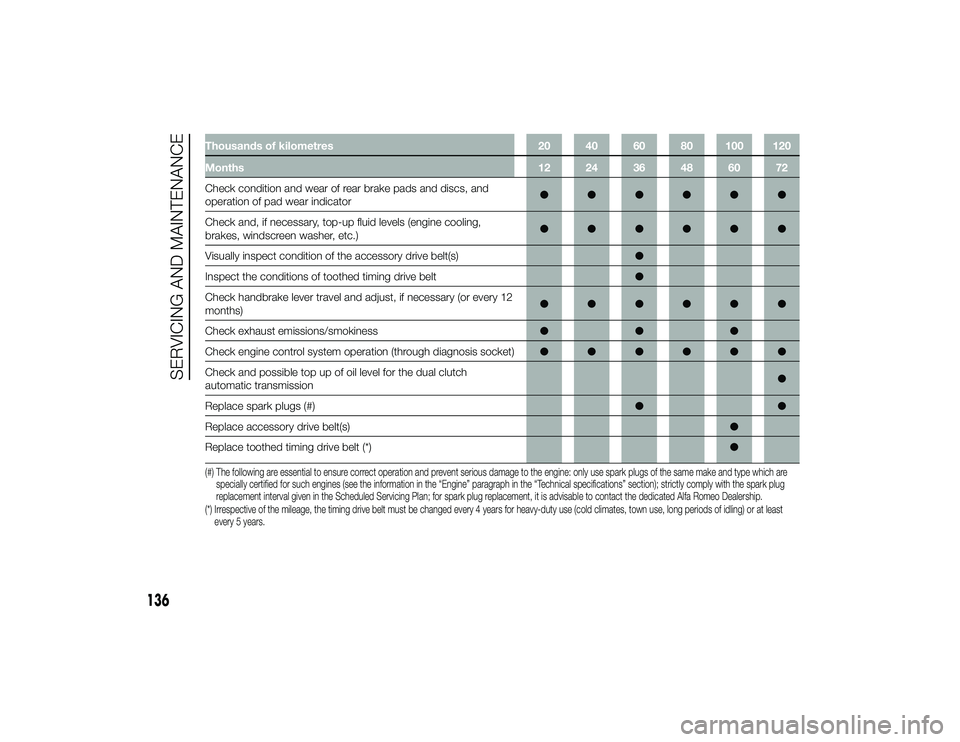
Thousands of kilometres20 40 60 80 100 120
Months 12 24 36 48 60 72
Check condition and wear of rear brake pads and discs, and
operation of pad wear indicator ●●●●●●
Check and, if necessary, top-up fluid levels (engine cooling,
brakes, windscreen washer, etc.) ●●●●●●
Visually inspect condition of the accessory drive belt(s) ●
Inspect the conditions of toothed timing drive belt ●
Check handbrake lever travel and adjust, if necessary (or every 12
months) ●●●●●●
Check exhaust emissions/smokiness ●●●
Check engine control system operation (through diagnosis socket) ●●●●●●
Check and possible top up of oil level for the dual clutch
automatic transmission ●
Replace spark plugs (#) ●●
Replace accessory drive belt(s) ●
Replace toothed timing drive belt (*) ●(#) The following are essential to ensure correct operation and prevent serious damage to the engine: only use spark plugs of the same make and type which are
specially certified for such engines (see the information in the “Engine” paragraph in the “Technical specifications” section); strictly comply with the spark plug
replacement interval given in the Scheduled Servicing Plan; for spark plug replacement, it is advisable to contact the dedicated Alfa Romeo Dealership.
(*) Irrespective of the mileage, the timing drive belt must be changed every 4 years for heavy-duty use (cold climates, town use, long periods of idling) or at least every 5 years.
136
SERVICING AND MAINTENANCE
24-9-2013 11:50 Pagina 136
Page 141 of 190
PERIODIC CHECKSEvery 1,000 km or before long
journeys, check and, if necessary, top
up the following:
❒engine coolant level;
❒ brake fluid;
❒ screen washer fluid;
❒ tyre inflation pressure and condition;
❒ operation of lighting system
(headlamps, direction indicators,
hazard warning lights, etc.);
❒ operation of screen washing/wiping
system and positioning/wear of
wiper blade.
Every 3,000 km, check and top up if
required: engine oil level.
HEAVY-DUTY USE OF
THE CARIf the car is used mainly under one of
the following conditions:
❒ if the car is used under demanding
conditions, e.g. on track;
❒ dusty roads;
❒ short, repeated journeys (less than
7–8 km) at sub-zero outside
temperatures;
❒ engine often idling or driving long
distances at low speeds or long
periods of inactivity;
the following checks must be carried
out more often than indicated in the
Scheduled Servicing Plan:
❒ check of front and rear disc brake
pad condition and wear;
❒ check cleanliness of tailgate locks,
cleanliness and lubrication of linkage;
❒ visually inspect conditions of: engine,
gearbox, transmission, pipes and
hoses (exhaust - fuel system -
brakes) and rubber elements (boots -
sleeves - bushes - etc.);
❒ check battery charge and battery
fluid level (electrolyte);
❒ visually inspect condition of the
accessory drive belts; ❒
check and, if necessary, change
engine oil and replace oil filter;
❒ check and, if necessary, replace air
cleaner.
Using the car on track should be
regarded as an exception. The car has
been designed and produced for road
use.
138
SERVICING AND MAINTENANCE
24-9-2013 11:50 Pagina 138
Page 156 of 190

TECHNICAL SPECIFICATIONS
Everything you may find useful for
understanding how your car is made
and works is contained in this chapter
and illustrated with data, tables and
graphics. For the enthusiasts and the
technician, but also just for those who
want to know every detail of their
car.IDENTIFICATION DATA....................154
ENGINE CODES - BODY
VERSIONS ......................................156
ENGINE ..........................................157
FUEL SUPPLY .................................158
TRANSMISSION .............................159
BRAKES .........................................160
SUSPENSION .................................161
STEERING ......................................162
WHEELS .........................................163
DIMENSIONS ..................................167
PERFORMANCE .............................168
WEIGHTS .......................................169
REFUELLING ..................................170
FLUIDS AND LUBRICANTS ............171
FUEL CONSUMPTION ....................174
CO2 EMISSIONS ............................175
PRESCRIPTIONS FOR HANDLING
THE VEHICLE AT THE END OF ITS
LIFE ................................................176
153
24-9-2013 11:50 Pagina 153
Page 173 of 190

REFUELLING
1750 Turbo PetrolPrescribed fuels / Original fluids
and lubricants
litres kg
Fuel tank 40-
Unleaded petrol not less than 95
RON (EN 228 specification)
including a reserve of 4 - 5-
Engine cooling system 10.69.4Mixture of 50% demineralised water
and 50% PARAFLU
UP
(*)
Engine sump 5.44.6
SELENIA SPORT POWER
Engine sump and filter 5.85.0
Transmission/differential casing: 1.881.6TUTELA TRANSMISSION
GEARTECH
Transmission hydraulic activation system 1.45 1.2 TUTELA CS SPEED
Hydraulic brake circuit with ABS 0.520.56 TUTELA TOP 4
Windscreen washer fluid reservoir 1.91.7Mixture of water and TUTELA
PROFESSIONAL SC 35
(*) When the vehicle is used in particularly harsh weather conditions, we recommend using a 60-40 mixture of PARAFLU
UPand demineralised water.
170
TECHNICAL SPECIFICATIONS
24-9-2013 11:50 Pagina 170
Page 175 of 190

UseFluid and lubricant specifications for a correct
use of the car Genuine fluids and
lubricants Applications
Lubricants and
greases for drive
transmission SAE 75W 85 grade synthetic lubricant
FIAT 9.55550-MZ3 classification.
TUTELA
TRANSMISSION
GEARTECH
Contractual Technical
Reference No. F704.C08TCT automatic
transmission
Specific fluid for electro-hydraulic ratio selector
actuators
FIAT 9.55550-SA1 classification TUTELA CS SPEED
Contractual Technical
Reference No. F005.F98
Lubricant for electro-
hydraulic actuator
Molybdenum disulphide grease, for use at high
temperatures. NL.G.I. 1-2 consistency
FIAT 9.55580 classification TUTELA ALL STAR
Contractual Technical
Reference No. F702.G07
Wheel side constant
velocity joints
Grease for constant velocity joints with low friction
coefficient. NL.G.I. 0-1 consistency
FIAT 9.55580 classification TUTELA STAR 700
Contractual Technical
Reference No. F701.C07
Differential side
constant velocity joints
Brake fluid Synthetic fluid for brake and clutch systems.
Exceeds specifications: FMVSS no. 116 DOT 4,
ISO 4925, SAE J1704.
FIAT 9.55597 classification TUTELA TOP 4
Contractual Technical
Reference No. F001.A93
Hydraulic brakes and
hydraulic clutch
controls
172
TECHNICAL SPECIFICATIONS
24-9-2013 11:50 Pagina 172
Page 187 of 190

– speedometer ............................. 62Parking ......................................... 103
– Handbrake ................................ 103
Parking lights ................................. 27
Parking sensors ............................. 50
Passenger side front airbag ............ 98
Performance .................................. 168
Plugs (type) .................................... 157
Power socket ................................. 34
Pre-Fill system (RAB - Ready Alert Brake) .................................. 44
Pretensioners ................................. 92 – Load limiters.............................. 93
Protecting the environment ............ 57Radio system................................ 49
Radio transmitters and mobile phones......................................... 50
Raising the car ............................... 129
Rear direction indicators................. 123
Rear fog light.................................. 32
Rear fog light/reversing light ........... 124
Rear view mirrors ........................... 18 – Internal mirror ............................ 18
Rear window washer – rear window washer fluid level ... 141
Refuelling ....................................... 170
Refuelling the car ........................... 56
Rev counter ................................... 62
Rim Protector................................. 164 Roof light
– bulb replacement ...................... 125
Roof lights...................................... 31 – Front roof light ........................... 31
Saving fuel .................................... 109
SBR system (Seat Belt Reminder) .................................... 92
Scheduled Servicing Plan ............... 135
Screen wiper/washer ..................... 28 – “Smart washing” function .......... 29
Seat belts....................................... 90 – Use ........................................... 90
Seats ............................................. 15
Setup menu ............................... 62-63
Side air diffusers............................. 19
Side lights/brake lights ................... 123
Side lights/daytime running lights (DRL)
– bulb replacement ...................... 122
Side lights/dipped headlights ......... 27
Snow tyres ..................................... 111
Speedometer ................................. 62
Speedometer (speed indicator) ...... 62
Starting the engine ......................... 102
Starting the engine ......................... 114 – Bump starting ........................... 114
– Jump starting ............................ 114
Steering ......................................... 162
Steering lock .................................. 15
Steering wheel ............................... 17 Storage compartments .................. 33
Sun visors ...................................... 35
Suspension .................................... 161
Symbols......................................... 10
Technical data .............................. 154
The keys ........................................ 11 – Key without remote control........ 11
– Key with remote control............. 11
Third brake lights – bulb replacement ...................... 124
Towing the car ............................... 130 – Attaching the tow hook ............. 130
TPMS (Tyre Pressure Monitoring System)........................................ 53
Transmission .................................. 159
TRIP button.................................... 69
Trip Computer ................................ 68
Tyres – Fix&Go automatic (kit) ............... 115
– inflation pressures ..................... 166
– reading the tyre code ................ 163
– Rim Protector tyres ................... 164
– snow tyres................................. 165
– tyres provided ........................... 165
Tyres - maintenance ....................... 147Using the transmission.................. 104W
arning lights and messages ....... 71
Weights.......................................... 169
Wheel rims
INDEX