instrument panel Alfa Romeo 4C 2016 Owner handbook (in English)
[x] Cancel search | Manufacturer: ALFA ROMEO, Model Year: 2016, Model line: 4C, Model: Alfa Romeo 4C 2016Pages: 182, PDF Size: 9.49 MB
Page 10 of 182

GRAPHICAL INDEX
GETTING TO KNOW YOUR CAR
KNOWING THE INSTRUMENT PANEL
SAFETY
STARTING AND DRIVING
IN AN EMERGENCY
SERVICING AND MAINTENANCE
TECHNICAL SPECIFICATIONS
INDEX
Page 14 of 182
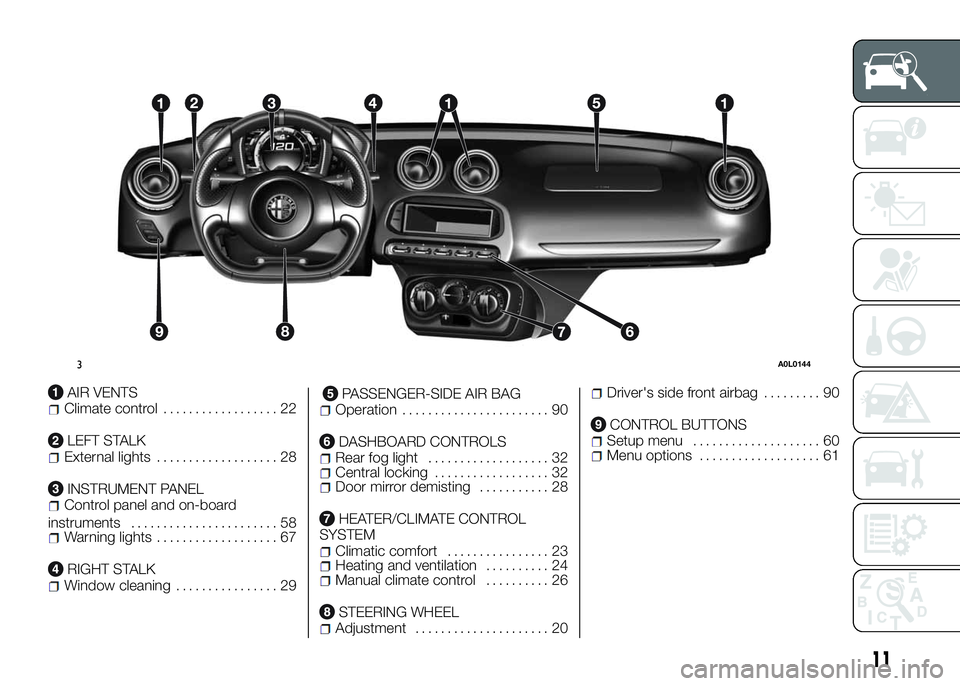
AIR VENTSClimate control.................. 22
LEFT STALKExternal lights................... 28
INSTRUMENT PANELControl panel and on-board
instruments....................... 58
Warning lights................... 67
RIGHT STALKWindow cleaning................ 29
PASSENGER-SIDE AIR BAGOperation....................... 90
DASHBOARD CONTROLSRear fog light................... 32Central locking.................. 32Door mirror demisting........... 28
HEATER/CLIMATE CONTROL
SYSTEM
Climatic comfort................ 23Heating and ventilation.......... 24Manual climate control.......... 26
STEERING WHEELAdjustment..................... 20
Driver's side front airbag......... 90
CONTROL BUTTONSSetup menu.................... 60Menu options................... 61
3A0L0144
11
Page 20 of 182
Activation
With the doors and tailgate closed and
the ignition key either turned to STOP
or removed, point the key with remote
control towards the car then press and
release the
button.
For versions/markets, where provided,
the system emits an acoustic signal and
activates door locking.
A self-diagnosis stage lasting
approximately 30 seconds precedes
the activation of the alarm: during this,
the LED flashes on the dashboard at a
frequency of about one flash per
second.
After the self-diagnosis stage, the LED
flashes at a lower frequency (one flash
every 3 seconds approx.).
If, after the alarm is switched on, a
second acoustic signal is emitted
and/or a visual signal via the LED on the
dashboard, wait about 4 seconds and
switch off the alarm by pressing the
button, check that the doors and
tailgate are closed correctly and then
reactivate the system by pressing the
button.
If the alarm emits an acoustic signal
even when the doors and tailgate are
closed correctly, a system malfunction
has occurred: in this case, contact a
dedicated Alfa Romeo Dealership.
Deactivation
Press thebutton.
The following operations are performed
(for versions/markets, where provided):
two brief flashes of the direction
indicators;
unlocking of the doors.
IMPORTANT If the central door locking
system is released using the metal
insert of the key, the alarm is not
disabled.
IMPORTANT In the event of accidental
activation of the alarm, or in any case to
interrupt the acoustic and visual signal
cycle when activated, it is possible to
press the
button or turn the ignition
key to MAR-ON for at least 5 seconds,
after which the system will deactivate.
Disabling
To completely disable the alarm (e.g.
during a lengthy period of car inactivity),
lock the car by turning the metal insert
of the key in the door lock.
IMPORTANT If the batteries of the key
with remote control run out or there is a
fault in the system, the alarm can be
switched off by inserting the key in the
ignition switch and turning it to
MAR-ON.
Volumetric/anti-lift
protection
To ensure the correct operation of the
protection, completely close the side
windows.
To disable the volumetric protection,
turn the ignition key from STOP to
MAR-ON twice in a row, then activate
the alarm within 15 seconds, pressing
the
button on the remote control.
When the function is deactivated, this is
indicated by the LED on the dashboard
flashing for several seconds.
To disable the anti-lift protection as well,
the ignition key must be turned from
STOP to MAR-ON three times in a row,
followed by activating the alarm within
15 seconds, pressing the
button on
the remote control.
When the function is deactivated, this is
indicated by the LED on the dashboard
flashing for several seconds.
Any disabling of the volumetric/anti-lift
protection must be repeated each time
the instrument panel is switched off.
17
Page 31 of 182
DOOR MIRROR
DEMISTING
Press thebutton F fig. 21 to
activate this function.
Activation is indicated by the digital
warning light on the display.
Press the
button again to deactivate
the function.
SYSTEM MAINTENANCE
In winter, the climate control system
must be turned on at least once a
month for about 10 minutes. Have the
system inspected at a dedicated Alfa
Romeo Dealership before the summer.
3)
IMPORTANT
3)The system uses R-1234yf coolant
which does not pollute the environment in
the event of accidental leakage. Under no
circumstances should you use R-134a fluid
which, in addition to being incompatible
with the system’s components, contributes
greatly to the greenhouse effect.
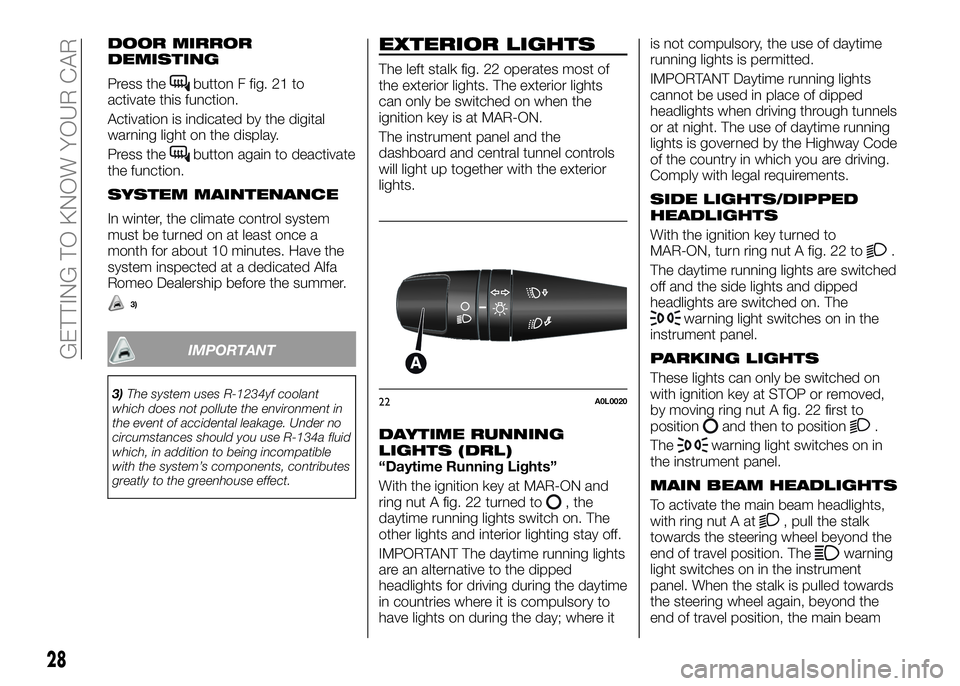
EXTERIOR LIGHTS
The left stalk fig. 22 operates most of
the exterior lights. The exterior lights
can only be switched on when the
ignition key is at MAR-ON.
The instrument panel and the
dashboard and central tunnel controls
will light up together with the exterior
lights.
DAYTIME RUNNING
LIGHTS (DRL)
“Daytime Running Lights”
With the ignition key at MAR-ON and
ring nut A fig. 22 turned to
, the
daytime running lights switch on. The
other lights and interior lighting stay off.
IMPORTANT The daytime running lights
are an alternative to the dipped
headlights for driving during the daytime
in countries where it is compulsory to
have lights on during the day; where itis not compulsory, the use of daytime
running lights is permitted.
IMPORTANT Daytime running lights
cannot be used in place of dipped
headlights when driving through tunnels
or at night. The use of daytime running
lights is governed by the Highway Code
of the country in which you are driving.
Comply with legal requirements.
SIDE LIGHTS/DIPPED
HEADLIGHTS
With the ignition key turned to
MAR-ON, turn ring nut A fig. 22 to.
The daytime running lights are switched
off and the side lights and dipped
headlights are switched on. The
warning light switches on in the
instrument panel.
PARKING LIGHTS
These lights can only be switched on
with ignition key at STOP or removed,
by moving ring nut A fig. 22 first to
position
and then to position.
The
warning light switches on in
the instrument panel.
MAIN BEAM HEADLIGHTS
To activate the main beam headlights,
with ring nut A at, pull the stalk
towards the steering wheel beyond the
end of travel position. The
warning
light switches on in the instrument
panel. When the stalk is pulled towards
the steering wheel again, beyond the
end of travel position, the main beam
22A0L0020
28
GETTING TO KNOW YOUR CAR
Page 32 of 182
headlights deactivate, the dipped beam
headlights reactivate and the warning
light
switches off.
FLASHING
To do this, pull the stalk towards the
steering wheel (unstable position)
regardless of the position of ring nut A.
The
warning light switches on in
the instrument panel.
REAR FOG LIGHTS
For the activation and deactivation of
the rear fog lights, refer to the
"Controls" section.
DIRECTION INDICATORS
Bring the stalk to the (stable) position:upwards: activates right direction
indicator;
downwards: activates left direction
indicator.
Warning light
orwill blink on the
instrument panel.
The direction indicators are switched off
automatically when the steering wheel
is straightened.
"Lane change" function
If you wish to signal a lane change,
place the left stalk in the unstable
position for less than half a second. The
direction indicator on the side selected
will flash five times and then switch off
automatically.
"FOLLOW ME HOME"
DEVICE
This device allows you to illuminate the
area in front of the car for a certain
amount of time.
Activation
With the key turned to STOP or
removed, pull stalk A towards the
steering wheel within 2 minutes from
when the engine is turned off.
Each time the stalk is moved, the lights
stay on for an extra 30 seconds up to a
maximum of 210 seconds; then the
lights are switched off automatically.
Also, each time the stalk is operated,
the
warning light on the
instrument panel switches on. The
display shows the time set for the
function and the corresponding
graphics.
The warning light comes on when the
lever is operated and stays on until the
function is automatically deactivated.
Each movement of the stalk only
increases the amount of time the lights
stay on.
Deactivation
Keep the stalk pulled towards the
steering wheel for more than 2
seconds.
WINDOW CLEANING
The right stalk controls screen
wiper/washer operation.
This operates only with the ignition key
at MAR-ON.
SCREEN WIPER/WASHER
Operation12) 13)
Ring nut A fig. 23 can be set to the
following positions:
Owiper off;
intermittent operation;
continuous slow operation;
continuous fast operation.
Move the stalk upwards (unstable
position) to limit operation to the time
for which the stalk is held manually in
this position. When released, the stalk
will return to its initial position and the
23A0L0021
29
Page 44 of 182
on the car to determine the trajectory
that the driver intends to follow and
compares it with the car’s effective
trajectory. When the real trajectory
deviates from the desired trajectory, the
ESC system intervenes to counter the
car’s understeer or oversteer.
Oversteer: occurs when the vehicle is
turning more than it should according
to the angle of the steering wheel.
Understeer: occurs when the vehicle
is turning less than it should according
to the angle of the steering wheel
The ESC system also includes the
following systems:
ABS
EBD
CBC
DTC
ASR
HILL HOLDER
HBA
“ELECTRONIC Q2” (“E-Q2”)
"PRE-FILL" (RAB - Ready Alert
Brake)
SYSTEM ACTIVATION
The ESC system activates automatically
when the engine is started and can only
be deactivated by selecting "Race"
mode. For more details, refer to the
"Alfa DNA system" paragraph in this
chapter.
SYSTEM INTERVENTION
This is indicated by the flashing of thewarning light on the instrument
panel, to inform the driver that the car is
in critical stability and grip conditions.
ABS
This system, which is an integral part of
the braking system, prevents one or
more wheels from locking and slipping
in all road surface conditions,
irrespective of the intensity of the
braking action, ensuring that the car
can be controlled even during
emergency braking and optimising
stopping distances.
The system intervenes when braking
and the wheels are about to lock,
typically in emergency braking or
low-grip conditions, when locking may
be more frequent.
The system also improves control and
stability of the car when braking on a
surface where the grip of the left and
right wheels varies, or on corners.
31) 32) 33) 34) 35) 36) 37)
System intervention
A slight pulsing of the brake pedal and
noise indicates the intervention of the
ABS: this is completely normal when
the system intervenes.
EBD SYSTEM
The EBD system is an integral part of
the ABS system and intervenes during
braking, distributing the brake force
optimally between front and rear
wheels.
This guarantees greater braking stability
for the vehicle, preventing sudden
locking of the rear wheels and the
consequent instability of the vehicle.
CBC (Cornering Brake
Control) SYSTEM
The system acts when braking on
corners, optimising the distribution of
brake pressure on the four wheels: the
system prevents the wheels on the
inside of the corner (less affected by the
weight of the car) from locking, ensuring
better stability and direction for the car.
DTC (Drag Torque
Control) SYSTEM
This is an integral part of the ABS
system and intervenes in the case of
sudden downshifting, or during braking
when the ABS intervenes, restoring
torque to the engine and thus
preventing excessive drag at the drive
wheels, which may lead the wheels to
lock and a loss of car stability, above all
in low-grip conditions.
41
Page 45 of 182
ASR (AntiSlip
Regulation) SYSTEM
29) 30) 38) 39) 40)
This is an integral part of the ESC
system and automatically operates in
the event of one or both drive wheels
slipping, loss of grip on wet roads
(aquaplaning) and acceleration on
slippery, snowy or icy roads, etc.
Depending on the slipping conditions,
two different control systems are
activated:
if the slipping involves both drive
wheels, the ASR system intervenes,
reducing the power transmitted by the
engine;
if the slipping only involves one of
the drive wheels, it also intervenes
automatically, braking the wheel that is
slipping.
System intervention
This is indicated by the flashing of the
warning light on the instrument
panel, to inform the driver that the car is
in critical stability and grip conditions.
HILL HOLDER SYSTEM
This is an integral part of the ESC
system and facilitates starting on
slopes, activating automatically in the
following cases:
uphill: car stationary on a road with a
gradient higher than 5%, engine
running, brake pressed and
transmission in neutral or gear otherthan reverse engaged;
downhill: car stationary on a road
with a gradient higher than 5%, engine
running, brake pressed and reverse
gear engaged.
When setting off, the ESC system
control unit maintains the braking
pressure on the wheels until the engine
torque necessary for starting is
reached, or in any case for a maximum
of 2 seconds, allowing your right foot to
be moved easily from the brake pedal
to the accelerator.
When the 2 seconds have elapsed,
without starting, the system is
automatically deactivated, gradually
releasing the braking pressure. During
this release stage, the typical brake
disengagement noise, indicating that
the car is going to move imminently,
can be heard.
IMPORTANT The Hill Holder system is
not a parking brake; therefore, never
leave the vehicle without having
engaged the handbrake, turned the
engine off and engaged first gear, so
that the vehicle is parked in safe
conditions (for further information read
the "Parking" paragraph in the "Starting
and driving" chapter).
IMPORTANT There may be situations
on small gradients (less than 8%), with
vehicle laden, in which the Hill Holder
system may not activate, causing a
slight reversing motion and increasingthe risk of collision with another vehicle
or object. The driver is, in any case,
responsible for safe driving.
HBA (Hydraulic Brake
Assistant) SYSTEM
41) 42) 43)
The HBA system is designed to
improve the car’s braking capacity
during emergency braking. The system
detects emergency braking by
monitoring the speed and force with
which the brake pedal is pressed, and
consequently applies the optimal brake
pressure. This can reduce the braking
distance, the HBA system therefore
completes the ABS.
Maximum assistance from the HBA
system is obtained pressing the brake
pedal very quickly. In addition, the brake
pedal should be pressed continuously
during braking, avoiding intermittent
presses, to get the most out of the
system.
Do not reduce pressure on the brake
pedal until braking is no longer
necessary.
The HBA system is deactivated when
the brake pedal is released.
“ELECTRONIC Q2”
SYSTEM (“E-Q2”)
The "Electronic Q2" system intervenes
during acceleration on corners, braking
the inner drive wheel and thus
increasing the traction of the outer
wheel (which bears more of the car’s
42
GETTING TO KNOW YOUR CAR
Page 49 of 182
safety in low-grip driving conditions. It is
advisable to select "All Weather" mode
in the presence of low-grip road
surfaces.
"ELECTRONIC Q2" SYSTEM: the
system is deactivated.
Engine and gearbox/transmission:
standard response.
Deactivation
To deactivate “All Weather” mode and
return to “Natural”, move lever A
fig. 47 upwards (to letter “d”) and keep
it in this position for half a second.
IMPORTANT
During the first 250 km of usage of
the car, the Dynamic and Race modes
are inhibited. Within this first interval of
start-up mileage it is advisable to refrain
from an aggressive driving style, so that
the best gear shifting quality can be
achieved over time.
When the engine is next started, the
"All Weather" or "Dynamic" mode
selected previously is retained. The
system will reactivate in "All Weather" or
"Dynamic" mode, depending on which
mode was selected before the engine
was switched off.
When the engine is next started, the
"Race" mode selected previously is not
retained. The system will reactivate in
"Dynamic" mode.
It is not possible to go directly from
“Dynamic” mode to “All Weather” modeand vice versa. You must always first go
back to “Natural” mode and then select
the other mode.
System failure
In the event of system failure or a fault
with lever A fig. 47, no driving modes
can be selected.
The display will become grey (same
screen as "Natural" mode) but without
an indication of the Alfa DNA setting.
The display will also show a warning
message.
EOBD SYSTEM
(European On
Board Diagnosis)
Operation
The EOBD system (European On Board
Diagnosis) carries out a continuous
diagnosis of the components of the car
related to emissions.
It also alerts the driver, by switching on
the
warning light on the instrument
panel, together with a message on the
display, when these components are no
longer in peak condition (see “Warning
lights and messages” paragraph in the
"Knowing the instrument panel"
chapter).
The aim of the EOBD system (European
On Board Diagnosis) is to:
monitor the efficiency of the system;
indicate an increase in emissions;
indicate the need to replace
deteriorated components.
The car also has a connector, which
can interface with appropriate tools,
that makes it possible to read the error
codes stored in the electronic control
units together with a series of specific
parameters for engine operation and
diagnosis. This check can also be
carried out by the traffic control
authorities.
IMPORTANT After eliminating a fault, to
check the system completely, the
dedicated Alfa Romeo Dealership is
46
GETTING TO KNOW YOUR CAR
Page 52 of 182
ACOUSTIC SIGNAL
When reverse gear is engaged and
there is an obstacle behind the vehicle,
an acoustic signal is emitted which
varies according to the distance of the
bumper from the obstacle.
The frequency of the acoustic signal:
increases as the distance between
car and obstacle decreases,
culminating in a continuous acoustic
signal, when the distance is less than
approximately 30 cm;
decreases if the distance from the
obstacle increases, until the signal
ceases entirely;
remains constant if the distance
between car and obstacle remains
unchanged; if this situation concerns
the side sensors, the signal will stop
after approximately 3 seconds to avoid,
for example, indications in the event of
manoeuvres along a wall.
If several obstacles are detected by the
sensors, only the nearest one is
considered.
INDICATIONS ON
DISPLAY
(for versions/markets, where provided)
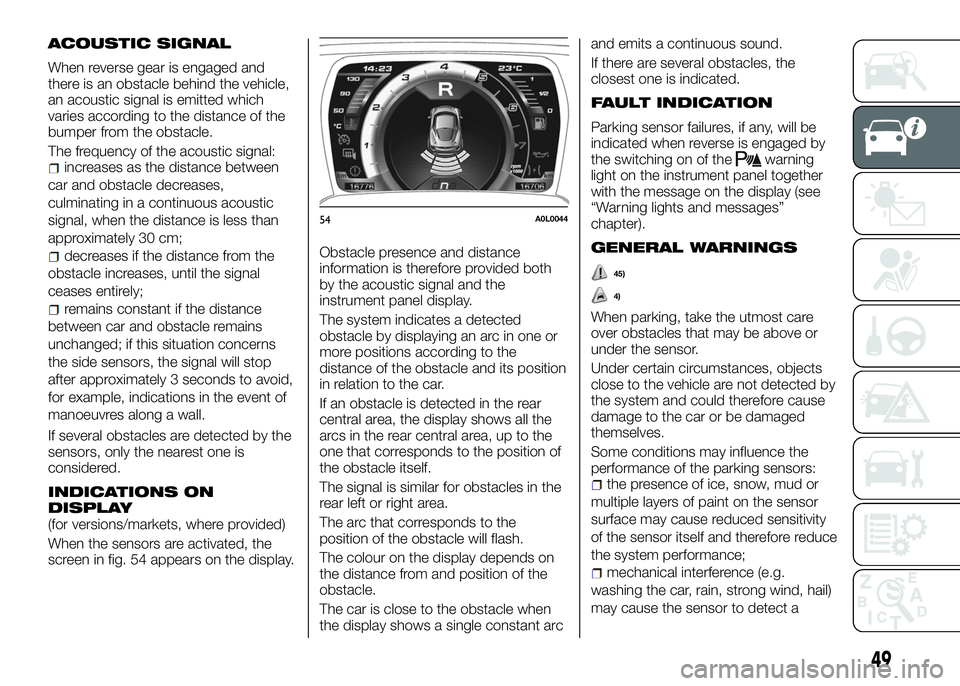
When the sensors are activated, the
screen in fig. 54 appears on the display.Obstacle presence and distance
information is therefore provided both
by the acoustic signal and the
instrument panel display.
The system indicates a detected
obstacle by displaying an arc in one or
more positions according to the
distance of the obstacle and its position
in relation to the car.
If an obstacle is detected in the rear
central area, the display shows all the
arcs in the rear central area, up to the
one that corresponds to the position of
the obstacle itself.
The signal is similar for obstacles in the
rear left or right area.
The arc that corresponds to the
position of the obstacle will flash.
The colour on the display depends on
the distance from and position of the
obstacle.
The car is close to the obstacle when
the display shows a single constant arcand emits a continuous sound.
If there are several obstacles, the
closest one is indicated.
FAULT INDICATION
Parking sensor failures, if any, will be
indicated when reverse is engaged by
the switching on of the
warning
light on the instrument panel together
with the message on the display (see
“Warning lights and messages”
chapter).
GENERAL WARNINGS
45)
4)
When parking, take the utmost care
over obstacles that may be above or
under the sensor.
Under certain circumstances, objects
close to the vehicle are not detected by
the system and could therefore cause
damage to the car or be damaged
themselves.
Some conditions may influence the
performance of the parking sensors:
the presence of ice, snow, mud or
multiple layers of paint on the sensor
surface may cause reduced sensitivity
of the sensor itself and therefore reduce
the system performance;
mechanical interference (e.g.
washing the car, rain, strong wind, hail)
may cause the sensor to detect a
54A0L0044
49
Page 54 of 182
tyre low pressure control warning lightswitches on constantly, the inflation
pressure must be adjusted until it
reaches the pressure prescribed for
cold tyres. After the automatic update
of the system, the tyre pressure control
warning light switches off. You may
need to drive the car for about 20
minutes at a speed higher than 20 km/h
to allow the TPMS to receive this
information.
NOTE
The TPMS does not replace the
normal tyre maintenance service and
does not indicate any fault in a tyre.
Therefore, the TPMS should not be
used as pressure switch while adjusting
the tyre inflation pressure.
Driving with insufficient tyre pressure
causes their overheating and can result
in tyre failure. The low inflation pressure
reduces fuel efficiency and tyre tread life
and may also affect handling and
braking performance of the car.
The TPMS does not replace the
correct tyre maintenance. It is up to the
driver to maintain the correct tyre
pressure level measuring it with a
suitable pressure switch. This is
necessary even if the decrease in the
inflation pressure value does not cause
the tyre pressure control warning light
to switch on.
The TPMS warns the driver of any
condition of insufficient tyre pressure Ifthis drops below the insufficient
pressure limit for any reason including
low temperature and normal pressure
loss of the tyre.
The seasonal temperature changes
affect tyre pressure.
The TPMS uses wireless devices with
electronic sensors mounted on the
wheel rims to constantly monitor the
value of tyre pressure. The sensors
mounted on each wheel as part of the
valve stem transmit various information
of the tyres to the receiver module, in
order to calculate the pressure.
IMPORTANT Monitoring and
maintaining the correct pressure in all
four tyres are particularly important.
Tyre pressure
monitoring system low
pressure warnings
46) 47) 48) 49) 50) 51) 52) 53) 54)
The system warns the driver if one or
more tyres are flat by the dedicated
warning light
continuously on in the
instrument panel and by displaying
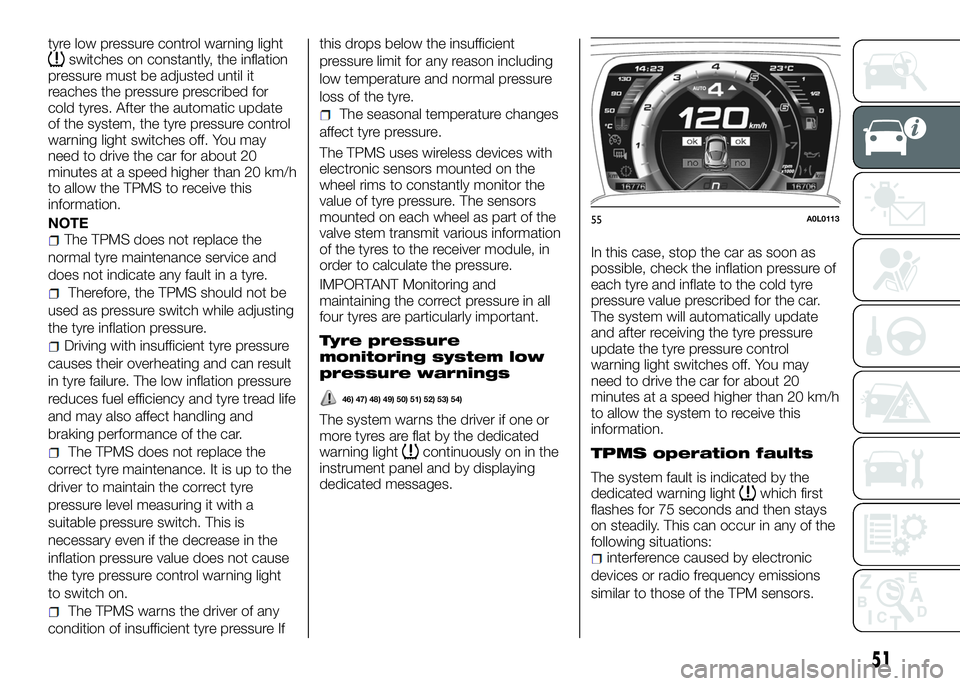
dedicated messages.In this case, stop the car as soon as
possible, check the inflation pressure of
each tyre and inflate to the cold tyre
pressure value prescribed for the car.
The system will automatically update
and after receiving the tyre pressure
update the tyre pressure control
warning light switches off. You may
need to drive the car for about 20
minutes at a speed higher than 20 km/h
to allow the system to receive this
information.TPMS operation faults
The system fault is indicated by the
dedicated warning lightwhich first
flashes for 75 seconds and then stays
on steadily. This can occur in any of the
following situations:
interference caused by electronic
devices or radio frequency emissions
similar to those of the TPM sensors.
55A0L0113
51