coolant Alfa Romeo 4C 2018 User Guide
[x] Cancel search | Manufacturer: ALFA ROMEO, Model Year: 2018, Model line: 4C, Model: Alfa Romeo 4C 2018Pages: 279, PDF Size: 3.08 MB
Page 209 of 279
CAUTION!(Continued)
condition. In the event of engine malfunction,
particularly involving engine misfire or other
apparent loss of performance, have your vehicle
serviced promptly. Continued operation of your
vehicle with a severe malfunction could cause the
converter to overheat, resulting in possible dam-
age to the converter and vehicle.
Under normal operating conditions, the catalytic con-
verter will not require maintenance. However, it is
important to keep the engine properly tuned to assure
proper catalyst operation and prevent possible catalyst
damage.
NOTE: Intentional tampering with emissions control
systems can result in civil penalties being assessed
against you.
In unusual situations involving grossly malfunctioning
engine operation, a scorching odor may suggest severe
and abnormal catalyst overheating. If this occurs, stop
the vehicle, turn off the engine and allow it to cool.
Service, including a tune-up to manufacturer’s specifi-
cations, should be obtained immediately.
To minimize the possibility of catalytic converter damage:
• Do not shut off the engine or interrupt the ignition,
when the transmission is in gear and the vehicle is in
motion.
• Do not try to start the engine by pushing or towing
the vehicle.
• Do not idle the engine with any spark plug wires
disconnected or removed, such as when diagnostic
testing, or for prolonged periods during very rough
idle or malfunctioning operating conditions.
Cooling System
WARNING!
• Turn vehicle off and disconnect the fan motor
lead before working near the radiator cooling fan.
•
You or others can be badly burned by hot engine
coolant (antifreeze) or steam from your radiator. If
you see or hear steam coming from under the hood,
do not open the hood until the radiator has had
time to cool. Never open a cooling system pressure
cap when the radiator or coolant bottle is hot.
(Continued)
8
SERVICING AND MAINTENANCE 207
Page 210 of 279
WARNING!(Continued)
•Keep hands, tools, clothing, and jewelry away
from the radiator cooling fan when the hood is
raised. The fan starts automatically and may start
at any time, whether the engine is running or not.
• When working near the radiator cooling fan,
disconnect the fan motor lead or turn the ignition
switch to the OFF position. The fan is temperature
controlled and can start at any time the ignition
switch is in the ON position.
Coolant Checks
Check engine coolant (antifreeze) protection every 12
months (before the onset of freezing weather, where
applicable). If the engine coolant (antifreeze) is dirty or
rusty in appearance, the system should be drained,
flushed and refilled with fresh engine coolant (anti-
freeze). Check the front of the A/C condenser for any
accumulation of bugs, leaves, etc. If dirty, clean by
gently spraying water from a garden hose vertically
down the face of the condenser.
Cooling System — Drain, Flush And Refill
NOTE: Some vehicles require special tools to add
coolant properly. Failure to fill these systems properly
could lead to severe internal engine damage. If any
coolant is needed to be added to the system please
contact an local authorized dealer.
If the engine coolant (antifreeze) is dirty or contains
visible sediment, have an authorized dealer clean and
flush with OAT coolant (antifreeze) (conforming to
MS.90032).
Refer to the “Maintenance Plan” in this section for the
proper maintenance intervals.
Selection Of Coolant
Refer to “Fluids And Lubricants” in “Technical Specifi-
cations” for further information.
208 SERVICING AND MAINTENANCE
Page 211 of 279
NOTE:
•Mixing of engine coolant (antifreeze) other than
specified Organic Additive Technology (OAT) engine
coolant (antifreeze), may result in engine damage
and may decrease corrosion protection. Organic Ad-
ditive Technology (OAT) engine coolant is different
and should not be mixed with Hybrid Organic
Additive Technology (HOAT) engine coolant (anti-
freeze) or any “globally compatible” coolant (anti-
freeze). If a non-OAT engine coolant (antifreeze) is
introduced into the cooling system in an emergency,
the cooling system will need to be drained, flushed,
and refilled with fresh OAT coolant (conforming to
MS.90032), by an authorized dealer as soon as pos-
sible.
• Do not use water alone or alcohol-based engine
coolant (antifreeze) products. Do not use additional
rust inhibitors or antirust products, as they may not
be compatible with the radiator engine coolant and
may plug the radiator.
• This vehicle has not been designed for use with
propylene glycol-based engine coolant (antifreeze).
Use of propylene glycolbased engine coolant (anti-
freeze) is not recommended. •
Some vehicles require special tools to add coolant
properly. Failure to fill these systems properly could
lead to severe internal engine damage. If any coolant
is needed to be added to the system please contact
your local authorized dealer.
Adding Coolant
Your vehicle has been built with an improved engine
coolant (OAT coolant conforming to MS.90032) that
allows extended maintenance intervals. This engine
coolant (antifreeze) can be used up to ten years or
150,000 miles (240,000 km) before replacement. To pre-
vent reducing this extended maintenance period, it is
important that you use the same engine coolant (OAT
coolant conforming to MS.90032) throughout the life of
your vehicle.
Please review these recommendations for using Or-
ganic Additive Technology (OAT) engine coolant (anti-
freeze) that meets the requirements of FCA Material
Standard MS.90032. When adding engine coolant (anti-
freeze):
• We recommend using Mopar Antifreeze/Coolant 10
Year/150,000 Mile (240,000 km) Formula OAT (Or-
ganic Additive Technology) that meets the require-
ments of FCA Material Standard MS.90032.
8
SERVICING AND MAINTENANCE 209
Page 212 of 279
•Mix a minimum solution of 50% OAT engine coolant
that meets the requirements of FCA Material Stan-
dard MS.90032 and distilled water. Use higher con-
centrations (not to exceed 70%) if temperatures below
34°F (37°C) are anticipated. Please contact an
authorized dealer for assistance.
• Use only high purity water such as distilled or
deionized water when mixing the water/engine
coolant (antifreeze) solution. The use of lower quality
water will reduce the amount of corrosion protection
in the engine cooling system.
NOTE:
• It is the owner’s responsibility to maintain the proper
level of protection against freezing according to the
temperatures occurring in the area where the vehicle
is operated.
• Some vehicles require special tools to add coolant
properly. Failure to fill these systems properly could
lead to severe internal engine damage. If any coolant
is needed to be added to the system, please contact a
local authorized dealer.
• Mixing engine coolant (antifreeze) types is not rec-
ommended and can result in cooling system damage. If HOAT and OAT coolant are mixed in an emer-
gency, have a authorized dealer drain, flush, and
refill with OAT coolant (conforming to MS.90032) as
soon as possible.
Cooling System Pressure Cap
The cap must be fully tightened to prevent loss of
engine coolant (antifreeze), and to ensure that engine
coolant (antifreeze) will return to the radiator from the
coolant expansion bottle/recovery tank if so equipped.
The cap should be inspected and cleaned if there is any
accumulation of foreign material on the sealing sur-
faces.
WARNING!
•
Do not open hot engine cooling system. Never
add engine coolant (antifreeze) when the engine
is overheated. Do not loosen or remove the cap to
cool an overheated engine. Heat causes pressure
to build up in the cooling system. To prevent
scalding or injury, do not remove the pressure cap
while the system is hot or under pressure.
(Continued)
210 SERVICING AND MAINTENANCE
Page 213 of 279
WARNING!(Continued)
•Do not use a pressure cap other than the one
specified for your vehicle. Personal injury or
engine damage may result.
Disposal Of Used Coolant
Used ethylene glycol-based coolant (antifreeze) is a
regulated substance requiring proper disposal. Check
with your local authorities to determine the disposal
rules for your community. To prevent ingestion by
animals or children, do not store ethylene glycol-based
coolant in open containers or allow it to remain in
puddles on the ground. If ingested by a child or pet,
seek emergency assistance immediately. Clean up any
ground spills immediately.
Coolant Level
The coolant expansion bottle provides a quick visual
method for determining that the coolant level is ad-
equate. With the engine off and cold, the level of the
engine coolant (antifreeze) in the bottle should be
between the “MIN” and “MAX” marks. As long as the engine operating temperature is satisfac-
tory, the coolant bottle need only be checked once a
month.
When additional engine coolant (antifreeze) is needed
to maintain the proper level, it should be added to the
coolant bottle. Do not overfill.
Points To Remember
NOTE:
When the vehicle is stopped after a few miles/
kilometers of operation, you may observe vapor coming
from the front of the engine compartment. This is
normally a result of moisture from rain, snow, or high
humidity accumulating on the radiator and being va-
porized when the thermostat opens, allowing hot en-
gine coolant (antifreeze) to enter the radiator.
If an examination of your engine compartment shows
no evidence of radiator or hose leaks, the vehicle may
be safely driven. The vapor will soon dissipate.
• Do not overfill the coolant expansion bottle.
• Check the coolant freeze point in the radiator and in
the coolant expansion bottle. If engine coolant (anti-
freeze) needs to be added, the contents of the coolant
expansion bottle must also be protected against freez-
ing.
8
SERVICING AND MAINTENANCE 211
Page 214 of 279
•If frequent engine coolant (antifreeze) additions are
required, the cooling system should be pressure
tested for leaks.
• Maintain engine coolant (antifreeze) concentration at
a minimum of 50% OAT coolant (conforming to
MS.90032) and distilled water for proper corrosion
protection of your engine which contains aluminum
components.
• Make sure that the coolant expansion bottle overflow
hoses are not kinked or obstructed.
• Keep the front of the radiator clean. If your vehicle is
equipped with air conditioning, keep the front of the
condenser clean.
• Do not change the thermostat for Summer or Winter
operation. If replacement is ever necessary, install
ONLY the correct type thermostat. Other designs
may result in unsatisfactory engine coolant (anti-
freeze) performance, poor gas mileage, and increased
emissions.
Brake System
In order to assure brake system performance, all brake
system components should be inspected periodically. Refer to the “Maintenance Plan” in this section for the
proper maintenance intervals.
WARNING!
Riding the brakes can lead to brake failure and
possibly a collision. Driving with your foot resting
or riding on the brake pedal can result in abnor-
mally high brake temperatures, excessive lining
wear, and possible brake damage. You would not
have your full braking capacity in an emergency.
Brake Master Cylinder
The fluid level in the master cylinder should be checked
when performing under hood services, or immediately
if the “Brake Warning Light” is on.
Be sure to clean the top of the master cylinder area
before removing the cap. If necessary, add fluid to bring
the fluid level up to the requirements described on the
brake fluid reservoir. Fluid level can be expected to fall
as the brake pads wear. The brake fluid level should be
checked when the pads are replaced. However, low
fluid level may be caused by a leak and a checkup may
be needed.
212 SERVICING AND MAINTENANCE
Page 254 of 279
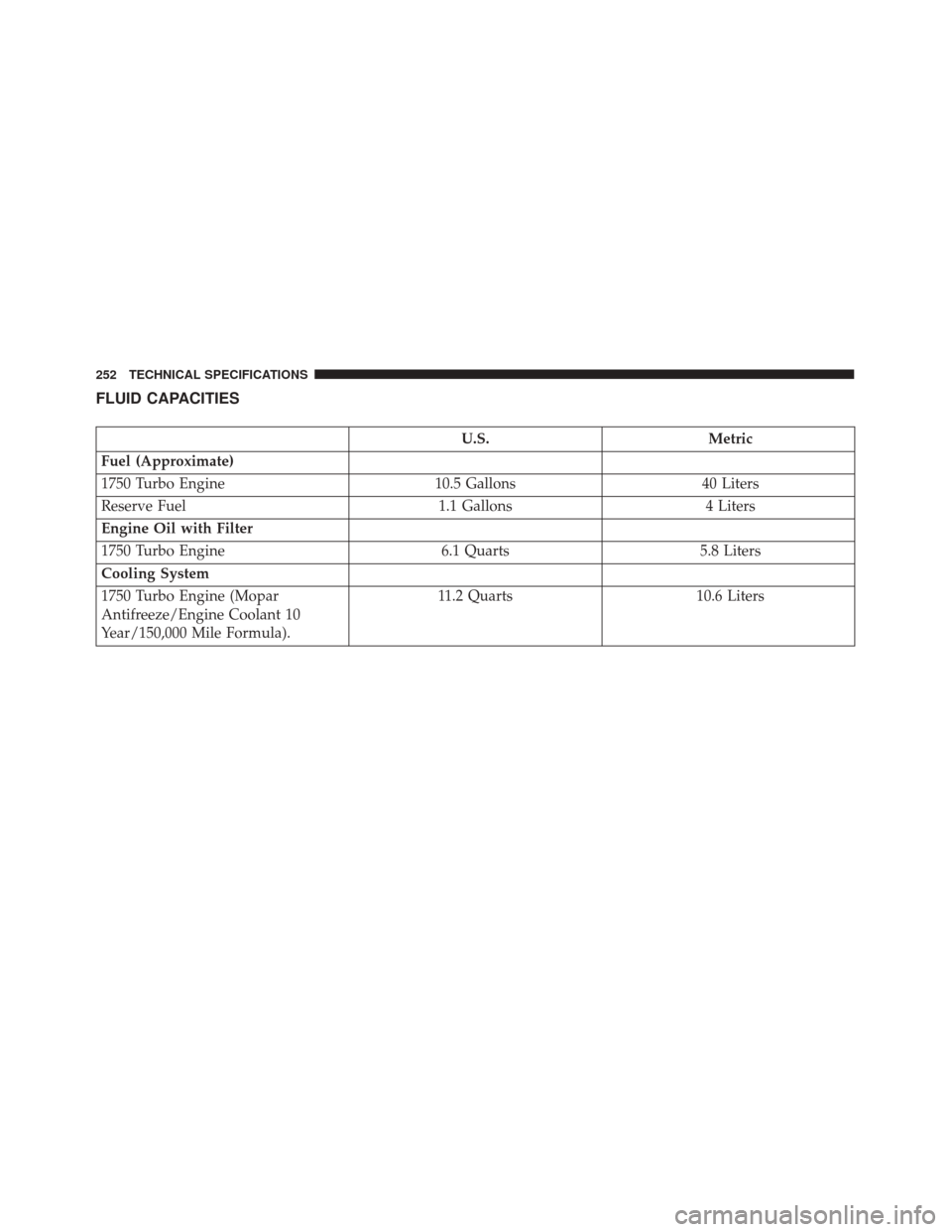
FLUID CAPACITIES
U.S.Metric
Fuel (Approximate)
1750 Turbo Engine 10.5 Gallons40 Liters
Reserve Fuel 1.1 Gallons4 Liters
Engine Oil with Filter
1750 Turbo Engine 6.1 Quarts5.8 Liters
Cooling System
1750 Turbo Engine (Mopar
Antifreeze/Engine Coolant 10
Year/150,000 Mile Formula). 11.2 Quarts
10.6 Liters
252 TECHNICAL SPECIFICATIONS
Page 255 of 279
FLUIDS AND LUBRICANTS
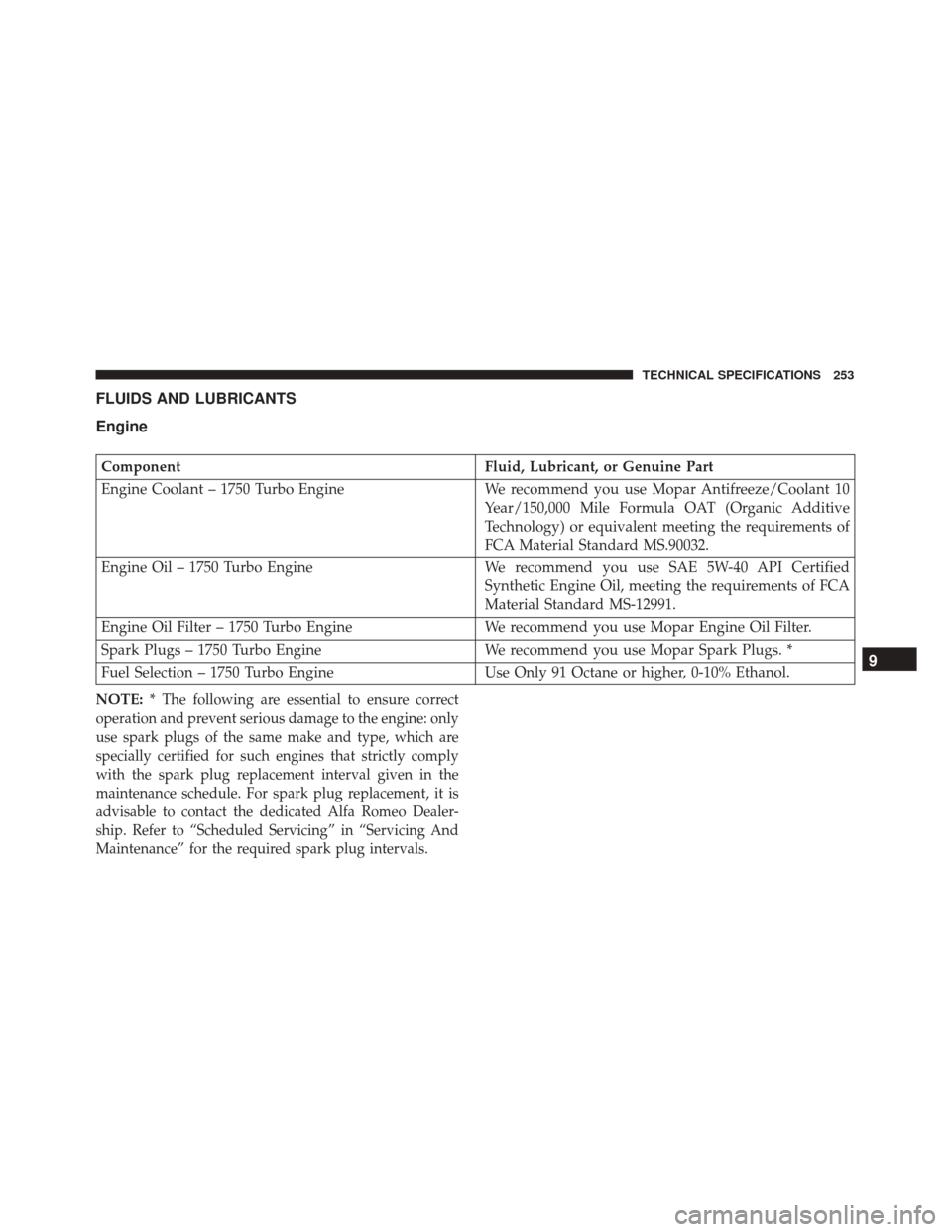
Engine
ComponentFluid, Lubricant, or Genuine Part
Engine Coolant – 1750 Turbo Engine We recommend you use Mopar Antifreeze/Coolant 10
Year/150,000 Mile Formula OAT (Organic Additive
Technology) or equivalent meeting the requirements of
FCA Material Standard MS.90032.
Engine Oil – 1750 Turbo Engine We recommend you use SAE 5W-40 API Certified
Synthetic Engine Oil, meeting the requirements of FCA
Material Standard MS-12991.
Engine Oil Filter – 1750 Turbo Engine We recommend you use Mopar Engine Oil Filter.
Spark Plugs – 1750 Turbo Engine We recommend you use Mopar Spark Plugs. *
Fuel Selection – 1750 Turbo Engine Use Only 91 Octane or higher, 0-10% Ethanol.
NOTE: *
The following are essential to ensure correct
operation and prevent serious damage to the engine: only
use spark plugs of the same make and type, which are
specially certified for such engines that strictly comply
with the spark plug replacement interval given in the
maintenance schedule. For spark plug replacement, it is
advisable to contact the dedicated Alfa Romeo Dealer-
ship. Refer to “Scheduled Servicing” in “Servicing And
Maintenance” for the required spark plug intervals.
9
TECHNICAL SPECIFICATIONS 253
Page 268 of 279
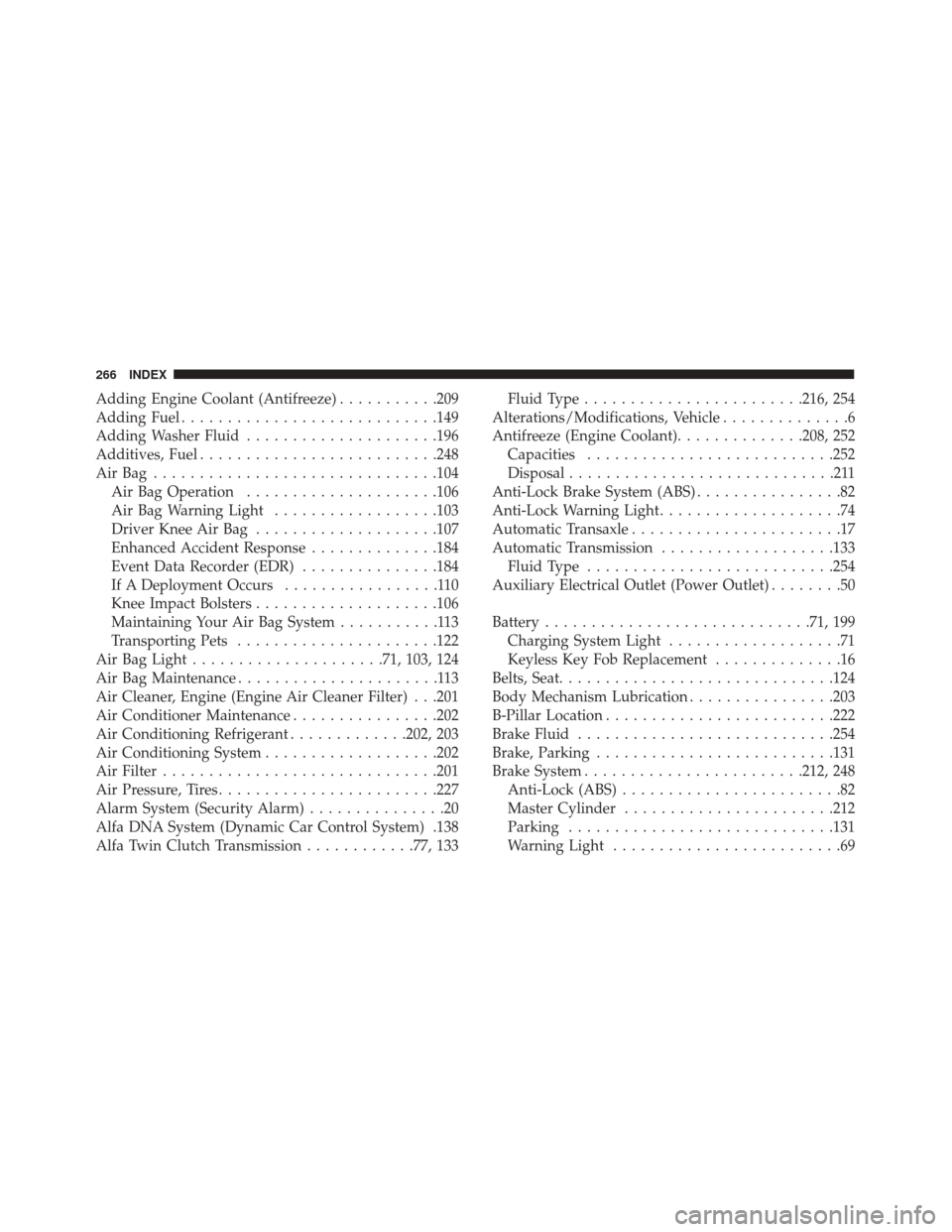
Adding Engine Coolant (Antifreeze)...........209
Adding Fuel ........................... .149
Adding Washer Fluid .....................196
Additives, Fuel ......................... .248
AirBag .............................. .104
Air Bag Operation .....................106
Air Bag Warning Light ..................103
Driver Knee Air Bag ....................107
Enhanced Accident Response ..............184
Event Data Recorder (EDR) ...............184
If A Deployment Occurs .................110
Knee Impact Bolsters ....................106
Maintaining Your Air Bag System ...........113
Transporting Pets ..................... .122
Air Bag Light .....................71, 103, 124
Air Bag Maintenance ......................113
Air Cleaner, Engine (Engine Air Cleaner Filter) . . .201
Air Conditioner Maintenance ................202
Air Conditioning Refrigerant .............202, 203
Air Conditioning System ...................202
Air Filter ............................. .201
Air Pressure, Tires ....................... .227
Alarm System (Security Alarm) ...............20
Alfa DNA System (Dynamic Car Control System) .138
Alfa Twin Clutch Transmission............77, 133 Fluid Type
....................... .216, 254
Alterations/Modifications, Vehicle ..............6
Antifreeze (Engine Coolant) ..............208, 252
Capacities .......................... .252
Disposal .............................211
Anti-Lock Brake System (ABS) ................82
Anti-Lock Warning Light ....................74
Automatic Transaxle .......................17
Automatic Transmission ...................133
Fluid Type .......................... .254
Auxiliary Electrical Outlet (Power Outlet) ........50
Battery ............................ .71, 199
Charging System Light ...................71
Keyless Key Fob Replacement ..............16
Belts, Seat ............................. .124
Body Mechanism Lubrication ................203
B-Pillar
Location ........................ .222
Brake Fluid ........................... .254
Brake, Parking ......................... .131
Brake System ....................... .212, 248
Anti-Lock (ABS) ........................82
Master Cylinder ...................... .212
Parking ............................ .131
Warning Light .........................69
266 INDEX
Page 269 of 279
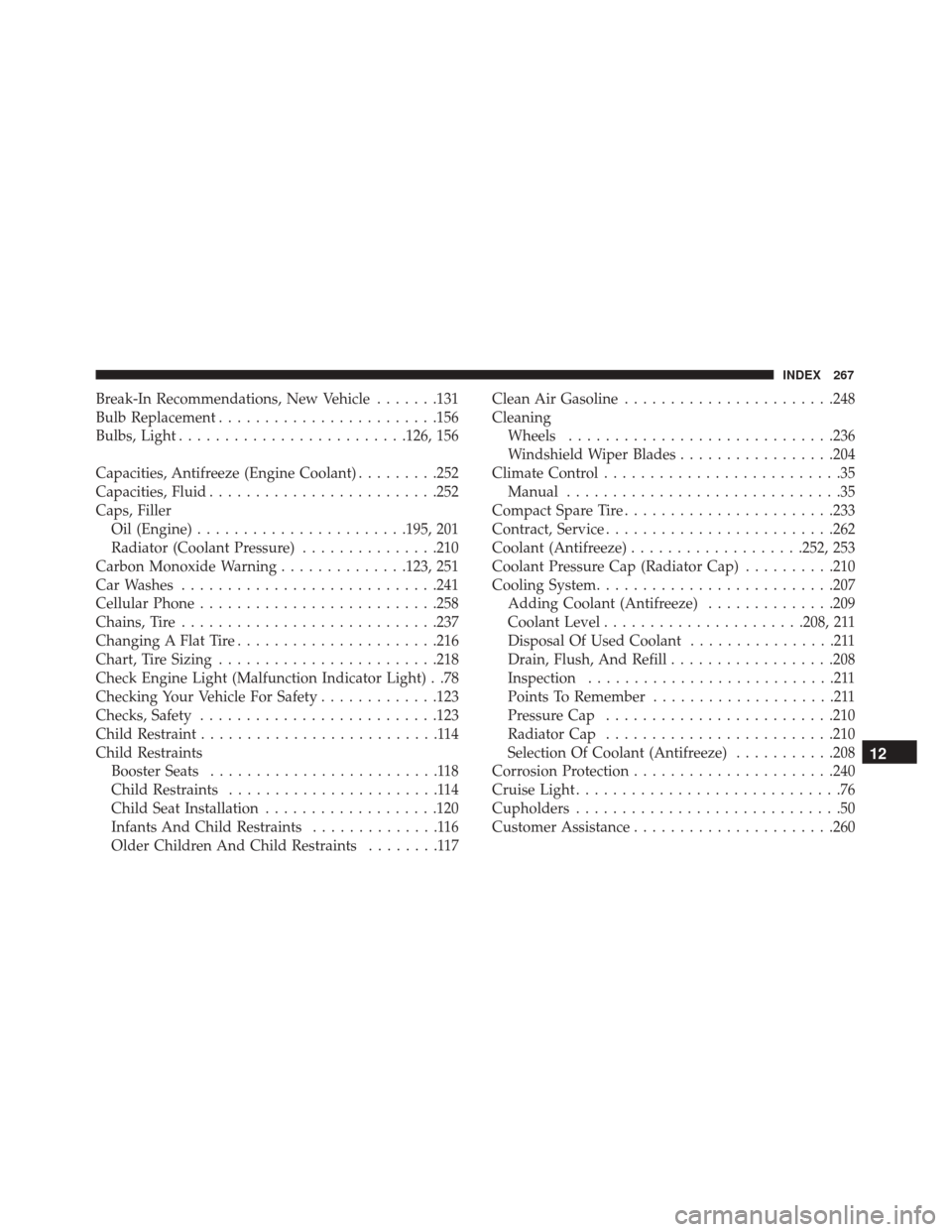
Break-In Recommendations, New Vehicle.......131
Bulb Replacement ....................... .156
Bulbs, Light ........................ .126, 156
Capacities, Antifreeze (Engine Coolant) .........252
Capacities, Fluid ........................ .252
Caps, Filler Oil (Engine) ...................... .195, 201
Radiator (Coolant Pressure) ...............210
Carbon Monoxide Warning ..............123, 251
Car Washes ........................... .241
Cellular Phone ......................... .258
Chains, Tire ........................... .237
Changing A Flat Tire ..................... .216
Chart, Tire Sizing ....................... .218
Check Engine Light (Malfunction Indicator Light) . .78
Checking Your Vehicle For Safety .............123
Checks, Safety ......................... .123
Child Restraint ..........................114
Child Restraints Booster Seats .........................118
Child Restraints .......................114
Child Seat Installation ...................120
Infants And Child Restraints ..............116
Older Children And Child Restraints ........117Clean Air Gasoline
...................... .248
Cleaning Wheels ............................ .236
Windshield Wiper Blades .................204
Climate Control ..........................35
Manual ..............................35
Compact Spare Tire ...................... .233
Contract, Service ........................ .262
Coolant (Antifreeze) ...................252, 253
Coolant Pressure Cap (Radiator Cap) ..........210
Cooling System ......................... .207
Adding Coolant (Antifreeze) ..............209
Coolant Level ..................... .208, 211
Disposal Of Used Coolant ................211
Drain, Flush, And Refill ..................208
Inspection ...........................211
Points
To Remember ....................211
Pressure Cap ........................ .210
Radiator Cap ........................ .210
Selection Of Coolant (Antifreeze) ...........208
Corrosion Protection ..................... .240
Cruise Light .............................76
Cupholders .............................50
Customer Assistance ..................... .260
12
INDEX 267