ECU Alfa Romeo 4C 2018 Owner's Guide
[x] Cancel search | Manufacturer: ALFA ROMEO, Model Year: 2018, Model line: 4C, Model: Alfa Romeo 4C 2018Pages: 279, PDF Size: 3.08 MB
Page 125 of 279
Pets should be restrained in the rear seat in pet har-
nesses or pet carriers that are secured by seat belts.
SAFETY TIPS
Transporting Passengers
NEVER TRANSPORT PASSENGERS IN THE CARGO
AREA.
WARNING!
•Do not leave children or animals inside parked
vehicles in hot weather. Interior heat build-up
may cause serious injury or death.
• It is extremely dangerous to ride in a cargo area,
inside or outside of a vehicle. In a collision,
people riding in these areas are more likely to be
seriously injured or killed.
• Do not allow people to ride in any area of your
vehicle that is not equipped with seats and seat
belts.
• Be sure everyone in your vehicle is in a seat and
using a seat belt properly.
Exhaust Gas
WARNING!
Exhaust gases can injure or kill. They contain
carbon monoxide (CO), which is colorless and odor-
less. Breathing it can make you unconscious and
can eventually poison you. To avoid breathing
(CO), follow these safety tips:
• Do not run the engine in a closed garage or in
confined areas any longer than needed to move
your vehicle in or out of the area.
• If you are required to drive with the trunk/
liftgate/rear doors open, make sure that all win-
dows are closed and the climate control BLOWER
switch is set at high speed. DO NOT use the
recirculation mode.
• If it is necessary to sit in a parked vehicle with the
engine running, adjust your heating or cooling
controls to force outside air into the vehicle. Set
the blower at high speed.
The best protection against carbon monoxide entry into
the vehicle body is a properly maintained engine ex-
haust system.
5
SAFETY 123
Page 127 of 279
operation of the accelerator, brake or clutch pedals.
Only use a floor mat that is securely attached using the
floor mat fasteners so it cannot slip out of position and
interfere with the accelerator, brake or clutch pedals or
impair safe operation of your vehicle in other ways.
WARNING!
An improperly attached, damaged, folded, or
stacked floor mat, or damaged floor mat fasteners
may cause your floor mat to interfere with the
accelerator, brake, or clutch pedals and cause a loss
of vehicle control. To prevent SERIOUS INJURY or
DEATH:
•ALWAYS securely attach
your floor mat using
the floor mat fasteners. DO NOT install your
floor mat upside down or turn your floor mat
over. Lightly pull to confirm mat is secured using
the floor mat fasteners on a regular basis.
• ALWAYS REMOVE THE EXISTING FLOOR
MAT FROM THE VEHICLE
before installing
any other floor mat. NEVER install or stack an
additional floor mat on top of an existing floor
mat.
(Continued)
WARNING! (Continued)
•ONLY install floor mats designed to fit your
vehicle. NEVER install a floor mat that cannot be
properly attached and secured to your vehicle. If a
floor mat needs to be replaced, only use a FCA
approved floor mat for the specific make, model,
and year of your vehicle.
• ONLY use the driver ’s side floor mat on the
driver ’s side floor area. To check for interference,
with the vehicle properly parked with the engine
off, fully depress the accelerator, the brake, and
the clutch pedal (if present) to check for interfer-
ence. If your floor mat interferes with the opera-
tion of any pedal, or is not secure to the floor,
remove the floor mat from the vehicle and place
the floor mat in your trunk.
• ONLY use the passenger ’s side floor mat on the
passenger ’s side floor area.
• ALWAYS make sure objects cannot fall or slide
into the driver ’s side floor area when the vehicle
is moving. Objects can become trapped under
accelerator, brake, or clutch pedals and could
cause a loss of vehicle control.
(Continued)
5
SAFETY 125
Page 128 of 279
WARNING!(Continued)
•NEVER place any objects under the floor mat
(e.g., towels, keys, etc.). These objects could
change the position of the floor mat and may
cause interference with the accelerator, brake, or
clutch pedals.
• If the vehicle carpet has been removed and re-
installed, always properly attach carpet to the
floor and check the floor mat fasteners are secure
to the vehicle carpet. Fully depress each pedal to
check for interference with the accelerator, brake,
or clutch pedals then re-install the floor mats.
• It is recommended to only use mild soap and
water to clean your floor mats. After cleaning,
always check your floor mat has been properly
installed and is secured to your vehicle using the
floor mat fasteners by lightly pulling mat.
Periodic Safety Checks You Should Make
Outside The Vehicle
Tires
Examine tires for excessive tread wear and uneven wear
patterns. Check for stones, nails, glass, or other objects
lodged in the tread or sidewall. Inspect the tread for cuts and cracks. Inspect sidewalls for cuts, cracks, and
bulges. Check the wheel nuts for tightness. Check the
tires (including spare) for proper cold inflation pres-
sure.
Lights
Have someone observe the operation of brake lights
and exterior lights while you work the controls. Check
turn signal and high beam indicator lights on the
instrument panel.
Door Latches
Check for proper closing, latching, and locking.
Fluid Leaks
Check area under the vehicle after overnight parking
for fuel, coolant, oil, or other fluid leaks. Also, if
gasoline fumes are detected or if fuel, or brake fluid
leaks are suspected. The cause should be located and
corrected immediately.
126 SAFETY
Page 138 of 279
speeds below 6 mph (10 km/h), attempts to shift
from 1 to R (or R to 1) will only be allowed if the
vehicle speed drops below the 2 mph (3 km/h)
threshold within three seconds of the request; other-
wise, the transmission will shift to NEUTRAL (N).
The driver should then repeat the request for 1st or R
once the vehicle has come to a stop.
Shift Paddles
In MANUAL mode, the steering wheel mounted shift
paddles (labeled + and -) control the transmission
shifting.
Tapping the (+) paddle will upshift the transmission to
the next higher gear, while tapping the (-) paddle will
downshift to the next lower gear. The current gear is
displayed in the instrument cluster. If a requested shift
would cause engine lugging or overspeed, that request
will be ignored.
In AUTO mode, tapping a shift paddle will temporarily
place the transmission in MANUAL mode, and execute
the requested upshift or downshift (if allowable). The
transmission will then return to AUTO mode after a
brief interval. Pressing a shift paddle will only shift the transmission
one gear at a time. Holding a paddle depressed will not
command multiple shifts; the paddle must be pressed
multiple times in succession to generate multiple shifts.
Neutral (N)
Use this range when the vehicle is standing for pro-
longed periods with the engine running. Always apply
the parking brake if you must exit the vehicle.
At engine startup, the transmission will automatically
select NEUTRAL (N) and AUTO mode. The brake pedal
must be pressed when starting the engine.
To select NEUTRAL (N) when the vehicle is stationary,
turn the ignition key to the MAR-ON position (engine
running or not), press the brake pedal, and push the N
button on the transmission gear selector.
When the vehicle is moving (with ignition ON), push-
ing the NEUTRAL (N) button will engage N, regardless
of whether the brake pedal is pressed.
136 STARTING AND OPERATING
Page 168 of 279
2. Open protective flap (2) and replace bulb (1), releas-ing it from the side contacts. Make sure that the new
bulb is correctly secured between the contacts.
3. Close protective flap (2) and install roof light in its housing, making sure that it is locked in place.Luggage Compartment Roof Light
To replace the bulb, proceed as follows:
1. Open the luggage compartment and remove luggagecompartment roof light, working in the direction
shown by the arrow.
2. Open light protector (2) and replace the bulb.
3. Close protector on the lens.
1 — Bulb
2 — Protective Flap
1 — Light Cover
2 — Light Protector
166 IN CASE OF EMERGENCY
Page 173 of 279
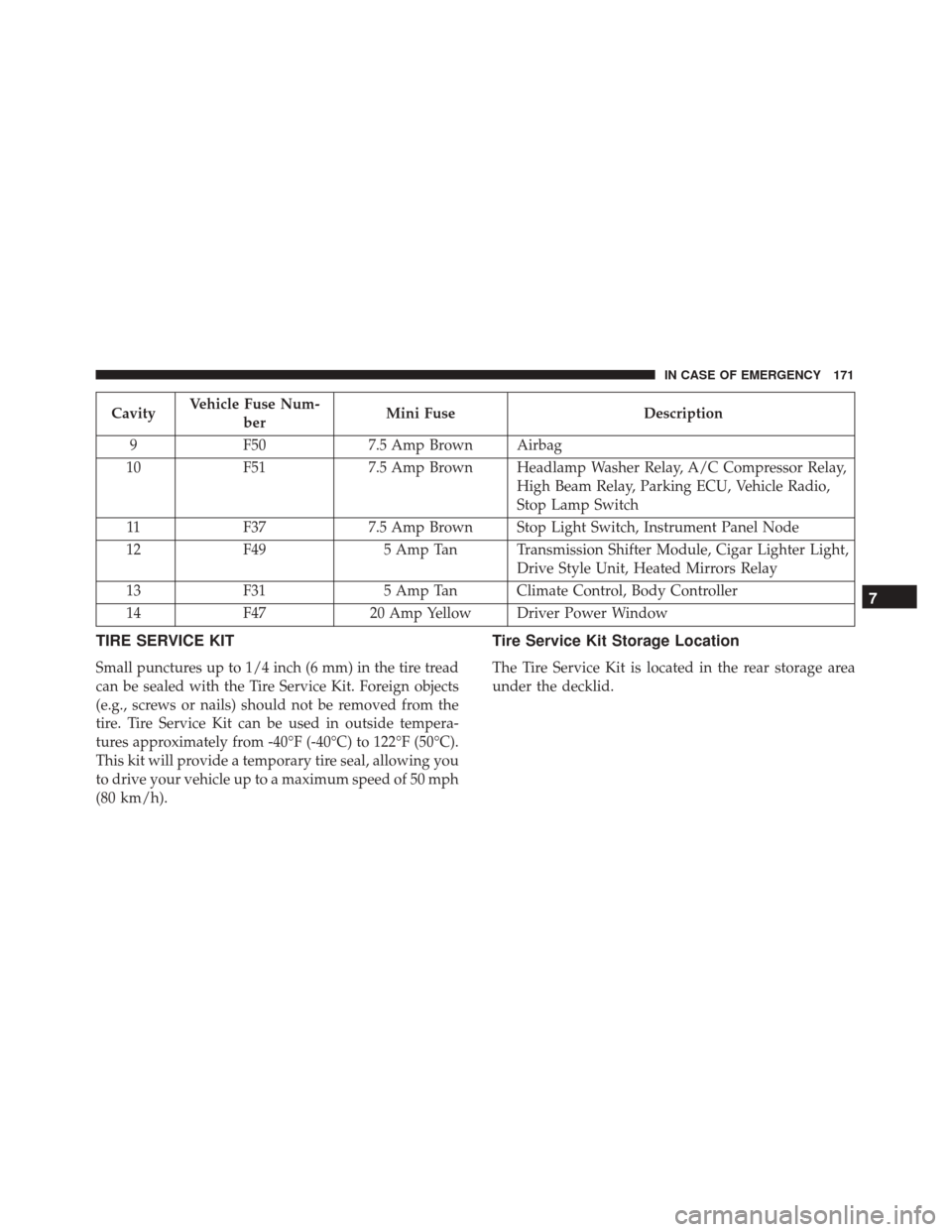
CavityVehicle Fuse Num-
ber Mini Fuse
Description
9 F50 7.5 Amp Brown Airbag
10 F51 7.5 Amp Brown Headlamp Washer Relay, A/C Compressor Relay,
High Beam Relay, Parking ECU, Vehicle Radio,
Stop Lamp Switch
11 F37 7.5 Amp Brown Stop Light Switch, Instrument Panel Node
12 F49 5 Amp Tan Transmission Shifter Module, Cigar Lighter Light,
Drive Style Unit, Heated Mirrors Relay
13 F31 5 Amp Tan Climate Control, Body Controller
14 F47 20 Amp Yellow Driver Power Window
TIRE SERVICE KIT
Small punctures up to 1/4 inch (6 mm) in the tire tread
can be sealed with the Tire Service Kit. Foreign objects
(e.g., screws or nails) should not be removed from the
tire. Tire Service Kit can be used in outside tempera-
tures approximately from -40°F (-40°C) to 122°F (50°C).
This kit will provide a temporary tire seal, allowing you
to drive your vehicle up to a maximum speed of 50 mph
(80 km/h).
Tire Service Kit Storage Location
The Tire Service Kit is located in the rear storage area
under the decklid.
7
IN CASE OF EMERGENCY 171
Page 177 of 279
5. Uncoil the Power Plug and insert the plug into thevehicle’s 12 Volt power outlet.
NOTE: Do not remove foreign objects (e.g., screws or
nails) from the tire.
Injecting Sealant Into The Tire
1. Always start the engine before turning on the Tire Service Kit.
2. After pushing the Power Button, the sealant (white fluid) will flow from the sealant cartridge through
the sealant hose and into the tire. As the sealant flows
through the sealant hose, the pressure gauge can
read as high as 70 psi (4.8 Bar). The pressure gauge
will decrease quickly from approximately 70 psi (4.8
Bar) to the actual tire pressure when the sealant
cartridge is empty.
NOTE: Sealant may leak out through the puncture in
the tire.
3. The pump will start to inject air into the tire imme- diately after the sealant cartridge is empty. Continue
to operate the pump and inflate the tire to the
pressure indicated on the tire pressure label on the driver-side latch pillar (recommended pressure).
Check the tire pressure by looking at the pressure
gauge.
NOTE: •If the tire does not inflate to at least 26 psi (1.8 Bar)
pressure within 15 minutes the tire is too badly
damaged. Do not attempt to drive the vehicle
further. Call for assistance.
• Do not let the compressor be turned on for more
than 20 consecutive minutes. The pump may over-
heat.
4. Remove sealant cartridge by pushing the cartridge release button on the side of the compressor.
Drive Vehicle
Immediately after injecting sealant and inflating the
tire, drive the vehicle 5 miles (8 km) or 10 minutes to
ensure distribution of the Tire Service Kit Sealant within
the tire. Do not exceed 50 mph (80 km/h).
7
IN CASE OF EMERGENCY 175
Page 184 of 279
When using a tow eye, be sure to follow the “Tow Eye
Usage Precautions” in this section.
Tow Eye Usage Precautions
The transmission must be in NEUTRAL when flat
towing this vehicle. The ignition must be ON in order to
place the transmission in NEUTRAL. Therefore, if the
key is unavailable or the battery is discharged, this
vehicle must be towed with all four wheels OFF the
ground (using a vehicle trailer or flatbed truck).
•Ensure that the tow eye is properly seated and secure
in the mounting receptacle. •
The tow eye is recommended for use with an ap-
proved tow bar and or rope.
• Do not use the tow eye to pull the vehicle onto a
flatbed truck.
• Do not use the tow eye to free a stuck vehicle.
WARNING!
Stand clear of vehicles when pulling with tow eyes.
•Do not use a chain with a tow eye. Chains may
break, causing serious injury or death.
• Do not use a tow strap with a tow eye. Tow straps
may break or become disengaged, causing serious
injury or death.
• Failure to follow proper tow eye usage may cause
components to break resulting in serious injury
or death.
Tow Eye
182 IN CASE OF EMERGENCY
Page 207 of 279
second. The windshield wiper then executes part of a
stroke; at each command, approximately 1/3 of a
normal wiper stroke is triggered.
NOTE: The previous operation can be repeated up to
three times. In order to move the blades to the most
suitable position.
4. Lift the blade from the windshield and proceed with the required operation.
5. Carefully lower the blade, bringing it back in contact with the windshield.
6. Bring the blade to the initial rest position, turning the ignition to MAR-ON.
NOTE: Do not operate the screen wiper with the blades
lifted from the windshield.
Front Wiper Blade Removal/Installation
1. Lift the front wiper arm upward to raise the wiper blade off of the windshield.
2. Push the release button on the arm of the wiper blade.
3. Push the wiper blade up and remove it. 4. Install the wiper blade and firmly push the wiper
blade until it snaps into place.Windshield Washer Nozzles
The windshield washer nozzles are adjustable. They
originally adjusted at the factory. Should it be necessary
to adjust them again, contact your authorized Alfa
Romeo Dealer.
1—WiperBlade
2 — Release Button
3—WiperArm8
SERVICING AND MAINTENANCE 205
Page 215 of 279
Use only manufacturer’s recommended brake fluid.
Refer to “Fluids And Lubricants ” in “Technical Speci-
fications” for further information.
WARNING!
•Use only manufacturer’s recommended brake
fluid. Refer to “Fluids And Lubricants” in “Tech-
nical Specifications” for further information. Us-
ing the wrong type of brake fluid can severely
damage your brake system and/or impair its per-
formance. The proper type of brake fluid for your
vehicle is also identified on the original factory
installed hydraulic master cylinder reservoir.
• To avoid contamination from foreign matter or
moisture, use only new brake fluid or fluid that
has been in a tightly closed container. Keep the
master cylinder reservoir cap secured at all times.
Brake fluid in a open container absorbs moisture
from the air resulting in a lower boiling point.
This may cause it to boil unexpectedly during
hard or prolonged braking, resulting in sudden
brake failure. This could result in a collision.
(Continued)
WARNING! (Continued)
•Overfilling the brake fluid reservoir can result in
spilling brake fluid on hot engine parts, causing
the brake fluid to catch fire. Brake fluid can also
damage painted and vinyl surfaces, care should
be taken to avoid its contact with these surfaces.
• Do not allow petroleum based fluid to contami-
nate the brake fluid. Brake seal components could
be damaged, causing partial or complete brake
failure. This could result in a collision.
CAUTION!
Use of improper brake fluids will affect overall
clutch system performance. Improper brake fluids
may damage the clutch system resulting in loss of
clutch function and the ability to shift the transmis-
sion.
8
SERVICING AND MAINTENANCE 213