wheel Alfa Romeo 4C 2020 Owner handbook (in English)
[x] Cancel search | Manufacturer: ALFA ROMEO, Model Year: 2020, Model line: 4C, Model: Alfa Romeo 4C 2020Pages: 156, PDF Size: 3.06 MB
Page 46 of 156
KNOWING THE INSTRUMENT PANEL TOOLS
44
Warning lights on panelMeaningWhat to do
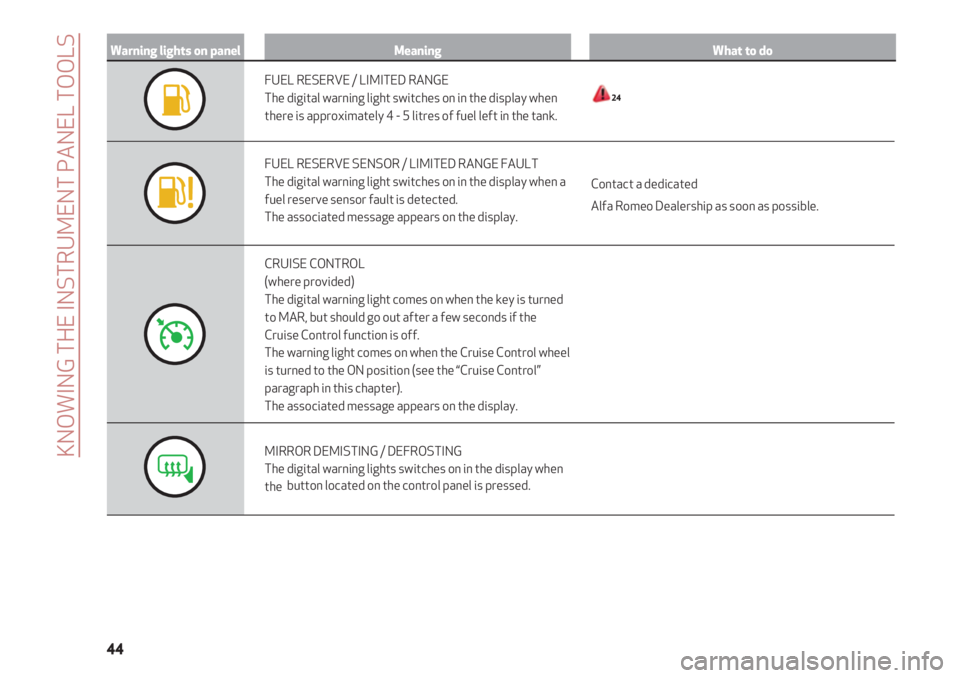
FUEL RESERVE / LIMITED RANGE
The digital warning light switches on in the display when
there is approximately 4 - 5 litres of fuel left in the tank.
FUEL RESERVE SENSOR / LIMITED RANGE FAULT
The digital warning light switches on in the display when a
fuel reserve sensor fault is detected.
The associated message appears on the display.
CRUISE CONTROL
(where provided)
The digital warning light comes on when the key is turned
to MAR, but should go out after a few seconds if the
Cruise Control function is off.
The warning light comes on when the Cruise Control wheel
is turned to the ON position (see the “Cruise Control”
paragraph in this chapter).
The associated message appears on the display.
MIRROR DEMISTING / DEFROSTING
The digital warning lights switches on in the display when
the button located on the control panel is pressed.
Contact a dedicated
Alfa Romeo Dealership as soon as possible.
24
Page 52 of 156
SAFETY
50
ACTIVE SAFETY SYSTEMS
ABS SYSTEM
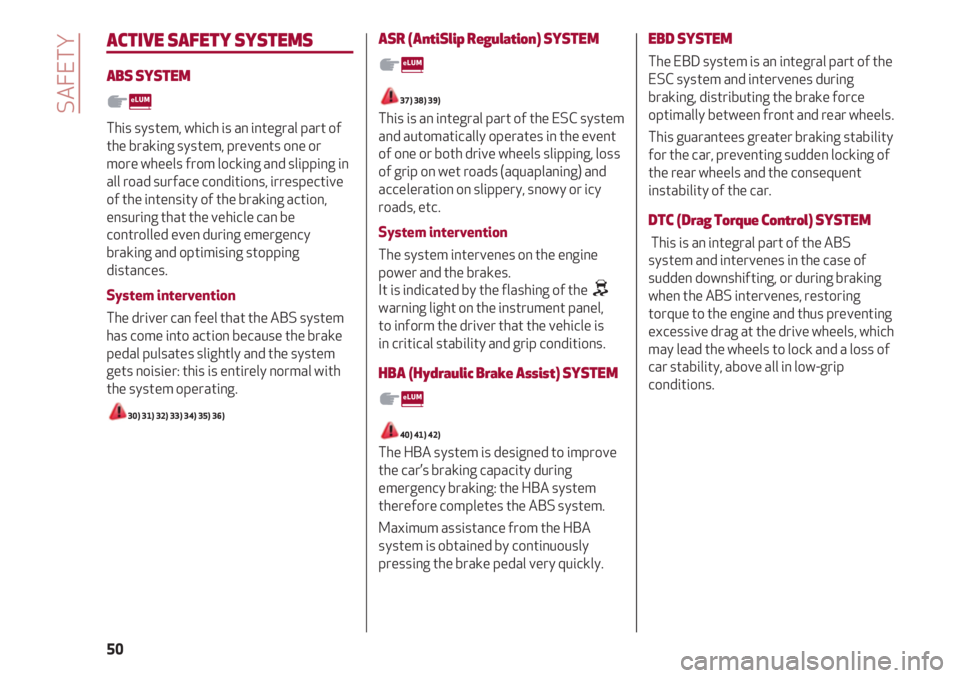
This system, which is an integral part of
the braking system, prevents one or
more wheels from locking and slipping in
all road surface conditions, irrespective
of the intensity of the braking action,
ensuring that the vehicle can be
controlled even during emergency
braking and optimising stopping
distances.
System intervention
The driver can feel that the ABS system
has come into action because the brake
pedal pulsates slightly and the system
gets noisier: this is entirely normal with
the system operating.
30) 31) 32) 33) 34) 35) 36)
ASR (AntiSlip Regulation) SYSTEM
37) 38) 39)
This is an integral part of the ESC system
and automatically operates in the event
of one or both drive wheels slipping, loss
of grip on wet roads (aquaplaning) and
acceleration on slippery, snowy or icy
roads, etc.
System intervention
The system intervenes on the engine
power and the brakes.
It is indicated by the flashing of the
warning light on the instrument panel,
to inform the driver that the vehicle is
in critical stability and grip conditions.
HBA (Hydraulic Brake Assist) SYSTEM
40) 41) 42)
The HBA system is designed to improve
the car’s braking capacity during
emergency braking: the HBA system
therefore completes the ABS system.
Maximum assistance from the HBA
system is obtained by continuously
pressing the brake pedal very quickly.
EBD SYSTEM
The EBD system is an integral part of the
ESC system and intervenes during
braking, distributing the brake force
optimally between front and rear wheels.
This guarantees greater braking stability
for the car, preventing sudden locking of
the rear wheels and the consequent
instability of the car.
DTC (Drag Torque Control) SYSTEM
This is an integral part of the ABS
system and intervenes in the case of
sudden downshifting, or during braking
when the ABS intervenes, restoring
torque to the engine and thus preventing
excessive drag at the drive wheels, which
may lead the wheels to lock and a loss of
car stability, above all in low-grip
conditions.
Page 53 of 156
51
ESC SYSTEM
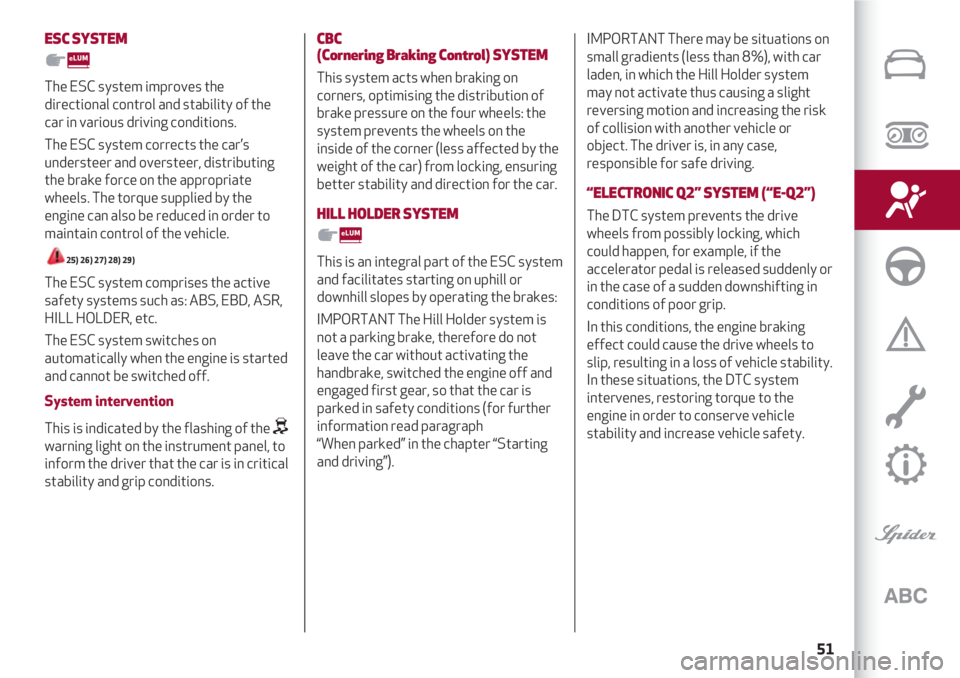
The ESC system improves the
directional control and stability of the
car in various driving conditions.
The ESC system corrects the car’s
understeer and oversteer, distributing
the brake force on the appropriate
wheels. The torque supplied by the
engine can also be reduced in order to
maintain control of the vehicle.
25) 26) 27) 28) 29)
The ESC system comprises the active
safety systems such as: ABS, EBD, ASR,
HILL HOLDER, etc.
The ESC system switches on
automatically when the engine is started
and cannot be switched off.
System intervention
This is indicated by the flashing of the
warning light on the instrument panel, to
inform the driver that the car is in critical
stability and grip conditions.
CBC
(Cornering Braking Control) SYSTEM
This system acts when braking on
corners, optimising the distribution of
brake pressure on the four wheels: the
system prevents the wheels on the
inside of the corner (less affected by the
weight of the car) from locking, ensuring
better stability and direction for the car.
HILL HOLDER SYSTEM
This is an integral part of the ESC system
and facilitates starting on uphill or
downhill slopes by operating the brakes:
IMPORTANT The Hill Holder system is
not a parking brake, therefore do not
leave the car without activating the
handbrake, switched the engine off and
engaged first gear, so that the car is
parked in safety conditions (for further
information read paragraph
“When parked” in the chapter “Starting
and driving”).
IMPORTANT There may be situations on
small gradients (less than 8%), with car
laden, in which the Hill Holder system
may not activate thus causing a slight
reversing motion and increasing the risk
of collision with another vehicle or
object. The driver is, in any case,
responsible for safe driving.
“ELECTRONIC Q2” SYSTEM (“E-Q2”)
The DTC system prevents the drive
wheels from possibly locking, which
could happen, for example, if the
accelerator pedal is released suddenly or
in the case of a sudden downshifting in
conditions of poor grip.
In this conditions, the engine braking
effect could cause the drive wheels to
slip, resulting in a loss of vehicle stability.
In these situations, the DTC system
intervenes, restoring torque to the
engine in order to conserve vehicle
stability and increase vehicle safety.
Page 54 of 156
SAFETY
52
“PRE-FILL” SYSTEM
(RAB - Ready Alert Brake)
(only with “Dynamic” mode engaged)
This function activates automatically if
the accelerator pedal is released rapidly,
reducing the brake pad travel (both at
front and back), with the aim of preparing
the braking system and enhancing its
responsiveness, thus reducing the
stopping distance in the event of
subsequent braking.
25)The ESC system cannot alter the
natural laws of physics, and cannot
increase grip, which depends on the
condition of the road.
26)The ESC system cannot prevent
accidents, including those due to
excessive speed on corners, driving on
low-grip surfaces or aquaplaning.
27)The capability of the ESC system
must never be tested irresponsibly and
dangerously, in such a way as to
compromise personal safety and the
safety of others.
28)For the correct operation of the ASR
system, the tyres must of necessity be
the same make and type on all wheels, in
perfect condition and, above all, of the
prescribed type and dimensions.
IMPORTANT
29)Do not take unnecessary risks, even if
your vehicle is fitted with the ESC and
ASR systems.
Your driving style must always be suited
to the road conditions, visibility and
traffic.
The driver is always responsible for road
safety.
30)When the ABS intervenes and you
notice the brake pedal pulsating, do not
reduce the pressure, but hold it firmly and
confidently; in doing so you will brake in
the shortest distance possible, depending
on the road conditions.
31)For maximum efficiency of the
braking system, a bedding-in period of
about 500 km is needed: during this
period it is better to avoid sharp,
repeated and prolonged braking.
32)If the ABS intervenes, this indicates
that the grip of the tyres on the road is
nearing its limit: you must slow down to a
speed compatible with the available grip.
33)The ABS cannot overrule the natural
laws of physics, and cannot increase the
grip available according to the condition
of the road.
34)The ABS cannot prevent accidents,
including those due to excessive speed on
corners, driving on low-grip surfaces or
aquaplaning.35) The capability of the ABS must never
be tested irresponsibly and dangerously,
in such a way as to compromise personal
safety and the safety of others.
36)For the correct operation of the ABS,
the tyres must of necessity be the same
make and type on all wheels, in perfect
condition and, above all, of the prescribed
type and dimensions.
37)The ASR cannot overrule the natural
laws of physics, and cannot increase the
grip available according to the condition
of the road.
38)The ASR system cannot prevent
accidents, including those due to
excessive speed on corners, driving on
low-grip surfaces or aquaplaning.
39) The capability of the ASR must never
be tested irresponsibly and dangerously,
in such a way as to compromise personal
safety and the safety of others.
40)The HBA system can’t overrule the
natural laws of physics, and can’t increase
the grip available according to the
condition of the road.
41)The HBA system cannot prevent
accidents, including those due to
excessive speed on corners, driving on
low-grip surfaces or aquaplaning.
42) The capability of the HBA system
must never be tested irresponsibly and
dangerously, in such a way as to
compromise the safety of the driver, the
other occupants of the vehicle or any
other road user.
Page 56 of 156
SAFETY
54 The TPMS uses wireless devices with
electronic sensors mounted on the wheel
rims to constantly monitor the value of
tyre pressure.
The sensors mounted on each wheel as
part of the valve stem transmit various
information of the tyres to the receiver
module, in order to calculate the
pressure.
IMPORTANT Monitoring and maintaining
the correct pressure in all four tyres are
particularly important.
Tyre pressure monitoring system
low pressure warnings
43) 44) 45) 46) 47) 48) 49) 50) 51)
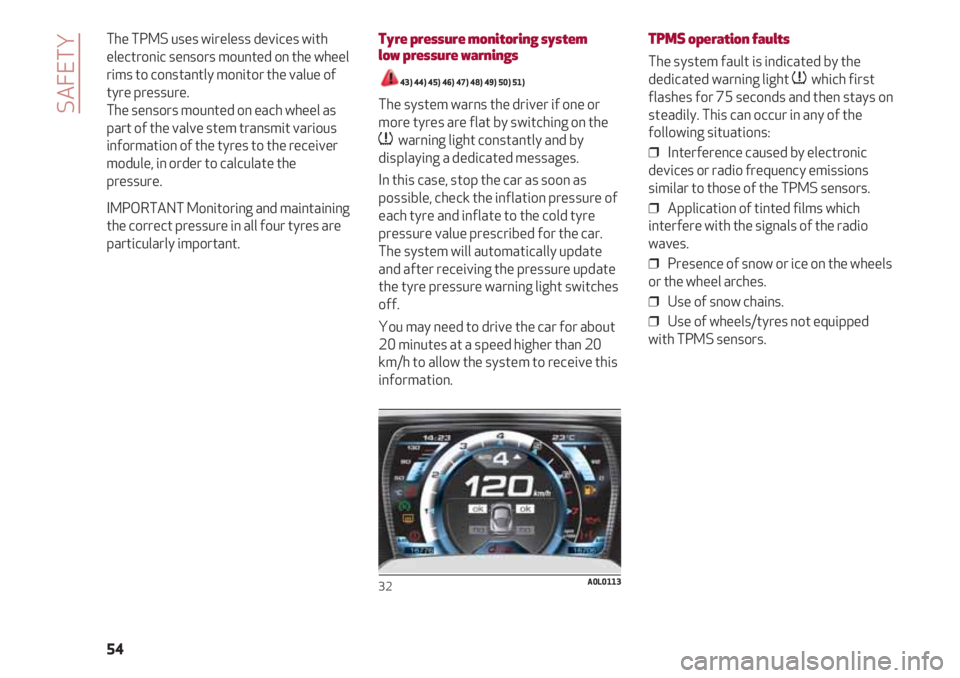
The system warns the driver if one or
more tyres are flat by switching on the
nwarning light constantly and by
displaying a dedicated messages.
In this case, stop the car as soon as
possible, check the inflation pressure of
each tyre and inflate to the cold tyre
pressure value prescribed for the car.
The system will automatically update
and after receiving the pressure update
the tyre pressure warning light switches
off.
You may need to drive the car for about
20 minutes at a speed higher than 20
km/h to allow the system to receive this
information.
32A0L0113
TPMS operation faults
The system fault is indicated by the
dedicated warning light
nwhich first
flashes for 75 seconds and then stays on
steadily. This can occur in any of the
following situations:
❒ Interference caused by electronic
devices or radio frequency emissions
similar to those of the TPMS sensors.
❒ Application of tinted films which
interfere with the signals of the radio
waves.
❒ Presence of snow or ice on the wheels
or the wheel arches.
❒ Use of snow chains.
❒ Use of wheels/tyres not equipped
with TPMS sensors.
Page 57 of 156
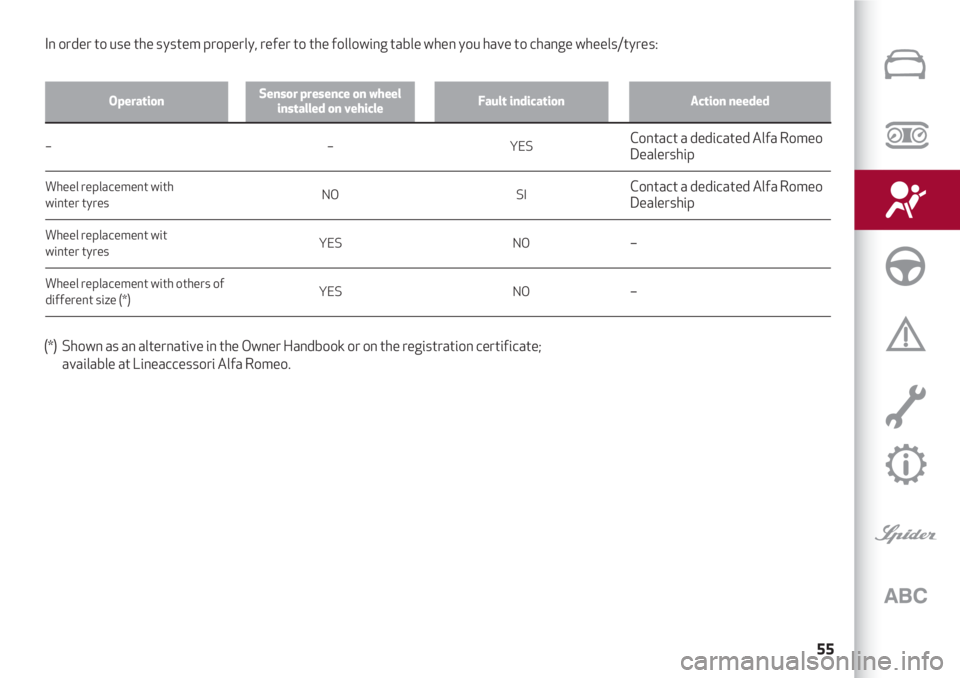
55
OperationSensor presence on wheel
installed on vehicleFault indicationAction needed
–
Wheel replacement with
winter tyres
Wheel replacement wit
winter tyres
Wheel replacement with others of
different size (*)–
NO
YES
YESYES
SI
NO
NOContact a dedicated Alfa Romeo
Dealership
Contact a dedicated Alfa Romeo
Dealership
–
–
(*) Shown as an alternative in the Owner Handbook or on the registration certificate;
available at Lineaccessori Alfa Romeo. In order to use the system properly, refer to the following table when you have to change wheels/tyres:
Page 58 of 156
SAFETY
56
43)The presence of the TPMS does not
permit the driver to neglect regular
checks of the tyre pressure, including for
the spare wheel.
44)Tyre pressure must be checked with
tyres rested and cold. Should it become
necessary for whatever reason to check
pressure with warm tyres, do not reduce
pressure even though it is higher than the
prescribed value. Repeat the check when
the tyres are cold.
45)Should one or more wheels be fitted
without sensors, the system will no longer
be available and, in addition to the TPMS
warning light flashing for less than one
minute before becoming constant, a
warning message will be shown on the
display, until 4 wheels with sensors are
fitted again.
46)The TPMS cannot warn of sudden
decreases in tyre pressure (for example
when a tyre bursts). In this case, stop the
car, braking with caution and avoiding
abrupt steering.
47)Replacing standard tyres with winter
tyres (and vice versa) requires TPMS
adjustment that must only be performed
by a dedicated Alfa Romeo Dealership.
IMPORTANT48)Changes in outside temperature may
cause tyre pressures to vary. The TPMS
system may temporarily indicate
insufficient pressure. In this case, check
the tyre pressure when cold and, if
necessary, restore the inflation values.
49)When a tyre is removed, it is
advisable to replace the rubber valve seal
as well: contact a dedicated Alfa Romeo
Dealership. Tyre and/or rim
fitting/removal operations require
specific precautions; to avoid damaging
or fitting the sensors incorrectly, tyre
and/or rim fitting/removal operations
should only be carried out by specialised
staff. Contact a dedicated Alfa Romeo
Dealership.
50)Strong radio-frequency interference
could inhibit the regular operation of the
TPMS. This condition will be indicated by
a message on the display. The message
will disappear automatically as soon as
the radio-frequency interference ceases
to affect the system.51)The tyre repair kit (“Fix&Go
Automatic”) provided with the car (where
provided) is compatible with the TPMS
sensors; using sealants not equivalent
with that in the original kit may adversely
affect its operation. If sealants not
equivalent with the original one are used,
it is recommended to have the TPMS
sensors checked by a qualified repair
centre.
Page 65 of 156
63
Main safety rules to be followed when
carrying children
❒ follow the instructions supplied with
the child restraint system itself, which
the manufacturer must provide.
Keep the instructions in the car along
with the other documents and this
handbook.
Do not use child seats without
instructions; always check the seat belt is
well fastened by pulling the belt;
❒ only one child is to be strapped into
each restraint system; never carry two
children using one child restraint system;
always check that the belts are not
resting on the child’s neck;
❒ while travelling, do not let the child sit
incorrectly or release the belts;
❒ never carry children on your lap, even
newborns. No-one could hold on to a child
in the event of an accident; in the event of
an accident, replace the child restraint
system with a new one. Also have the
seat belt to which the child restraint
system was attached replaced.
FRONT AIRBAGS
DRIVER AND PASSENGER FRONT
AIRBAGS
The car features multistage front airbags
(“Smart bag system”) for driver and
passenger.
The front driver/passenger airbags are
designed to protect occupants in the
event of frontal impacts of medium-high
severity, by placing the bag between the
occupant and the steering wheel or
dashboard.
Therefore, non-activation of the front
airbags in other types of collisions (side
collisions, rear shunts, rollovers, etc.)
does not indicate a system malfunction.
Airbags are not a replacement of but
complementary to the seat belts, which
you are recommended to always wear. In
the event of impact, those not wearing a
seat belt are projected forwards and may
come into contact with the bag which is
still inflating. The protection offered by
the bag is compromised in these
circumstances.
60)
59)The diagrams are indicative and
provided for assembly purposes only. Fit
the child restraint system according to
the instructions, which must be included.
IMPORTANT
❒ Incorrect fitting of the child restraint
system may result in an inefficient
protection system. In the event of an
accident the child restraint system may
become loose and the child may be
injured, even fatally. Strictly comply with
the instructions provided when fitting a
child restraint system.
❒ When the child restraint system is not
used, secure it with the seat belt or
remove it from the vehicle. Do not leave it
unsecured inside the passenger
compartment. In this way, in the case of
sudden braking or an accident, it will not
cause injuries to the occupants.
Page 66 of 156
Front airbags may not activate in the
following situations:
❒ frontal impacts against highly
deformable objects not involving the
front surface of the car (e.g. wing collision
against guard rail);
❒ jamming of the car underneath other
vehicles or protective barriers
(e.g. underneath a truck or a guard rail); in
this case, the bags would offer no
additional protection with respect to the
seat belt and their deployment would be
inappropriate.
In these cases, non-deployment does not
indicate a system malfunction.
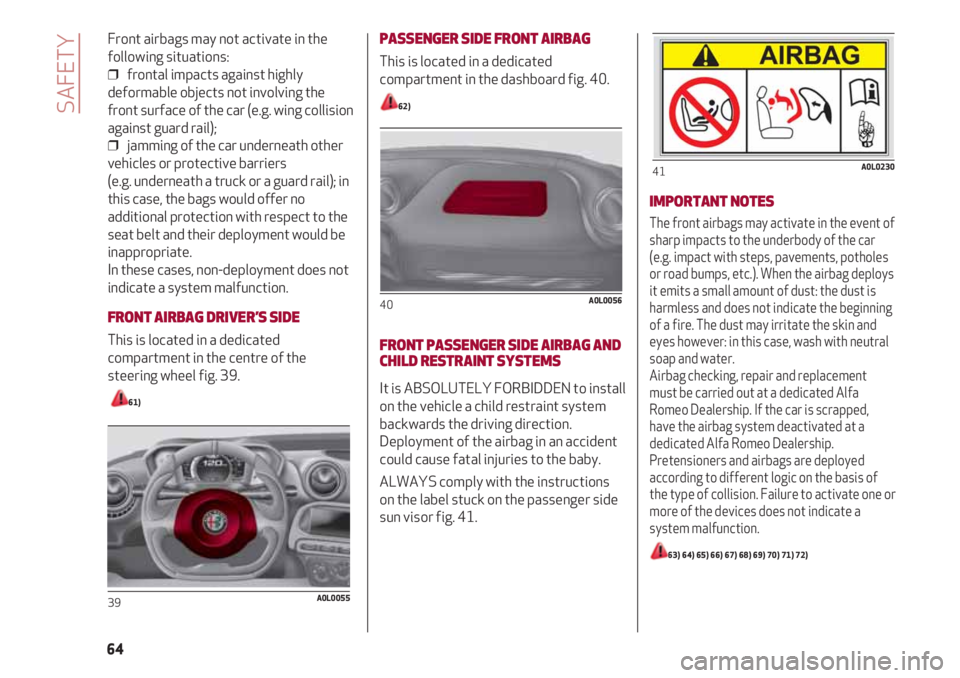
FRONT AIRBAG DRIVER’S SIDE
This is located in a dedicated
compartment in the centre of the
steering wheel fig. 39.
61)
39A0L0055
PASSENGER SIDE FRONT AIRBAG
This is located in a dedicated
compartment in the dashboard fig. 40.
62)
FRONT PASSENGER SIDE AIRBAG AND
CHILD RESTRAINT SYSTEMS
It is ABSOLUTELY FORBIDDEN to install
on the vehicle a child restraint system
backwards the driving direction.
Deployment of the airbag in an accident
could cause fatal injuries to the baby.
ALWAYS comply with the instructions
on the label stuck on the passenger side
sun visor fig. 41.
40A0L0056
IMPORTANT NOTES
The front airbags may activate in the event of
sharp impacts to the underbody of the car
(e.g. impact with steps, pavements, potholes
or road bumps, etc.). When the airbag deploys
it emits a small amount of dust: the dust is
harmless and does not indicate the beginning
of a fire. The dust may irritate the skin and
eyes however: in this case, wash with neutral
soap and water.
Airbag checking, repair and replacement
must be carried out at a dedicated Alfa
Romeo Dealership. If the car is scrapped,
have the airbag system deactivated at a
dedicated Alfa Romeo Dealership.
Pretensioners and airbags are deployed
according to different logic on the basis of
the type of collision. Failure to activate one or
more of the devices does not indicate a
system malfunction.
63) 64) 65) 66) 67) 68) 69) 70) 71) 72)
SAFETY
64
41A0L0230
Page 68 of 156
SAFETY
66
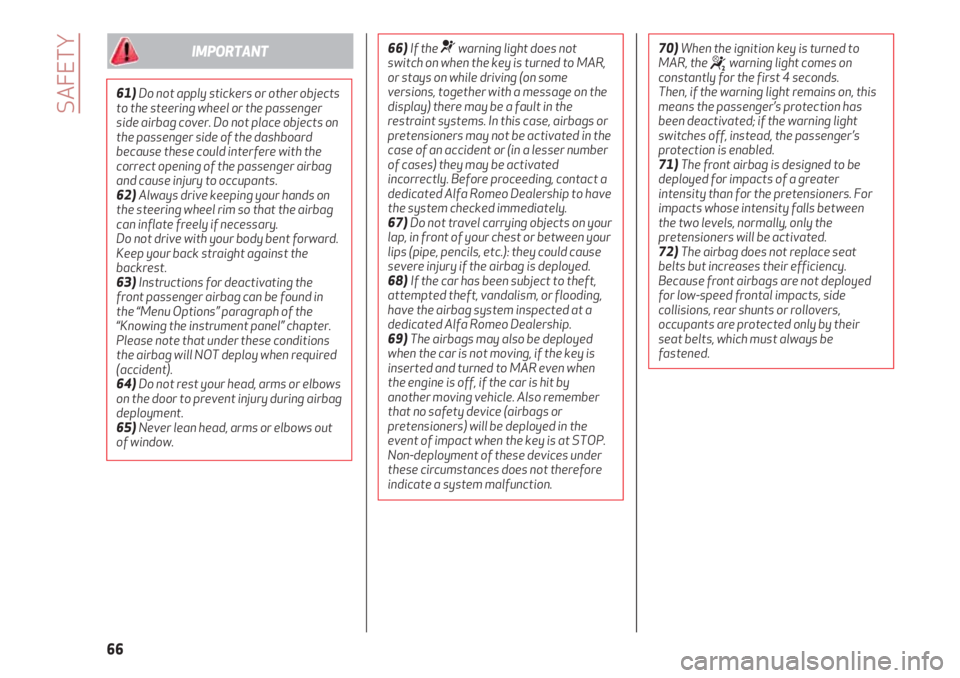
61)Do not apply stickers or other objects
to the steering wheel or the passenger
side airbag cover. Do not place objects on
the passenger side of the dashboard
because these could interfere with the
correct opening of the passenger airbag
and cause injury to occupants.
62)Always drive keeping your hands on
the steering wheel rim so that the airbag
can inflate freely if necessary.
Do not drive with your body bent forward.
Keep your back straight against the
backrest.
63)Instructions for deactivating the
front passenger airbag can be found in
the “Menu Options” paragraph of the
“Knowing the instrument panel” chapter.
Please note that under these conditions
the airbag will NOT deploy when required
(accident).
64)Do not rest your head, arms or elbows
on the door to prevent injury during airbag
deployment.
65)Never lean head, arms or elbows out
of window.
IMPORTANT66)If the ¬warning light does not
switch on when the key is turned to MAR,
or stays on while driving (on some
versions, together with a message on the
display) there may be a fault in the
restraint systems. In this case, airbags or
pretensioners may not be activated in the
case of an accident or (in a lesser number
of cases) they may be activated
incorrectly. Before proceeding, contact a
dedicated Alfa Romeo Dealership to have
the system checked immediately.
67)Do not travel carrying objects on your
lap, in front of your chest or between your
lips (pipe, pencils, etc.): they could cause
severe injury if the airbag is deployed.
68) If the car has been subject to theft,
attempted theft, vandalism, or flooding,
have the airbag system inspected at a
dedicated Alfa Romeo Dealership.
69)The airbags may also be deployed
when the car is not moving, if the key is
inserted and turned to MAR even when
the engine is off, if the car is hit by
another moving vehicle. Also remember
that no safety device (airbags or
pretensioners) will be deployed in the
event of impact when the key is at STOP.
Non-deployment of these devices under
these circumstances does not therefore
indicate a system malfunction.70)When the ignition key is turned to
MAR, the
“warning light comes on
constantly for the first 4 seconds.
Then, if the warning light remains on, this
means the passenger’s protection has
been deactivated; if the warning light
switches off, instead, the passenger’s
protection is enabled.
71)The front airbag is designed to be
deployed for impacts of a greater
intensity than for the pretensioners. For
impacts whose intensity falls between
the two levels, normally, only the
pretensioners will be activated.
72)The airbag does not replace seat
belts but increases their efficiency.
Because front airbags are not deployed
for low-speed frontal impacts, side
collisions, rear shunts or rollovers,
occupants are protected only by their
seat belts, which must always be
fastened.