wheel Alfa Romeo 4C 2020 Owner handbook (in English)
[x] Cancel search | Manufacturer: ALFA ROMEO, Model Year: 2020, Model line: 4C, Model: Alfa Romeo 4C 2020Pages: 156, PDF Size: 3.06 MB
Page 94 of 156
IN AN EMERGENCY
92
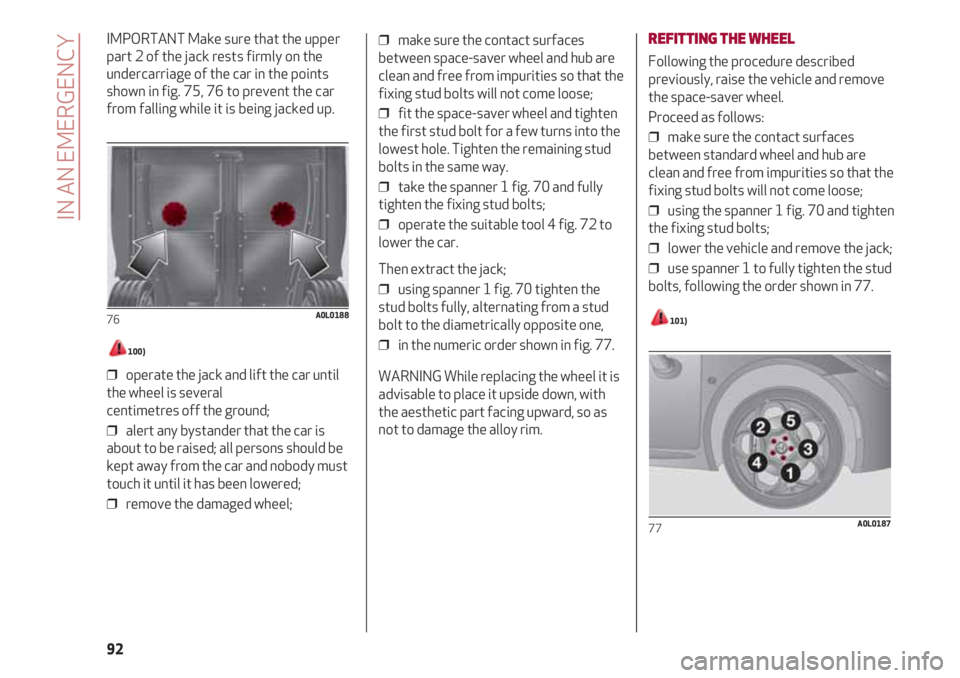
IMPORTANT Make sure that the upper
part 2 of the jack rests firmly on the
undercarriage of the car in the points
shown in fig. 75, 76 to prevent the car
from falling while it is being jacked up.
100)
❒ operate the jack and lift the car until
the wheel is several
centimetres off the ground;
❒ alert any bystander that the car is
about to be raised; all persons should be
kept away from the car and nobody must
touch it until it has been lowered;
❒ remove the damaged wheel;
76A0L0188
❒ make sure the contact surfaces
between space-saver wheel and hub are
clean and free from impurities so that the
fixing stud bolts will not come loose;
❒ fit the space-saver wheel and tighten
the first stud bolt for a few turns into the
lowest hole. Tighten the remaining stud
bolts in the same way.
❒ take the spanner 1 fig. 70 and fully
tighten the fixing stud bolts;
❒ operate the suitable tool 4 fig. 72 to
lower the car.
Then extract the jack;
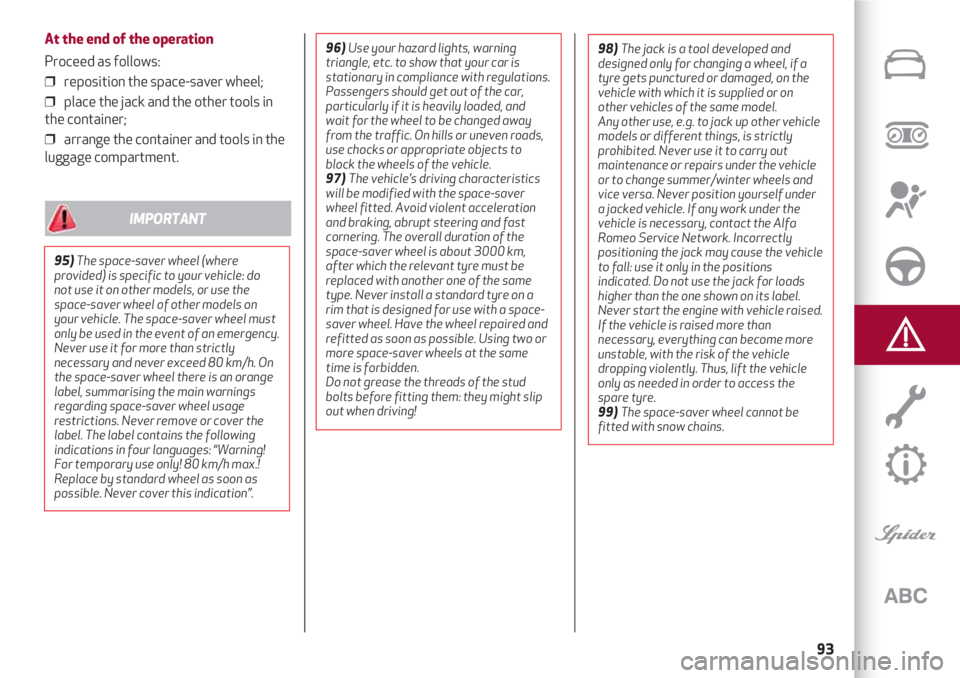
❒ using spanner 1 fig. 70 tighten the
stud bolts fully, alternating from a stud
bolt to the diametrically opposite one,
❒ in the numeric order shown in fig. 77.
WARNING While replacing the wheel it is
advisable to place it upside down, with
the aesthetic part facing upward, so as
not to damage the alloy rim.REFITTING THE WHEEL
Following the procedure described
previously, raise the vehicle and remove
the space-saver wheel.
Proceed as follows:
❒ make sure the contact surfaces
between standard wheel and hub are
clean and free from impurities so that the
fixing stud bolts will not come loose;
❒ using the spanner 1 fig. 70 and tighten
the fixing stud bolts;
❒ lower the vehicle and remove the jack;
❒ use spanner 1 to fully tighten the stud
bolts, following the order shown in 77.
101)
77A0L0187
Page 95 of 156
93
At the end of the operation
Proceed as follows:
❒ reposition the space-saver wheel;
❒ place the jack and the other tools in
the container;
❒ arrange the container and tools in the
luggage compartment.
95)The space-saver wheel (where
provided) is specific to your vehicle: do
not use it on other models, or use the
space-saver wheel of other models on
your vehicle. The space-saver wheel must
only be used in the event of an emergency.
Never use it for more than strictly
necessary and never exceed 80 km/h. On
the space-saver wheel there is an orange
label, summarising the main warnings
regarding space-saver wheel usage
restrictions. Never remove or cover the
label. The label contains the following
indications in four languages: “Warning!
For temporary use only! 80 km/h max.!
Replace by standard wheel as soon as
possible. Never cover this indication”.
IMPORTANT
96)Use your hazard lights, warning
triangle, etc. to show that your car is
stationary in compliance with regulations.
Passengers should get out of the car,
particularly if it is heavily loaded, and
wait for the wheel to be changed away
from the traffic. On hills or uneven roads,
use chocks or appropriate objects to
block the wheels of the vehicle.
97) The vehicle’s driving characteristics
will be modified with the space-saver
wheel fitted. Avoid violent acceleration
and braking, abrupt steering and fast
cornering. The overall duration of the
space-saver wheel is about 3000 km,
after which the relevant tyre must be
replaced with another one of the same
type. Never install a standard tyre on a
rim that is designed for use with a space-
saver wheel. Have the wheel repaired and
refitted as soon as possible. Using two or
more space-saver wheels at the same
time is forbidden.
Do not grease the threads of the stud
bolts before fitting them: they might slip
out when driving!98) The jack is a tool developed and
designed only for changing a wheel, if a
tyre gets punctured or damaged, on the
vehicle with which it is supplied or on
other vehicles of the same model.
Any other use, e.g. to jack up other vehicle
models or different things, is strictly
prohibited. Never use it to carry out
maintenance or repairs under the vehicle
or to change summer/winter wheels and
vice versa. Never position yourself under
a jacked vehicle. If any work under the
vehicle is necessary, contact the Alfa
Romeo Service Network. Incorrectly
positioning the jack may cause the vehicle
to fall: use it only in the positions
indicated. Do not use the jack for loads
higher than the one shown on its label.
Never start the engine with vehicle raised.
If the vehicle is raised more than
necessary, everything can become more
unstable, with the risk of the vehicle
dropping violently. Thus, lift the vehicle
only as needed in order to access the
spare tyre.
99) The space-saver wheel cannot be
fitted with snow chains.
Page 96 of 156
IN AN EMERGENCY
94
“AUTOMATIC FIX&GO
AUTOMATIC” KIT
GENERAL INSTRUCTIONS
The car is equipped with a quick tyre
repair device called the “Fix&Go
Automatic” kit.
102) 103)
To use it, follow the instructions below.
104) 105) 106) 12) 3)
It is located in the luggage compartment.
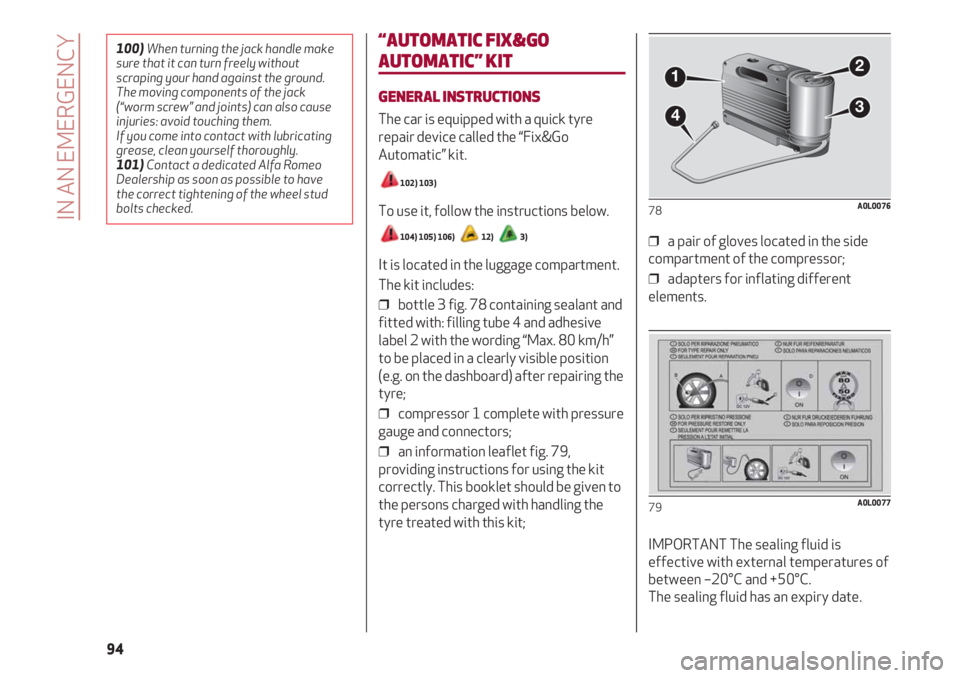
The kit includes:
❒ bottle 3 fig. 78 containing sealant and
fitted with: filling tube 4 and adhesive
label 2 with the wording “Max. 80 km/h”
to be placed in a clearly visible position
(e.g. on the dashboard) after repairing the
tyre;
❒ compressor 1 complete with pressure
gauge and connectors;
❒ an information leaflet fig. 79,
providing instructions for using the kit
correctly. This booklet should be given to
the persons charged with handling the
tyre treated with this kit;
❒ a pair of gloves located in the side
compartment of the compressor;
❒ adapters for inflating different
elements.
IMPORTANT The sealing fluid is
effective with external temperatures of
between –20°C and +50°C.
The sealing fluid has an expiry date.
78A0L0076
79A0L0077
100) When turning the jack handle make
sure that it can turn freely without
scraping your hand against the ground.
The moving components of the jack
(“worm screw” and joints) can also cause
injuries: avoid touching them.
If you come into contact with lubricating
grease, clean yourself thoroughly.
101)Contact a dedicated Alfa Romeo
Dealership as soon as possible to have
the correct tightening of the wheel stud
bolts checked.
1
43
2
Page 97 of 156
95
INFLATION PROCEDURE
Proceed as follows:
107)
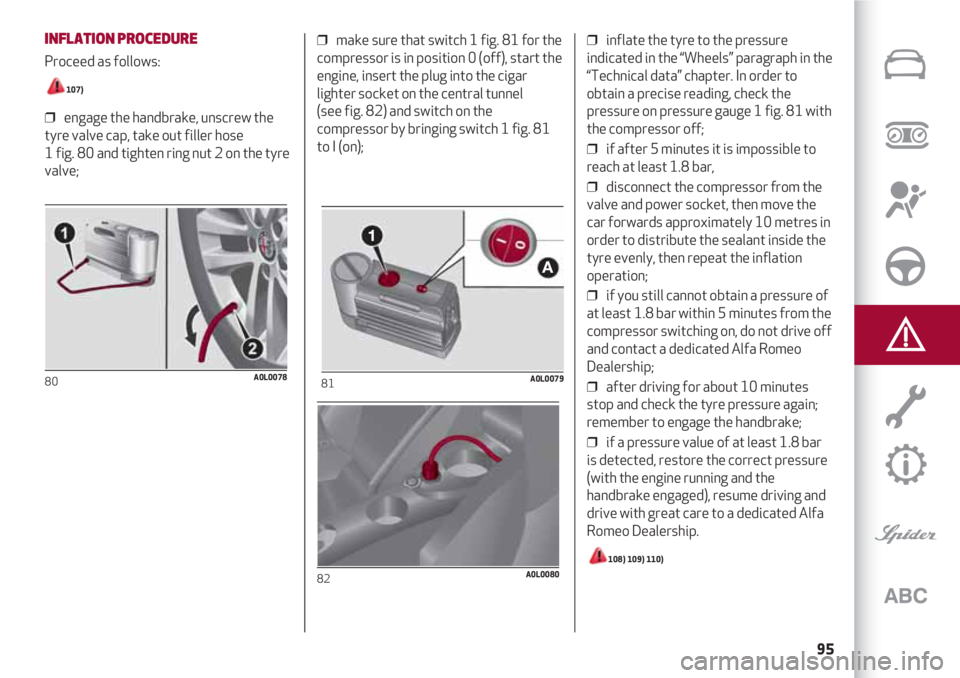
❒ engage the handbrake, unscrew the
tyre valve cap, take out filler hose
1 fig. 80 and tighten ring nut 2 on the tyre
valve;
80A0L0078
❒ make sure that switch 1 fig. 81 for the
compressor is in position 0 (off), start the
engine, insert the plug into the cigar
lighter socket on the central tunnel
(see fig. 82) and switch on the
compressor by bringing switch 1 fig. 81
to I (on);
82A0L0080
❒ inflate the tyre to the pressure
indicated in the “Wheels” paragraph in the
“Technical data” chapter. In order to
obtain a precise reading, check the
pressure on pressure gauge 1 fig. 81 with
the compressor off;
❒ if after 5 minutes it is impossible to
reach at least 1.8 bar,
❒ disconnect the compressor from the
valve and power socket, then move the
car forwards approximately 10 metres in
order to distribute the sealant inside the
tyre evenly, then repeat the inflation
operation;
❒ if you still cannot obtain a pressure of
at least 1.8 bar within 5 minutes from the
compressor switching on, do not drive off
and contact a dedicated Alfa Romeo
Dealership;
❒ after driving for about 10 minutes
stop and check the tyre pressure again;
remember to engage the handbrake;
❒ if a pressure value of at least 1.8 bar
is detected, restore the correct pressure
(with the engine running and the
handbrake engaged), resume driving and
drive with great care to a dedicated Alfa
Romeo Dealership.
108) 109) 110)
81A0L0079
1
A
Page 98 of 156
IN AN EMERGENCY
96
CHECKING AND RESTORING TYRE
PRESSURE
The compressor can also be used to
check and, if necessary, restore the tyre
pressure.
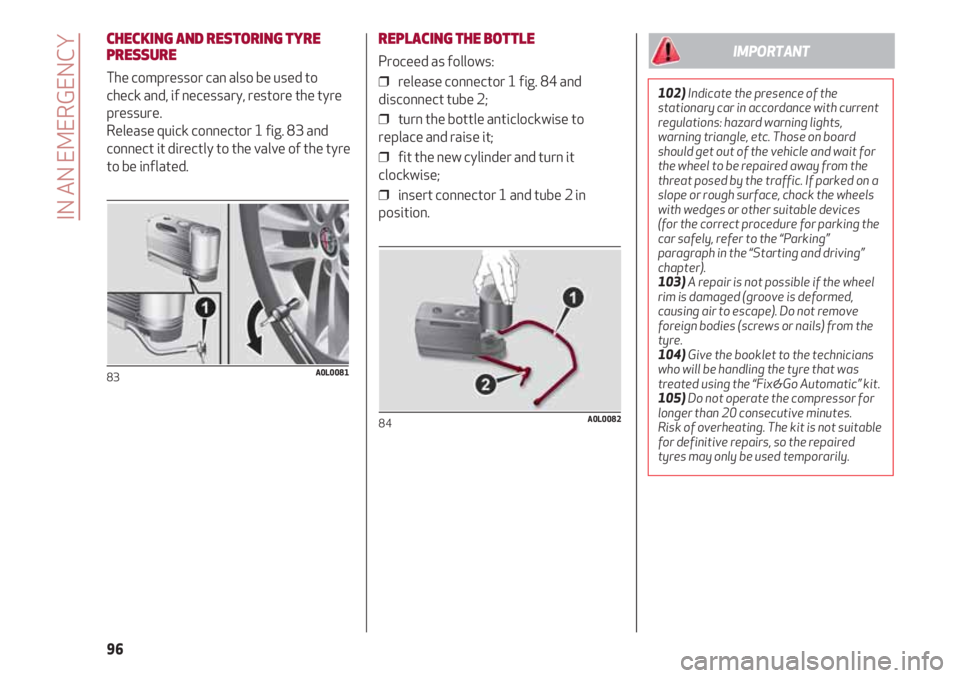
Release quick connector 1 fig. 83 and
connect it directly to the valve of the tyre
to be inflated.
83A0L0081
REPLACING THE BOTTLE
Proceed as follows:
❒ release connector 1 fig. 84 and
disconnect tube 2;
❒ turn the bottle anticlockwise to
replace and raise it;
❒ fit the new cylinder and turn it
clockwise;
❒ insert connector 1 and tube 2 in
position.
84A0L0082
102)Indicate the presence of the
stationary car in accordance with current
regulations: hazard warning lights,
warning triangle, etc. Those on board
should get out of the vehicle and wait for
the wheel to be repaired away from the
threat posed by the traffic. If parked on a
slope or rough surface, chock the wheels
with wedges or other suitable devices
(for the correct procedure for parking the
car safely, refer to the “Parking”
paragraph in the “Starting and driving”
chapter).
103)A repair is not possible if the wheel
rim is damaged (groove is deformed,
causing air to escape). Do not remove
foreign bodies (screws or nails) from the
tyre.
104)Give the booklet to the technicians
who will be handling the tyre that was
treated using the “Fix&Go Automatic” kit.
105)Do not operate the compressor for
longer than 20 consecutive minutes.
Risk of overheating. The kit is not suitable
for definitive repairs, so the repaired
tyres may only be used temporarily.
IMPORTANT
Page 102 of 156
IN AN EMERGENCY
100
113)Before towing, turn the ignition key
to the MAR position and then to STOP
without removing it. The steering column
will automatically lock when the key is
removed and the wheels cannot be
steered. Also check that the transmission
is in neutral (N).
114) When towing, remember that the
assistance of the brake servo is absent.
Consequently, more force is required at
the pedal in order to brake. Do not use
flexible cables when towing and avoid
jerky movements. Make sure not to
damage parts in contact with the car
while towing.
When towing the vehicle, you must
comply with all specific traffic
regulations and adopt an appropriate
driving behaviour.
Do not start the engine while towing the
car. Before tightening the ring, clean the
threaded housing thoroughly. Make sure
that the ring is fully fastened in the
housing before towing the vehicle.
IMPORTANT115) The tow hook should be used only
for emergencies on the road. You are
allowed to tow the vehicle for short
distances using an appropriate device in
accordance with the highway code (a rigid
bar), to move the vehicle on the road in
readiness for towing or transporting via a
breakdown vehicle.
Tow hooks MUST NOT be used to tow
vehicles off the road or where there are
obstacles and/or for towing operations
using cables or other non-rigid devices.
In compliance with the above conditions,
towing must take place with the two
vehicles (one towing, the other towed)
aligned as much as possible along the
same centre line.
Page 120 of 156
SERVICING AND CARE
118
Proceed as follows to reposition:
❒ tighten the screws with folding ring
1 fig. 103 in the housings on the floor;
❒ unite the Velcro fabric strips 2 of the
mats with those on the floor, taking care
to apply light pressure and ensure that
the fastening is efficient.
132)
SEATS AND FABRIC OR
MICROFIBRE PARTS
Remove dust with a soft brush or a
vacuum cleaner.
For cleaning microfibre upholstery
(on some versions, including steering
wheel).
It is advisable to moisten the brush.
Rub the seats with a sponge moistened
with a solution of water and neutral
detergent.
LEATHER SEATS
(where provided)
Remove the dry dirt with a chamois or
slightly damp cloth, without exerting too
much pressure.
Remove any liquid or grease stains using
an absorbent dry cloth, without rubbing.
Then clean with a soft cloth or buckskin
cloth dampened with water and mild
soap. If the stain persists, use specific
products and observe the instructions
carefully.
IMPORTANT Never use alcohol.
Make sure that the cleaning products
used contain no alcohol or alcohol
derivatives, even in small quantities.
PLASTIC, CARBON AND
COATED PARTS
Clean interior plastic and visible carbon
parts with a damp cloth (if possible made
from microfibre), and a solution of water
and neutral, non-abrasive detergent.
To clean oily or persistent stains, use
specific products free from solvents and
designed to maintain the original
appearance and colour of the
components.
Remove any dust using a microfibre cloth,
if necessary moistened with water.
The use of paper tissues is not
recommended as these may leave
residues.
26)
LEATHER UPHOLSTERY
(for versions/markets, where provided)
Use only water and mild soap to clean
these parts. Never use alcohol or
alcohol-based products.
Before using a specific product for
cleaning interiors, make sure that it does
not contain spirit and/or alcohol based
substances.
130)Never use flammable products, such
as petroleum ether or modified petrol, to
clean the inside of the car. The
electrostatic charges which are
generated by rubbing during the cleaning
operation may cause a fire.
131)Do not keep aerosol cans in the car:
danger of explosion.
Aerosol cans must not be exposed to a
temperature exceeding 50°C.
When the vehicle is exposed to sunlight,
the internal temperature can greatly
exceed this value.
132)It is essential that there is nothing
under the pedals: make sure the mats are
lying flat and do not get in the way of the
pedals.
IMPORTANT
26)Never use alcohol, petrols and
derivatives to clean the dashboard and
instrument panel lens.
WARNING
Page 121 of 156
TECHNICAL DATA
IDENTIFICATION DATA ..................................................................................... 120
IDENTIFICATION DATA PLATE ..................................................................... 120
CHASSIS HOOKS .................................................................................................. 121
BODYWORK PAINT IDENTIFICATION PLATE ...................................... 121
ENGINE MARKING ............................................................................................... 121
ENGINE ....................................................................................................................... 122
WHEELS...................................................................................................................... 123
DIMENSIONS .......................................................................................................... 127
WEIGHTS ................................................................................................................... 128
REFUELLING ........................................................................................................... 129
FLUIDS AND LUBRICANTS ............................................................................. 130
PERFORMANCE .................................................................................................... 132
FUEL CONSUMPTION......................................................................................... 132
CO
2EMISSIONS ......................................................................................................133
PRESCRIPTIONS FOR HANDLING THE
VEHICLE AT THE END OF ITS LIFE .............................................................. 134
Everything you may find useful for understanding how your car
is made and works is contained in this chapter and
illustrated with data, tables and graphics.
For the enthusiasts and the technician, but also just
for those who want to know every detail of their car.
Page 125 of 156
123
WHEELS
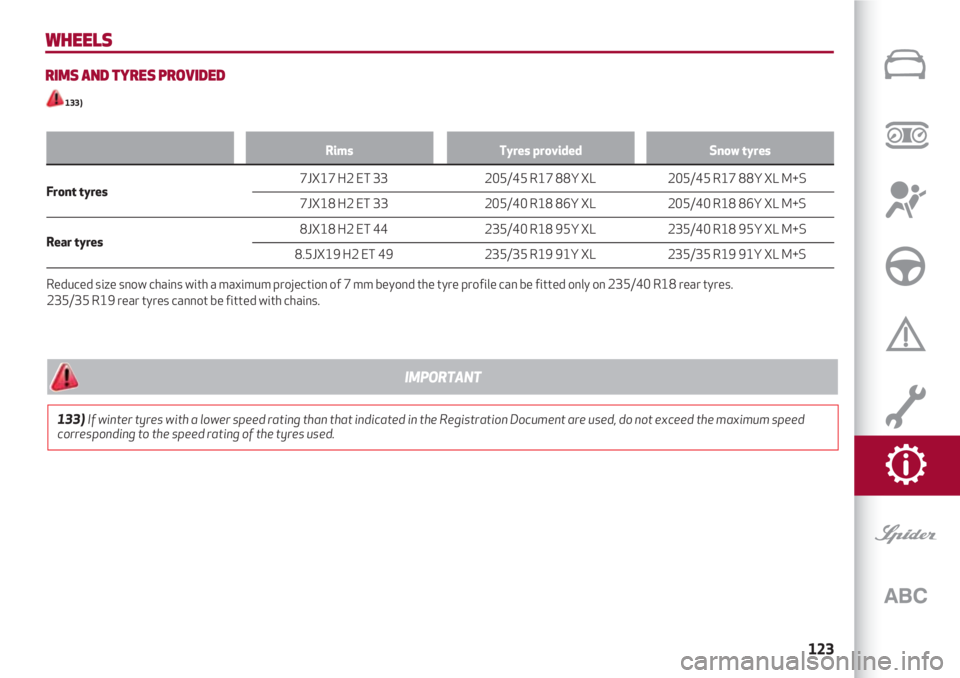
RIMS AND TYRES PROVIDED
133)
Rims Tyres provided Snow tyres
Front tyres 7JX17 H2 ET 33 205/45 R17 88Y XL 205/45 R17 88Y XL M+S 7JX18 H2 ET 33 205/40 R18 86Y XL 205/40 R18 86Y XL M+S
Rear tyres 8JX18 H2 ET 44 235/40 R18 95Y XL 235/40 R18 95Y XL M+S 8.5JX19 H2 ET 49 235/35 R19 91Y XL 235/35 R19 91Y XL M+S
Reduced size snow chains with a maximum projection of 7 mm beyond the tyre profile can be fitted only on 235/40 R18 rear tyres.
235/35 R19 rear tyres cannot be fitted with chains.
133)If winter tyres with a lower speed rating than that indicated in the Registration Document are used, do not exceed the maximum speed
corresponding to the speed rating of the tyres used.
IMPORTANT
Page 128 of 156
TECHNICAL DATA
126
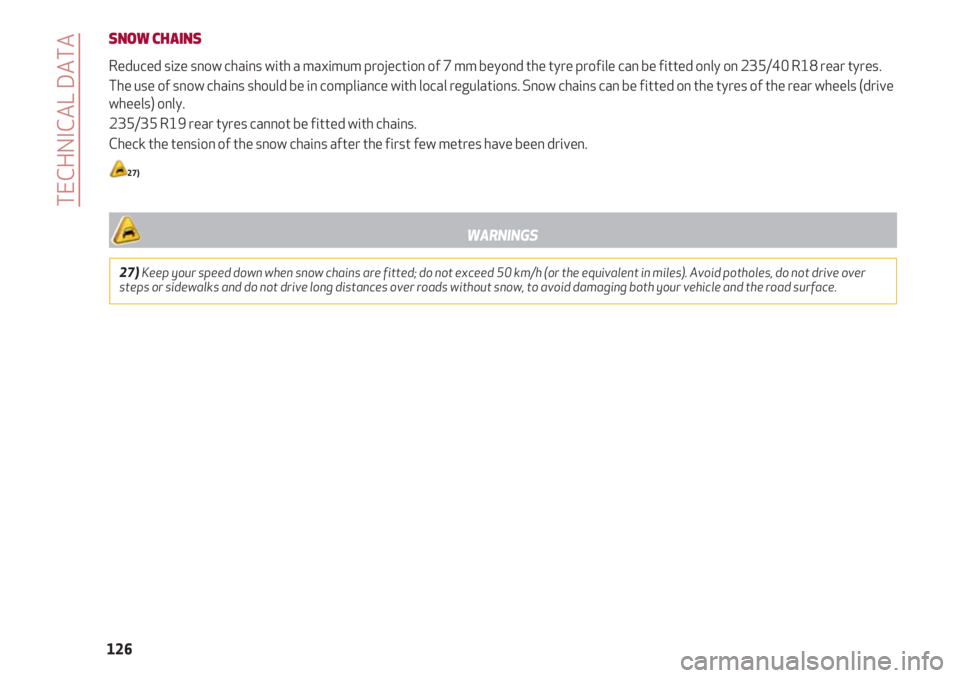
SNOW CHAINS
Reduced size snow chains with a maximum projection of 7 mm beyond the tyre profile can be fitted only on 235/40 R18 rear tyres.
The use of snow chains should be in compliance with local regulations. Snow chains can be fitted on the tyres of the rear wheels (drive
wheels) only.
235/35 R19 rear tyres cannot be fitted with chains.
Check the tension of the snow chains after the first few metres have been driven.
27)
27)Keep your speed down when snow chains are fitted; do not exceed 50 km/h (or the equivalent in miles). Avoid potholes, do not drive over
steps or sidewalks and do not drive long distances over roads without snow, to avoid damaging both your vehicle and the road surface.
WARNINGS