sensor Alfa Romeo 4C Spider 2016 User Guide
[x] Cancel search | Manufacturer: ALFA ROMEO, Model Year: 2016, Model line: 4C Spider, Model: Alfa Romeo 4C Spider 2016Pages: 371, PDF Size: 2.93 MB
Page 135 of 371

CAUTION!
The TPMS has been optimized for the original
equipment tires and wheels. TPMS pressures and
warning have been established for the tire size
equipped on your vehicle. Undesirable system opera-
tion or sensor damage may result when using re-
placement equipment that is not of the same size,
type, and/or style. Aftermarket wheels can cause
sensor damage. Using aftermarket tire sealants may
cause the Tire Pressure Monitoring System (TPMS)
sensor to become inoperable. After using an after-
market tire sealant it is recommended that you take
your vehicle to an authorized dealership to have your
sensor function checked.
4
UNDERSTANDING YOUR INSTRUMENT PANEL 133
Page 136 of 371
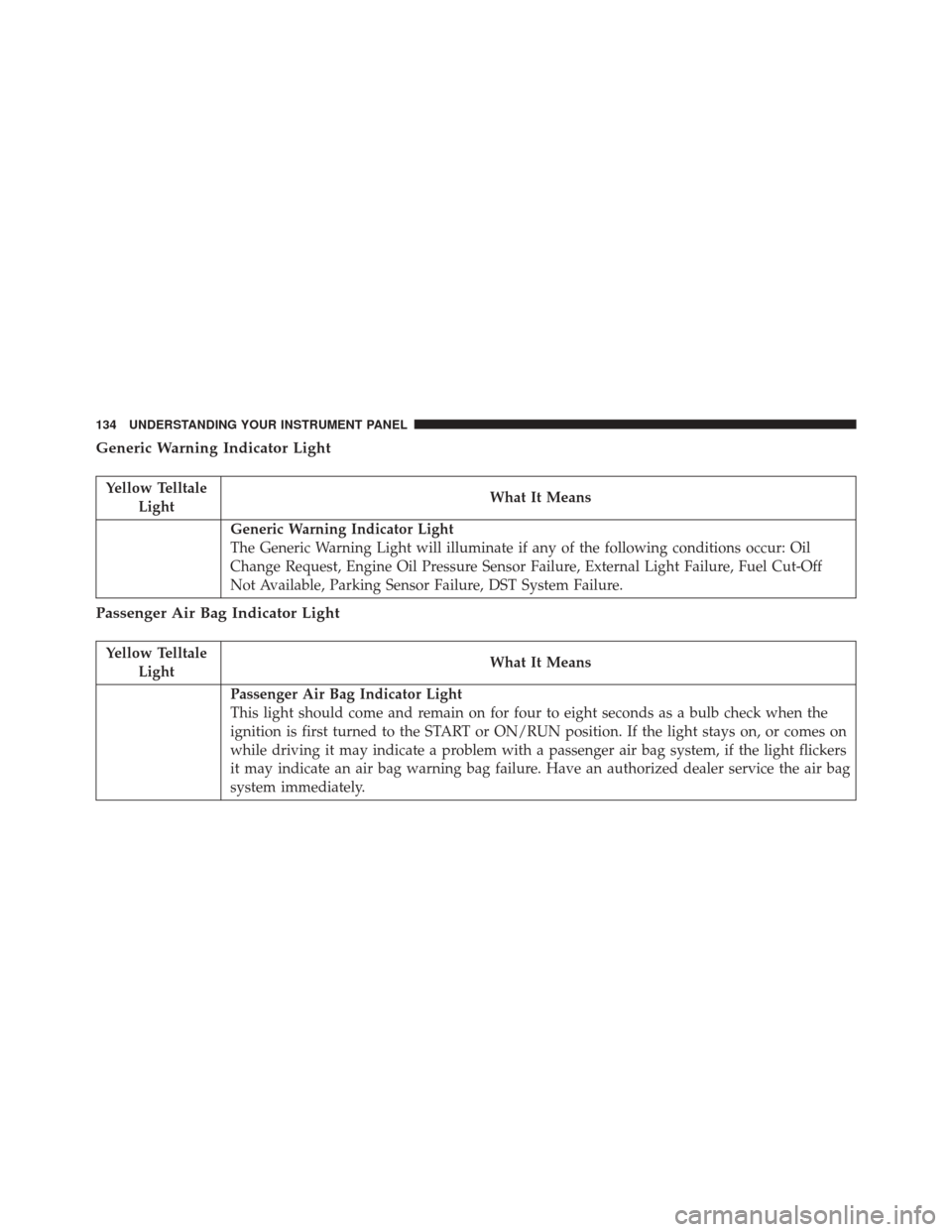
Generic Warning Indicator Light
Yellow TelltaleLight What It Means
Generic Warning Indicator Light
The Generic Warning Light will illuminate if any of the following conditions occur: Oil
Change Request, Engine Oil Pressure Sensor Failure, External Light Failure, Fuel Cut-Off
Not Available, Parking Sensor Failure, DST System Failure.
Passenger Air Bag Indicator Light
Yellow Telltale
Light What It Means
Passenger Air Bag Indicator Light
This light should come and remain on for four to eight seconds as a bulb check when the
ignition is first turned to the START or ON/RUN position. If the light stays on, or comes on
while driving it may indicate a problem with a passenger air bag system, if the light flickers
it may indicate an air bag warning bag failure. Have an authorized dealer service the air bag
system immediately.
134 UNDERSTANDING YOUR INSTRUMENT PANEL
Page 164 of 371

Range
This indicates the distance which may be traveled with
the fuel remaining in the tank, assuming that driving
conditions will not change. The message “----” will
appear on the display in the following cases:
•Distance less than 30 miles (or 50 km).
• The vehicle is parked for a long time with the engine
running.
NOTE: The range depends on several factors: driving
style, type of route (freeway, residential, mountain roads,
etc.), conditions of use of the vehicle (load, tire pressure,
etc.). Trip planning must take into account the above
notes.
Average Fuel Consumption
This value shows the approximate average consumption
since the last reset.
Travel Distance
This value shows the distance covered since the last reset.
Current Fuel Consumption
This indicates the fuel consumption. The value is con-
stantly updated. The message “----” will appear on the
display if the vehicle is parked with the engine running.
Average Speed
This value shows the vehicle’s average speed as a func-
tion of the overall time elapsed since the last reset.
Travel Time
This value shows the time elapsed since the last reset.
Tire Pressure Values
This screen will display OK at each Tire Pressure Moni-
toring sensor. Refer to “Tire Pressure Monitoring System”
in “Starting And Operating.”
162 UNDERSTANDING YOUR INSTRUMENT PANEL
Page 200 of 371
WARNING!(Continued)
hydroplaning. ESC also cannot prevent collisions
resulting from loss of vehicle control due to inap-
propriate driver input for the conditions. Only a
safe, attentive, and skillful driver can prevent col-
lisions.The capabilities of an ESC equipped ve-
hicle must never be exploited in a reckless or
dangerous manner which could jeopardize the us-
er ’s safety or the safety of others.
• Vehicle modifications, or failure to properly main-
tain your vehicle, may change the handling charac-
teristics of your vehicle, and may negatively affect
the performance of the ESC system. Changes to the
steering system, suspension, braking system, tire
type and size or wheel size may adversely affect
(Continued)
WARNING! (Continued)
ESC performance. Improperly inflated and un-
evenly worn tires may also degrade ESC perfor-
mance. Any vehicle modification or poor vehicle
maintenance that reduces the effectiveness of the
ESC system can increase the risk of loss of vehicle
control, vehicle rollover, personal injury and death.
The ESC system uses sensors installed on the vehicle to
determine the trajectory that the driver intends to follow
and compares it with the vehicles effective trajectory.
When the real trajectory deviates from the desired trajec-
tory, the ESC system intervenes to counter the vehicles
understeer or oversteer.
• Oversteer: occurs when the vehicle is turning more
than it should according to the angle of the steering
wheel.
198 STARTING AND OPERATING
Page 234 of 371
Light) illuminates, you must increase the tire pressure to
the recommended cold tire pressure in order for the Tire
Pressure Monitoring Telltale Light to turn off. The system
will automatically update and the Tire Pressure Monitor-
ing Telltale Light will turn off once the system receives
the updated tire pressures. The vehicle may need to be
driven for up to 20 minutes above 15 mph (24 km/h) in
order for the TPMS to receive this information.
For example, your vehicle may have a recommended
cold (parked for more than three hours) tire pressure of
30 psi (207 kPa). If the ambient temperature is 68°F (20°C)
and the measured tire pressure is 27 psi (186 kPa), a
temperature drop to 20°F (-7°C) will decrease the tire
pressure to approximately 23 psi (159 kPa). This tire
pressure is sufficiently low enough to turn on the Tire
Pressure Monitoring Telltale Light. Driving the vehicle
may cause the tire pressure to rise to approximately 27
psi (186 kPa), but the Tire Pressure Monitoring Telltale
Light will still be on. In this situation, the Tire PressureMonitoring Telltale Light will turn off only after the tires
are inflated to the vehicle’s recommended cold tire pres-
sure value.
CAUTION!
•
The TPMS has been optimized for the original
equipment tires and wheels. TPMS pressures and
warnings have been established for the tire size
equipped on your vehicle. Undesirable system op-
eration or sensor damage may result when using
replacement equipment that is not of the same size,
type, and/or style. Aftermarket wheels can cause
sensor damage. Using aftermarket tire sealants may
cause the Tire Pressure Monitoring System (TPMS)
sensor to become inoperable. After using an after-
market tire sealant it is recommended that you take
your vehicle to an authorized dealership to have
your sensor function checked.
(Continued)
232 STARTING AND OPERATING
Page 235 of 371
CAUTION!(Continued)
•After inspecting or adjusting the tire pressure,
always reinstall the valve stem cap. This will
prevent moisture and dirt from entering the valve
stem, which could damage the Tire Pressure Moni-
toring Sensor.
NOTE:
• The TPMS is not intended to replace normal tire care
and maintenance, or to provide warning of a tire
failure or condition.
• The TPMS should not be used as a tire pressure gauge
while adjusting your tire pressure.
• Driving on a significantly under-inflated tire causes
the tire to overheat and can lead to tire failure. Under-inflation also reduces fuel efficiency and tire
tread life, and may affect the vehicle’s handling and
stopping ability.
• The TPMS is not a substitute for proper tire mainte-
nance, and it is the driver ’s responsibility to maintain
correct tire pressure using an accurate tire gauge, even
if under-inflation has not reached the level to trigger
illumination of the Tire Pressure Monitoring Telltale
Light.
• Seasonal temperature changes will affect tire pressure,
and the TPMS will monitor the actual tire pressure in
the tire.
Base System
This is the TPMS warning indicator located in the
instrument cluster.
5
STARTING AND OPERATING 233
Page 236 of 371
The TPMS uses wireless technology with wheel rim
mounted electronic sensors to monitor tire pressure lev-
els. Sensors, mounted to each wheel as part of the valve
stem, transmit tire pressure readings to the Receiver
Module.
NOTE:It is particularly important for you to check the
tire pressure in all of the tires on your vehicle regularly
and to maintain the proper pressure.
The TPMS consists of the following components:
• Receiver Module.
• Four Tire Pressure Monitoring Sensors.
• Tire Pressure Monitoring Telltale Light.
Tire Pressure Monitoring Low Pressure Warnings
The Tire Pressure Monitoring Telltale Light will illumi-
nate in the instrument cluster, an acoustic signal will be
activated, and the “Check left or right front/rear tire” text message will display when one or more of the four
active road tire pressures are low. Should this occur, you
should stop as soon as possible, check the inflation
pressure of each tire on your vehicle, and inflate each tire
to the vehicle’s recommended cold placard pressure
value. The system will automatically update and the Tire
Pressure Monitoring Light will extinguish once the up-
dated tire pressures have been received. The vehicle may
need to be driven for up to 20 minutes above 15 mph
(24 km/h) to receive this information.
Check TPMS Warnings
The Tire Pressure Monitoring Telltale Light will flash on
and off for 75 seconds and remain on solid when a system
fault is detected, the “TIRE PRESSURE MONITORING
UNAVAILABLE” text message will display. If the igni-
tion key is cycled, this sequence will repeat providing the
system fault still exists. The Tire Pressure Monitoring
234 STARTING AND OPERATING
Page 237 of 371
Telltale Light will turn off when the fault condition no
longer exists. A system fault can occur with any of the
following scenarios:
1. Jamming due to electronic devices or driving next tofacilities emitting the same radio frequencies as the
TPM sensors.
2. Installing some form of aftermarket window tinting that affects radio wave signals.
3. Snow or ice around the wheels or wheel housings.
4. Using tire chains on the vehicle.
5. Using wheels/tires not equipped with TPM sensors.
NOTE: Your vehicle may be equipped with a compact
spare wheel and tire assembly.
1. The compact spare tire does not have a tire pressure monitoring sensor. Therefore, the TPMS will not moni-
tor the tire pressure in the compact spare tire. 2. If you install the compact spare tire in place of a road
tire that has a pressure below the low-pressure warn-
ing limit, upon the next ignition key cycle, a chime will
sound and the Tire Pressure Monitoring Telltale Light
will still turn ON due to the low tire.
3. However, after driving the vehicle for up to 20 min- utes above 15 mph (24 km/h), the Tire Pressure
Monitoring Telltale Light will flash on and off for 75
seconds and then remain on solid.
4. This occurs for each subsequent ignition key cycle, a chime will sound and the Tire Pressure Monitoring
Telltale Light will flash on and off for 75 seconds and
then remain on solid.
5. Once you repair or replace the original road tire and reinstall it on the vehicle in place of the compact spare
tire, the TPMS will update automatically and the Tire
Pressure Monitoring Telltale Light will turn OFF, as
long as no tire pressure is below the low-pressure
5
STARTING AND OPERATING 235