ecu Alfa Romeo 4C Spider 2017 User Guide
[x] Cancel search | Manufacturer: ALFA ROMEO, Model Year: 2017, Model line: 4C Spider, Model: Alfa Romeo 4C Spider 2017Pages: 297, PDF Size: 2.84 MB
Page 48 of 297
such as law enforcement, that have the special equip-
ment, can read the information if they have access to the
vehicle or the EDR.
Child Restraints
Everyone in your vehicle needs to be buckled up at all
times, including babies and children. Every state in the
United States, and every Canadian province, requires
that small children ride in proper restraint systems. This
is the law, and you can be prosecuted for ignoring it.
Children 12 years or younger should ride properly
buckled up in a rear seat, if available. According to
crash statistics, children are safer when properly re-
strained in the rear seats rather than in the front.
WARNING!
In a collision, an unrestrained child can become a
projectile inside the vehicle. The force required to
hold even an infant on your lap could become so
great that you could not hold the child, no matter
how strong you are. The child and others could be
badly injured. Any child riding in your vehicle
should be in a proper restraint for the child’s size.There are different sizes and types of restraints for
children from newborn size to the child almost large
enough for an adult safety belt. Always check the child
seat Owner ’s Manual to make sure you have the correct
seat for your child. Carefully read and follow all the
instructions and warnings in the child restraint Own-
er ’s Manual and on all the labels attached to the child
restraint.
Before buying any restraint system, make sure that it
has a label certifying that it meets all applicable Safety
Standards. You should also make sure that you can
install it in the vehicle where you will use it.
NOTE:
•
For additional information, refer to www.seatcheck.org
or call 1-866-SEATCHECK.
•Canadian residents should refer to Transport Canada’s
website for additional information: www.tc.gc.ca/
eng/motorvehiclesafety/safedrivers-childsafety-
index-53.htm
46 THINGS TO KNOW BEFORE STARTING YOUR VEHICLE
Page 51 of 297
over the vehicle’s seat cushion while the child’s back is
against the seatback, they should use a belt-positioning
booster seat. The child and belt-positioning booster seat
are held in the vehicle by the seat belt.
WARNING!
•Improper installation can lead to failure of an
infant or child restraint. It could come loose in a
collision. The child could be badly injured or
killed. Follow the child restraint manufacturer ’s
directions exactly when installing an infant or
child restraint.
•
After a child restraint is installed in the vehicle, do
not move the vehicle seat forward or rearward
because it can loosen the child restraint attach-
ments. Remove the child restraint before adjusting
the vehicle seat position. When the vehicle seat has
been adjusted, reinstall the child restraint.
• When your child restraint is not in use, secure it
in the vehicle with the seat belt or LATCH anchor-
ages, or remove it from the vehicle. Do not leave
it loose in the vehicle. In a sudden stop or
accident, it could strike the occupants or seat-
backs and cause serious personal injury.
Children Too Large For Booster Seats
Children who are large enough to wear the shoulder
belt comfortably, and whose legs are long enough to
bend over the front of the seat when their back is
against the seatback, should use the seat belt in a rear
seat. Use this simple 5-step test to decide whether the
child can use the vehicle’s seat belt alone:
1. Can the child sit all the way back against the back of
the vehicle seat?
2. Do the child’s knees bend comfortably over the front of the vehicle seat – while they are still sitting all the
way back?
3. Does the shoulder belt cross the child’s shoulder between their neck and arm?
4. Is the lap part of the belt as low as possible, touching the child’s thighs and not their stomach?
5. Can the child stay seated like this for the whole trip?
If the answer to any of these questions was “no,” then
the child still needs to use a booster seat in this vehicle.
If the child is using the lap/shoulder belt, check seat
belt fit periodically and make sure the seat belt buckle is
latched. A child’s squirming or slouching can move the
2
THINGS TO KNOW BEFORE STARTING YOUR VEHICLE 49
Page 52 of 297
belt out of position. If the shoulder belt contacts the face
or neck, move the child closer to the center of the
vehicle, or use a booster seat to position the seat belt on
the child correctly.
WARNING!
Never allow a child to put the shoulder belt under
an arm or behind their back. In a crash, the shoulder
belt will not protect a child properly, which may
result in serious injury or death. A child must
always wear both the lap and shoulder portions of
the seat belt correctly.
Installing Child Restraints Using The Vehicle
Seat Belt
Child restraint systems are designed to be secured in
vehicle seats by lap belts or the lap belt portion of a
lap/shoulder belt.
WARNING!
•Improper installation or failure to properly secure
a child restraint can lead to failure of the restraint.
The child could be badly injured or killed.
• Follow the child restraint manufacturer ’s direc-
tions exactly when installing an infant or child
restraint.
The seat belts in the passenger seating positions are
equipped with a Switchable Automatic Locking Retrac-
tor (ALR) that is designed to keep the lap portion of the
seat belt tight around the child restraint so that it is not
necessary to use a locking clip. The ALR retractor can be
“switched” into a locked mode by pulling all of the
webbing out of the retractor and then letting the web-
bing retract back into the retractor. If it is locked, the
ALR will make a clicking noise while the webbing is
pulled back into the retractor. Refer to the “Automatic
Locking Mode” description under “Occupant Re-
straints” for additional information on ALR.
50 THINGS TO KNOW BEFORE STARTING YOUR VEHICLE
Page 54 of 297
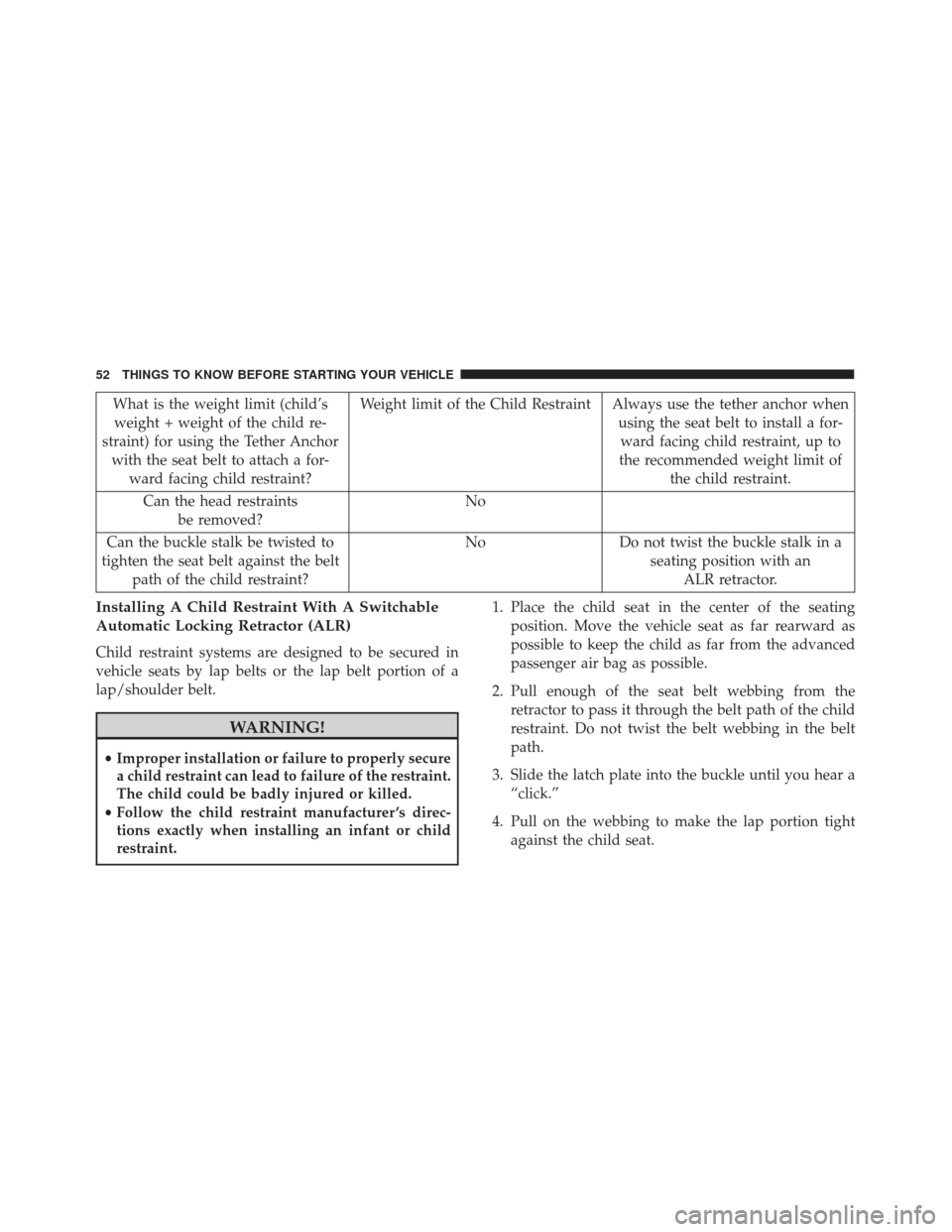
What is the weight limit (child’sweight + weight of the child re-
straint) for using the Tether Anchor with the seat belt to attach a for- ward facing child restraint? Weight limit of the Child Restraint Always use the tether anchor when
using the seat belt to install a for-ward facing child restraint, up to
the recommended weight limit of the child restraint.
Can the head restraints be removed? No
Can the buckle stalk be twisted to
tighten the seat belt against the belt path of the child restraint? No
Do not twist the buckle stalk in a
seating position with an ALR retractor.
Installing A Child Restraint With A Switchable
Automatic Locking Retractor (ALR)
Child restraint systems are designed to be secured in
vehicle seats by lap belts or the lap belt portion of a
lap/shoulder belt.
WARNING!
•Improper installation or failure to properly secure
a child restraint can lead to failure of the restraint.
The child could be badly injured or killed.
• Follow the child restraint manufacturer ’s direc-
tions exactly when installing an infant or child
restraint. 1. Place the child seat in the center of the seating
position. Move the vehicle seat as far rearward as
possible to keep the child as far from the advanced
passenger air bag as possible.
2. Pull enough of the seat belt webbing from the retractor to pass it through the belt path of the child
restraint. Do not twist the belt webbing in the belt
path.
3. Slide the latch plate into the buckle until you hear a “click.”
4. Pull on the webbing to make the lap portion tight against the child seat.
52 THINGS TO KNOW BEFORE STARTING YOUR VEHICLE
Page 56 of 297
Always use the tether anchor when using the seat belt
to install a forward facing child restraint, up to the
recommended weight limit of the child restraint. This
vehicle is equipped with a tether anchorage, located
behind the front passenger seat, near the floor.
1. Look behind the seating position where you plan toinstall the child restraint to find the tether anchorage.
You may need to move the seat forward to provide
better access to the tether anchorage. If there is no
top tether anchorage for that seating position, move
the child restraint to another position in the vehicle if
one is available. 2. Route the tether strap around the outboard side of
the head restraint to the tether anchorage.
3. Attach the tether strap hook of the child restraint to the top tether anchorage as shown in the diagram.
4. Remove slack in the tether strap according to the child restraint manufacturer ’s instructions.
WARNING!
An incorrectly anchored tether strap could lead to
increased head motion and possible injury to the
child. Use only the anchorage position directly
behind the child seat to secure a child restraint top
tether strap.
ENGINE BREAK-IN RECOMMENDATIONS
A long break-in period is not required for the drivetrain
(engine, transmission, and rear axle) in your new ve-
hicle.
Driving your vehicle with a new transmission requires
no special techniques but, to reach optimal shifting
quality and help with engine Break-in, Dynamic and
Race Mode will be inhibited until the vehicle has
accumulated 155 miles (250 km).Upper Tether Anchorage
54 THINGS TO KNOW BEFORE STARTING YOUR VEHICLE
Page 59 of 297
Air Bag Warning Light
The light should come on and remain on for four to
eight seconds as a bulb check when the ignition is first
cycled to ON. If the light is not lit during starting, see
your authorized dealer. If the light stays on, flickers, or
comes on while driving, have the system checked by an
authorized dealer.
Defroster
Check operation by selecting the defrost mode and
place the blower control on high speed. You should be
able to feel the air directed against the windshield. See
your authorized dealer for service if your defroster is
inoperable.
Floor Mat Safety Information
Always use floor mats designed to fit the footwell of
your vehicle. Use only floor mats that leave the pedal
area unobstructed and that are firmly secured so that
they cannot slip out of position and interfere with the
pedals or impair safe operation of your vehicle in other
ways.
WARNING!
An improperly attached, damaged, folded, or
stacked floor mat, or damaged floor mat fasteners
may cause your floor mat to interfere with the
accelerator, brake, or clutch pedals and cause a loss
of vehicle control. To prevent SERIOUS INJURY or
DEATH:
•ALWAYS securely attach
your floor mat using
the floor mat fasteners. DO NOT install your
floor mat upside down or turn your floor mat
over. Lightly pull to confirm mat is secured
using the floor mat fasteners on a regular basis.
• ALWAYS REMOVE THE EXISTING FLOOR
MAT FROM THE VEHICLE
before installing
any other floor mat. NEVER install or stack an
additional floor mat on top of an existing floor
mat.
• ONLY install floor mats designed to fit your
vehicle. NEVER install a floor mat that cannot be
properly attached and secured to your vehicle. If a
floor mat needs to be replaced, only use a FCA
approved floor mat for the specific make, model,
and year of your vehicle.
(Continued)
2
THINGS TO KNOW BEFORE STARTING YOUR VEHICLE 57
Page 60 of 297
WARNING!(Continued)
•ONLY use the driver ’s side floor mat on the
driver ’s side floor area. To check for interference,
with the vehicle properly parked with the engine
off, fully depress the accelerator, the brake, and
the clutch pedal (if present) to check for interfer-
ence. If your floor mat interferes with the opera-
tion of any pedal, or is not secure to the floor,
remove the floor mat from the vehicle and place
the floor mat in your trunk.
• ONLY use the passenger ’s side floor mat on the
passenger ’s side floor area.
• ALWAYS make sure objects cannot fall or slide
into the driver ’s side floor area when the vehicle
is moving. Objects can become trapped under
accelerator, brake, or clutch pedals and could
cause a loss of vehicle control.
• NEVER place any objects under the floor mat
(e.g., towels, keys, etc.). These objects could
change the position of the floor mat and may
cause interference with the accelerator, brake, or
clutch pedals.
(Continued)
WARNING! (Continued)
•If the vehicle carpet has been removed and re-
installed, always properly attach carpet to the
floor and check the floor mat fasteners are secure
to the vehicle carpet. Fully depress each pedal to
check for interference with the accelerator, brake,
or clutch pedals then re-install the floor mats.
• It is recommended to only use mild soap and
water to clean your floor mats. After cleaning,
always check your floor mat has been properly
installed and is secured to your vehicle using the
floor mat fasteners by lightly pulling mat.
Periodic Safety Checks You Should Make
Outside The Vehicle
Tires
Examine tires for excessive tread wear and uneven wear
patterns. Check for stones, nails, glass, or other objects
lodged in the tread. Inspect the tread and sidewall for
cuts and cracks. Check the wheel nuts for tightness.
Check the tires for proper pressure.
58 THINGS TO KNOW BEFORE STARTING YOUR VEHICLE
Page 75 of 297
WARNING!
•Adjusting a seat while driving may be dangerous.
Moving a seat while driving could result in loss
of control which could cause a collision and
serious injury or death.
• Seats should be adjusted before fastening the seat
belts and while the vehicle is parked. Serious
injury or death could result from a poorly ad-
justed seat belt.
(Continued)
WARNING! (Continued)
•Do not ride with the seatback reclined so that the
shoulder belt is no longer resting against your
chest. In a collision you could slide under the seat
belt, which could result in serious injury or death.
Non-Adjustable Head Restraints
The non-adjustable head restraints are form fitted into
the upper structure of the seatback and are designed to
reduce the risk of injury by restricting head movement
in the event of a rear impact. The seatback should be
properly adjusted to an upright position where the head
restraint is positioned as close as possible to the back of
your head.
WARNING!
Be certain that the seatback is locked securely into
position. Otherwise, the seat will not provide the
proper stability for passengers. An improperly
latched seatback could cause serious injury.
Recline Lever
3
UNDERSTANDING THE FEATURES OF YOUR VEHICLE 73
Page 78 of 297
5. Place the decklid prop rod in the decklid slot tosecure the decklid in the open position.WARNING!
•The maximum load limit for the luggage compart-
ment, in addition to the kits provided, is 33.1 lbs.
(15kg). Do not exceed the maximum permitted
load in the luggage compartment. When accessing
the rear luggage compartment, do not come into
contact with engine, or other components, that
may be hot and could burn you if touched.
• Access the luggage compartment only with the
vehicle stationary. Before exiting the vehicle, you
should always place the vehicle into FIRST gear
or REVERSE, apply the parking brake, and re-
move the key from the ignition. Never leave the
key fob in the vehicle or in a location accessible to
children.
• The decklid may drop suddenly, causing serious
injury, if the supporting rod is not positioned
correctly.
• The decklid must always be closed properly, and
the lock engaged, while the vehicle is in motions.
Decklid Prop Rod Slot
76 UNDERSTANDING THE FEATURES OF YOUR VEHICLE
Page 96 of 297
As a security measure, an internal decklid emergency
release lever is built into the rear compartment storage
latching mechanism. In a event of a person trapped
inside the storage compartment, the decklid can be
simply opened by pulling on the phosphorescent
handle attached to the decklid latching mechanism.WARNING!
•The maximum load limit for the luggage compart-
ment (located rear of the engine), in addition to
the kits provided, is 33 lbs. (15kg). Do not exceed
the maximum permitted load in the luggage com-
partment. When accessing the rear luggage com-
partment, do not come into contact with engine,
or other components, that may be hot and could
burn you if touched.
• Access the luggage compartment only with the
vehicle stationary. Before exiting the vehicle, you
should always place the vehicle into FIRST gear
or REVERSE, apply the parking brake, and re-
move the key from the ignition. Never leave the
key fob in the vehicle or in a location accessible to
children.
• The decklid may drop suddenly, causing serious
injury, if the supporting rod is not positioned
correctly.
• The decklid must always be closed properly, and
the lock engaged, while the vehicle is in motions.
Rear Compartment Light
94 UNDERSTANDING THE FEATURES OF YOUR VEHICLE