lock Alfa Romeo 4C Spider 2018 Workshop Manual
[x] Cancel search | Manufacturer: ALFA ROMEO, Model Year: 2018, Model line: 4C Spider, Model: Alfa Romeo 4C Spider 2018Pages: 294, PDF Size: 3.31 MB
Page 142 of 294
Normal Starting
NOTE:Normal starting of either a cold or a warm
engine is obtained without pumping or pressing the
accelerator pedal.
Turn the ignition switch to the AVV (START) position
and release it when the engine starts. If the engine fails
to start within 10 seconds, turn the ignition switch to
the STOP (OFF/LOCK) position, wait 10 to 15 seconds,
then repeat the “Normal Starting” procedure.
Cold Weather Operation
Your engine is designed to operate at temperatures as
low as 0°F (-18°C).
CAUTION!
Use of the recommended oil and adhering to the
prescribed oil change intervals is important to pre-
vent engine damage and ensure satisfactory starting
in cold conditions.
If Engine Fails To Start
WARNING!
Never pour fuel or other flammable liquids into the
throttle body air inlet opening in an attempt to start
the vehicle. This could result in a flash fire causing
serious personal injury.
CAUTION!
• Do not attempt to push or tow your vehicle to get
it started. Vehicles equipped with a Alfa Twin
Clutch Transmission cannot be started this way.
Unburned fuel could enter the catalytic converter
and once the engine has started, ignite and dam-
age the converter and vehicle.
• To prevent damage to the starter, do not continu-
ously crank the engine for more than 15 seconds
at a time. Wait 10 to 15 seconds before trying
again.
140 STARTING AND OPERATING
Page 144 of 294
The parking brake lever is located in the central tunnel.
To apply the parking brake, pull the parking brake lever
up as firmly as possible. To release the parking brake,
pull the parking brake lever up slightly, push the center
button, then lower the parking brake lever completely.
When the parking brake is applied with the ignition
switch in the MAR (ACC/ON/RUN) position, the
Brake Warning Light in the instrument cluster display
will illuminate.
When parking on a hill, it is important to turn the front
wheels toward the curb on a downhill grade and away
from the curb on an uphill grade. The parking brakeshould always be applied whenever the driver is not in
the vehicle.
WARNING!
•
Never leave children alone in a vehicle, or with
access to an unlocked vehicle.
•
Allowing children to be in a vehicle unattended is
dangerous for a number of reasons. A child or others
could be seriously or fatally injured. Children
should be warned not to touch the parking brake,
brake pedal or the transmission gear selector.
• Do not leave the key fob in or near the vehicle or
in a location accessible to children. A child could
operate power windows, other controls, or move
the vehicle.
• Be sure the parking brake is fully disengaged
before driving; failure to do so can lead to brake
failure and a collision.
• Always fully apply the parking brake when leav-
ing your vehicle, or it may roll and cause damage
or injury. Also be certain to leave a manual
transmission in REVERSE or FIRST gear. Failure
to do so may allow the vehicle to roll and cause
damage or injury.
Parking Brake Lever
142 STARTING AND OPERATING
Page 145 of 294
CAUTION!
If the Brake Warning Light remains on with the
parking brake released, a brake system malfunction
is indicated. Have the brake system serviced by an
authorized dealer immediately.
SIX-SPEED ALFA TWIN CLUTCH
TRANSMISSION
WARNING!
•It is dangerous to shift out of NEUTRAL if the
engine speed is higher than idle speed. If your
foot is not firmly pressing the brake pedal, the
vehicle could accelerate quickly forward or in
reverse. You could lose control of the vehicle and
hit someone or something. Only shift into gear
when the engine is idling normally and your foot
is firmly pressing the brake pedal.
• Unintended movement of a vehicle could injure
those in or near the vehicle. As with all vehicles,
you should never exit a vehicle while the engine
is running.
(Continued)
WARNING! (Continued)
•Before exiting the vehicle, always come to a
complete stop, then apply the parking brake, shift
the transmission into FIRST gear or REVERSE,
turn the engine OFF, remove the key fob, and lock
the vehicle.
• Never leave children alone in a vehicle, or with
access to an unlocked vehicle. Allowing children
to be in a vehicle unattended is dangerous for a
number of reasons. A child or others could be
seriously or fatally injured. Children should be
warned not to touch the parking brake, brake
pedal or the transmission gear selector.
• Do not leave the key fob in or near the vehicle (or
in a location accessible to children). A child could
operate power windows, other controls, or move
the vehicle.
Using The Transmission
This vehicle is equipped with a Six-Speed Alfa Twin
Clutch transmission with steering wheel mounted shift
paddles.
6
STARTING AND OPERATING 143
Page 166 of 294
WARNING!
•Driving through standing water limits your vehi-
cle’s traction capabilities. Do not exceed 5 mph
(8 km/h) when driving through standing water.
• Driving through standing water limits your vehi-
cle’s braking capabilities, which increases stop-
ping distances. Therefore, after driving through
standing water, drive slowly and lightly press on
the brake pedal several times to dry the brakes.
• Failure to follow these warnings may result in
injuries that are serious or fatal to you, your
passengers, and others around you.
CAUTION!
• Always check the depth of the standing water
before driving through it. Never drive through
standing water that is deeper than the bottom of
the tire rims mounted on the vehicle.
• Determine the condition of the road or the path
that is under water and if there are any obstacles
in the way before driving through the standing
water.
(Continued)
CAUTION! (Continued)
•Do not exceed 5 mph (8 km/h) when driving
through standing water. This will minimize wave
effects.
• Driving through standing water may cause dam-
age to your vehicle’s drivetrain components. Al-
ways inspect your vehicle’s fluids (i.e., engine oil,
transmission, axle, etc.) for signs of contamination
(i.e., fluid that is milky or foamy in appearance)
after driving through standing water. Do not
continue to operate the vehicle if any fluid ap-
pears contaminated, as this may result in further
damage. Such damage is not covered by the New
Vehicle Limited Warranty.
• Getting water inside your vehicle’s engine can
cause it to lock up and stall out, and cause serious
internal damage to the engine. Such damage is
not covered by the New Vehicle Limited War-
ranty.
164 STARTING AND OPERATING
Page 171 of 294
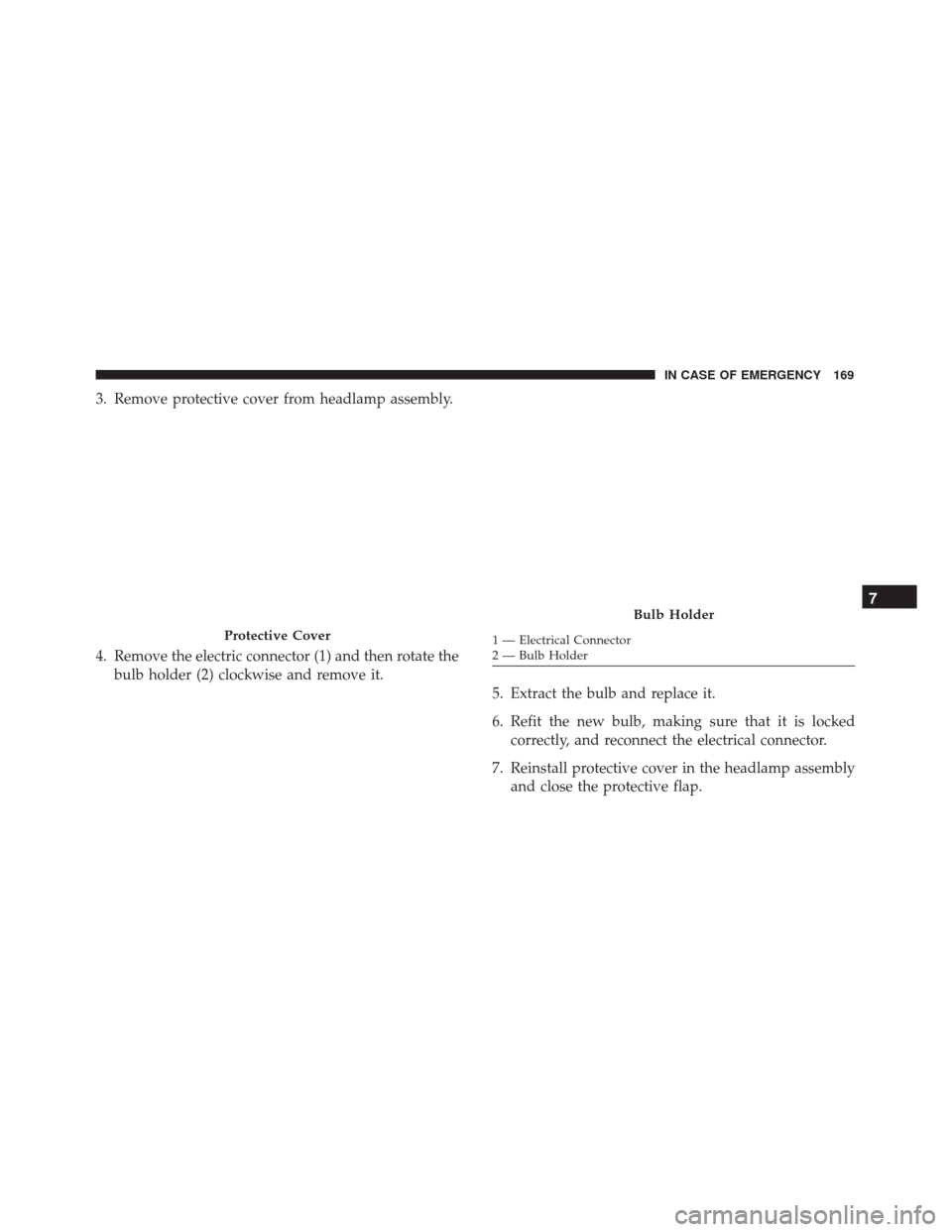
3. Remove protective cover from headlamp assembly.
4. Remove the electric connector (1) and then rotate thebulb holder (2) clockwise and remove it.
5. Extract the bulb and replace it.
6. Refit the new bulb, making sure that it is lockedcorrectly, and reconnect the electrical connector.
7. Reinstall protective cover in the headlamp assembly and close the protective flap.
Protective Cover
Bulb Holder
1 — Electrical Connector
2 — Bulb Holder
7
IN CASE OF EMERGENCY 169
Page 172 of 294
Low/High Beam HID & LED Headlights
For the replacement, contact an authorized dealer.
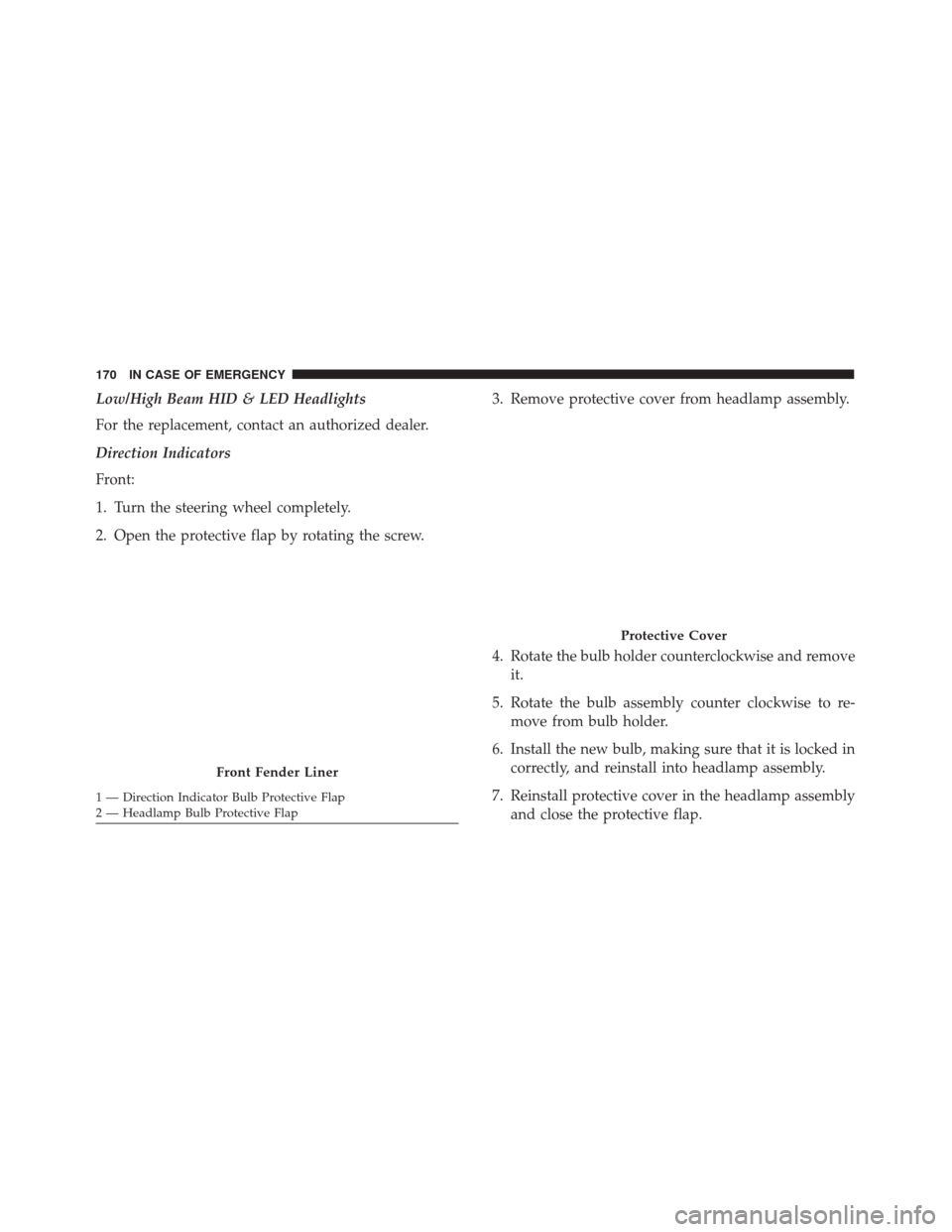
Direction Indicators
Front:
1. Turn the steering wheel completely.
2. Open the protective flap by rotating the screw.3. Remove protective cover from headlamp assembly.
4. Rotate the bulb holder counterclockwise and remove
it.
5. Rotate the bulb assembly counter clockwise to re- move from bulb holder.
6. Install the new bulb, making sure that it is locked in correctly, and reinstall into headlamp assembly.
7. Reinstall protective cover in the headlamp assembly and close the protective flap.
Front Fender Liner
1 — Direction Indicator Bulb Protective Flap
2 — Headlamp Bulb Protective Flap
Protective Cover
170 IN CASE OF EMERGENCY
Page 173 of 294
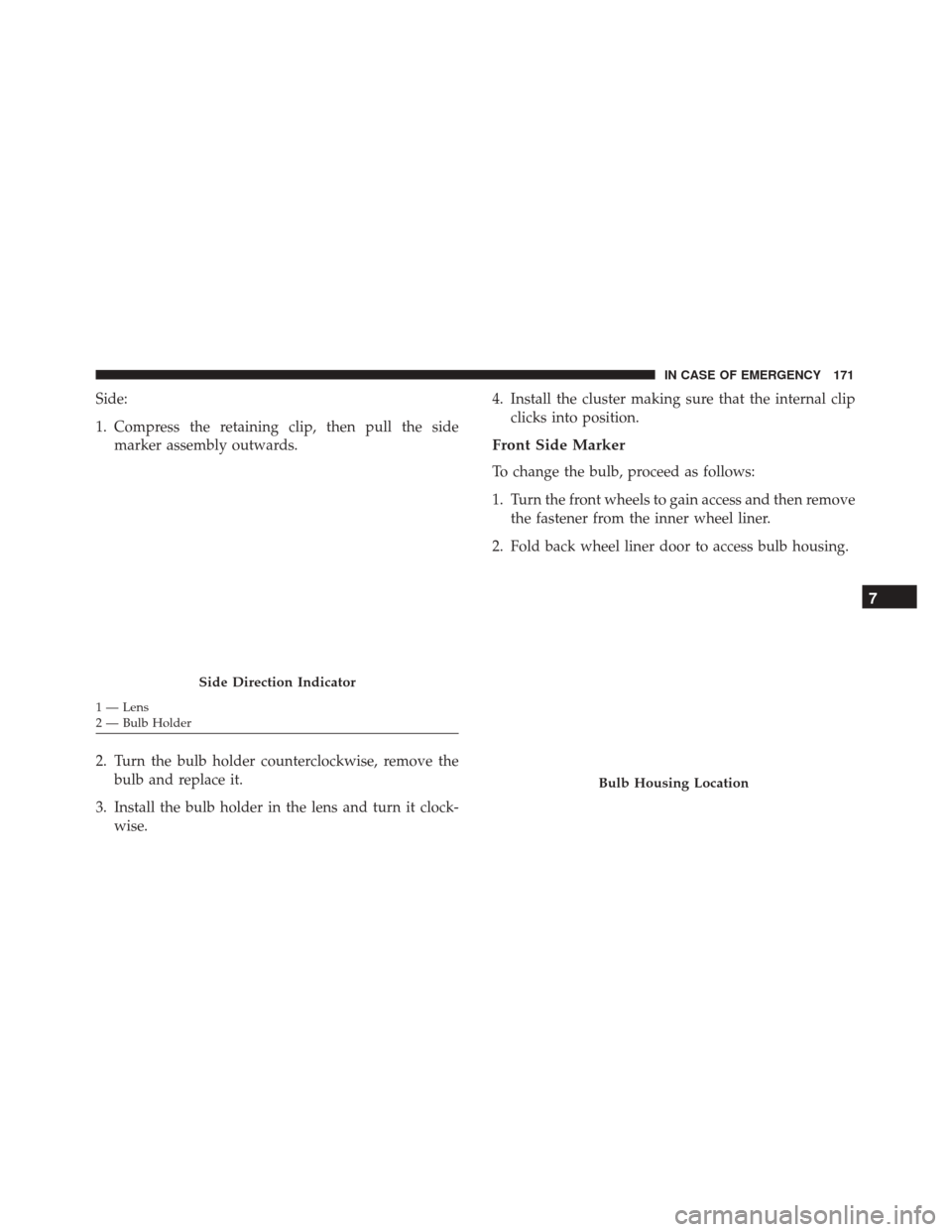
Side:
1. Compress the retaining clip, then pull the sidemarker assembly outwards.
2. Turn the bulb holder counterclockwise, remove the bulb and replace it.
3. Install the bulb holder in the lens and turn it clock- wise. 4. Install the cluster making sure that the internal clip
clicks into position.
Front Side Marker
To change the bulb, proceed as follows:
1. Turn the front wheels to gain access and then removethe fastener from the inner wheel liner.
2. Fold back wheel liner door to access bulb housing.
Side Direction Indicator
1 — Lens
2 — Bulb Holder
Bulb Housing Location
7
IN CASE OF EMERGENCY 171
Page 175 of 294
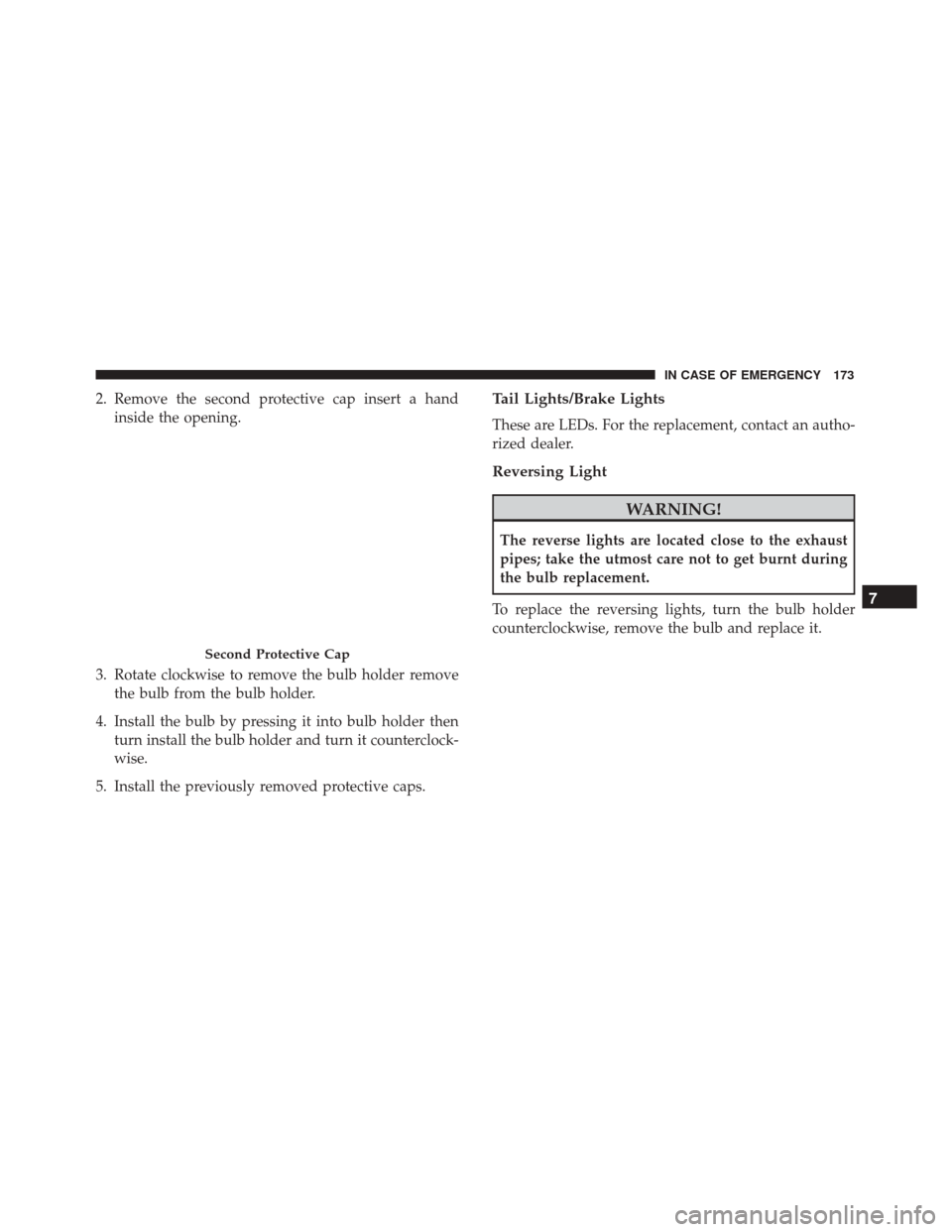
2. Remove the second protective cap insert a handinside the opening.
3. Rotate clockwise to remove the bulb holder remove the bulb from the bulb holder.
4. Install the bulb by pressing it into bulb holder then turn install the bulb holder and turn it counterclock-
wise.
5. Install the previously removed protective caps.Tail Lights/Brake Lights
These are LEDs. For the replacement, contact an autho-
rized dealer.
Reversing Light
WARNING!
The reverse lights are located close to the exhaust
pipes; take the utmost care not to get burnt during
the bulb replacement.
To replace the reversing lights, turn the bulb holder
counterclockwise, remove the bulb and replace it.
Second Protective Cap
7
IN CASE OF EMERGENCY 173
Page 177 of 294
Third Brake Lights
These are LEDs. For the replacement, contact an autho-
rized dealer.
License Plate Lights
To replace the bulbs proceed as follows:
1. Compress the retaining clip, then pull the licenseplate light cluster out. 2. Turn bulb holder counterclockwise, remove bulb and
replace it.
License Plate Lamp Removal
1 — Bulb Holder
2 — Bulb
7
IN CASE OF EMERGENCY 175
Page 178 of 294
Roof Light
To change the bulb, proceed as follows:
1. Remove roof light working at the points indicated bythe arrows.
2. Open protective flap (2) and replace bulb (1), releas- ing it from the side contacts. Make sure that the new
bulb is correctly secured between the contacts. 3. Close protective flap (2) and install roof light in its
housing, making sure that it is locked in place.
Luggage Compartment Roof Light
To replace the bulb, proceed as follows:
1. Open the luggage compartment and remove luggagecompartment roof light, working in the direction
shown by the arrow.
Roof Light
1 — Bulb
2 — Protective Flap
176 IN CASE OF EMERGENCY