battery Alfa Romeo 4C Spider 2019 User Guide
[x] Cancel search | Manufacturer: ALFA ROMEO, Model Year: 2019, Model line: 4C Spider, Model: Alfa Romeo 4C Spider 2019Pages: 292, PDF Size: 3.25 MB
Page 79 of 292
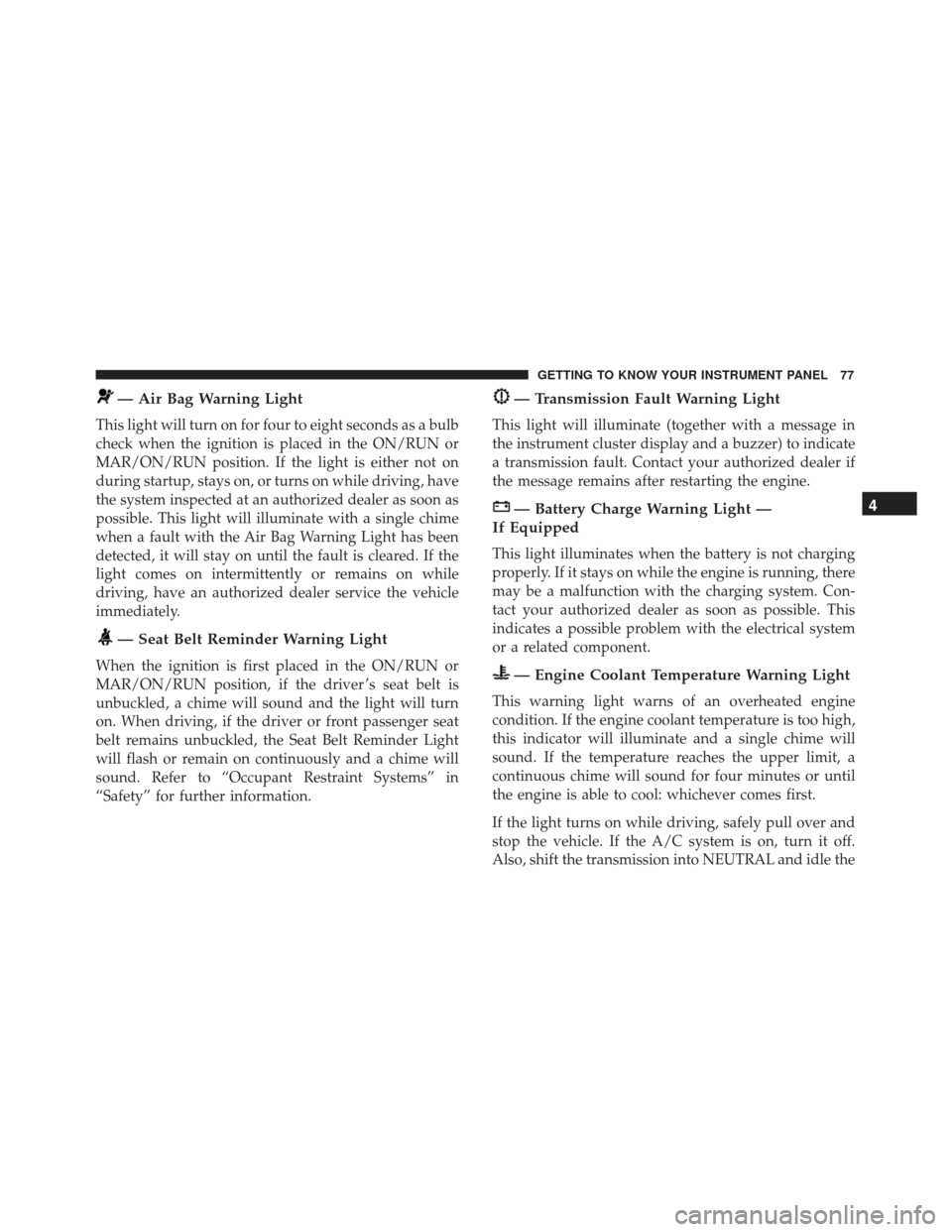
— Air Bag Warning Light
This light will turn on for four to eight seconds as a bulb
check when the ignition is placed in the ON/RUN or
MAR/ON/RUN position. If the light is either not on
during startup, stays on, or turns on while driving, have
the system inspected at an authorized dealer as soon as
possible. This light will illuminate with a single chime
when a fault with the Air Bag Warning Light has been
detected, it will stay on until the fault is cleared. If the
light comes on intermittently or remains on while
driving, have an authorized dealer service the vehicle
immediately.
— Seat Belt Reminder Warning Light
When the ignition is first placed in the ON/RUN or
MAR/ON/RUN position, if the driver ’s seat belt is
unbuckled, a chime will sound and the light will turn
on. When driving, if the driver or front passenger seat
belt remains unbuckled, the Seat Belt Reminder Light
will flash or remain on continuously and a chime will
sound. Refer to “Occupant Restraint Systems” in
“Safety” for further information.
— Transmission Fault Warning Light
This light will illuminate (together with a message in
the instrument cluster display and a buzzer) to indicate
a transmission fault. Contact your authorized dealer if
the message remains after restarting the engine.
— Battery Charge Warning Light —
If Equipped
This light illuminates when the battery is not charging
properly. If it stays on while the engine is running, there
may be a malfunction with the charging system. Con-
tact your authorized dealer as soon as possible. This
indicates a possible problem with the electrical system
or a related component.
— Engine Coolant Temperature Warning Light
This warning light warns of an overheated engine
condition. If the engine coolant temperature is too high,
this indicator will illuminate and a single chime will
sound. If the temperature reaches the upper limit, a
continuous chime will sound for four minutes or until
the engine is able to cool: whichever comes first.
If the light turns on while driving, safely pull over and
stop the vehicle. If the A/C system is on, turn it off.
Also, shift the transmission into NEUTRAL and idle the
4
GETTING TO KNOW YOUR INSTRUMENT PANEL 77
Page 86 of 292
WARNING!(Continued)
•If unauthorized equipment is connected to the
OBD II connection port, such as a driver-behavior
tracking device, it may:
• Be possible that vehicle systems, including
safety related systems, could be impaired or a
loss of vehicle control could occur that may
result in an accident involving serious injury or
death.
• Access, or allow others to access, information
stored in your vehicle systems, including per-
sonal information.
For further information, refer to “Cybersecurity” in the
“Multimedia” section.
EMISSIONS INSPECTION AND MAINTENANCE
PROGRAMS
In some localities, it may be a legal requirement to pass
an inspection of your vehicle’s emissions control sys-
tem. Failure to pass could prevent vehicle registration. For states that require an Inspection and
Maintenance (I/M), this check verifies the
“Malfunction Indicator Light (MIL)” is func-
tioning and is not on when the engine is
running, and that the OBD II system is ready for testing.
Normally, the OBD II system will be ready. The OBD II
system may notbe ready if your vehicle was recently
serviced, recently had a dead battery or a battery
replacement. If the OBD II system should be deter-
mined not ready for the I/M test, your vehicle may fail
the test.
84 GETTING TO KNOW YOUR INSTRUMENT PANEL
Page 87 of 292
Your vehicle has a simple ignition actuated test, which
you can use prior to going to the test station. To check
if your vehicle’s OBD II system is ready, you must do
the following:
1. Cycle the ignition switch to the ON position, but donot crank or start the engine.
NOTE: If you crank or start the engine, you will have to
start this test over.
2. As soon as you cycle the ignition switch to the ON position, you will see the “Malfunction Indicator
Light (MIL)” symbol come on as part of a normal
bulb check.
3. Approximately 15 seconds later, one of two things will happen:
• The MIL will flash for about ten seconds and then
return to being fully illuminated until you turn OFF
the ignition or start the engine. This means that your
vehicle’s OBD II system is not readyand you should
not proceed to the I/M station. •
The MIL will not flash at all and will remain fully
illuminated until you place the ignition in the off
position or start the engine. This means that your
vehicle’s OBD II system is readyand you can proceed
to the I/M station.
If your OBD II system is not ready,you should see an
authorized dealer or repair facility. If your vehicle was
recently serviced or had a battery failure or replace-
ment, you may need to do nothing more than drive
your vehicle as you normally would in order for your
OBD II system to update. A recheck with the above test
routine may then indicate that the system is now ready.
Regardless of whether your vehicle’s OBD II system is
ready or not, if the MIL is illuminated during normal
vehicle operation you should have your vehicle ser-
viced before going to the I/M station. The I/M station
can fail your vehicle because the MIL is on with the
engine running.
4
GETTING TO KNOW YOUR INSTRUMENT PANEL 85
Page 111 of 292
Air Bag Warning Light
The ORC monitors the readiness of the electronic partsof the air bag system whenever the ignition
switch is in the AVV/START or MAR/ACC/
ON/RUN position. If the ignition switch is in
the STOP/OFF/LOCK position the air bag
system is not on and the air bags will not inflate.
The ORC contains a backup power supply system that
may deploy the air bag system even if the battery loses
power or it becomes disconnected prior to deployment.
The ORC turns on the Air Bag Warning Light in the
instrument panel for approximately four to eight sec-
onds for a self-check when the ignition switch is in the
MAR/ACC/ON/RUN position. After the self-check,
the Air Bag Warning Light will turn off. If the ORC
detects a malfunction in any part of the system, it turns
on the Air Bag Warning Light, either momentarily or
continuously. A single chime will sound to alert you if
the light comes on again after initial startup.
The ORC also includes diagnostics that will illuminate
the instrument panel Air Bag Warning Light if a mal-
function is detected that could affect the air bag system. The diagnostics also record the nature of the malfunc-
tion. While the air bag system is designed to be main-
tenance free, if any of the following occurs, have an
authorized dealer service the air bag system
immediately.
•
The Air Bag Warning Light does not come on during
the four to eight seconds when the ignition switch is
first in the MAR/ACC/ON/RUN position.
• The Air Bag Warning Light remains on after the four
to eight-second interval.
• The Air Bag Warning Light comes on intermittently
or remains on while driving.
NOTE: If the speedometer, tachometer, or any engine
related gauges are not working, the Occupant Restraint
Controller (ORC) may also be disabled. In this condi-
tion the air bags may not be ready to inflate for your
protection. Have an authorized dealer service the air
bag system immediately.
5
SAFETY 109
Page 119 of 292
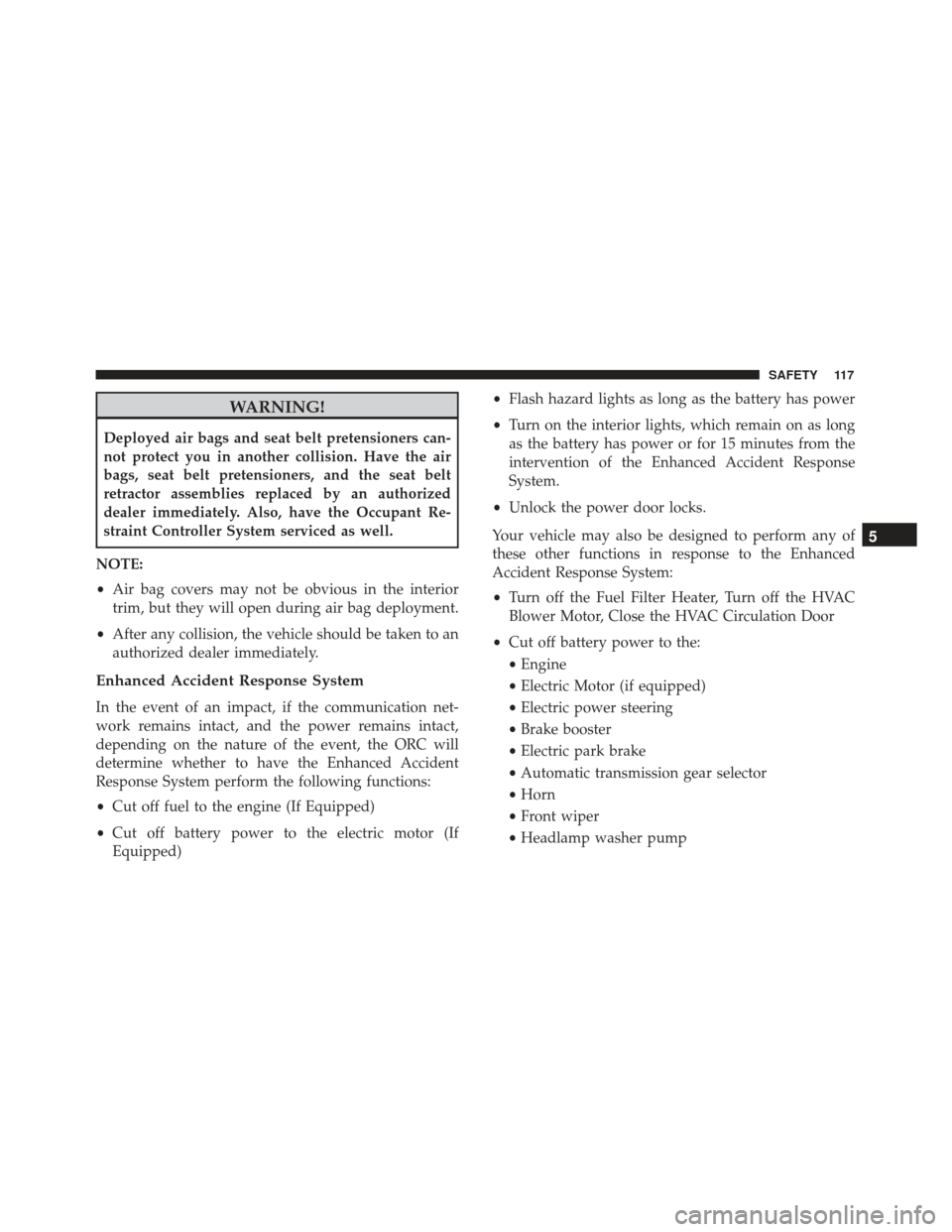
WARNING!
Deployed air bags and seat belt pretensioners can-
not protect you in another collision. Have the air
bags, seat belt pretensioners, and the seat belt
retractor assemblies replaced by an authorized
dealer immediately. Also, have the Occupant Re-
straint Controller System serviced as well.
NOTE:
• Air bag covers may not be obvious in the interior
trim, but they will open during air bag deployment.
• After any collision, the vehicle should be taken to an
authorized dealer immediately.
Enhanced Accident Response System
In the event of an impact, if the communication net-
work remains intact, and the power remains intact,
depending on the nature of the event, the ORC will
determine whether to have the Enhanced Accident
Response System perform the following functions:
• Cut off fuel to the engine (If Equipped)
• Cut off battery power to the electric motor (If
Equipped) •
Flash hazard lights as long as the battery has power
• Turn on the interior lights, which remain on as long
as the battery has power or for 15 minutes from the
intervention of the Enhanced Accident Response
System.
• Unlock the power door locks.
Your vehicle may also be designed to perform any of
these other functions in response to the Enhanced
Accident Response System:
• Turn off the Fuel Filter Heater, Turn off the HVAC
Blower Motor, Close the HVAC Circulation Door
• Cut off battery power to the:
• Engine
• Electric Motor (if equipped)
• Electric power steering
• Brake booster
• Electric park brake
• Automatic transmission gear selector
• Horn
• Front wiper
• Headlamp washer pump
5
SAFETY 117
Page 120 of 292
NOTE:After an accident, remember to cycle the igni-
tion to the STOP (OFF/LOCK) position and remove the
key from the ignition switch to avoid draining the
battery. Carefully check the vehicle for fuel leaks in the
engine compartment and on the ground near the engine
compartment and fuel tank before resetting the system
and starting the engine. If there are no fuel leaks or
damage to the vehicle electrical devices (e.g. headlights)
after an accident, reset the system by following the
procedure described below. If you have any doubt,
contact an authorized dealer.
Enhanced Accident Response System Reset
Procedure
After the event occurs, when the system is active, a
message regarding fuel cutoff is displayed. Turn the
ignition switch from ignition AVV/START or MAR/
ACC/ON/RUN to ignition STOP/OFF/LOCK. Care-
fully check the vehicle for fuel leaks in the engine
compartment and on the ground near the engine com-
partment and fuel tank before resetting the system and
starting the engine.
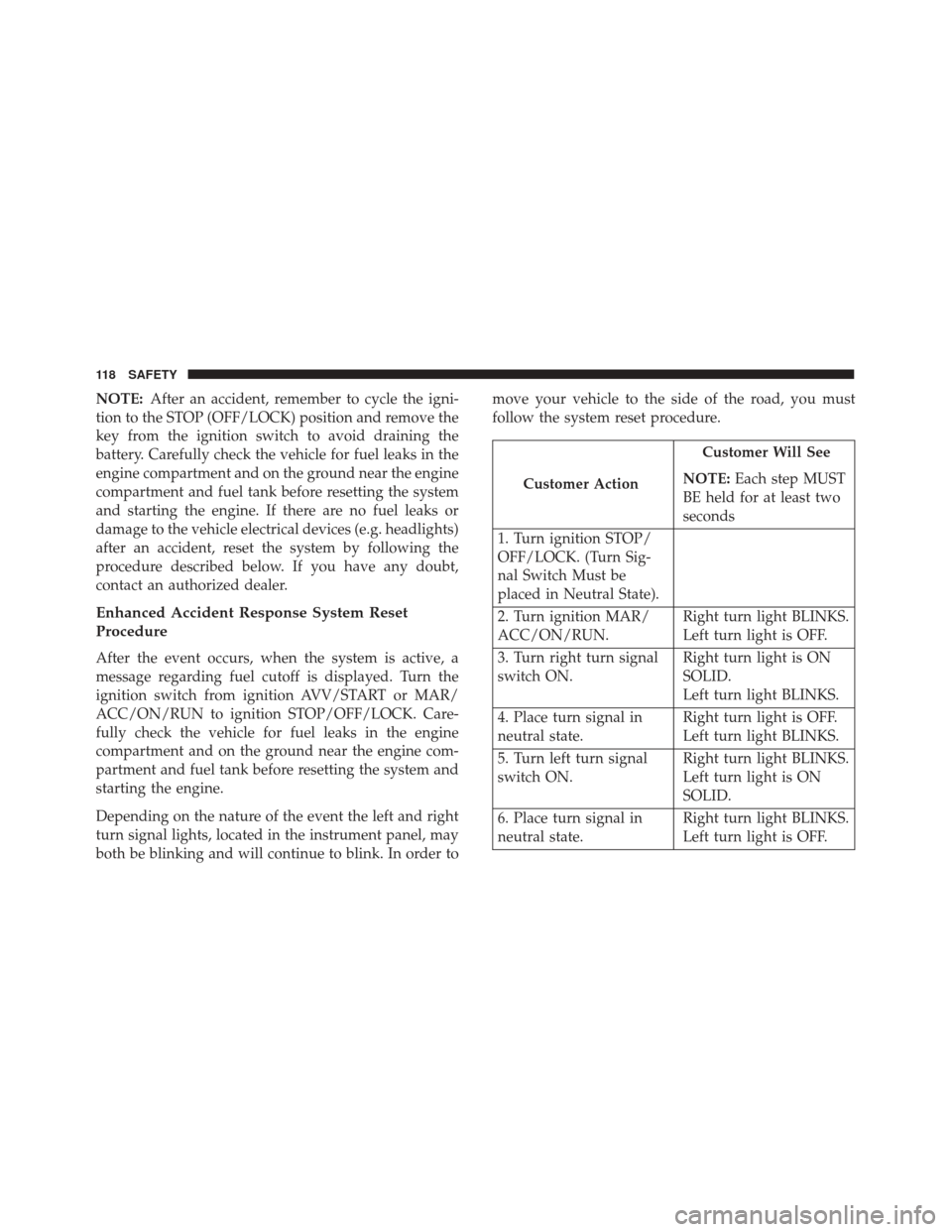
Depending on the nature of the event the left and right
turn signal lights, located in the instrument panel, may
both be blinking and will continue to blink. In order to move your vehicle to the side of the road, you must
follow the system reset procedure.
Customer Action
Customer Will See
NOTE: Each step MUST
BE held for at least two
seconds
1. Turn ignition STOP/
OFF/LOCK. (Turn Sig-
nal Switch Must be
placed in Neutral State).
2. Turn ignition MAR/
ACC/ON/RUN. Right turn light BLINKS.
Left turn light is OFF.
3. Turn right turn signal
switch ON. Right turn light is ON
SOLID.
Left turn light BLINKS.
4. Place turn signal in
neutral state. Right turn light is OFF.
Left turn light BLINKS.
5. Turn left turn signal
switch ON. Right turn light BLINKS.
Left turn light is ON
SOLID.
6. Place turn signal in
neutral state. Right turn light BLINKS.
Left turn light is OFF.
118 SAFETY
Page 168 of 292
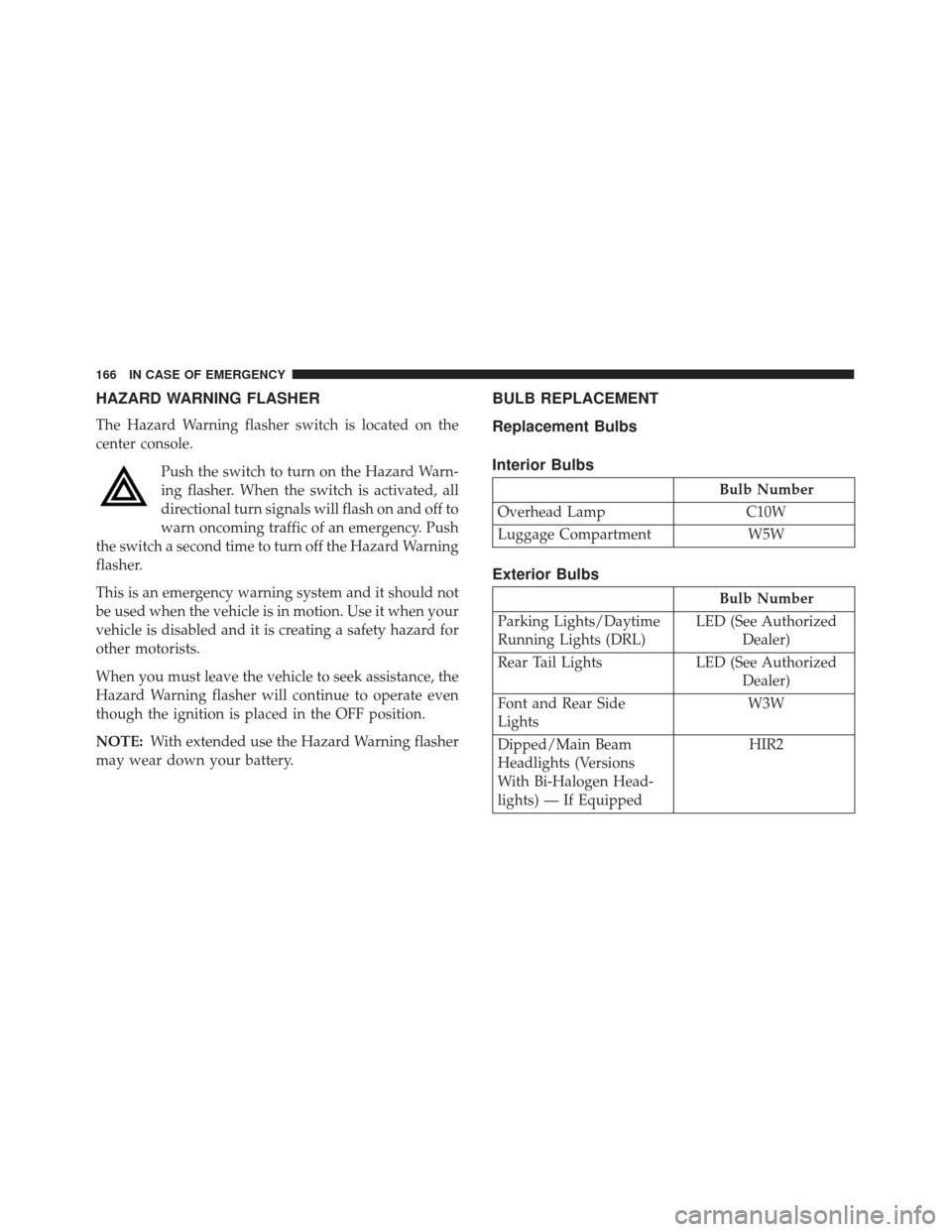
HAZARD WARNING FLASHER
The Hazard Warning flasher switch is located on the
center console.Push the switch to turn on the Hazard Warn-
ing flasher. When the switch is activated, all
directional turn signals will flash on and off to
warn oncoming traffic of an emergency. Push
the switch a second time to turn off the Hazard Warning
flasher.
This is an emergency warning system and it should not
be used when the vehicle is in motion. Use it when your
vehicle is disabled and it is creating a safety hazard for
other motorists.
When you must leave the vehicle to seek assistance, the
Hazard Warning flasher will continue to operate even
though the ignition is placed in the OFF position.
NOTE: With extended use the Hazard Warning flasher
may wear down your battery.
BULB REPLACEMENT
Replacement Bulbs
Interior Bulbs
Bulb Number
Overhead Lamp C10W
Luggage Compartment W5W
Exterior Bulbs
Bulb Number
Parking Lights/Daytime
Running Lights (DRL) LED (See Authorized
Dealer)
Rear Tail Lights LED (See Authorized
Dealer)
Font and Rear Side
Lights W3W
Dipped/Main Beam
Headlights (Versions
With Bi-Halogen Head-
lights) — If Equipped HIR2
166 IN CASE OF EMERGENCY
Page 180 of 292
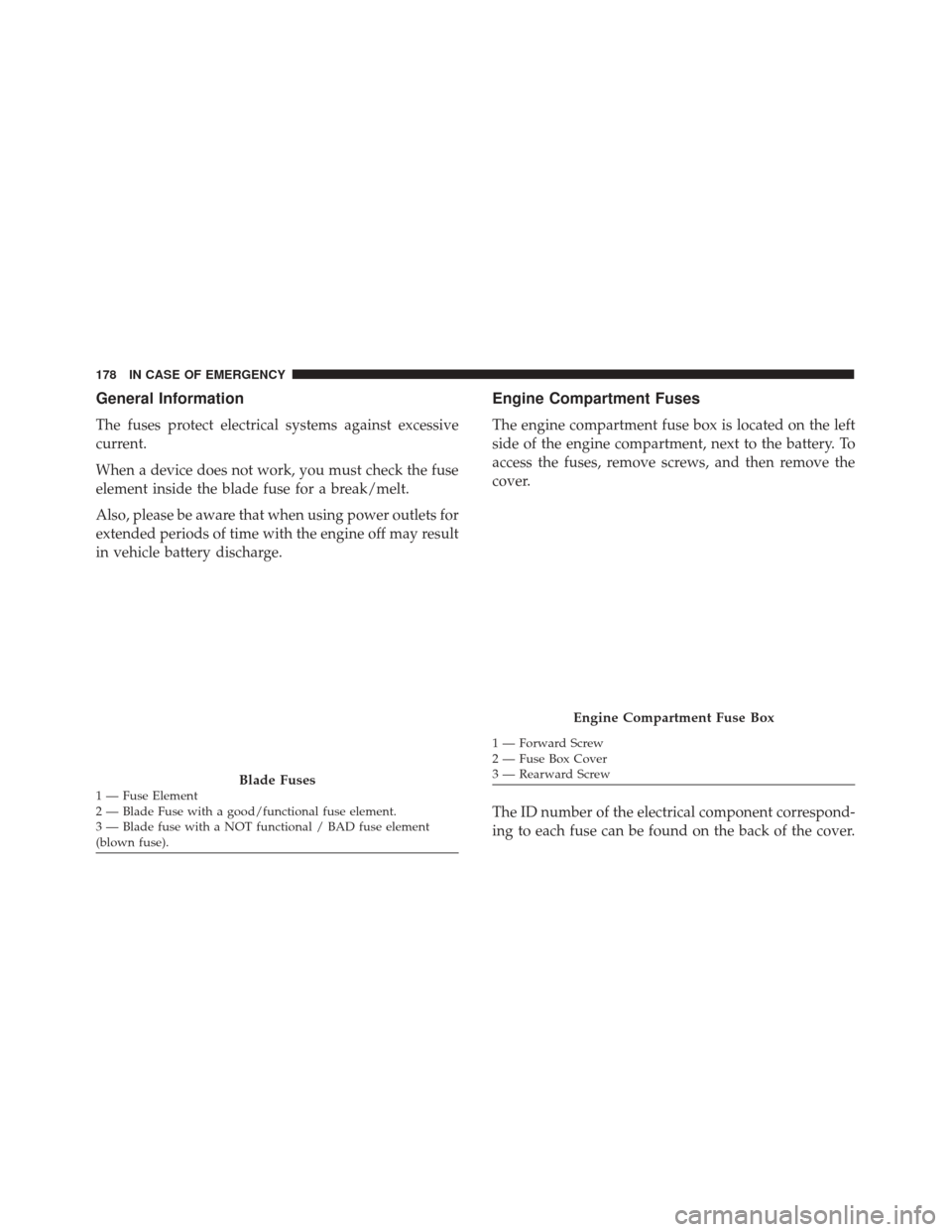
General Information
The fuses protect electrical systems against excessive
current.
When a device does not work, you must check the fuse
element inside the blade fuse for a break/melt.
Also, please be aware that when using power outlets for
extended periods of time with the engine off may result
in vehicle battery discharge.
Engine Compartment Fuses
The engine compartment fuse box is located on the left
side of the engine compartment, next to the battery. To
access the fuses, remove screws, and then remove the
cover.
The ID number of the electrical component correspond-
ing to each fuse can be found on the back of the cover.
Blade Fuses1 — Fuse Element
2 — Blade Fuse with a good/functional fuse element.
3 — Blade fuse with a NOT functional / BAD fuse element
(blown fuse).
Engine Compartment Fuse Box
1 — Forward Screw
2 — Fuse Box Cover
3 — Rearward Screw
178 IN CASE OF EMERGENCY
Page 188 of 292
WARNING!(Continued)
Failure to follow this warning can result in injuries
that are serious or fatal to you, your passengers, and
others around you.
After Driving
1. Attach the air pump hose (black) to the repaired tire.
2. Check the pressure in the tire by reading the pressure gauge. If the pressure is less than 19 psi (1.3 Bar), the
tire is too badly damaged. Do not attempt to drive
the vehicle further. Call for assistance.
NOTE: A replacement sealant cartridge is available at
an authorized dealer.
Tire Service Kit Usage Precautions
• Replace the Tire Service Kit Sealant Cartridge and
Sealant Hose prior to the expiration date (printed on
the left hand side of the cartridge label) to assure
optimum operation of the system.
• The Sealant Cartridge and Sealant Hose are a one tire
application use and need to be replaced after each
use. Always replace these components immediately
at an authorized dealer. •
When the Tire Service Kit sealant is in a liquid form,
clean water, and a damp cloth will remove the
material from the vehicle or tire and wheel compo-
nents. Once the sealant dries, it can easily be peeled
off and properly discarded.
• For optimum performance, make sure the valve stem
on the wheel is free of debris before connecting the
Tire Service Kit.
• Do not lift or carry the Tire Service Kit by the hoses.
JUMP STARTING
If your vehicle has a discharged battery, it can be jump
started using a set of jumper cables and a battery in
another vehicle, or by using a portable battery booster
pack. Jump starting can be dangerous if done improp-
erly, so please follow the procedures in this section
carefully.
WARNING!
Do not attempt jump starting if the battery is
frozen. It could rupture or explode and cause per-
sonal injury.
186 IN CASE OF EMERGENCY
Page 189 of 292
CAUTION!
Do not use a portable battery booster pack or any
other booster source with a system voltage greater
than 12 Volts or damage to the battery, starter motor,
alternator or electrical system may occur.
NOTE: When using a portable battery booster pack,
follow the manufacturer’s operating instructions and
precautions.
Preparations For Jump Start
The battery in your vehicle is located on the left side of
the engine compartment. To access the battery, remove
the protective cover. NOTE:
Be sure that the disconnected ends of the cables
do not touch while still connected to the other vehicle.
1. Firmly apply the parking brake, and turn the ignition OFF.
2. Turn off the heater, radio, and all unnecessary elec- trical accessories.
3. To remove the protective cover off the battery, pull upward on the cover.Positive Battery Post7
IN CASE OF EMERGENCY 187