coolant Alfa Romeo Giulia 2017 User Guide
[x] Cancel search | Manufacturer: ALFA ROMEO, Model Year: 2017, Model line: Giulia, Model: Alfa Romeo Giulia 2017Pages: 268, PDF Size: 18.64 MB
Page 220 of 268
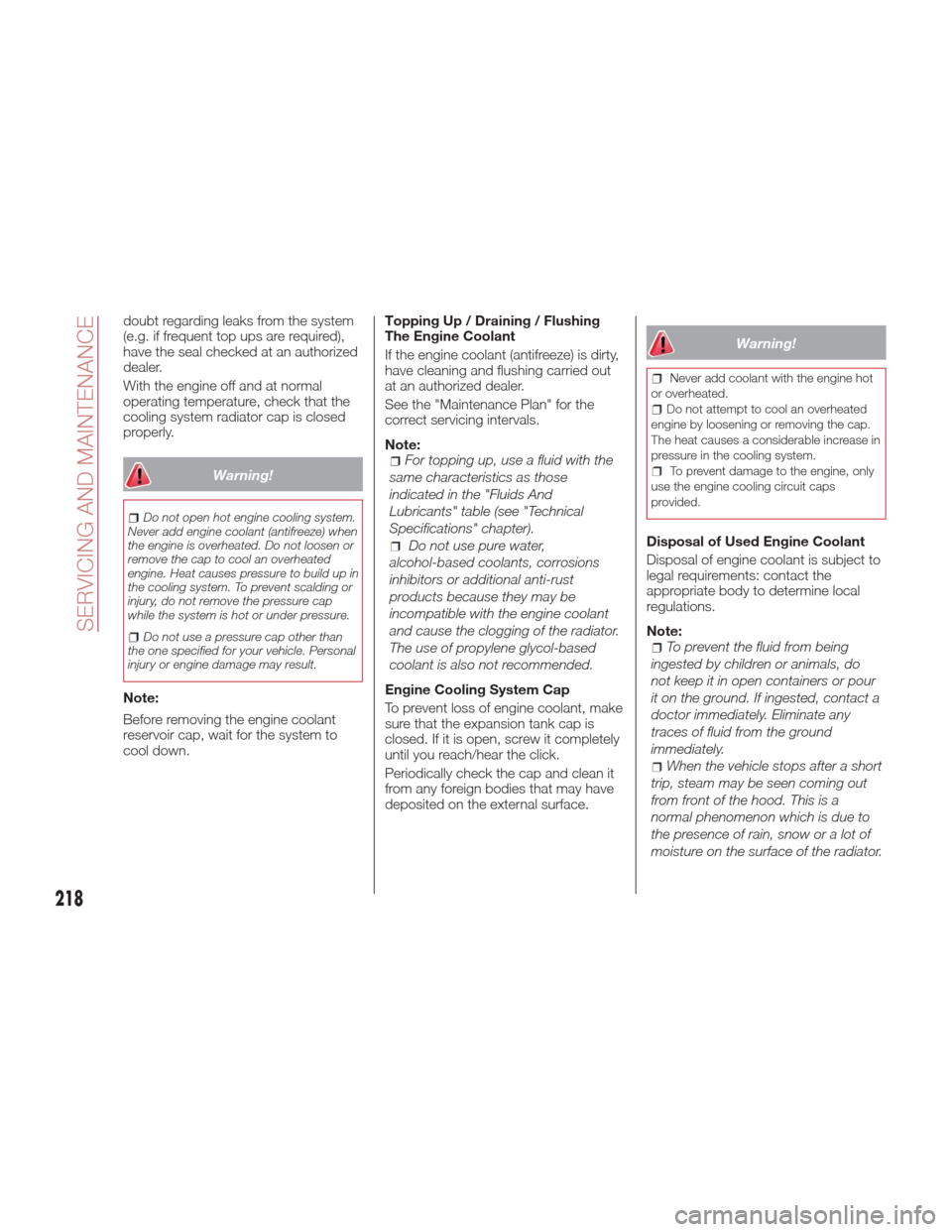
doubt regarding leaks from the system
(e.g. if frequent top ups are required),
have the seal checked at an authorized
dealer.
With the engine off and at normal
operating temperature, check that the
cooling system radiator cap is closed
properly.
Warning!
Do not open hot engine cooling system.
Never add engine coolant (antifreeze) when
the engine is overheated. Do not loosen or
remove the cap to cool an overheated
engine. Heat causes pressure to build up in
the cooling system. To prevent scalding or
injury, do not remove the pressure cap
while the system is hot or under pressure.
Do not use a pressure cap other than
the one specified for your vehicle. Personal
injury or engine damage may result.
Note:
Before removing the engine coolant
reservoir cap, wait for the system to
cool down. Topping Up / Draining / Flushing
The Engine Coolant
If the engine coolant (antifreeze) is dirty,
have cleaning and flushing carried out
at an authorized dealer.
See the "Maintenance Plan" for the
correct servicing intervals.
Note:
For topping up, use a fluid with the
same characteristics as those
indicated in the "Fluids And
Lubricants" table (see "Technical
Specifications" chapter).
Do not use pure water,
alcohol-based coolants, corrosions
inhibitors or additional anti-rust
products because they may be
incompatible with the engine coolant
and cause the clogging of the radiator.
The use of propylene glycol-based
coolant is also not recommended.
Engine Cooling System Cap
To prevent loss of engine coolant, make
sure that the expansion tank cap is
closed. If it is open, screw it completely
until you reach/hear the click.
Periodically check the cap and clean it
from any foreign bodies that may have
deposited on the external surface.
Warning!
Never add coolant with the engine hot
or overheated.
Do not attempt to cool an overheated
engine by loosening or removing the cap.
The heat causes a considerable increase in
pressure in the cooling system.
To prevent damage to the engine, only
use the engine cooling circuit caps
provided.
Disposal of Used Engine Coolant
Disposal of engine coolant is subject to
legal requirements: contact the
appropriate body to determine local
regulations.
Note:
To prevent the fluid from being
ingested by children or animals, do
not keep it in open containers or pour
it on the ground. If ingested, contact a
doctor immediately. Eliminate any
traces of fluid from the ground
immediately.
When the vehicle stops after a short
trip, steam may be seen coming out
from front of the hood. This is a
normal phenomenon which is due to
the presence of rain, snow or a lot of
moisture on the surface of the radiator.
218
SERVICING AND MAINTENANCE
Page 221 of 268
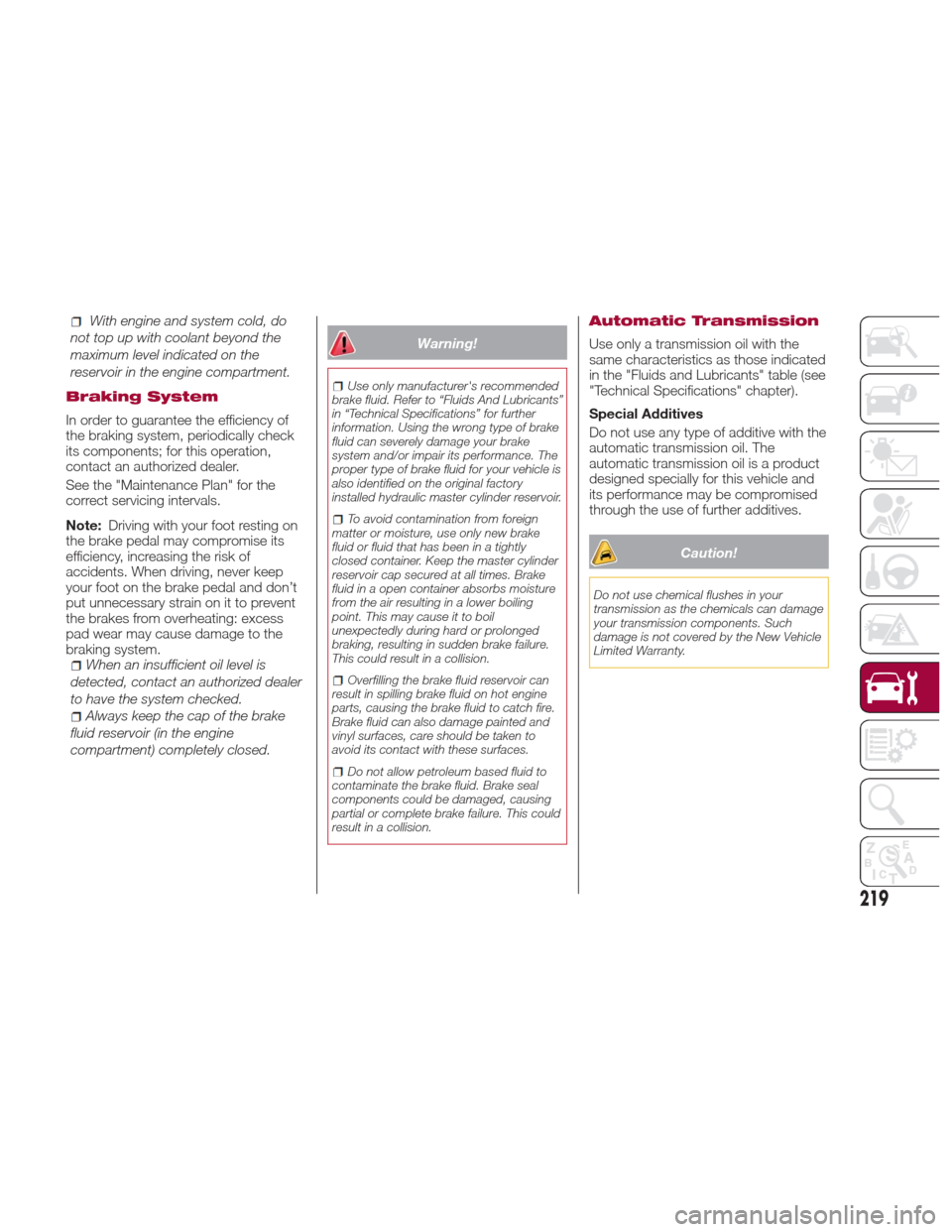
With engine and system cold, do
not top up with coolant beyond the
maximum level indicated on the
reservoir in the engine compartment.
Braking System
In order to guarantee the efficiency of
the braking system, periodically check
its components; for this operation,
contact an authorized dealer.
See the "Maintenance Plan" for the
correct servicing intervals.
Note: Driving with your foot resting on
the brake pedal may compromise its
efficiency, increasing the risk of
accidents. When driving, never keep
your foot on the brake pedal and don’t
put unnecessary strain on it to prevent
the brakes from overheating: excess
pad wear may cause damage to the
braking system.
When an insufficient oil level is
detected, contact an authorized dealer
to have the system checked.
Always keep the cap of the brake
fluid reservoir (in the engine
compartment) completely closed.
Warning!
Use only manufacturer's recommended
brake fluid. Refer to “Fluids And Lubricants”
in “Technical Specifications” for further
information. Using the wrong type of brake
fluid can severely damage your brake
system and/or impair its performance. The
proper type of brake fluid for your vehicle is
also identified on the original factory
installed hydraulic master cylinder reservoir.
To avoid contamination from foreign
matter or moisture, use only new brake
fluid or fluid that has been in a tightly
closed container. Keep the master cylinder
reservoir cap secured at all times. Brake
fluid in a open container absorbs moisture
from the air resulting in a lower boiling
point. This may cause it to boil
unexpectedly during hard or prolonged
braking, resulting in sudden brake failure.
This could result in a collision.
Overfilling the brake fluid reservoir can
result in spilling brake fluid on hot engine
parts, causing the brake fluid to catch fire.
Brake fluid can also damage painted and
vinyl surfaces, care should be taken to
avoid its contact with these surfaces.
Do not allow petroleum based fluid to
contaminate the brake fluid. Brake seal
components could be damaged, causing
partial or complete brake failure. This could
result in a collision.
Automatic Transmission
Use only a transmission oil with the
same characteristics as those indicated
in the "Fluids and Lubricants" table (see
"Technical Specifications" chapter).
Special Additives
Do not use any type of additive with the
automatic transmission oil. The
automatic transmission oil is a product
designed specially for this vehicle and
its performance may be compromised
through the use of further additives.
Caution!
Do not use chemical flushes in your
transmission as the chemicals can damage
your transmission components. Such
damage is not covered by the New Vehicle
Limited Warranty.
219
Page 255 of 268
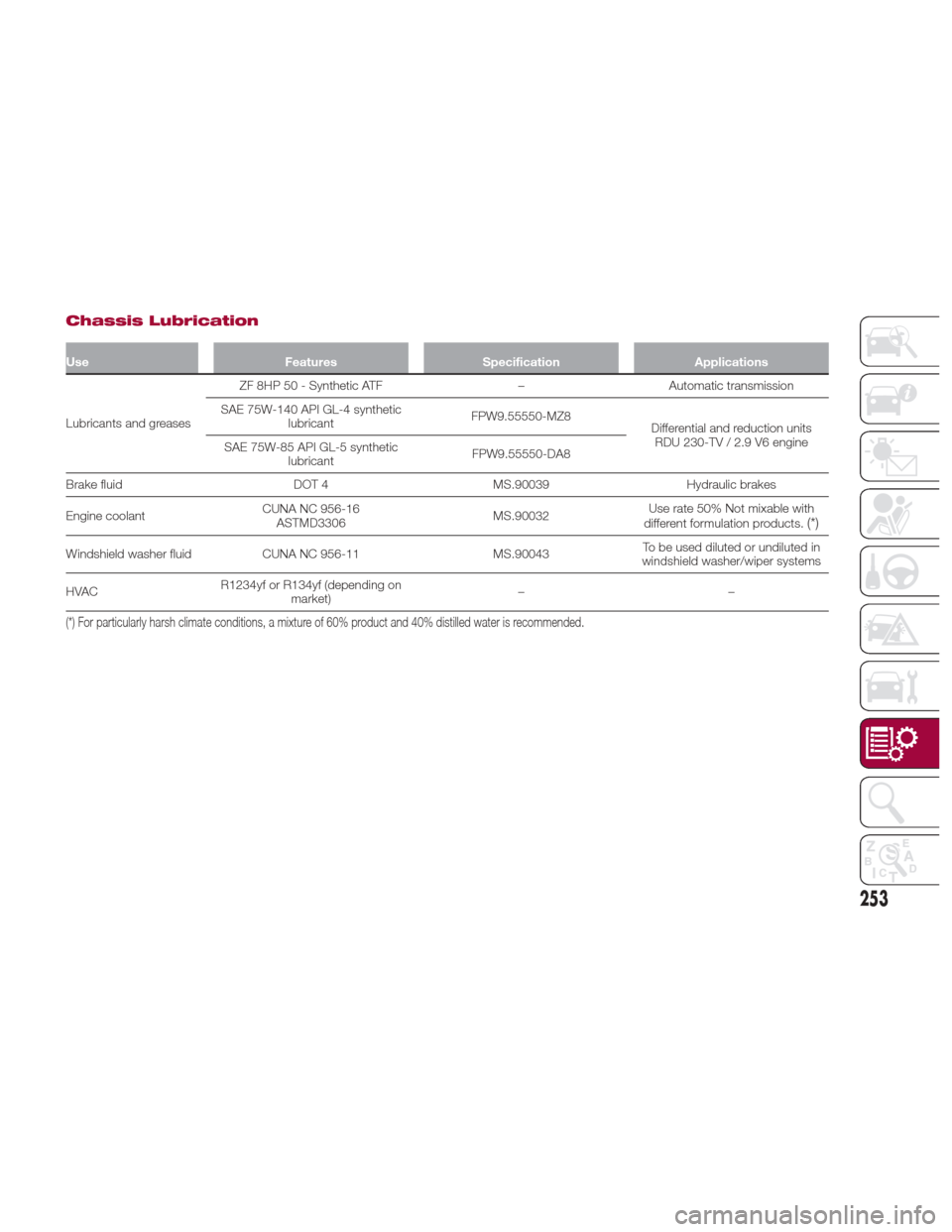
Chassis Lubrication
UseFeaturesSpecification Applications
Lubricants and greases ZF
8HP 50 - Synthetic ATF
–Automatic transmission
SAE 75W-140 API GL-4 synthetic lubricant FPW9.55550-MZ8
Differential and reduction units
RDU 230-TV / 2.9 V6 engine
SAE 75W-85 API GL-5 synthetic
lubricant FPW9.55550-DA8
Brake fluid DOT 4MS.90039Hydraulic brakes
Engine coolant CUNA NC 956-16
ASTMD3306 MS.90032Use rate 50% Not mixable with
different formulation products.
(*)
Windshield washer fluid CUNA NC 956-11 MS.90043To be used diluted or undiluted in
windshield washer/wiper systems
HVAC R1234yf or R134yf (depending on
market) ––
(*) For particularly harsh climate conditions, a mixture of 60% product and 40% distilled water is recommended.
253
Page 263 of 268
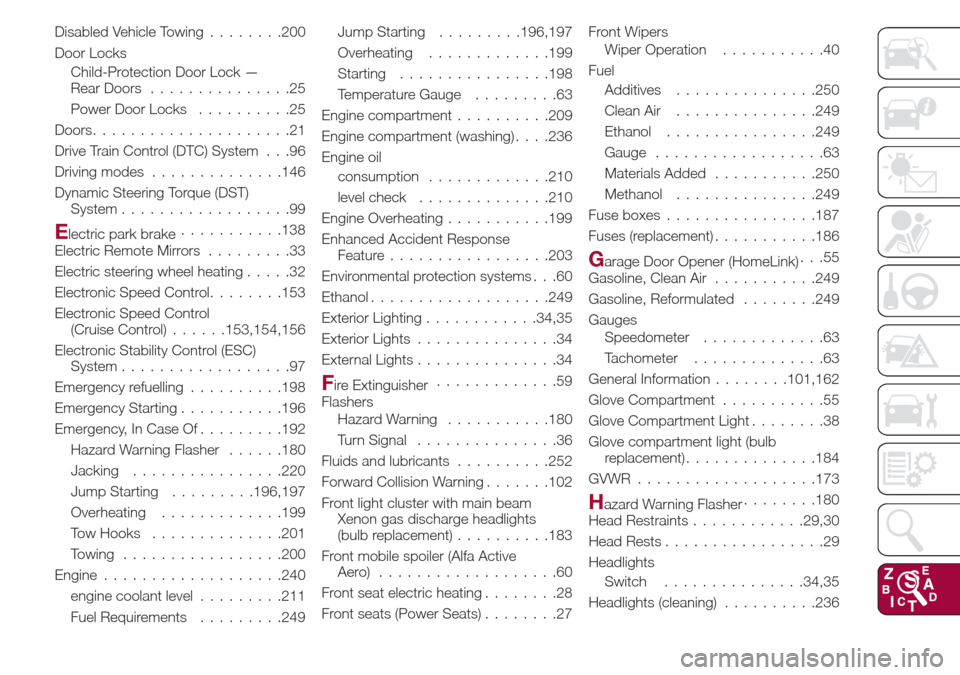
Disabled Vehicle Towing........200
Door Locks Child-Protection Door Lock —
Rear Doors ...............25
Power Door Locks ..........25
Doors .....................21
Drive Train Control (DTC) System . . .96
Driving modes ..............146
Dynamic Steering Torque (DST) System ..................99
Electric park brake ...........138
Electric Remote Mirrors .........33
Electric steering wheel heating .....32
Electronic Speed Control ........153
Electronic Speed Control (Cruise Control) ......153,154,156
Electronic Stability Control (ESC) System ..................97
Emergency refuelling ..........198
Emergency Starting ...........196
Emergency, In Case Of .........192
Hazard Warning Flasher ......180
Jacking ............... .220
Jump Starting .........196,197
Overheating .............199
Tow Hooks ..............201
Towing ................ .200
Engine .................. .240
engine coolant level .........211
Fuel Requirements .........249 Jump Starting
.........196,197
Overheating .............199
Starting ............... .198
Temperature Gauge .........63
Engine compartment ..........209
Engine compartment (washing) . . . .236
Engine oil consumption .............210
level check ..............210
Engine Overheating ...........199
Enhanced Accident Response Feature ................ .203
Environmental protection systems . . .60
Ethanol .................. .249
Exterior Lighting ............34,35
Exterior Lights ...............34
External Lights ...............34
Fire Extinguisher .............59
Flashers Hazard Warning ...........180
Turn Signal ...............36
Fluids and lubricants ..........252
Forward Collision Warning .......102
Front light cluster with main beam Xenon gas discharge headlights
(bulb replacement) ..........183
Front mobile spoiler (Alfa Active Aero) ...................60
Front seat electric heating ........28
Front seats (Power Seats) ........27Front Wipers
Wiper Operation ...........40
Fuel Additives ...............250
Clean Air ...............249
Ethanol ............... .249
Gauge ..................63
Materials Added ...........250
Methanol ...............249
Fuse boxes ............... .187
Fuses (replacement) ...........186
Garage Door Opener (HomeLink) . . .55
Gasoline, Clean Air ...........249
Gasoline, Reformulated ........249
Gauges Speedometer .............63
Tachometer ..............63
General Information ........101,162
Glove Compartment ...........55
Glove Compartment Light ........38
Glove compartment light (bulb replacement) ..............184
GVWR .................. .173
Hazard Warning Flasher........180
Head Restraints ............29,30
Head Rests .................29
Headlights Switch ...............34,35
Headlights (cleaning) ..........236