radio Alfa Romeo Giulia 2017 User Guide
[x] Cancel search | Manufacturer: ALFA ROMEO, Model Year: 2017, Model line: Giulia, Model: Alfa Romeo Giulia 2017Pages: 268, PDF Size: 18.64 MB
Page 119 of 268
collisions. A higher energy output is
used for more severe collisions.
This vehicle may be equipped with a
driver and/or front passenger seat belt
buckle switch that detects whether the
driver or front passenger seat belt is
buckled. The seat belt buckle switch
may adjust the inflation rate of the
Advanced Front Air Bags.
This vehicle may be equipped with
driver and/or front passenger seat track
position sensors that may adjust the
inflation rate of the Advanced Front Air
Bags based upon seat position.
Warning!
No objects should be placed over or
near the air bag on the instrument panel or
steering wheel because any such objects
could cause harm if the vehicle is in a
collision severe enough to cause the air
bag to inflate.
Do not put anything on or around the air
bag covers or attempt to open them
manually. You may damage the air bags
and you could be injured because the air
bags may no longer be functional. The
protective covers for the air bag cushions
are designed to open only when the air
bags are inflating.
Relying on the air bags alone could lead
to more severe injuries in a collision. The air
bags work with your seat belt to restrain
you properly. In some collisions, air bags
won’t deploy at all. Always wear your seat
belts even though you have air bags.
Front Air Bag Operation
Front Air Bags are designed to provide
additional protection by supplementing
the seat belts. Front air bags are not
expected to reduce the risk of injury in
rear, side, or rollover collisions. The front
air bags will not deploy in all frontal
collisions, including some that may
produce substantial vehicle damage —
for example, some pole collisions, truck
underrides, and angle offset collisions.
On the other hand, depending on the
type and location of impact, front air
bags may deploy in crashes with little
vehicle front-end damage but that
produce a severe initial deceleration.
Because air bag sensors measure
vehicle deceleration over time, vehicle
speed and damage by themselves are
not good indicators of whether or not
an air bag should have deployed.
Seat belts are necessary for your
protection in all collisions, and also are
needed to help keep you in position,
away from an inflating air bag. When the ORC detects a collision
requiring the front air bags, it signals the
inflator units. A large quantity of
non-toxic gas is generated to inflate the
front air bags.
The steering wheel hub trim cover and
the upper right side of the instrument
panel separate and fold out of the way
as the air bags inflate to their full size.
The front air bags fully inflate in less
time than it takes to blink your eyes.
The front air bags then quickly deflate
while helping to restrain the driver and
front passenger.
Knee Impact Bolsters
The Knee Impact Bolsters help protect
the knees of the driver and front
passenger, and position the front
occupants for improved interaction with
the front air bags.
Warning!
Do not drill, cut, or tamper with the knee
impact bolsters in any way.
Do not mount any accessories to the
knee impact bolsters such as alarm lights,
stereos, citizen band radios, etc.
117
Page 164 of 268
In this case, sufficient distance from the
vehicle which is changing lanes may not
be guaranteed. It is advisable to pay the
utmost attention at all times and be
always ready to apply the brakes if
needed.
Small Vehicles
Some narrow vehicles (e.g. bicycles
and motorcycles) travelling near the
outer edges of the lane or which enter
the lane from curb side are not
detected until they are fully in the lane.Sufficient distance from the vehicles
ahead may not be guaranteed in these
cases.
Stationary Objects And Vehicles
The system cannot detect the presence
of stationary vehicles or objects. For
example, the system will not operate if
the vehicle ahead leaves the lane and a
vehicle ahead of that one is stationary in
that lane. Pay the utmost attention at all
times and be always ready to apply the
brakes if needed.
Objects And Vehicles Moving In
Opposite Or Crosswise Direction
The system cannot detect the presence
of objects or vehicles traveling in
opposite or crosswise directions and
consequently will not be operated.General Information
This vehicle has systems that operate
on radio frequency that comply with
Part 15 of the Federal Communications
Commission (FCC) rules and with
Industry Canada Standards RSS-
GEN/210/220/310.
Operation is subject to the following
two conditions:
1. The device may not cause harmful
interference.
2. The device must accept any
interference received, including
interference that may cause undesired
operation of the device.
Changes or modifications to any of
these systems by other than an
authorized service facility could void
authorization to use this equipment.
GUID-07146S0012EMLane ChangeGUID-07146S0013EMSmall VehiclesGUID-07146S0014EMObjects And Vehicles Moving In
Opposite Or Crosswise Direction
162
STARTING AND OPERATING
Page 182 of 268
HAZARD WARNING
LIGHTS
The Hazard Warning flasher switch is
located in the switch bank below the
radio screen.Push the switch once
to turn the hazard
warning flasher on.
When the switch is
activated, all
directional turn signals
will flash on and off to warn oncoming
traffic of an emergency. Push the switch
a second time to turn the hazard
warning flashers off.
This is an emergency warning system
and it should not be used when the
vehicle is in motion. Use it when your
vehicle is disabled and is creating a
safety hazard for other motorists.
When you must leave the vehicle to
seek assistance, the hazard warning
flashers will continue to operate even
though the ignition is placed in the OFF
position.
Note:
With extended use the hazard warning
flashers may discharge your battery.
Caution!
Prolonged use of the hazard warning
flashers may discharge the vehicle’s
battery.
BULB
REPLACEMENT
General InstructionsBefore replacing a bulb, check the
contacts for oxidation.
Replace blown bulbs with others of
the same type and power.
After replacing a headlight bulb,
always check its alignment.
When a light is not working, check
that the corresponding fuse is intact
before changing the bulb. For the
location of fuses, refer to “Fuses” in this
chapter.
Note:
In some particular climate conditions,
such as low temperature, humidity, or
after washing the car, a thin
condensation layer may form on the
internal surfaces of the front and rear
headlights. This condensation will
disappear after switching on the
headlights.08016S0001EMHazard Warning Switch
180
IN CASE OF EMERGENCY
Page 213 of 268
Engine Coolant Fluid
If the level is too low, unscrew the cap
of reservoir and add the fluid described
in the "Technical Specifications"
chapter.
Washer Fluid For
Windshield/Headlights
The windshield and headlights washer
fluid reservoir (if equipped) has a
telescopic filler.
If the level is too low, remove reservoir
cap and lift the filler. Then, add the fluid
described in the "Technical
Specifications" chapter.
Note:
The headlight washing system will not
work if the liquid level is low (situation
indicated by the symbol on the
instrument panel display). The
windshield washer will keep working.
On vehicles equipped with headlight
washers, if equipped, there is a
reference notch on the dipstick: ONLY
the windshield/rear window washer
operates with the level below this
reference.
Brake Fluid
Check that the fluid is at the maximum
level. If the fluid level in the tank is low,
contact your authorized dealer to have
the system checked.
Automatic Transmission
Activation System Oil
The transmission control oil level should
only be checked at your authorized
dealer.
Useful Advice For
Extending The Life Of
Your Battery
To avoid draining your battery and
make it last longer, observe the
following instructions:
When you park the car, ensure that
the doors and trunk are closed properly
to prevent any lights from remaining on
inside the passenger's compartment.
Do not keep accessories (e.g. radio,
hazard warning lights, etc.) switched on
for a long time when the engine is not
running.
Before performing any operation on
the electrical system, disconnect the
negative battery cable.
If, after purchasing the car, you wish to
install electrical accessories that require
permanent electrical supply (e.g. alarm,
etc.), or accessories which influence the
electrical supply requirements, contact
your authorized dealer, whose qualified
staff will evaluate the overall electrical
consumption.
Caution!
If the charge level remains under 50% for a
long time, the battery may be damaged by
sulphation, reducing its capacity and
efficiency at start the vehicle. The battery is
also more prone to the risk of freezing (at
temperatures as high as 14°F (-10°C).
Note:
After the battery is disconnected, the
steering must be initialized. The
warning light on the instrument
panel switches on to indicate this. To
carry out this procedure, simply turn the
steering wheel all the way from one end
to the other, and then turn it back to the
central position.
211
Page 265 of 268
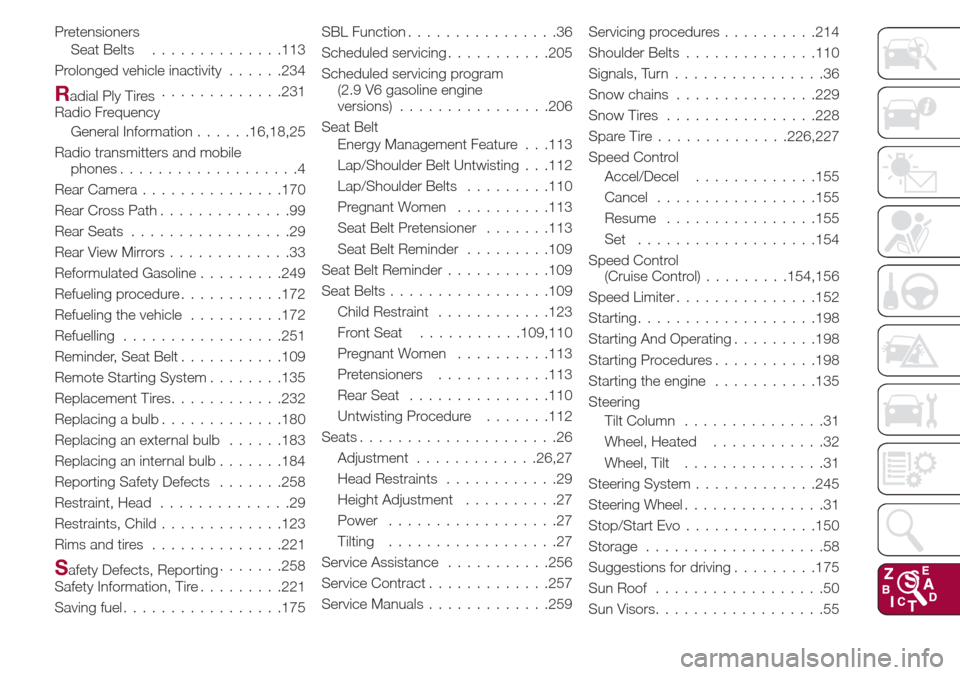
PretensionersSeat Belts ..............113
Prolonged vehicle inactivity ......234
Radial Ply Tires.............231
Radio Frequency General Information ......16,18,25
Radio transmitters and mobile phones ...................4
Rear Camera ...............170
Rear Cross Path ..............99
Rear Seats .................29
Rear View Mirrors .............33
Reformulated Gasoline .........249
Refueling procedure ...........172
Refueling the vehicle ..........172
Refuelling ................ .251
Reminder, Seat Belt ...........109
Remote Starting System ........135
Replacement Tires ............232
Replacing a bulb .............180
Replacing an external bulb ......183
Replacing an internal bulb .......184
Reporting Safety Defects .......258
Restraint, Head ..............29
Restraints, Child .............123
Rimsandtires ............. .221
Safety Defects, Reporting.......258
Safety Information, Tire .........221
Saving fuel ................ .175SBL Function
................36
Scheduled servicing ...........205
Scheduled servicing program (2.9 V6 gasoline engine
versions) ............... .206
Seat Belt Energy Management Feature . . .113
Lap/Shoulder Belt Untwisting . . .112
Lap/Shoulder Belts .........110
Pregnant Women ..........113
Seat Belt Pretensioner .......113
Seat Belt Reminder .........109
Seat Belt Reminder ...........109
Seat Belts ................ .109
Child Restraint ............123
Front Seat ...........109,110
Pregnant Women ..........113
Pretensioners ............113
Rear Seat ...............110
Untwisting Procedure .......112
Seats .....................26
Adjustment .............26,27
Head Restraints ............29
Height Adjustment ..........27
Power ..................27
Tilting ..................27
Service Assistance ...........256
Service Contract .............257
Service Manuals .............259 Servicing procedures
..........214
Shoulder Belts ..............110
Signals, Turn ................36
Snow chains ...............229
Snow Tires ............... .228
Spare Tire ..............226,227
Speed Control Accel/Decel .............155
Cancel ................ .155
Resume ............... .155
S
et .................. .154
Speed Control (Cruise Control) .........154,156
Speed Limiter ...............152
Starting .................. .198
Starting And Operating .........198
Starting Procedures ...........198
Starting the engine ...........135
Steering Tilt Column ...............31
Wheel, Heated ............32
Wheel, Tilt ...............31
Steering System .............245
Steering Wheel ...............31
Stop/Start Evo ..............150
Storage ...................58
Suggestions for driving .........175
Sun Roof ..................50
Sun Visors ..................55
Page 267 of 268

INSTALLATION OF RADIO TRANSMITTING
EQUIPMENTSpecial design considerations are incorporated into this
vehicle’s electronic system to provide immunity to radio
frequency signals. Mobile two-way radios and telephone
equipment must be installed properly by trained person-
nel. The following must be observed during installation.
The positive power connection should be made directly
to the battery and fused as close to the battery as possible.
The negative power connection should be made to body
sheet metal adjacent to the negative battery connection.
This connection should not be fused.
Antennas for two-way radios should be mounted on the
roof or the rear area of the vehicle. Care should be used
in mounting antennas with magnet bases. Magnets may
affect the accuracy or operation of the compass on
vehicles so equipped.The antenna cable should be as short as practical and
routed away from the vehicle wiring when possible. Use
only fully shielded coaxial cable.
Carefully match the antenna and cable to the radio to
ensure a low Standing Wave Ratio (SWR).
Mobile radio equipment with output power greater than
normal may require special precautions.
All installations should be checked for possible interfer-
ence between the communications equipment and the
vehicle’s electronic systems.