air conditioning Alfa Romeo Giulia 2017 Owner's Manual
[x] Cancel search | Manufacturer: ALFA ROMEO, Model Year: 2017, Model line: Giulia, Model: Alfa Romeo Giulia 2017Pages: 268, PDF Size: 18.64 MB
Page 45 of 268
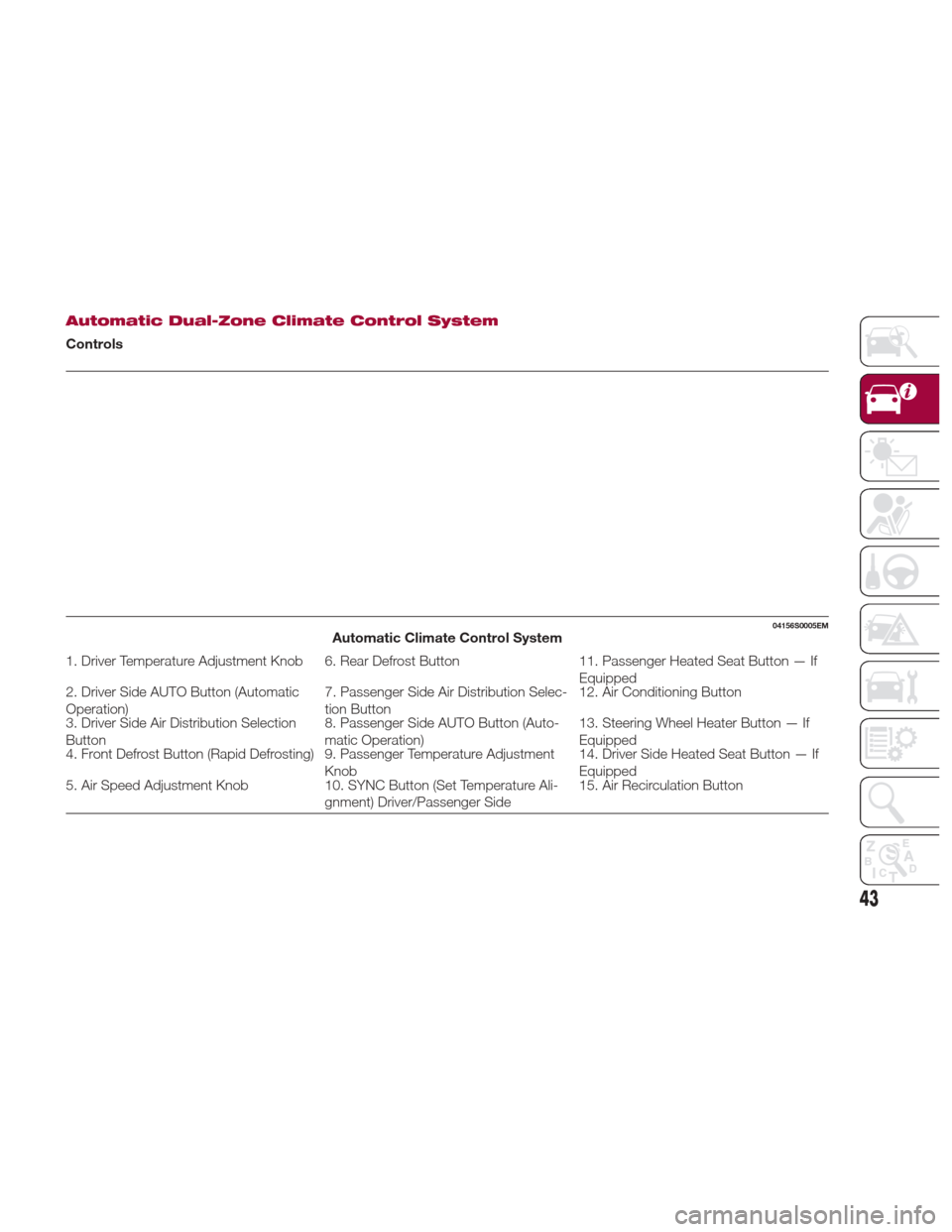
Automatic Dual-Zone Climate Control System
Controls
04156S0005EMAutomatic Climate Control System
1. Driver Temperature Adjustment Knob 6. Rear Defrost Button11. Passenger Heated Seat Button — If
Equipped
2. Driver Side AUTO Button (Automatic
Operation) 7. Passenger Side Air Distribution Selec-
tion Button12. Air Conditioning Button
3. Driver Side Air Distribution Selection
Button 8. Passenger Side AUTO Button (Auto-
matic Operation)13. Steering Wheel Heater Button — If
Equipped
4. Front Defrost Button (Rapid Defrosting) 9. Passenger Temperature Adjustment
Knob14. Driver Side Heated Seat Button — If
Equipped
5. Air Speed Adjustment Knob 10. SYNC Button (Set Temperature Ali-
gnment) Driver/Passenger Side 15. Air Recirculation Button
43
Page 216 of 268
DEALER SERVICE
The following pages contain
instructions on the required
maintenance from the technical
personnel who designed the vehicle.
In addition to these specific
maintenance instructions specified for
routine scheduled servicing, there are
other components which may require
periodic maintenance or replacement
over the vehicle’s life cycle.
Engine Oil
Engine Oil Level Check
To ensure correct engine lubrication, the
oil must always be kept at the
prescribed level (see "Engine
Compartment" in this chapter).
Check the oil level at regular intervals,
for example every 1864 miles
(3000 km).
It must be checked about five minutes
after stopping the engine, once full
operating temperature is reached. The
vehicle must also be parked on as level
a surface as possible.
Ensure that the oil level is within the
interval on the dipstick between the
minimum and maximum limits.
The engine oil level can be checked
using the Connect system. To access
the function, activate the main menu
(MENU button) and select the following
options in sequence: “Applications”;
“My Car”; “Oil level”.Changing the Engine Oil
See the "Maintenance Plan" for the
correct servicing intervals.
Choice of Engine Oil Type
To ensure optimal performance and
maximum protection in all operating
conditions, it is advisable to use solely
certified engine oils (see description in
"Fluid And Lubricants" in the "Technical
Specifications" chapter).
Additives for Engine Oil
It is strongly recommended not to use
additives (other than leak detection
dyes) with the engine oil.
The engine oil is a product designed
specially for the vehicle and its
performance may be deteriorated
through the use of further additives.
Disposal of Used Engine Oil and
Filters
For the disposal of the engine oil and
filters, contact the appropriate body to
determine local regulations.
Note:
Used engine oil disposed of incorrectly
may seriously harm the environment.
Engine Oil Filter
Replacing the Engine Oil Filter
The engine oil filter must be replaced
each time the engine oil is changed. It is
advised to replace it with a genuine spare
part, specifically designed for this vehicle.
Air Filter
Replacing the Air Cleaner
See the "Maintenance Plan" for the
correct servicing intervals. It is advised
to replace it with a genuine spare part,
specifically designed for this vehicle.
Air Conditioning System
Maintenance
To ensure the best possible
performance, the air conditioning
system must be checked and undergo
maintenance at an authorized dealer at
the beginning of the summer.
Caution!
Do not use chemicals to clean the air
conditioning system, since the internal
components may be damaged. This kind of
damage is not covered by warranty.
Replace The Cabin Air Filter
See the "Maintenance Plan" for the
correct servicing intervals. For cleaner
replacement, contact an authorized
dealer.
214
SERVICING AND MAINTENANCE
Page 217 of 268
Warning!
Use only refrigerants and compressor
lubricants approved by the manufacturer
for your air conditioning system. Some
unapproved refrigerants are flammable and
can explode, injuring you. Other
unapproved refrigerants or lubricants can
cause the system to fail, requiring costly
repairs. Refer to Warranty Information
Book, located in your owner’s information
kit, for further warranty information.
Lubricating Moving
Parts Of The Bodywork
Ensure that the locks and bodywork
junction points, including components
such as the seat guides, door hinges
(and rollers), trunk and hood are
periodically lubricated with
lithium-based grease to ensure correct,
silent operation and to protect them
from rust and wear.
Thoroughly clean the components,
eliminating every trace of dirt and dust.
After lubricating, eliminate excess oil
and grease. Also pay particular
attention to the hood closing devices,
to ensure correct operation. During
operations on the hood, to be carried
out with the engine cold, also
remember to check, clean and lubricate
the locking, release and safety devices.Lubricate the external lock barrels twice
a year. Apply a small amount of
high-quality lubricant directly into the
lock barrel.
If necessary, contact your authorized
dealer as soon as possible.
Windshield Wiper
Periodically clean the windshield and
rear window and rubber profile of the
windshield wiper blades, using a
sponge or a soft cloth and a
non-abrasive detergent. This eliminates
the salt or impurities accumulated when
driving.
Prolonged operation of the windshield
window wipers with dry glass may
cause the deterioration of the blades, in
addition to abrasion of the surface of
the glass. To eliminate the impurities on
the dry glass, always operate the
windshield washers.
In the event of very low outdoor
temperatures, below zero degrees,
ensure that the movement of the rubber
part in contact with the glass is not
obstructed. Use a suitable deicing
product to release it if required.
Avoid using the windshield wipers to
remove frost or ice.
Also avoid contact of the rubber profile
of the blades with petroleum derivatives
such as engine oil, gas, etc.
Warning!
Driving with worn windshield wiper blades
is a serious hazard, because visibility is
reduced in bad weather conditions.
Note:
The life of the windshield wiper blades
varies according to the usage
frequency. In any case, it is advised to
replace the blades approximately once
a year. When the blades are worn,
noise, marks on the glass or streaks of
water may be noticed. In the presence
of these conditions, clean the
windshield wiper blades or, if necessary,
replace them.
Raising The Windshield Wiper
Blades ("Service Position"
Function)
The "service position" function allows
the driver to replace the windshield
wiper blades more easily. It is also
recommended to activate this function
when it is snowing and to make it easier
to remove any dirt deposits in the area
where the blades are normally
positioned, when washing.
Activation Of The Function
To activate this function, disable the
windshield wiper before setting the
ignition device to STOP.
215
Page 236 of 268
Temperature Grades
The temperature grades are A (the
highest), B, and C, representing the
tire's resistance to the generation of
heat and its ability to dissipate heat,
when tested under controlled
conditions on a specified indoor
laboratory test wheel. Sustained high
temperature can cause the material of
the tire to degenerate and reduce tire
life, and excessive temperature can
lead to sudden tire failure. The grade C
corresponds to a level of performance,
which all passenger vehicle tires must
meet under the Federal Motor Vehicle
Safety Standard No. 109. Grades B
and A represent higher levels of
performance on the laboratory test
wheel, than the minimum required by
law.
Warning!
The temperature grade for this tire is
established for a tire that is properly
inflated and not overloaded. Excessive
speed, under-inflation, or excessive
loading, either separately or in
combination, can cause heat buildup and
possible tire failure.
STORING THE
VEHICLE
If the vehicle is left inactive for longer
than a month, the following precautions
should be observed:
Park the car in an area that is
covered and dry, and well-ventilated if
possible. Slightly open the windows.
Check that the electric park brake is
not activated.
Carry out the procedure: “manual
trunk opening device” procedure
described in this paragraph.
Disconnect the negative battery
terminal and check the battery charge.
Repeat this check once every three
months during storage.
If the battery is not disconnected
from the electrical system, check its
state of charge every thirty days.
Clean and protect the painted parts
using protective wax.
Clean and protect the shiny metal
parts using special compounds
available commercially.
Sprinkle talcum powder on the
windshield wiper rubber blades, and lift
them off the glass.
Cover the vehicle with a fabric or
perforated plastic sheet, paying
particular care not to damage the
painted surface by dragging any dust
that may have accumulated on it. Do
not use compact plastic sheets, as they do not allow humidity to evaporate from
the surface of the vehicle.
Inflate tires to +7.25 psi (+0.5 bar)
above the standard prescribed pressure
and check it periodically.
Do not drain the engine cooling
system.
Any time the car is left inactive for
two weeks or more, operate the air
conditioning system with engine idling
for at least five minutes, setting external
air and with fan set to maximum speed.
This operation will ensure appropriate
lubrication for the system, thus
minimizing the possibility of damage to
the compressor when the system is
operated again.
Note:
After cycling the ignition to STOP and
having closed the driver side door, wait
at least one minute before
disconnecting the electrical supply from
the battery. When reconnecting the
electrical supply to the battery, make
sure that the ignition is in the STOP
position and the driver side door is
closed.
Manual Trunk Opening Device
Proceed as follows if the battery needs
to be disconnected:
1. From the trunk interior covering,
rotate the plug to the left of the lock
and extract the strap connected to it.
234
SERVICING AND MAINTENANCE