ABS Alfa Romeo Giulia 2017 Owner's Guide
[x] Cancel search | Manufacturer: ALFA ROMEO, Model Year: 2017, Model line: Giulia, Model: Alfa Romeo Giulia 2017Pages: 268, PDF Size: 18.64 MB
Page 180 of 268
Preheating the carbon ceramic
material brake discs
The brake discs must be warmed up to
make them fully efficient. You are
advised to perform the following
procedure:
Brake nine times from 80 mph to
18 mph (130 km/h to 30 km/h) with
deceleration equal to 0.7g (the
longitudinal acceleration value is shown
on the instrument panel display by
setting RACE mode and selecting the
“Performance” page) with 20 second
intervals between brake applications;
keep the car at a speed comprised
between 37 mph and 62 mph (60 km/h
and 100 km/h) and do not brake for
4 minutes to allow the brakes to cool
down;
Then brake three times from
124 mph to 18 mph (200 km/h to
30 km/h) with deceleration equal to
1.1g (ABS operation) with 30 second
intervals between brake applications;
keep the car at a speed comprised
between 37 mph and 62 mph (60 km/h
and 100 km/h) and do not brake for
5 minutes to allow the brakes to cool
down.
178
STARTING AND OPERATING
Page 188 of 268
FUSES
General Information
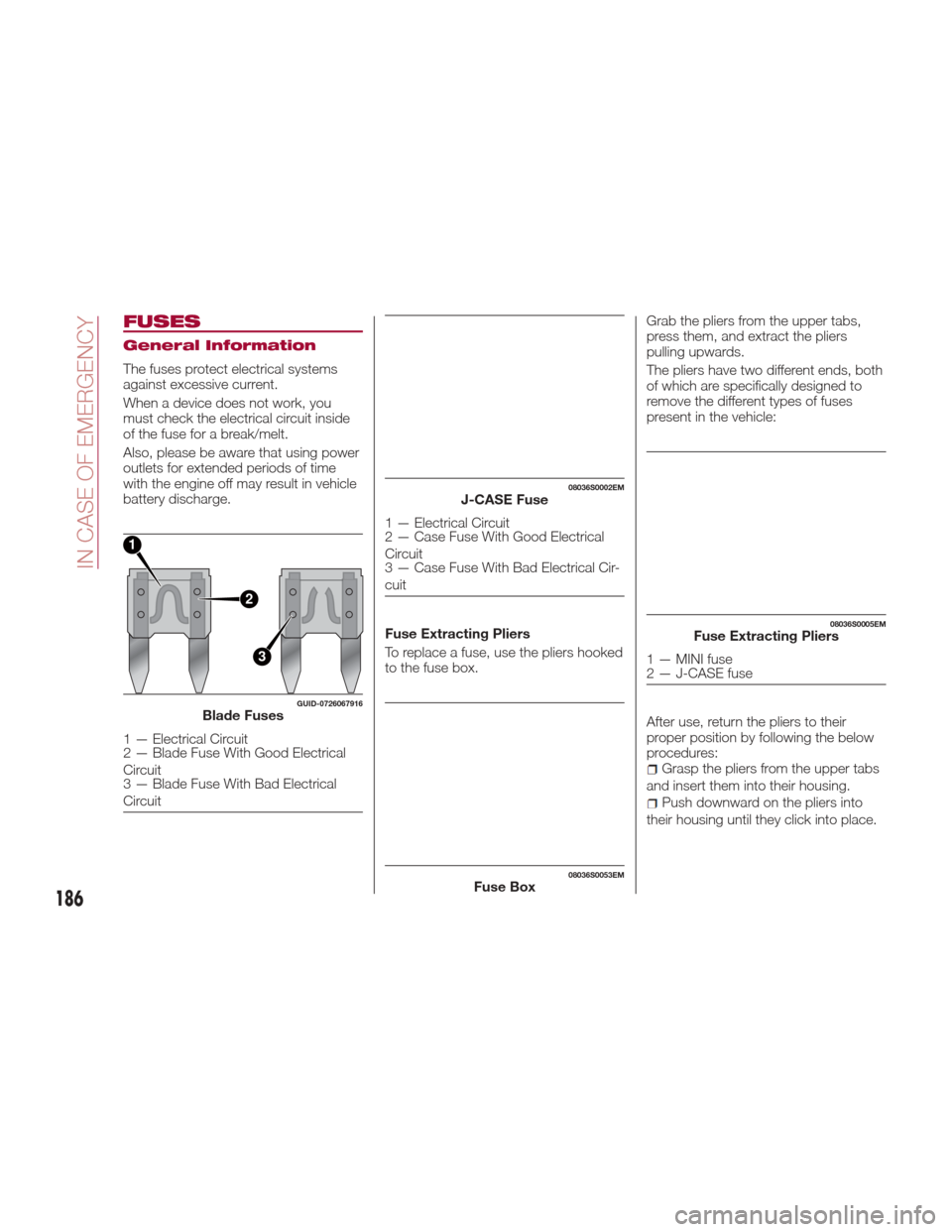
The fuses protect electrical systems
against excessive current.
When a device does not work, you
must check the electrical circuit inside
of the fuse for a break/melt.
Also, please be aware that using power
outlets for extended periods of time
with the engine off may result in vehicle
battery discharge.Fuse Extracting Pliers
To replace a fuse, use the pliers hooked
to the fuse box.Grab the pliers from the upper tabs,
press them, and extract the pliers
pulling upwards.
The pliers have two different ends, both
of which are specifically designed to
remove the different types of fuses
present in the vehicle:
After use, return the pliers to their
proper position by following the below
procedures:
Grasp the pliers from the upper tabs
and insert them into their housing.
Push downward on the pliers into
their housing until they click into place.
2
3
1
GUID-0726067916Blade Fuses
1 — Electrical Circuit
2 — Blade Fuse With Good Electrical
Circuit
3 — Blade Fuse With Bad Electrical
Circuit
08036S0002EMJ-CASE Fuse
1 — Electrical Circuit
2 — Case Fuse With Good Electrical
Circuit
3 — Case Fuse With Bad Electrical Cir-
cuit
08036S0053EMFuse Box
08036S0005EMFuse Extracting Pliers
1 — MINI fuse
2 — J-CASE fuse
186
IN CASE OF EMERGENCY
Page 195 of 268
Inflation Procedure
Warning!
Do not attempt to seal a tire on the side
of the vehicle closest to traffic. Pull far
enough off the road to avoid the danger of
being hit when using the Tire Service Kit.
Do not use Tire Service Kit or drive the
vehicle under the following circumstances:
If the puncture in the tire tread is
approximately 1/4 inch (6 mm) or larger.
If the tire has any sidewall damage.
If the tire has any damage from driving
with extremely low tire pressure.
If the tire has any damage from driving
on a flat tire.
If the wheel has any damage.
If you are unsure of the condition of the
tire or the wheel.
Keep Tire Service Kit away from open
flames or heat sources.
A loose Tire Service Kit thrown forward
in a collision or hard stop could endanger
the occupants of the vehicle. Always stow
the Tire Service Kit in the place provided.
Failure to follow these warnings can result
in injuries that are serious or fatal to you,
your passengers, and others around you.
Take care not to allow the contents of
Tire Service Kit to come in contact with
hair, eyes, or clothing. Tire Service Kit
sealant is harmful if inhaled, swallowed, or
absorbed through the skin. It causes skin,
eye, and respiratory irritation. Flush
immediately with plenty of water if there is
any contact with eyes or skin. Change
clothing as soon as possible, if there is any
contact with clothing.
Tire Service Kit Sealant solution contains
latex. In case of an allergic reaction or rash,
consult a physician immediately. Keep Tire
Service Kit out of reach of children. If
swallowed, rinse mouth immediately with
plenty of water and drink plenty of water.
Do not induce vomiting! Consult a
physician immediately.
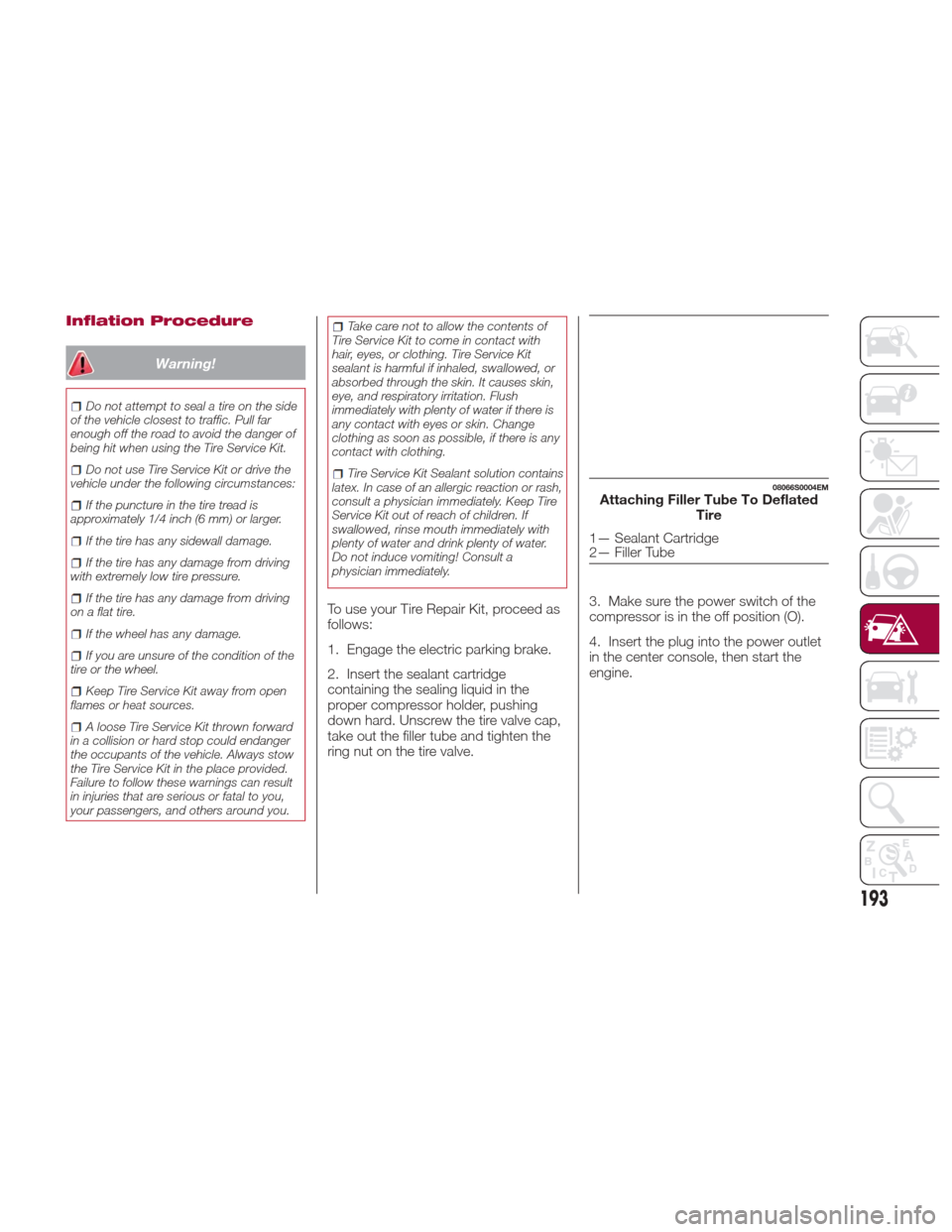
To use your Tire Repair Kit, proceed as
follows:
1. Engage the electric parking brake.
2. Insert the sealant cartridge
containing the sealing liquid in the
proper compressor holder, pushing
down hard. Unscrew the tire valve cap,
take out the filler tube and tighten the
ring nut on the tire valve. 3. Make sure the power switch of the
compressor is in the off position (O).
4. Insert the plug into the power outlet
in the center console, then start the
engine.
08066S0004EMAttaching Filler Tube To Deflated
Tire
1— Sealant Cartridge
2— Filler Tube
193
Page 221 of 268
With engine and system cold, do
not top up with coolant beyond the
maximum level indicated on the
reservoir in the engine compartment.
Braking System
In order to guarantee the efficiency of
the braking system, periodically check
its components; for this operation,
contact an authorized dealer.
See the "Maintenance Plan" for the
correct servicing intervals.
Note: Driving with your foot resting on
the brake pedal may compromise its
efficiency, increasing the risk of
accidents. When driving, never keep
your foot on the brake pedal and don’t
put unnecessary strain on it to prevent
the brakes from overheating: excess
pad wear may cause damage to the
braking system.
When an insufficient oil level is
detected, contact an authorized dealer
to have the system checked.
Always keep the cap of the brake
fluid reservoir (in the engine
compartment) completely closed.
Warning!
Use only manufacturer's recommended
brake fluid. Refer to “Fluids And Lubricants”
in “Technical Specifications” for further
information. Using the wrong type of brake
fluid can severely damage your brake
system and/or impair its performance. The
proper type of brake fluid for your vehicle is
also identified on the original factory
installed hydraulic master cylinder reservoir.
To avoid contamination from foreign
matter or moisture, use only new brake
fluid or fluid that has been in a tightly
closed container. Keep the master cylinder
reservoir cap secured at all times. Brake
fluid in a open container absorbs moisture
from the air resulting in a lower boiling
point. This may cause it to boil
unexpectedly during hard or prolonged
braking, resulting in sudden brake failure.
This could result in a collision.
Overfilling the brake fluid reservoir can
result in spilling brake fluid on hot engine
parts, causing the brake fluid to catch fire.
Brake fluid can also damage painted and
vinyl surfaces, care should be taken to
avoid its contact with these surfaces.
Do not allow petroleum based fluid to
contaminate the brake fluid. Brake seal
components could be damaged, causing
partial or complete brake failure. This could
result in a collision.
Automatic Transmission
Use only a transmission oil with the
same characteristics as those indicated
in the "Fluids and Lubricants" table (see
"Technical Specifications" chapter).
Special Additives
Do not use any type of additive with the
automatic transmission oil. The
automatic transmission oil is a product
designed specially for this vehicle and
its performance may be compromised
through the use of further additives.
Caution!
Do not use chemical flushes in your
transmission as the chemicals can damage
your transmission components. Such
damage is not covered by the New Vehicle
Limited Warranty.
219
Page 223 of 268

TIRES
Tire Safety Information
Tire safety information will cover
aspects of the following information:
Tire Markings, Tire Identification
Numbers, Tire Terminology and
Definitions, Tire Pressures, and Tire
Loading.
Tire Markings
Note:
P (Passenger) — Metric tire sizing is
based on U.S. design standards.
P-Metric tires have the letter “P”
molded into the sidewall preceding the
size designation. Example:
P215/65R15 95H.
European — Metric tire sizing is
based on European design standards.
Tires designed to this standard have
the tire size molded into the sidewall
beginning with the section width. The
letter "P" is absent from this tire size
designation. Example: 215/
65R15 96H.
LT (Light Truck) — Metric tire sizing
is based on U.S. design standards.
The size designation for LT-Metric tires
is the same as for P-Metric tires except
for the letters “LT” that are molded into
the sidewall preceding the size
designation. Example: LT235/85R16.
Temporary spare tires are designed
for temporary emergency use only.
Temporary high pressure compact
spare tires have the letter “T” or “S”
molded into the sidewall preceding the
size designation. Example:
T145/80D18 103M.
High flotation tire sizing is based on
U.S. design standards and it begins
with the tire diameter molded into the
sidewall. Example: 31x10.5 R15 LT.
Tire Identification Number (TIN)
The TIN may be found on one or both
sides of the tire; however, the date code
mayonlybeononeside.Tireswith
white sidewalls will have the full TIN,
including the date code, located on the
white sidewall side of the tire. Look for
the TIN on the outboard side of black
sidewall tires as mounted on the
vehicle. If the TIN is not found on the
outboard side, then you will find it on
the inboard side of the tire.
GUID-0601085395USTire Markings
1 — U.S. DOT Sa-
fety Standards
Code (TIN) 4 — Maximum
Load
2 — Size Designa-
tion 5 — Maximum
Pressure
3 — Service De-
scription 6 — Treadwear,
Traction and Tem-
perature Grades
221
Page 239 of 268
INTERIORS
Periodically check the cleanliness of the
interior, beneath the mats, which could
cause oxidation of the sheet metal.
Seats And Fabric Parts
Remove dust with a soft brush or a
vacuum cleaner. It is advised to use a
moist brush on velvet upholstery. Rub
the seats with a sponge moistened with
a solution of water and neutral
detergent.
Leather Seats — If
Equipped
Remove the dry dirt with a chamois or
slightly damp cloth, without exerting too
much pressure.
Remove any liquid or grease stains
using an absorbent dry cloth, without
rubbing. Then clean with a soft cloth or
buckskin cloth dampened with water
and mild soap. If the stain persists, use
specific products and observe the
instructions carefully.
Note:Never use alcohol. Make sure
that the cleaning products used contain
no alcohol or alcohol derivatives, even
in small quantities.
Plastic And Coated
Parts
Clean interior plastic parts with a damp
cloth (if possible made from microfiber),
and a solution of water and neutral,
non-abrasive detergent.
To clean oily or persistent stains, use
specific products free from solvents and
designed to maintain the original
appearance and color of the
components.
Remove any dust using a microfiber
cloth, if necessary moistened with
water. The use of paper tissues is not
recommended as these may leave
residues.
Genuine Leather Parts —
If Equipped
Use only water and mild soap to clean
these parts. Never use alcohol or
alcohol-based products.
Before using a specific product for
cleaning interiors, make sure that it
does not contain alcohol and/or alcohol
based substances.
Carbon Fiber Parts
To eliminate small scratches and marks
on the carbon, contact your authorized
dealer. An improperly performed
operation may irreparably damage the
carbon.
237
Page 241 of 268
IDENTIFICATION
DATA
Vehicle Identification
Number
The Vehicle Identification Number (VIN)
is stamped on a plate on the front left
corner of the dashboard cover, which
can be seen from outside the vehicle,
through the windshield.This number is also printed on the
chassis at the front left shock absorber
and can be seen by opening the engine
compartment hood.
Vehicle Identification
Number (VIN) Plate
The plates are located on the left side A
pillar and contain the data about:
Chassis number (VIN).
Vehicle type (USA and Canada only).
Color code.
Place of manufacturing of the vehicle
(USA and Mexico only).
Vehicle manufacturing date.
Maximum permitted weights.
Permitted tire inflation pressure (USA
and Canada only).
10016S0001EMVehicle Identification Number
10016S0002EMVehicle Identification Number
239
Page 259 of 268
Customer Assistance
For The Hearing Or
Speech Impaired
(TDD/TTY)
To assist customers who have hearing
difficulties, the manufacturer has
installed special TDD
(Telecommunication Devices for the
Deaf) equipment at its customer center.
Any hearing or speech impaired
customer, who has access to a TDD or
a conventional teletypewriter (TTY) in
the United States, can communicate
with the manufacturer by dialing
1-800-380-CHRY.
Canadian residents with hearing
difficulties that require assistance can
use the special needs relay service
offered by Bell Canada. For TTY
teletypewriter users, dial 711 and for
Voice callers, dial 1-800-855-0511 to
connect with a Bell Relay Service
operator.
Service Contract
You may have purchased a service
contract for a vehicle to help protect
you from the high cost of unexpected
repairs after the manufacturer's New
Vehicle Limited Warranty expires. The
manufacturer stands behind only the
manufacturer's service contracts. If you
purchased a manufacturer's service
contract, you will receive Plan
Provisions and an Owner Identification
Card in the mail within three weeks of
the vehicle delivery date. If you have
any questions about the service
contract, call the manufacturer's
Service Contract National Customer
Hotline at 1-800-521-9922 (Canadian
residents, call (800) 465-2001 English /
(800) 387-9983 French).
The manufacturer will not stand behind
any service contract that is not the
manufacturer's service contract. It is
not responsible for any service contract
other than the manufacturer's service
contract. If you purchased a service
contract that is not a manufacturer's
service contract, and you require
service after the manufacturer's New
Vehicle Limited Warranty expires,
please refer to the contract documents,
and contact the person listed in those
documents.We appreciate that you have made a
major investment when you purchased
the vehicle. An authorized dealer has
also made a major investment in
facilities, tools, and training to assure
that you are absolutely delighted with
the ownership experience. You will be
pleased with their sincere efforts to
resolve any warranty issues or related
concerns.
Warning!
Engine exhaust (internal combustion
engines only), some of its constituents, and
certain vehicle components contain, or
emit, chemicals known to the State of
California to cause cancer and birth
defects, or other reproductive harm. In
addition, certain fluids contained in vehicles
and certain products of component wear
contain, or emit, chemicals known to the
State of California to cause cancer and
birth defects, or other reproductive harm.
257
Page 262 of 268
INDEX
Accessories purchased by theowner ....................3
Active aerodynamics ...........60
Active safety systems ...........96
Active Torque Vectoring (ATV) System ..................99
Adaptive Cruise Control ........156
Adaptive Cruise Control (ACC) (Cruise Control) ............156
Additional Heaters .............48
Additives, Fuel ..............250
AirBag.................. .116
Air Bag Components .....115,120
Air Bag Operation ..........117
Air Bag Warning Light .......115
Driver Knee Air Bag .........118
Enhanced Accident Response . .203
Event Data Recorder (EDR) . . . .203
FrontAirBag ............ .116
If A Deployment Occurs ......120
Knee Impact Bolsters .......117
Maintaining Your Air Bag
System ............... .122
Redundant Air Bag Warning
Light ................. .116
Side Air Bags .............118
Transporting Pets ..........133
Air Bag Light ...............115
Air Bag Maintenance ..........122Air Pressure, Tires
............230
Alarm (Security Alarm) ..........19
Alfa Active Suspension (AAS) .....149
Alfa DNA system .............146
Anti-Lock Braking (ABS) System ....96
Automatic Dimming Mirror ........33
Automatic Headlights ...........34
Automatic Temperature Control (ATC) ...................43
Automatic transmission.........140
Auxiliary Driving Systems ........99
B-Pillar Location.............223
Battery .................. .212
Battery recharging ............212
Blind Spot Monitoring ..........99
Bodywork (cleaning and maintenance) .............235
Brakes .................. .243
brake fluid level ............211
Brightness, Interior Lights ........39
Camera, Rear..............170
Cargo Tie-Downs .............54
Certification Label ............173
Changing A Flat Tire ...........220
Checking levels ..............209
Child Restraint ..............123
Child Restraints Booster Seats ............125
Child Restraints ...........123 Child Seat Installation
........131
How To Stow An Unused ALR
Seat Belt ............... .129
Infants And Child Restraints . . . .124
LATCH Positions ..........126
Lower Anchors And Tethers For
Children ............... .126
Older Children And Child
Restraints ...............124
Seating Positions ..........126
Using The Top Tether
Anchorage ..............132
Clean Air Gasoline ............249
Cleaning Wheels ............... .227
Climate Control ............42,45
Close The Hood ..............52
Compact Spare Tire ...........226
Contract, Service ............257
Courtesy mirror light (bulb replacement) ..............184
Cruise Control (Speed Control) . . . .156
Cupholder ..................59
Cupholders .................59
Customer Assistance ..........256
Daytime Running Lights .........35
Daytime Running Lights (DRL) .....35
Dimensions ............... .246
Direction indicators (changing a bulb) .................. .183
INDEX