change time Alfa Romeo Giulia 2017 Owner's Guide
[x] Cancel search | Manufacturer: ALFA ROMEO, Model Year: 2017, Model line: Giulia, Model: Alfa Romeo Giulia 2017Pages: 268, PDF Size: 18.64 MB
Page 207 of 268
SCHEDULED
SERVICING
Correct servicing is crucial for
guaranteeing a long life for the vehicle
under the best conditions.
For this reason, Alfa Romeo has
planned a series of checks and services
for your vehicle at fixed intervals based
on distance and time, as described in
the Scheduled Servicing Plan.
Before each service, it is always
necessary to carefully follow the
instructions in the Scheduled Servicing
Plan (e.g. periodically check level of
fluids, tire pressure, etc.).
Scheduled Servicing is offered by an
authorized dealer according to a set
time schedule. If, during each
operation, in addition to the ones
scheduled, the need arises for further
replacements or repairs, these may be
carried out with owners explicit consent
only.
Note:
Scheduled Servicing intervals are
required by the Manufacturer. Failure to
have them carried out may invalidate
the New Vehicle Limited Warranty.
You are advised to inform your
authorized dealer of any small operating
irregularities without waiting for the next
service.
Periodic Checks
Every month or every600miles
( 1,000 km) or before long trips check
and, if necessary, top off:
Engine coolant level.
Brake fluid level (if insufficient, see
your authorized dealer as soon as
possible).
Windshield washer fluid level.
Tire inflation pressure and condition.
Operation of lighting system
(headlights, direction indicators, hazard
warning lights, etc.).
Operation of windshield
washing/wiping system and
positioning/wear of wiper blades.
Every 2,000 miles ( 3,000km), check
and top off if required:
Engine oil level.
Heavy Usage Of The Car
If the vehicle is used under one of the
following conditions:
Dusty roads.
Short, repeated journeys less than
4 miles (7-8 km) at sub-zero outside
temperatures.
Engine often idling or driving long
distances at low speeds or long periods
of inactivity.
In the event of a long period of
inactivity. The following checks must be carried
out more often than indicated in the
Scheduled Servicing Plan:
Check cleanliness of hood and trunk
locks, cleanliness and lubrication of
linkage.
Visually inspect conditions of: engine,
transmission, pipes and hoses
(exhaust/fuel system/brakes) and
rubber elements (sleeves/bushes, etc.).
Check battery charge and battery
fluid level (electrolyte).
Visually inspect conditions of the
accessory drive belts.
Check and, if necessary, change
engine oil and replace oil filter.
Check and, if necessary, replace
cabin air filter.
Check and, if necessary, replace air
cleaner.
Severe Duty All Models
Change Engine Oil at 4,000 miles
(6,500 km) if the vehicle is operated in a
dusty and off-road environment or is
operated predominately at idle or only
very low engine RPM’s. This type of
vehicle use is considered Severe Duty.
205
Page 212 of 268
ENGINE OIL
The engine oil level can be seen on the
instrument cluster display every time
the engine is started, or on the Connect
system display by activating on the
main menu (MENU button) the following
functions in sequence: “Apps”; “My
Car” and “Oil Level”.
Check on the display using the
6 notches that the oil level is between
the MIN and MAX level: 1 notch MIN
level, 6 notches MAX level.
If the oil level is close to or below the
MIN mark, add oil gradually through the
filler, considering that each notch
shown on the display corresponds to
approximately 8.8 fl oz (250 ml).
The oil level can also be checked
manually.
Caution!
Make sure not to add too much oil when
topping off the engine. Engine oil in excess
may damage the engine. Have the vehicle
checked. Never exceed the MAX level
when topping off engine oil. It is advisable
to check the oil level in intermediate steps
using the oil dipstick.
The oil level is not refreshed immediately on
the display after topping off. Consequently,
wait for the oil level to be refreshed on the
display and follow the procedure below.
Manual oil level checking
procedure
Check that the oil level is between the
MIN and MAX marks on dipstick, clean
it with a lint-free cloth and reinsert it.
Extract the dipstick again and check
that the level is between the MIN and
MAX marks.
Top-up and oil level indication
update on display
Ifaengineoiltop-offisneeded,inorder
to ensure the correct indication of the
oil level on the display, leave the car on
flat ground with the engine running for
approximately 5 minutes (temperature
higher than 176°F (80°C)) and proceed
with the process below:
Wait for five minutes, turn the ignition
to the ON mode without starting the
engine and wait for a few seconds. If
the indication is not correct after the
procedure, contact your authorized
dealer. Engine oil consumption
The maximum engine oil consumption
is usually 14.1 ounces (400 grams,
0.88 pounds) every 620 miles
(1,000 km). When the vehicle is new,
the engine needs to be run in; therefore
the engine oil consumption can only be
considered established after the first
3,100 - 3,730 miles (5,000 - 6,000 km).
Warning!
If the engine oil is being topped up, wait for
the engine to cool down before loosening
the filler cap, particularly for vehicles with
aluminium cap (if equipped). WARNING:
risk of burns!
Caution!
The oil level must never exceed the MAX
mark.
If the MAX mark is exceeded MAX (last
notch on the right turns red) after the fill-up,
go to your authorized dealer as soon as
possible to have the oil in excess removed.
Do not add oil with specifications different
from those of the oil already in the engine.
Used engine oil and oil filters contain
substances which are harmful to the
environment. To change the oil and filters,
we advise you to contact your authorized
dealer.
210
SERVICING AND MAINTENANCE
Page 216 of 268
DEALER SERVICE
The following pages contain
instructions on the required
maintenance from the technical
personnel who designed the vehicle.
In addition to these specific
maintenance instructions specified for
routine scheduled servicing, there are
other components which may require
periodic maintenance or replacement
over the vehicle’s life cycle.
Engine Oil
Engine Oil Level Check
To ensure correct engine lubrication, the
oil must always be kept at the
prescribed level (see "Engine
Compartment" in this chapter).
Check the oil level at regular intervals,
for example every 1864 miles
(3000 km).
It must be checked about five minutes
after stopping the engine, once full
operating temperature is reached. The
vehicle must also be parked on as level
a surface as possible.
Ensure that the oil level is within the
interval on the dipstick between the
minimum and maximum limits.
The engine oil level can be checked
using the Connect system. To access
the function, activate the main menu
(MENU button) and select the following
options in sequence: “Applications”;
“My Car”; “Oil level”.Changing the Engine Oil
See the "Maintenance Plan" for the
correct servicing intervals.
Choice of Engine Oil Type
To ensure optimal performance and
maximum protection in all operating
conditions, it is advisable to use solely
certified engine oils (see description in
"Fluid And Lubricants" in the "Technical
Specifications" chapter).
Additives for Engine Oil
It is strongly recommended not to use
additives (other than leak detection
dyes) with the engine oil.
The engine oil is a product designed
specially for the vehicle and its
performance may be deteriorated
through the use of further additives.
Disposal of Used Engine Oil and
Filters
For the disposal of the engine oil and
filters, contact the appropriate body to
determine local regulations.
Note:
Used engine oil disposed of incorrectly
may seriously harm the environment.
Engine Oil Filter
Replacing the Engine Oil Filter
The engine oil filter must be replaced
each time the engine oil is changed. It is
advised to replace it with a genuine spare
part, specifically designed for this vehicle.
Air Filter
Replacing the Air Cleaner
See the "Maintenance Plan" for the
correct servicing intervals. It is advised
to replace it with a genuine spare part,
specifically designed for this vehicle.
Air Conditioning System
Maintenance
To ensure the best possible
performance, the air conditioning
system must be checked and undergo
maintenance at an authorized dealer at
the beginning of the summer.
Caution!
Do not use chemicals to clean the air
conditioning system, since the internal
components may be damaged. This kind of
damage is not covered by warranty.
Replace The Cabin Air Filter
See the "Maintenance Plan" for the
correct servicing intervals. For cleaner
replacement, contact an authorized
dealer.
214
SERVICING AND MAINTENANCE
Page 219 of 268
bodywork areas checked at your
authorized dealer to identify any
components which are broken,
damaged, worn or have moved from
their correct fitting position.
Open welding or loose connections
may permit exhaust gas to enter the
passenger compartment.
Have the exhaust system checked
every time the vehicle is raised. Replace
the components where necessary (for
these operations, contact an authorized
dealer).
In normal operating conditions, the
catalytic converter does not require
maintenance. To ensure that it operates
correctly, however, and prevent it from
getting damaged, it is extremely
important that the engine operates
perfectly.
To minimize the risk of damaging the
catalytic converter, proceed as follows:
Do not stop the engine or deactivate
the ignition with gear engaged and
vehicle in motion.
Do not attempt to start the engine
by bump starting.
Do not persist in using the vehicle if
idling is very irregular or the operating
conditions are very notably irregular.
Warning!
Exhaust gases can injure or kill. They
contain carbon monoxide (CO), which is
colorless and odorless. Breathing it can
make you unconscious and can eventually
poison you.
A hot exhaust system can start a fire if
you park over materials that can burn.
Such materials might be grass or leaves
coming into contact with your exhaust
system. Do not park or operate your
vehicle in areas where your exhaust system
can contact anything that can burn.
Cooling System
Warning!
Turn vehicle off and disconnect the fan
motor lead before working near the radiator
cooling fan.
You or others can be badly burned by
hot engine coolant (antifreeze) or steam
from your radiator. If you see or hear steam
coming from under the hood, do not open
the hood until the radiator has had time to
cool. Never open a cooling system
pressure cap when the radiator or coolant
bottle is hot.
Keep hands, tools, clothing, and jewelry
away from the radiator cooling fan when
the hood is raised. The fan starts
automatically and may start at any time,
whether the engine is running or not.
When working near the radiator cooling
fan, disconnect the fan motor lead or turn
the ignition to the OFF mode. The fan is
temperature controlled and can start at any
time the ignition is in the ON mode.
You or others can be badly burned by
hot engine coolant (antifreeze) or steam
from your radiator. If you see or hear steam
coming from under the hood, do not open
the hood until the radiator has had time to
cool. Never try to open a cooling system
pressure cap when the radiator is hot.
Engine Coolant Check
Check the engine coolant level every oil
change or before long trips.
If there are impurities in the engine
coolant, the system must be drained,
flushed and refilled: contact an
authorized dealer.
Check the front part of the condenser
to check for any build-up of insects,
leaves or other debris. Should it be
dirty, clean it by spraying delicately with
water.
Check the hoses of the engine cooling
system to ensure that the rubber has
not deteriorated and that there are no
cracks, tears, cuts or obstructions in
the expansion tank side and radiator
side connectors. Should there be any
217
Page 235 of 268

Warning!
Do not use a tire, wheel size, load rating,
or speed rating other than that specified for
your vehicle. Some combinations of
unapproved tires and wheels may change
suspension dimensions and performance
characteristics, resulting in changes to
steering, handling, and braking of your
vehicle. This can cause unpredictable
handling and stress to steering and
suspension components. You could lose
control and have a collision resulting in
serious injury or death. Use only the tire
and wheel sizes with load ratings approved
for your vehicle.
Never use a tire with a smaller load
index or capacity, other than what was
originally equipped on your vehicle. Using a
tire with a smaller load index could result in
tire overloading and failure. You could lose
control and have a collision.
Failure to equip your vehicle with tires
having adequate speed capability can
result in sudden tire failure and loss of
vehicle control.
Caution!
Replacing original tires with tires of a
different size may result in false
speedometer and odometer readings.
DEPARTMENT OF
TRANSPORTATION
UNIFORM TIRE
QUALITY GRADES
The following tire grading categories
were established by the National
Highway Traffic Safety Administration.
The specific grade rating assigned by
the tire's manufacturer in each category
is shown on the sidewall of the tires on
your vehicle.
All passenger vehicle tires must
conform to Federal safety requirements
in addition to these grades.
Treadwear
The Treadwear grade is a comparative
rating, based on the wear rate of the
tire when tested under controlled
conditions on a specified government
test course. For example, a tire graded
150 would wear one and one-half times
as well on the government course as a
tire graded 100. The relative
performance of tires depends upon the
actual conditions of their use, however,
and may depart significantly from the
norm due to variations in driving habits,
service practices, and differences in
road characteristics and climate.
Traction Grades
The Traction grades, from highest to
lowest, are AA, A, B, and C. These
grades represent the tire's ability to
stop on wet pavement, as measured
under controlled conditions on specified
government test surfaces of asphalt
and concrete. A tire marked C may
have poor traction performance.
Warning!
The traction grade assigned to this tire is
based on straight-ahead braking traction
tests, and does not include acceleration,
cornering, hydroplaning, or peak traction
characteristics.
233
Page 264 of 268
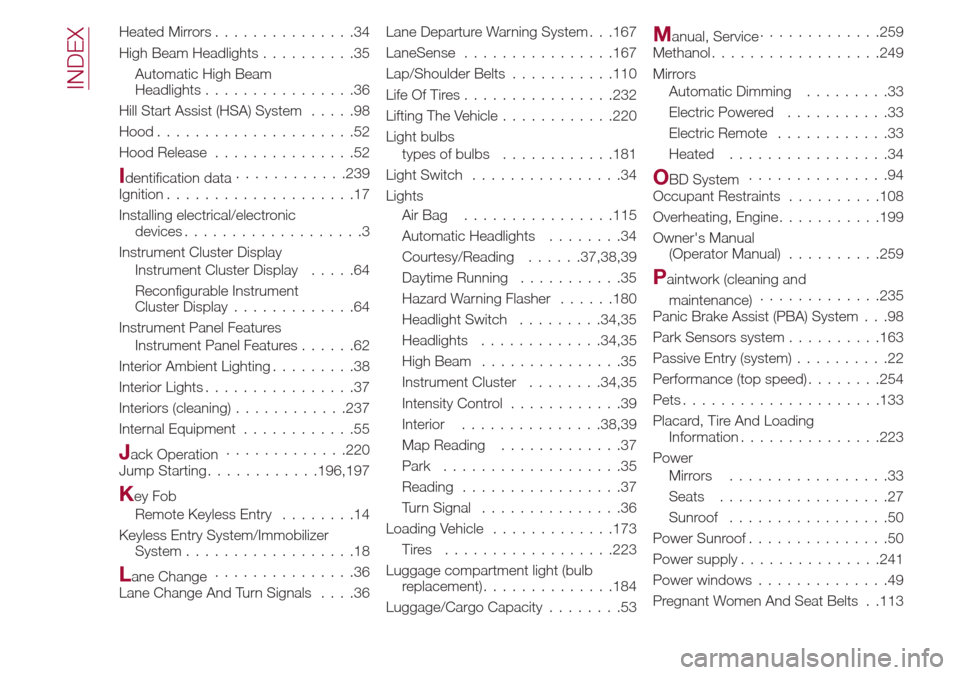
Heated Mirrors...............34
High Beam Headlights ..........35
Automatic High Beam
Headlights ................36
Hill Start Assist (HSA) System .....98
Hood.....................52
Hood Release ...............52
Identification data ............239
Ignition ....................17
Installing electrical/electronic devices ...................3
Instrument Cluster Display Instrument Cluster Display .....64
Reconfigurable Instrument
Cluster Display .............64
Instrument Panel Features Instrument Panel Features ......62
Interior Ambient Lighting .........38
Interior Lights ................37
Interiors (cleaning) ............237
Internal Equipment ............55
Jack Operation.............220
Jump Starting ............196,197
Key Fob
Remote Keyless Entry ........14
Keyless Entry System/Immobilizer System ..................18
Lane Change ...............36
Lane Change And Turn Signals ....36Lane Departure Warning System . . .167
LaneSense
............... .167
Lap/Shoulder Belts ...........110
Life Of Tires ............... .232
Lifting The Vehicle ............220
Light bulbs types of bulbs ............181
Light Switch ................34
Lights AirBag ............... .115
Automatic Headlights ........34
Courtesy/Reading ......37,38,39
Daytime Running ...........35
Hazard Warning Flasher ......180
Headlight Switch .........34,35
Headlights .............34,35
High Beam ...............35
Instrument Cluster ........34,35
Intensity Control ............39
Interior ...............38,39
Map Reading .............37
Park ...................35
Reading .................37
Turn Signal ...............36
Loading Vehicle .............173
Tires ................. .223
Luggage compartment light (bulb replacement) ..............184
Luggage/Cargo Capacity ........53
Manual, Service.............259
Methanol ................. .249
Mirrors Automatic Dimming .........33
Electric Powered ...........33
Electric Remote ............33
Heated .................34
OBD System ...............94
Occupant Restraints ..........108
Overheating, Engine ...........199
Owner's Manual (Operator Manual) ..........259
Paintwork (cleaning and
maintenance) .............235
Panic Brake Assist (PBA) System . . .98
Park Sensors system ..........163
Passive Entry (system) ..........22
Performance (top speed) ........254
Pets .................... .133
Placard, Tire And Loading Information ...............223
Power Mirrors .................33
Seats ..................27
Sunroof .................50
Power Sunroof ...............50
Power supply ...............241
Power windows ..............49
Pregnant Women And Seat Belts . .113
INDEX