engine oil Alfa Romeo Giulia 2017 Owner's Guide
[x] Cancel search | Manufacturer: ALFA ROMEO, Model Year: 2017, Model line: Giulia, Model: Alfa Romeo Giulia 2017Pages: 268, PDF Size: 18.64 MB
Page 217 of 268
Warning!
Use only refrigerants and compressor
lubricants approved by the manufacturer
for your air conditioning system. Some
unapproved refrigerants are flammable and
can explode, injuring you. Other
unapproved refrigerants or lubricants can
cause the system to fail, requiring costly
repairs. Refer to Warranty Information
Book, located in your owner’s information
kit, for further warranty information.
Lubricating Moving
Parts Of The Bodywork
Ensure that the locks and bodywork
junction points, including components
such as the seat guides, door hinges
(and rollers), trunk and hood are
periodically lubricated with
lithium-based grease to ensure correct,
silent operation and to protect them
from rust and wear.
Thoroughly clean the components,
eliminating every trace of dirt and dust.
After lubricating, eliminate excess oil
and grease. Also pay particular
attention to the hood closing devices,
to ensure correct operation. During
operations on the hood, to be carried
out with the engine cold, also
remember to check, clean and lubricate
the locking, release and safety devices.Lubricate the external lock barrels twice
a year. Apply a small amount of
high-quality lubricant directly into the
lock barrel.
If necessary, contact your authorized
dealer as soon as possible.
Windshield Wiper
Periodically clean the windshield and
rear window and rubber profile of the
windshield wiper blades, using a
sponge or a soft cloth and a
non-abrasive detergent. This eliminates
the salt or impurities accumulated when
driving.
Prolonged operation of the windshield
window wipers with dry glass may
cause the deterioration of the blades, in
addition to abrasion of the surface of
the glass. To eliminate the impurities on
the dry glass, always operate the
windshield washers.
In the event of very low outdoor
temperatures, below zero degrees,
ensure that the movement of the rubber
part in contact with the glass is not
obstructed. Use a suitable deicing
product to release it if required.
Avoid using the windshield wipers to
remove frost or ice.
Also avoid contact of the rubber profile
of the blades with petroleum derivatives
such as engine oil, gas, etc.
Warning!
Driving with worn windshield wiper blades
is a serious hazard, because visibility is
reduced in bad weather conditions.
Note:
The life of the windshield wiper blades
varies according to the usage
frequency. In any case, it is advised to
replace the blades approximately once
a year. When the blades are worn,
noise, marks on the glass or streaks of
water may be noticed. In the presence
of these conditions, clean the
windshield wiper blades or, if necessary,
replace them.
Raising The Windshield Wiper
Blades ("Service Position"
Function)
The "service position" function allows
the driver to replace the windshield
wiper blades more easily. It is also
recommended to activate this function
when it is snowing and to make it easier
to remove any dirt deposits in the area
where the blades are normally
positioned, when washing.
Activation Of The Function
To activate this function, disable the
windshield wiper before setting the
ignition device to STOP.
215
Page 219 of 268
bodywork areas checked at your
authorized dealer to identify any
components which are broken,
damaged, worn or have moved from
their correct fitting position.
Open welding or loose connections
may permit exhaust gas to enter the
passenger compartment.
Have the exhaust system checked
every time the vehicle is raised. Replace
the components where necessary (for
these operations, contact an authorized
dealer).
In normal operating conditions, the
catalytic converter does not require
maintenance. To ensure that it operates
correctly, however, and prevent it from
getting damaged, it is extremely
important that the engine operates
perfectly.
To minimize the risk of damaging the
catalytic converter, proceed as follows:
Do not stop the engine or deactivate
the ignition with gear engaged and
vehicle in motion.
Do not attempt to start the engine
by bump starting.
Do not persist in using the vehicle if
idling is very irregular or the operating
conditions are very notably irregular.
Warning!
Exhaust gases can injure or kill. They
contain carbon monoxide (CO), which is
colorless and odorless. Breathing it can
make you unconscious and can eventually
poison you.
A hot exhaust system can start a fire if
you park over materials that can burn.
Such materials might be grass or leaves
coming into contact with your exhaust
system. Do not park or operate your
vehicle in areas where your exhaust system
can contact anything that can burn.
Cooling System
Warning!
Turn vehicle off and disconnect the fan
motor lead before working near the radiator
cooling fan.
You or others can be badly burned by
hot engine coolant (antifreeze) or steam
from your radiator. If you see or hear steam
coming from under the hood, do not open
the hood until the radiator has had time to
cool. Never open a cooling system
pressure cap when the radiator or coolant
bottle is hot.
Keep hands, tools, clothing, and jewelry
away from the radiator cooling fan when
the hood is raised. The fan starts
automatically and may start at any time,
whether the engine is running or not.
When working near the radiator cooling
fan, disconnect the fan motor lead or turn
the ignition to the OFF mode. The fan is
temperature controlled and can start at any
time the ignition is in the ON mode.
You or others can be badly burned by
hot engine coolant (antifreeze) or steam
from your radiator. If you see or hear steam
coming from under the hood, do not open
the hood until the radiator has had time to
cool. Never try to open a cooling system
pressure cap when the radiator is hot.
Engine Coolant Check
Check the engine coolant level every oil
change or before long trips.
If there are impurities in the engine
coolant, the system must be drained,
flushed and refilled: contact an
authorized dealer.
Check the front part of the condenser
to check for any build-up of insects,
leaves or other debris. Should it be
dirty, clean it by spraying delicately with
water.
Check the hoses of the engine cooling
system to ensure that the rubber has
not deteriorated and that there are no
cracks, tears, cuts or obstructions in
the expansion tank side and radiator
side connectors. Should there be any
217
Page 221 of 268
With engine and system cold, do
not top up with coolant beyond the
maximum level indicated on the
reservoir in the engine compartment.
Braking System
In order to guarantee the efficiency of
the braking system, periodically check
its components; for this operation,
contact an authorized dealer.
See the "Maintenance Plan" for the
correct servicing intervals.
Note: Driving with your foot resting on
the brake pedal may compromise its
efficiency, increasing the risk of
accidents. When driving, never keep
your foot on the brake pedal and don’t
put unnecessary strain on it to prevent
the brakes from overheating: excess
pad wear may cause damage to the
braking system.
When an insufficient oil level is
detected, contact an authorized dealer
to have the system checked.
Always keep the cap of the brake
fluid reservoir (in the engine
compartment) completely closed.
Warning!
Use only manufacturer's recommended
brake fluid. Refer to “Fluids And Lubricants”
in “Technical Specifications” for further
information. Using the wrong type of brake
fluid can severely damage your brake
system and/or impair its performance. The
proper type of brake fluid for your vehicle is
also identified on the original factory
installed hydraulic master cylinder reservoir.
To avoid contamination from foreign
matter or moisture, use only new brake
fluid or fluid that has been in a tightly
closed container. Keep the master cylinder
reservoir cap secured at all times. Brake
fluid in a open container absorbs moisture
from the air resulting in a lower boiling
point. This may cause it to boil
unexpectedly during hard or prolonged
braking, resulting in sudden brake failure.
This could result in a collision.
Overfilling the brake fluid reservoir can
result in spilling brake fluid on hot engine
parts, causing the brake fluid to catch fire.
Brake fluid can also damage painted and
vinyl surfaces, care should be taken to
avoid its contact with these surfaces.
Do not allow petroleum based fluid to
contaminate the brake fluid. Brake seal
components could be damaged, causing
partial or complete brake failure. This could
result in a collision.
Automatic Transmission
Use only a transmission oil with the
same characteristics as those indicated
in the "Fluids and Lubricants" table (see
"Technical Specifications" chapter).
Special Additives
Do not use any type of additive with the
automatic transmission oil. The
automatic transmission oil is a product
designed specially for this vehicle and
its performance may be compromised
through the use of further additives.
Caution!
Do not use chemical flushes in your
transmission as the chemicals can damage
your transmission components. Such
damage is not covered by the New Vehicle
Limited Warranty.
219
Page 254 of 268
FLUIDS AND LUBRICANTS
Your vehicle is equipped with an engine oil that has been thoroughly developed and tested in order to meet the requirements of
the Scheduled Servicing Plan. Constant use of the prescribed lubricants guarantees the fuel consumption and emission
specifications. Lubricant quality is crucial for engine operation and duration.
2.9L V6 — Engine Lubrication
FeaturesSpecificationReplacement interval
SAE 0W-40
Pennzoil
Ultra
API SN FPT 9.55535-Z2
MS-12991 According to the Maintenance Plan
If lubricants conforming to the specific request are not available, products that meet the indicated specifications can be used to
top up; in this case optimal performance of the engine is not guaranteed.
252
TECHNICAL SPECIFICATIONS
Page 263 of 268
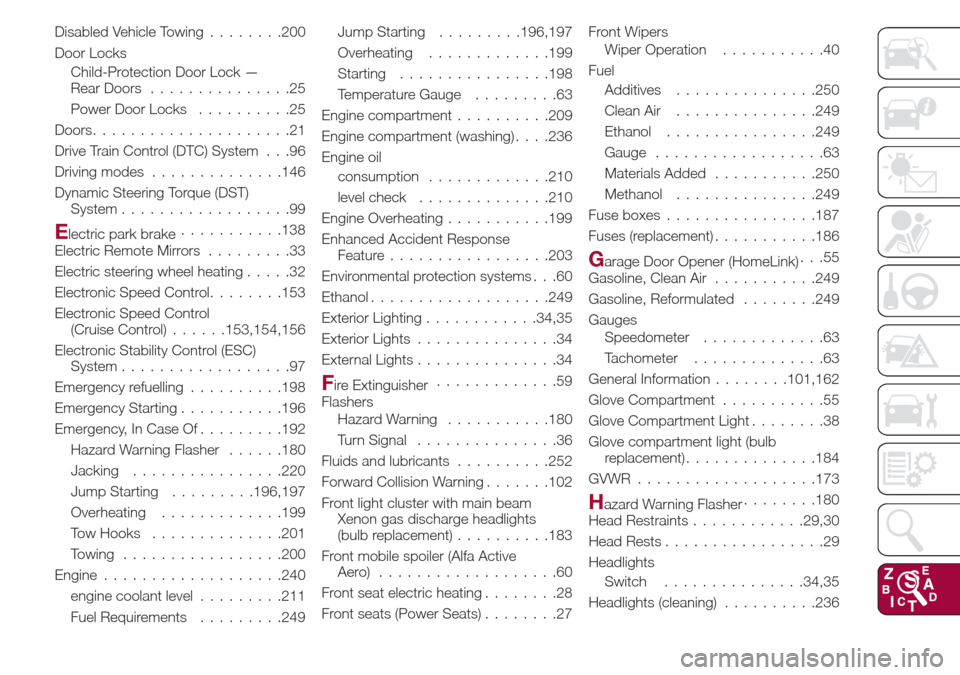
Disabled Vehicle Towing........200
Door Locks Child-Protection Door Lock —
Rear Doors ...............25
Power Door Locks ..........25
Doors .....................21
Drive Train Control (DTC) System . . .96
Driving modes ..............146
Dynamic Steering Torque (DST) System ..................99
Electric park brake ...........138
Electric Remote Mirrors .........33
Electric steering wheel heating .....32
Electronic Speed Control ........153
Electronic Speed Control (Cruise Control) ......153,154,156
Electronic Stability Control (ESC) System ..................97
Emergency refuelling ..........198
Emergency Starting ...........196
Emergency, In Case Of .........192
Hazard Warning Flasher ......180
Jacking ............... .220
Jump Starting .........196,197
Overheating .............199
Tow Hooks ..............201
Towing ................ .200
Engine .................. .240
engine coolant level .........211
Fuel Requirements .........249 Jump Starting
.........196,197
Overheating .............199
Starting ............... .198
Temperature Gauge .........63
Engine compartment ..........209
Engine compartment (washing) . . . .236
Engine oil consumption .............210
level check ..............210
Engine Overheating ...........199
Enhanced Accident Response Feature ................ .203
Environmental protection systems . . .60
Ethanol .................. .249
Exterior Lighting ............34,35
Exterior Lights ...............34
External Lights ...............34
Fire Extinguisher .............59
Flashers Hazard Warning ...........180
Turn Signal ...............36
Fluids and lubricants ..........252
Forward Collision Warning .......102
Front light cluster with main beam Xenon gas discharge headlights
(bulb replacement) ..........183
Front mobile spoiler (Alfa Active Aero) ...................60
Front seat electric heating ........28
Front seats (Power Seats) ........27Front Wipers
Wiper Operation ...........40
Fuel Additives ...............250
Clean Air ...............249
Ethanol ............... .249
Gauge ..................63
Materials Added ...........250
Methanol ...............249
Fuse boxes ............... .187
Fuses (replacement) ...........186
Garage Door Opener (HomeLink) . . .55
Gasoline, Clean Air ...........249
Gasoline, Reformulated ........249
Gauges Speedometer .............63
Tachometer ..............63
General Information ........101,162
Glove Compartment ...........55
Glove Compartment Light ........38
Glove compartment light (bulb replacement) ..............184
GVWR .................. .173
Hazard Warning Flasher........180
Head Restraints ............29,30
Head Rests .................29
Headlights Switch ...............34,35
Headlights (cleaning) ..........236