service Alfa Romeo Giulia 2017 Owner's Guide
[x] Cancel search | Manufacturer: ALFA ROMEO, Model Year: 2017, Model line: Giulia, Model: Alfa Romeo Giulia 2017Pages: 268, PDF Size: 18.64 MB
Page 202 of 268
TOWING A
DISABLED VEHICLE
This section describes procedures for
towing a disabled vehicle using a
commercial towing service.
Caution!
The vehicle should be transported with
all four wheels OFF the ground on the
flatbed of a roadside assistance vehicle.
Avoid towing with only the front (or rear)
wheels lifted. When towing with only the
front (or rear) wheels lifted, in addition to
damaging the body, it could damage the
transmission.
Do not use sling-type equipment when
towing. Vehicle damage may occur.
When securing the vehicle to a flatbed
truck, do not attach to front or rear
suspension components. Damage to your
vehicle may result from improper towing.
Ensure that the Electric Park Brake is
released, and remain released, while being
towed.
Damage from improper towing is not
covered under the New Vehicle Limited
Warranty.
The operators of the assistance vehicle
must be informed of your vehicle's
minimum required height from the
ground, in order to avoid contact
between the ends of the bumpers and
the equipment of the breakdown truck.
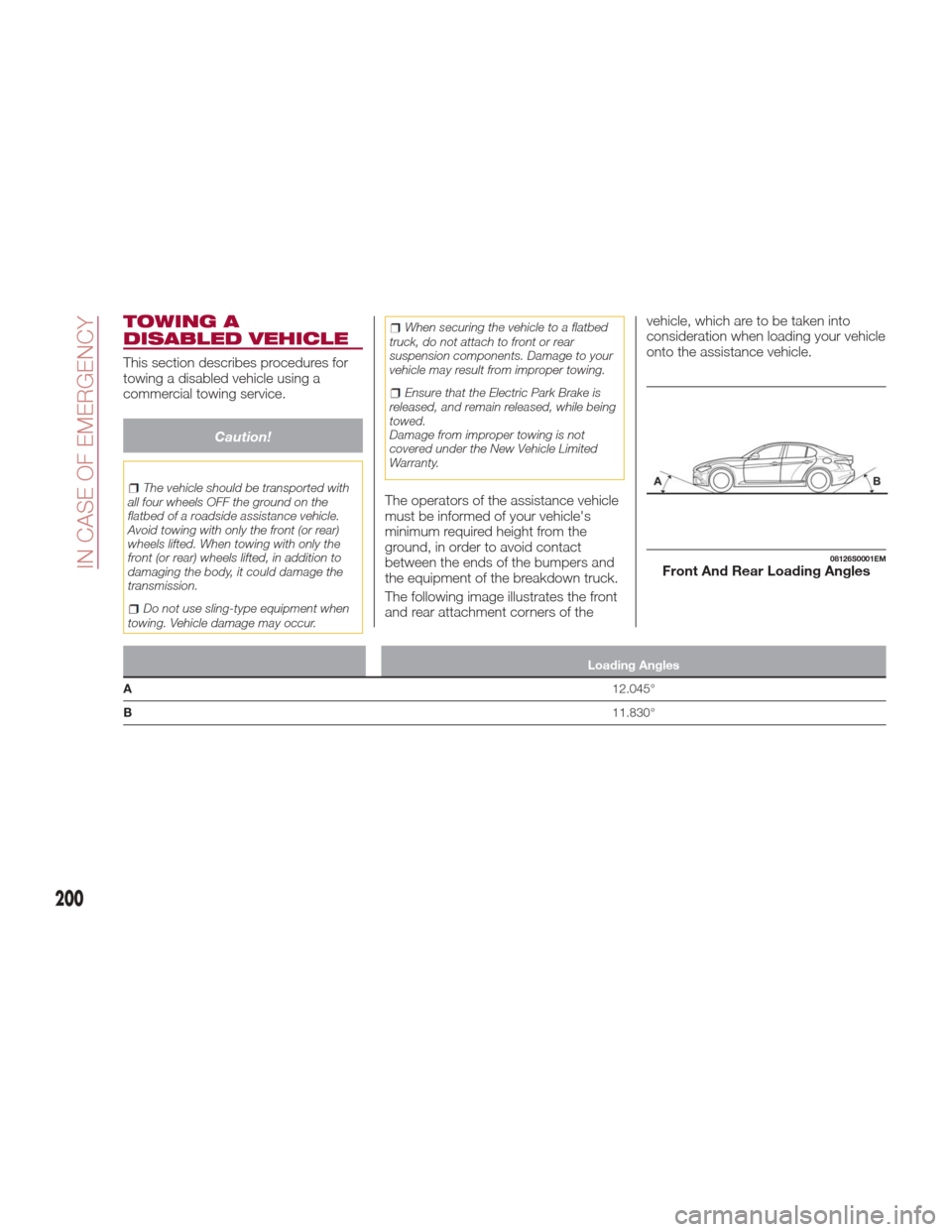
The following image illustrates the front
and rear attachment corners of the vehicle, which are to be taken into
consideration when loading your vehicle
onto the assistance vehicle.
Loading Angles
A 12.045°
B 11.830°
08126S0001EMFront And Rear Loading Angles
200
IN CASE OF EMERGENCY
Page 204 of 268
2. Remove the tow hook from its
housing in the trunk and carefully clean
the threaded housing on the vehicle
before using it.
3. Tighten the vehicle's tow hook in
place (about 11 turns).
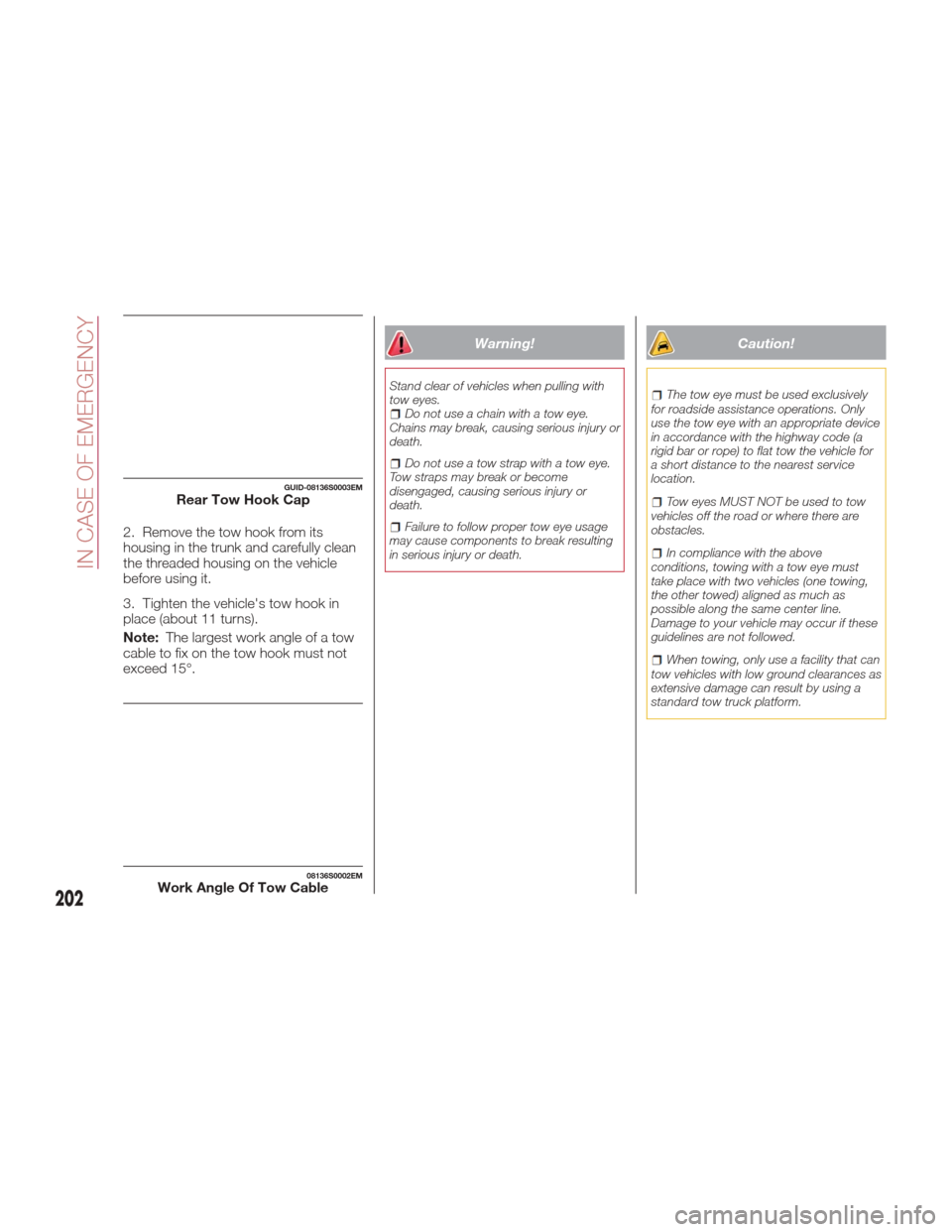
Note:The largest work angle of a tow
cable to fix on the tow hook must not
exceed 15°.
Warning!
Stand clear of vehicles when pulling with
tow eyes.
Do not use a chain with a tow eye.
Chains may break, causing serious injury or
death.
Do not use a tow strap with a tow eye.
Tow straps may break or become
disengaged, causing serious injury or
death.
Failure to follow proper tow eye usage
may cause components to break resulting
in serious injury or death.
Caution!
The tow eye must be used exclusively
for roadside assistance operations. Only
use the tow eye with an appropriate device
in accordance with the highway code (a
rigid bar or rope) to flat tow the vehicle for
a short distance to the nearest service
location.
Tow eyes MUST NOT be used to tow
vehicles off the road or where there are
obstacles.
In compliance with the above
conditions, towing with a tow eye must
take place with two vehicles (one towing,
the other towed) aligned as much as
possible along the same center line.
Damage to your vehicle may occur if these
guidelines are not followed.
When towing, only use a facility that can
tow vehicles with low ground clearances as
extensive damage can result by using a
standard tow truck platform.
GUID-08136S0003EMRear Tow Hook Cap
08136S0002EMWork Angle Of Tow Cable202
IN CASE OF EMERGENCY
Page 206 of 268
SERVICING AND MAINTENANCE
Correct servicing permits the
performance of the vehicle to be
maintained over time, as well as limited
running costs and safeguarding the
efficiency of the safety systems.
This chapter explains how.SCHEDULED SERVICING.......205
ENGINECOMPARTMENT ......209
BATTERY RECHARGING .......212
DEALER SERVICE ...........214
RAISING THE VEHICLE ........220
TIRES .................. .221DEPARTMENT OF
TRANSPORTATION UNIFORM TIRE
QUALITY GRADES
...........233
STORING THE VEHICLE .......234
BODYWORK...............235
INTERIORS ............... .237
204
SERVICING AND MAINTENANCE
Page 207 of 268
SCHEDULED
SERVICING
Correct servicing is crucial for
guaranteeing a long life for the vehicle
under the best conditions.
For this reason, Alfa Romeo has
planned a series of checks and services
for your vehicle at fixed intervals based
on distance and time, as described in
the Scheduled Servicing Plan.
Before each service, it is always
necessary to carefully follow the
instructions in the Scheduled Servicing
Plan (e.g. periodically check level of
fluids, tire pressure, etc.).
Scheduled Servicing is offered by an
authorized dealer according to a set
time schedule. If, during each
operation, in addition to the ones
scheduled, the need arises for further
replacements or repairs, these may be
carried out with owners explicit consent
only.
Note:
Scheduled Servicing intervals are
required by the Manufacturer. Failure to
have them carried out may invalidate
the New Vehicle Limited Warranty.
You are advised to inform your
authorized dealer of any small operating
irregularities without waiting for the next
service.
Periodic Checks
Every month or every600miles
( 1,000 km) or before long trips check
and, if necessary, top off:
Engine coolant level.
Brake fluid level (if insufficient, see
your authorized dealer as soon as
possible).
Windshield washer fluid level.
Tire inflation pressure and condition.
Operation of lighting system
(headlights, direction indicators, hazard
warning lights, etc.).
Operation of windshield
washing/wiping system and
positioning/wear of wiper blades.
Every 2,000 miles ( 3,000km), check
and top off if required:
Engine oil level.
Heavy Usage Of The Car
If the vehicle is used under one of the
following conditions:
Dusty roads.
Short, repeated journeys less than
4 miles (7-8 km) at sub-zero outside
temperatures.
Engine often idling or driving long
distances at low speeds or long periods
of inactivity.
In the event of a long period of
inactivity. The following checks must be carried
out more often than indicated in the
Scheduled Servicing Plan:
Check cleanliness of hood and trunk
locks, cleanliness and lubrication of
linkage.
Visually inspect conditions of: engine,
transmission, pipes and hoses
(exhaust/fuel system/brakes) and
rubber elements (sleeves/bushes, etc.).
Check battery charge and battery
fluid level (electrolyte).
Visually inspect conditions of the
accessory drive belts.
Check and, if necessary, change
engine oil and replace oil filter.
Check and, if necessary, replace
cabin air filter.
Check and, if necessary, replace air
cleaner.
Severe Duty All Models
Change Engine Oil at 4,000 miles
(6,500 km) if the vehicle is operated in a
dusty and off-road environment or is
operated predominately at idle or only
very low engine RPM’s. This type of
vehicle use is considered Severe Duty.
205
Page 210 of 268
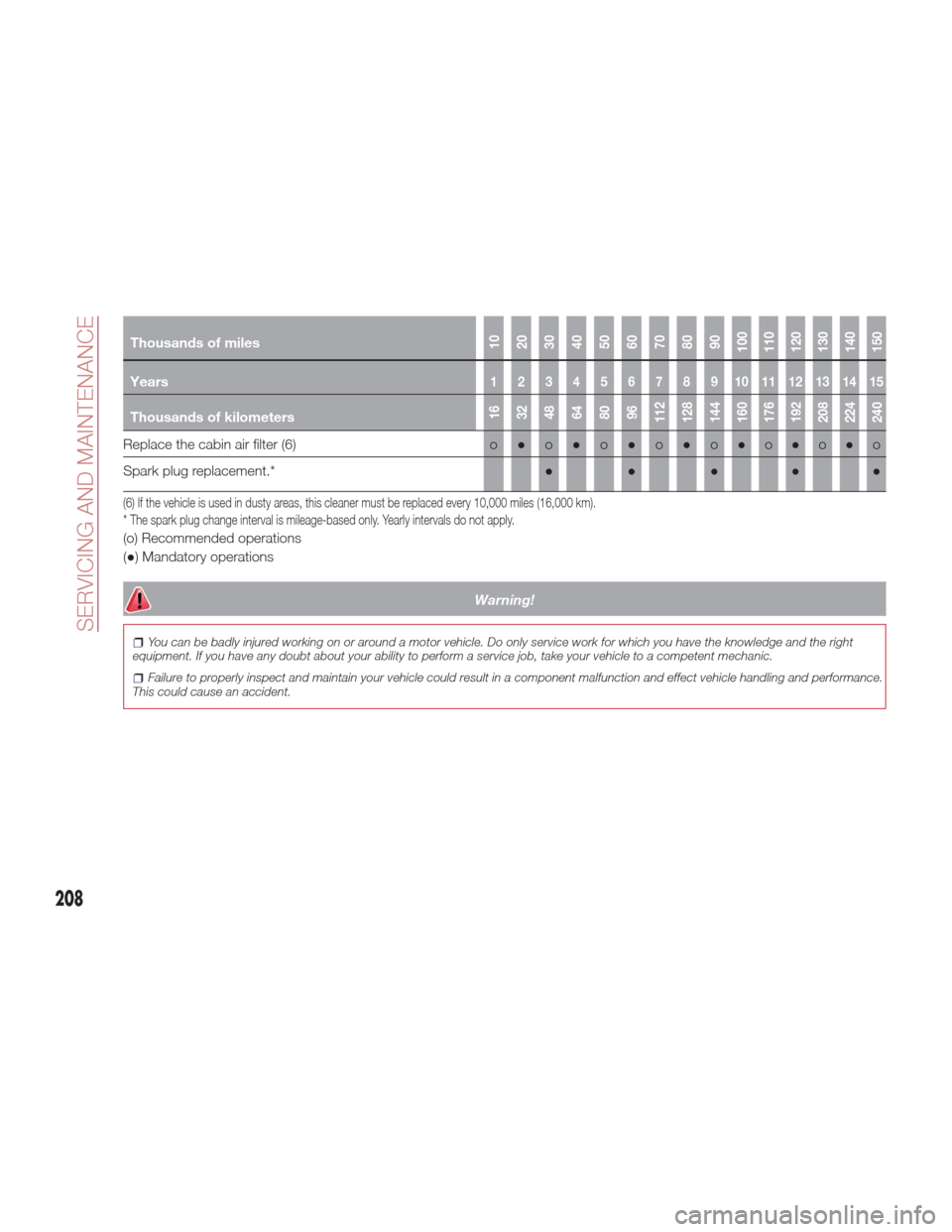
Thousands of miles10
20
30
40
50
60
70
80
90
100
110
120
130
140
150
Years123456789101112131415
Thousands of kilometers16
32
48
64
80
96
112
128
144
160
176
192
208
224
240
Replace the cabin air filter(6)o ● o● o● o● o● o● o● o
Spark plug replacement.
*●●●●●
(6) If the vehicle is used in dusty areas, this cleaner must be replaced every 10,000 miles (16,000 km).
* The spark plug change interval is mileage-based only. Yearly intervals do not apply.
(o) Recommended operations
(●) Mandatory operations
Warning!
You can be badly injured working on or around a motor vehicle. Do only service work for which you have the knowledge and the right
equipment. If you have any doubt about your ability to perform a service job, take your vehicle to a competent mechanic.
Failure to properly inspect and maintain your vehicle could result in a component malfunction and effect vehicle handling and performance.
This could cause an accident.
208
SERVICING AND MAINTENANCE
Page 216 of 268
DEALER SERVICE
The following pages contain
instructions on the required
maintenance from the technical
personnel who designed the vehicle.
In addition to these specific
maintenance instructions specified for
routine scheduled servicing, there are
other components which may require
periodic maintenance or replacement
over the vehicle’s life cycle.
Engine Oil
Engine Oil Level Check
To ensure correct engine lubrication, the
oil must always be kept at the
prescribed level (see "Engine
Compartment" in this chapter).
Check the oil level at regular intervals,
for example every 1864 miles
(3000 km).
It must be checked about five minutes
after stopping the engine, once full
operating temperature is reached. The
vehicle must also be parked on as level
a surface as possible.
Ensure that the oil level is within the
interval on the dipstick between the
minimum and maximum limits.
The engine oil level can be checked
using the Connect system. To access
the function, activate the main menu
(MENU button) and select the following
options in sequence: “Applications”;
“My Car”; “Oil level”.Changing the Engine Oil
See the "Maintenance Plan" for the
correct servicing intervals.
Choice of Engine Oil Type
To ensure optimal performance and
maximum protection in all operating
conditions, it is advisable to use solely
certified engine oils (see description in
"Fluid And Lubricants" in the "Technical
Specifications" chapter).
Additives for Engine Oil
It is strongly recommended not to use
additives (other than leak detection
dyes) with the engine oil.
The engine oil is a product designed
specially for the vehicle and its
performance may be deteriorated
through the use of further additives.
Disposal of Used Engine Oil and
Filters
For the disposal of the engine oil and
filters, contact the appropriate body to
determine local regulations.
Note:
Used engine oil disposed of incorrectly
may seriously harm the environment.
Engine Oil Filter
Replacing the Engine Oil Filter
The engine oil filter must be replaced
each time the engine oil is changed. It is
advised to replace it with a genuine spare
part, specifically designed for this vehicle.
Air Filter
Replacing the Air Cleaner
See the "Maintenance Plan" for the
correct servicing intervals. It is advised
to replace it with a genuine spare part,
specifically designed for this vehicle.
Air Conditioning System
Maintenance
To ensure the best possible
performance, the air conditioning
system must be checked and undergo
maintenance at an authorized dealer at
the beginning of the summer.
Caution!
Do not use chemicals to clean the air
conditioning system, since the internal
components may be damaged. This kind of
damage is not covered by warranty.
Replace The Cabin Air Filter
See the "Maintenance Plan" for the
correct servicing intervals. For cleaner
replacement, contact an authorized
dealer.
214
SERVICING AND MAINTENANCE
Page 217 of 268
Warning!
Use only refrigerants and compressor
lubricants approved by the manufacturer
for your air conditioning system. Some
unapproved refrigerants are flammable and
can explode, injuring you. Other
unapproved refrigerants or lubricants can
cause the system to fail, requiring costly
repairs. Refer to Warranty Information
Book, located in your owner’s information
kit, for further warranty information.
Lubricating Moving
Parts Of The Bodywork
Ensure that the locks and bodywork
junction points, including components
such as the seat guides, door hinges
(and rollers), trunk and hood are
periodically lubricated with
lithium-based grease to ensure correct,
silent operation and to protect them
from rust and wear.
Thoroughly clean the components,
eliminating every trace of dirt and dust.
After lubricating, eliminate excess oil
and grease. Also pay particular
attention to the hood closing devices,
to ensure correct operation. During
operations on the hood, to be carried
out with the engine cold, also
remember to check, clean and lubricate
the locking, release and safety devices.Lubricate the external lock barrels twice
a year. Apply a small amount of
high-quality lubricant directly into the
lock barrel.
If necessary, contact your authorized
dealer as soon as possible.
Windshield Wiper
Periodically clean the windshield and
rear window and rubber profile of the
windshield wiper blades, using a
sponge or a soft cloth and a
non-abrasive detergent. This eliminates
the salt or impurities accumulated when
driving.
Prolonged operation of the windshield
window wipers with dry glass may
cause the deterioration of the blades, in
addition to abrasion of the surface of
the glass. To eliminate the impurities on
the dry glass, always operate the
windshield washers.
In the event of very low outdoor
temperatures, below zero degrees,
ensure that the movement of the rubber
part in contact with the glass is not
obstructed. Use a suitable deicing
product to release it if required.
Avoid using the windshield wipers to
remove frost or ice.
Also avoid contact of the rubber profile
of the blades with petroleum derivatives
such as engine oil, gas, etc.
Warning!
Driving with worn windshield wiper blades
is a serious hazard, because visibility is
reduced in bad weather conditions.
Note:
The life of the windshield wiper blades
varies according to the usage
frequency. In any case, it is advised to
replace the blades approximately once
a year. When the blades are worn,
noise, marks on the glass or streaks of
water may be noticed. In the presence
of these conditions, clean the
windshield wiper blades or, if necessary,
replace them.
Raising The Windshield Wiper
Blades ("Service Position"
Function)
The "service position" function allows
the driver to replace the windshield
wiper blades more easily. It is also
recommended to activate this function
when it is snowing and to make it easier
to remove any dirt deposits in the area
where the blades are normally
positioned, when washing.
Activation Of The Function
To activate this function, disable the
windshield wiper before setting the
ignition device to STOP.
215
Page 218 of 268
This function can only be activated
within two minutes of cycling the
ignition to STOP.
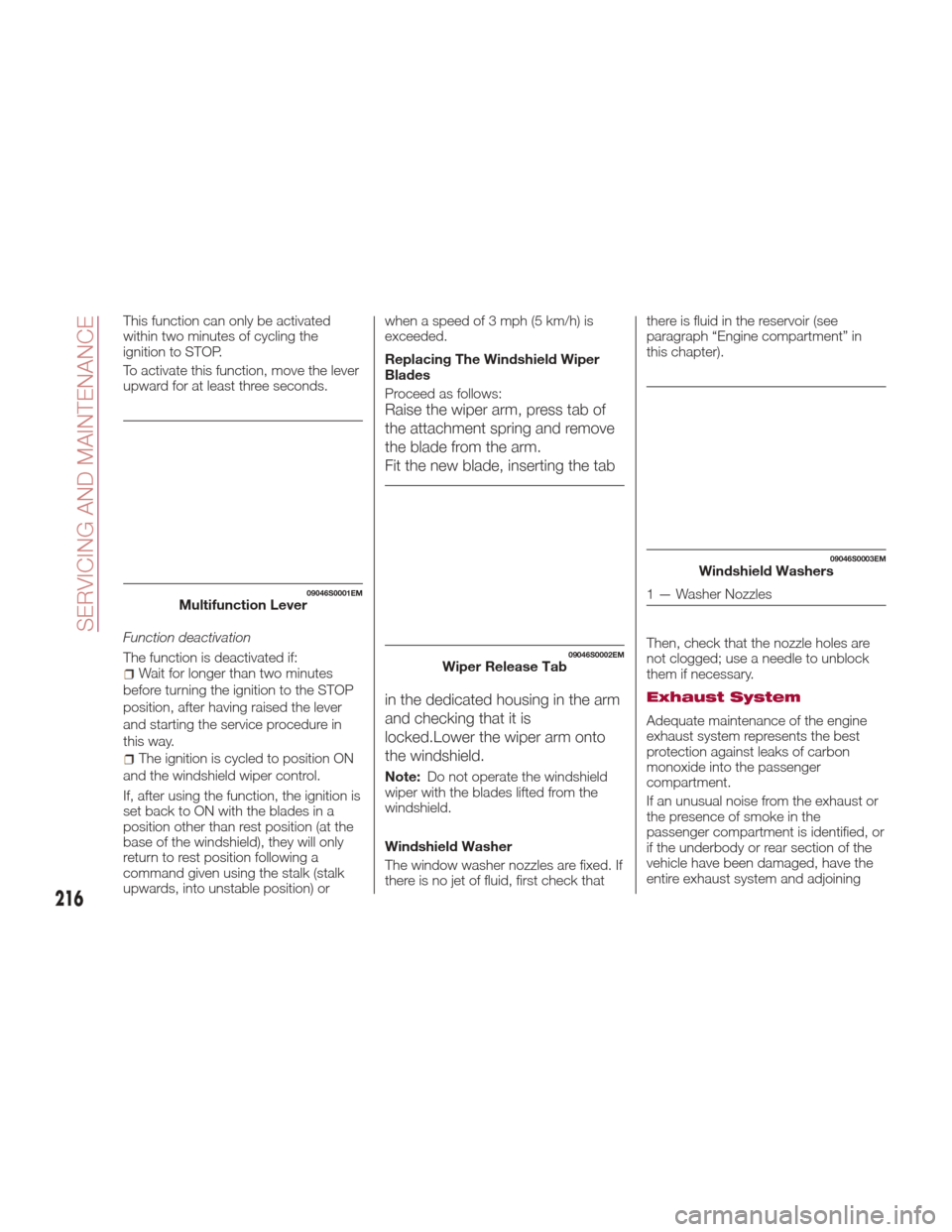
To activate this function, move the lever
upward for at least three seconds.
Function deactivation
The function is deactivated if:
Wait for longer than two minutes
before turning the ignition to the STOP
position, after having raised the lever
and starting the service procedure in
this way.
The ignition is cycled to position ON
and the windshield wiper control.
If, after using the function, the ignition is
set back to ON with the blades in a
position other than rest position (at the
base of the windshield), they will only
return to rest position following a
command given using the stalk (stalk
upwards, into unstable position) or when a speed of 3 mph (5 km/h) is
exceeded.
Replacing The Windshield Wiper
Blades
Proceed as follows:
Raise the wiper arm, press tab of
the attachment spring and remove
the blade from the arm.
Fit the new blade, inserting the tab
in the dedicated housing in the arm
and checking that it is
locked.Lower the wiper arm onto
the windshield.
Note:
Do not operate the windshield
wiper with the blades lifted from the
windshield.
Windshield Washer
The window washer nozzles are fixed. If
there is no jet of fluid, first check that there is fluid in the reservoir (see
paragraph “Engine compartment” in
this chapter).
Then, check that the nozzle holes are
not clogged; use a needle to unblock
them if necessary.
Exhaust System
Adequate maintenance of the engine
exhaust system represents the best
protection against leaks of carbon
monoxide into the passenger
compartment.
If an unusual noise from the exhaust or
the presence of smoke in the
passenger compartment is identified, or
if the underbody or rear section of the
vehicle have been damaged, have the
entire exhaust system and adjoining
09046S0001EMMultifunction Lever
09046S0002EMWiper Release Tab
09046S0003EMWindshield Washers
1 — Washer Nozzles
216
SERVICING AND MAINTENANCE
Page 223 of 268

TIRES
Tire Safety Information
Tire safety information will cover
aspects of the following information:
Tire Markings, Tire Identification
Numbers, Tire Terminology and
Definitions, Tire Pressures, and Tire
Loading.
Tire Markings
Note:
P (Passenger) — Metric tire sizing is
based on U.S. design standards.
P-Metric tires have the letter “P”
molded into the sidewall preceding the
size designation. Example:
P215/65R15 95H.
European — Metric tire sizing is
based on European design standards.
Tires designed to this standard have
the tire size molded into the sidewall
beginning with the section width. The
letter "P" is absent from this tire size
designation. Example: 215/
65R15 96H.
LT (Light Truck) — Metric tire sizing
is based on U.S. design standards.
The size designation for LT-Metric tires
is the same as for P-Metric tires except
for the letters “LT” that are molded into
the sidewall preceding the size
designation. Example: LT235/85R16.
Temporary spare tires are designed
for temporary emergency use only.
Temporary high pressure compact
spare tires have the letter “T” or “S”
molded into the sidewall preceding the
size designation. Example:
T145/80D18 103M.
High flotation tire sizing is based on
U.S. design standards and it begins
with the tire diameter molded into the
sidewall. Example: 31x10.5 R15 LT.
Tire Identification Number (TIN)
The TIN may be found on one or both
sides of the tire; however, the date code
mayonlybeononeside.Tireswith
white sidewalls will have the full TIN,
including the date code, located on the
white sidewall side of the tire. Look for
the TIN on the outboard side of black
sidewall tires as mounted on the
vehicle. If the TIN is not found on the
outboard side, then you will find it on
the inboard side of the tire.
GUID-0601085395USTire Markings
1 — U.S. DOT Sa-
fety Standards
Code (TIN) 4 — Maximum
Load
2 — Size Designa-
tion 5 — Maximum
Pressure
3 — Service De-
scription 6 — Treadwear,
Traction and Tem-
perature Grades
221
Page 231 of 268
While studded tires improve
performance on ice, skid and traction
capability on wet or dry surfaces may
be poorer than that of non-studded
tires. Some states prohibit studded
tires; therefore, local laws should be
checked before using these tire types.
Snow Chains
It is only possible to put chains on the
rear 265/35 R19 tire (winter tire size).
Avoid using traditional chains as they
can damage the braking system if not
installed correctly, thereby
compromising the vehicles safety.
We strongly advise using
zero-clearance chains and to use
equipment proposed by an authorized
dealer.
Suggestions About The
Rotation Of The Tires
The front and rear tires are subject to
different loads and stress due to
steering, maneuver and braking. For
this reason they are subject to uneven
wear.
To resolve this problem, tires should be
rotated at each service interval
(approximately every 10,000 miles
[16,000km]). Inverting the tires means
moving them to different positions on
the same side of the car (front to back
and vice versa).Note:
Crossing the tires is not advised, so
placing a tire on a different axle on the
other side of the car is impossible.
On cars equipped with
differentiated tires (tire size different
between front and rear axles, ex.
Quadrifoglio models and other Giulia
vehicles equipped with 19”
performance tires) rotation of any of
the tires is not advised.
Tire rotation contributes to the
preservation of the grip and traction
performance on wet, muddy or snowy
roads, guaranteeing optimal driveability
of the vehicle.
In the case of irregular wear of the tires
identify the cause and correct it as soon
as possible, by contacting an
authorized dealer.
The suggested method for inverting the
tires is shown in (the arrow indicates the
vehicle's travel direction).
Tires — General
Information
Tire Pressure
Proper tire inflation pressure is essential
to the safe and satisfactory operation of
your vehicle. Four primary areas are
affected by improper tire pressure:
Safety and Vehicle Stability
Economy
Tread Wear
Ride Comfort
Safety
Warning!
Improperly inflated tires are dangerous
and can cause collisions.
Underinflation increases tire flexing and
can result in overheating and tire failure.
Overinflation reduces a tire's ability to
cushion shock. Objects on the road and
chuckholes can cause damage that result
in tire failure.
Overinflated or underinflated tires can
affect vehicle handling and can fail
suddenly, resulting in loss of vehicle
control.
Unequal tire pressures can cause
steering problems. You could lose control
of your vehicle.
09066S0002EMTire Rotation229