Trunk Alfa Romeo Giulia 2018 Owner's Guide
[x] Cancel search | Manufacturer: ALFA ROMEO, Model Year: 2018, Model line: Giulia, Model: Alfa Romeo Giulia 2018Pages: 260, PDF Size: 6 MB
Page 203 of 260
Battery gas is flammable and explosive.
Keep flame or sparks away from the
battery. Do not use a booster battery or any
other booster source with an output greater
than 12 Volts. Do not allow cable clamps to
touch each other.
Battery posts, terminals, and related
accessories contain lead and lead
compounds. Wash hands after handling.
Note: It will not be possible to open the
trunk with a key or by pressing the button
in the passenger compartment when the
battery is disconnected. So, always
position the manual trunk opening strap
on the trunk lock before disconnecting
the battery. The procedure is described in
the "Storing The Vehicle" paragraph in
this chapter.
BATTERY RECHARGING
Important Notes
Warning!
Never charge or recharge a frozen
battery: it may explode because of the
nitrogen trapped inside the ice crystals.
At all times while charging or recharging
the battery, make sure that any sparks or
open flames are kept sufficiently far away
from the battery.
Note:
Before using the charging device,
always make sure that it is appropriate
for the installed battery, with constant
voltage (below 14.8 V) and low
amperage (maximum 15 A).
Recharge the battery in a well
ventilated environment.
Before using any devices to charge or
to maintain the charge of the battery,
carefully follow the instructions provided
with the device in order to properly and
safely connect it to the car battery.
You can recharge the battery without
disconnecting the wires of the vehicle's
electrical system.
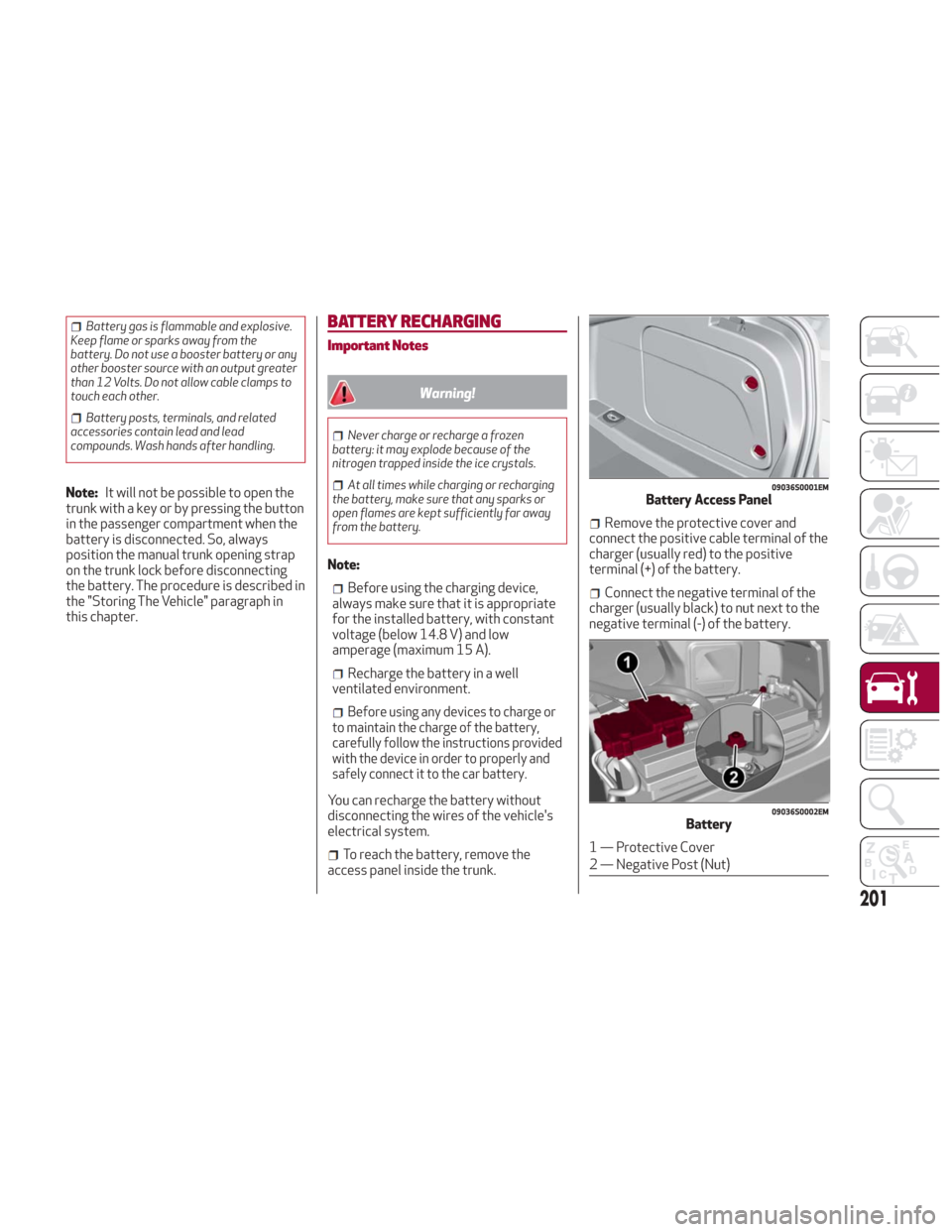
To reach the battery, remove the
access panel inside the trunk.
Remove the protective cover and
connect the positive cable terminal of the
charger (usually red) to the positive
terminal (+) of the battery.
Connect the negative terminal of the
charger (usually black) to nut next to the
negative terminal (-) of the battery.
09036S0001EMBattery Access Panel
09036S0002EMBattery
1 — Protective Cover
2 — Negative Post (Nut)
201
Page 205 of 260
Air Filter
Replacing The Air Cleaner
See the "Maintenance Plan" for the
correct servicing intervals. It is advised to
replace it with a genuine spare part,
specifically designed for this vehicle.
Air Conditioning System Maintenance
To ensure the best possible performance,
the air conditioning system must be
checked and undergo maintenance at an
authorized dealer at the beginning of the
summer.
Caution!
Do not use chemicals to clean the air
conditioning system, since the internal
components may be damaged. This kind of
damage is not covered by warranty.
Replace The Cabin Air Filter
See the "Maintenance Plan" for the
correct servicing intervals. For cleaner
replacement, contact an authorized
dealer.
Warning!
Use only refrigerants and compressor
lubricants approved by the manufacturer for
your air conditioning system. Some
unapproved refrigerants are flammable and
can explode, injuring you. Other unapproved
refrigerants or lubricants can cause the
system to fail, requiring costly repairs. Refer
to Warranty Information Book, located in
your owner’s information kit, for further
warranty information.
Lubricating Moving Parts Of The
Bodywork
Ensure that the locks and bodywork
junction points, including components
such as the seat guides, door hinges (and
rollers), trunk and hood are periodically
lubricated with lithium-based grease to
ensure correct, silent operation and to
protect them from rust and wear.
Thoroughly clean the components,
eliminating every trace of dirt and dust.
After lubricating, eliminate excess oil and
grease. Also pay particular attention to
the hood closing devices, to ensure
correct operation. During operations on
the hood, to be carried out with the
engine cold, also remember to check,
clean and lubricate the locking, release
and safety devices.Lubricate the external lock barrels twice
a year. Apply a small amount of
high-quality lubricant directly into the
lock barrel.
If necessary, contact your authorized
dealer as soon as possible.
Windshield Wiper
Periodically clean the windshield and rear
window and rubber profile of the
windshield wiper blades, using a sponge
or a soft cloth and a non-abrasive
detergent. This eliminates the salt or
impurities accumulated when driving.
Prolonged operation of the windshield
window wipers with dry glass may cause
the deterioration of the blades, in
addition to abrasion of the surface of the
glass. To eliminate the impurities on the
dry glass, always operate the windshield
washers.
In the event of very low outdoor
temperatures, below zero degrees,
ensure that the movement of the rubber
part in contact with the glass is not
obstructed. Use a suitable deicing
product to release it if required.
Avoid using the windshield wipers to
remove frost or ice.
Also avoid contact of the rubber profile
of the blades with petroleum derivatives
such as engine oil, gas, etc.
203
Page 210 of 260
Frequency Of Oil Changes
In normal vehicle operating conditions, it
is not necessary to change the
transmission oil.
Caution!
If a transmission fluid leak occurs, visit an
authorized dealer immediately. Severe
transmission damage may occur. An
authorized dealer has the proper tools to
adjust the fluid level accurately.
Replacing The Battery
If necessary, replace the battery with
another battery with the same
specifications. It is advised to contact an
authorized dealer for replacement.
Follow the battery manufacturer's
instructions for maintenance.
Note:It will not be possible to open the
trunk with a key or by pressing the button
in the passenger compartment when the
battery is disconnected. So, always
position the manual trunk opening strap
on the trunk lock before disconnecting
the battery. The procedure is described in
the "Storing The Vehicle" section in this
chapter.
RAISING THE VEHICLE
If the vehicle requires lifting, visit an
authorized dealer which is equipped with
shop jacks or jack arms.
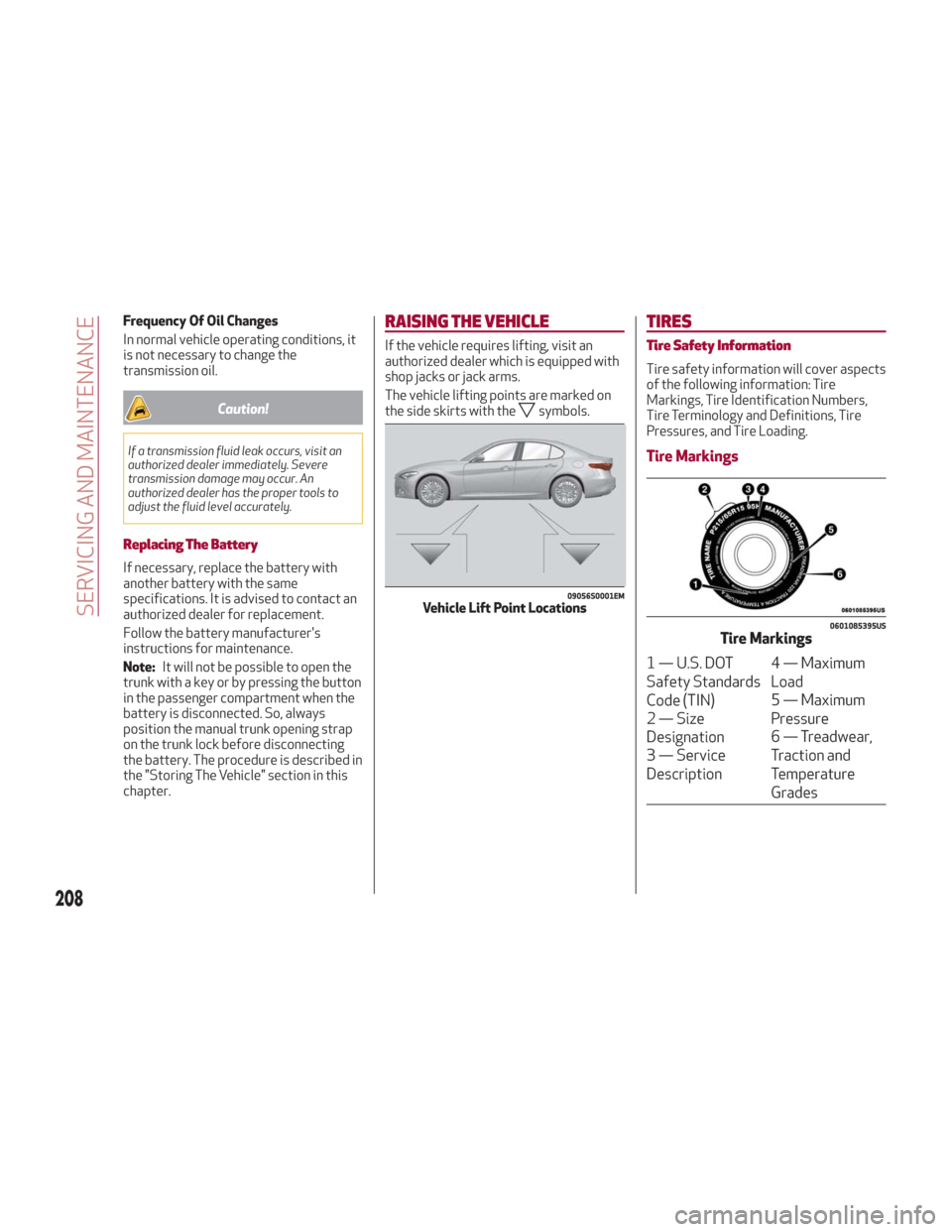
The vehicle lifting points are marked on
the side skirts with the
symbols.
TIRES
Tire Safety Information
Tire safety information will cover aspects
of the following information: Tire
Markings, Tire Identification Numbers,
Tire Terminology and Definitions, Tire
Pressures, and Tire Loading.
Tire Markings
09056S0001EMVehicle Lift Point Locations
0601085395USTire Markings
1 — U.S. DOT
Safety Standards
Code (TIN) 4 — Maximum
Load
2 — Size
Designation 5 — Maximum
Pressure
3 — Service
Description 6 — Treadwear,
Traction and
Temperature
Grades
208
SERVICING AND MAINTENANCE
Page 227 of 260
STORING THE VEHICLE
If the vehicle is left inactive for longer
than a month, the following precautions
should be observed:
Park the vehicle in an area that is
covered and dry, and well-ventilated if
possible. Slightly open the windows.
Check that the electric park brake is
not activated.
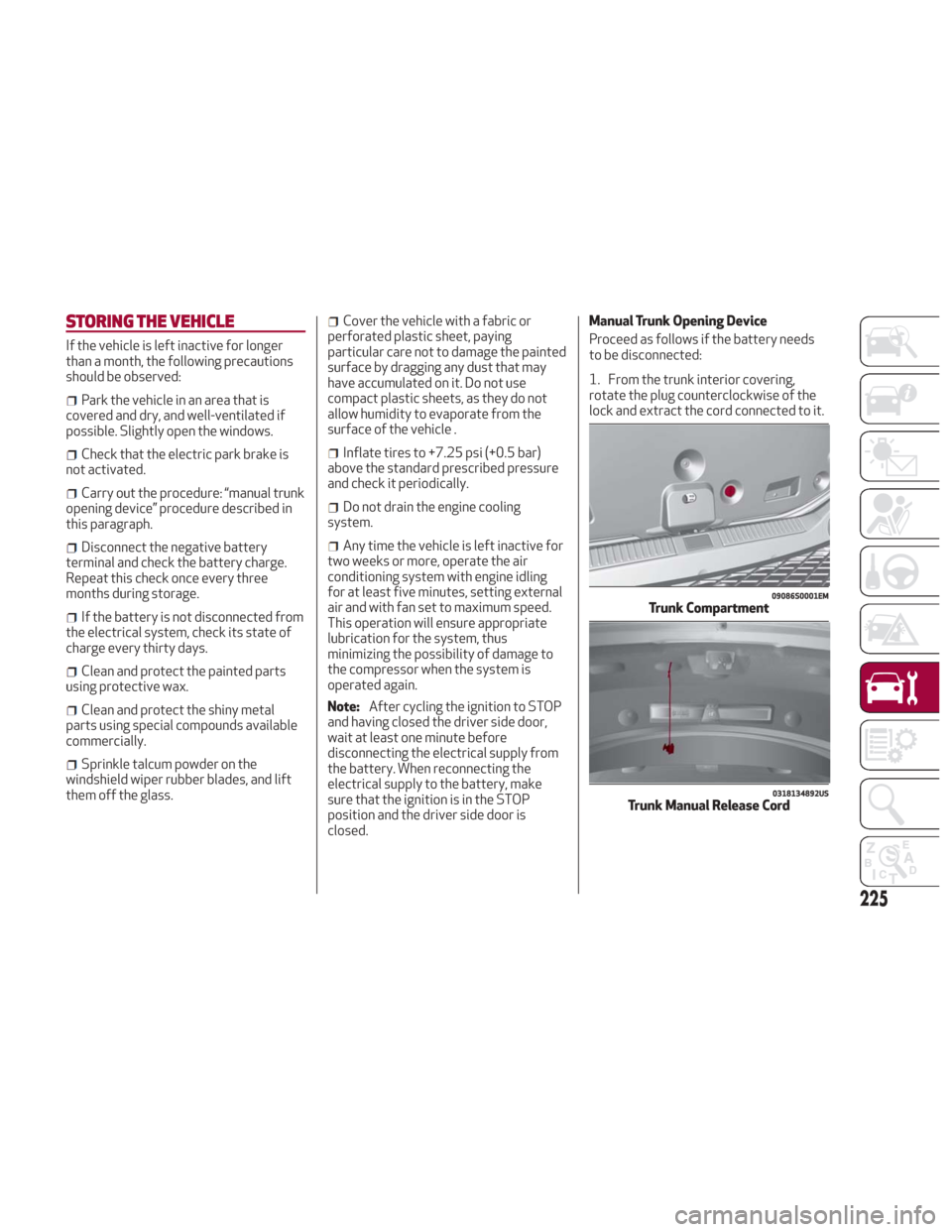
Carry out the procedure: “manual trunk
opening device” procedure described in
this paragraph.
Disconnect the negative battery
terminal and check the battery charge.
Repeat this check once every three
months during storage.
If the battery is not disconnected from
the electrical system, check its state of
charge every thirty days.
Clean and protect the painted parts
using protective wax.
Clean and protect the shiny metal
parts using special compounds available
commercially.
Sprinkle talcum powder on the
windshield wiper rubber blades, and lift
them off the glass.
Cover the vehicle with a fabric or
perforated plastic sheet, paying
particular care not to damage the painted
surface by dragging any dust that may
have accumulated on it. Do not use
compact plastic sheets, as they do not
allow humidity to evaporate from the
surface of the vehicle .
Inflate tires to +7.25 psi (+0.5 bar)
above the standard prescribed pressure
and check it periodically.
Do not drain the engine cooling
system.
Any time the vehicle is left inactive for
two weeks or more, operate the air
conditioning system with engine idling
for at least five minutes, setting external
air and with fan set to maximum speed.
This operation will ensure appropriate
lubrication for the system, thus
minimizing the possibility of damage to
the compressor when the system is
operated again.
Note: After cycling the ignition to STOP
and having closed the driver side door,
wait at least one minute before
disconnecting the electrical supply from
the battery. When reconnecting the
electrical supply to the battery, make
sure that the ignition is in the STOP
position and the driver side door is
closed. Manual Trunk Opening Device
Proceed as follows if the battery needs
to be disconnected:
1. From the trunk interior covering,
rotate the plug counterclockwise of the
lock and extract the cord connected to it.
09086S0001EMTrunk Compartment
0318134892USTrunk Manual Release Cord
225
Page 228 of 260
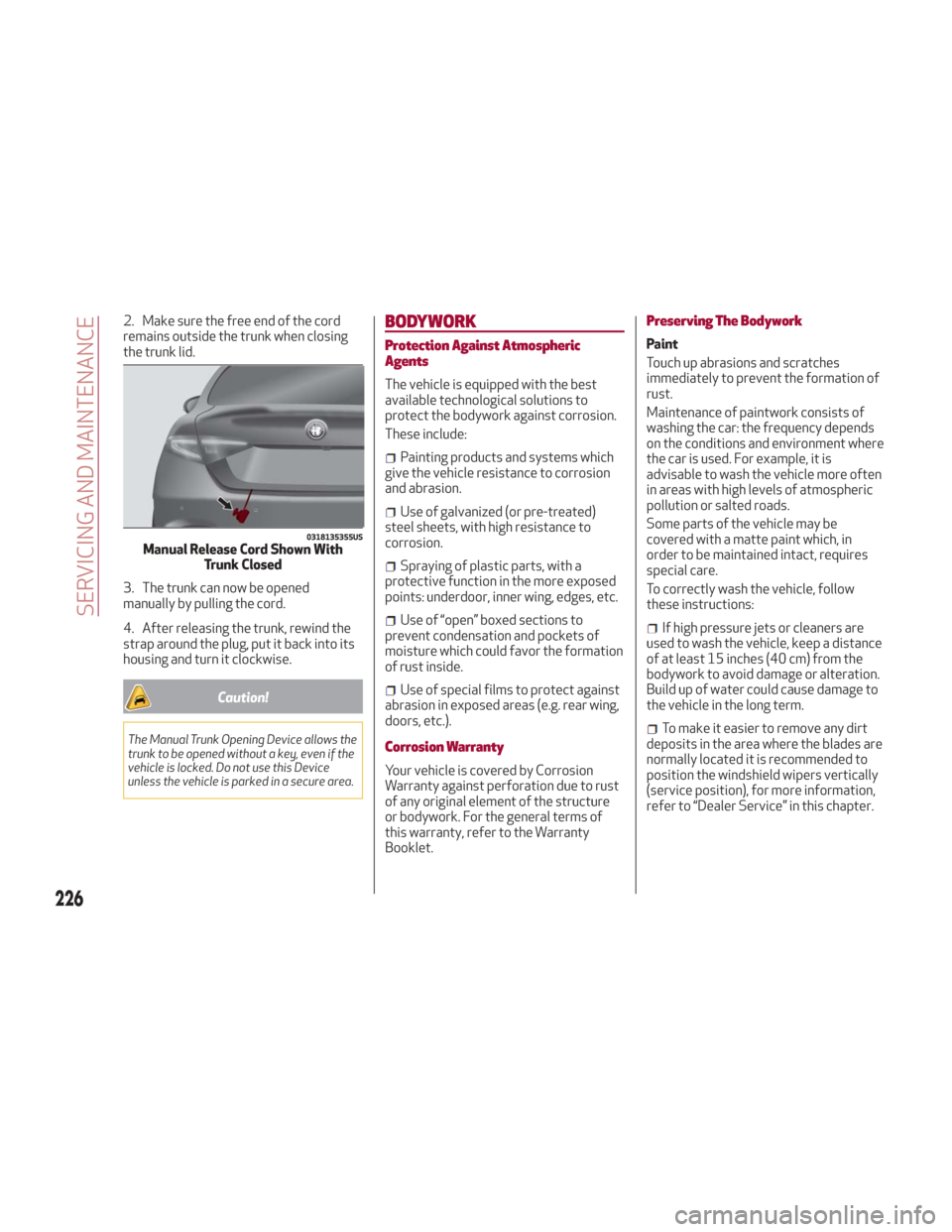
2. Make sure the free end of the cord
remains outside the trunk when closing
the trunk lid.
3. The trunk can now be opened
manually by pulling the cord.
4. After releasing the trunk, rewind the
strap around the plug, put it back into its
housing and turn it clockwise.
Caution!
The Manual Trunk Opening Device allows the
trunk to be opened without a key, even if the
vehicle is locked. Do not use this Device
unless the vehicle is parked in a secure area.
BODYWORK
Protection Against Atmospheric
Agents
The vehicle is equipped with the best
available technological solutions to
protect the bodywork against corrosion.
These include:
Painting products and systems which
give the vehicle resistance to corrosion
and abrasion.
Use of galvanized (or pre-treated)
steel sheets, with high resistance to
corrosion.
Spraying of plastic parts, with a
protective function in the more exposed
points: underdoor, inner wing, edges, etc.
Use of “open” boxed sections to
prevent condensation and pockets of
moisture which could favor the formation
of rust inside.
Use of special films to protect against
abrasion in exposed areas (e.g. rear wing,
doors, etc.).
Corrosion Warranty
Your vehicle is covered by Corrosion
Warranty against perforation due to rust
of any original element of the structure
or bodywork. For the general terms of
this warranty, refer to the Warranty
Booklet.
Preserving The Bodywork
Paint
Touch up abrasions and scratches
immediately to prevent the formation of
rust.
Maintenance of paintwork consists of
washing the car: the frequency depends
on the conditions and environment where
the car is used. For example, it is
advisable to wash the vehicle more often
in areas with high levels of atmospheric
pollution or salted roads.
Some parts of the vehicle may be
covered with a matte paint which, in
order to be maintained intact, requires
special care.
To correctly wash the vehicle, follow
these instructions:
If high pressure jets or cleaners are
used to wash the vehicle, keep a distance
of at least 15 inches (40 cm) from the
bodywork to avoid damage or alteration.
Build up of water could cause damage to
the vehicle in the long term.
To make it easier to remove any dirt
deposits in the area where the blades are
normally located it is recommended to
position the windshield wipers vertically
(service position), for more information,
refer to “Dealer Service” in this chapter.
0318135355USManual Release Cord Shown With Trunk Closed
226
SERVICING AND MAINTENANCE