key Alfa Romeo Giulia 2018 Owner's Guide
[x] Cancel search | Manufacturer: ALFA ROMEO, Model Year: 2018, Model line: Giulia, Model: Alfa Romeo Giulia 2018Pages: 260, PDF Size: 6 MB
Page 141 of 260
To shift out of PARK (P), or to pass from
position NEUTRAL (N) to position DRIVE
(D) or REVERSE (R), the vehicle must be
moving at a low speed or stopped, and
the brake pedal must also be pressed.
Note:
DO NOT accelerate while shifting
from position PARK (P) or NEUTRAL (N)
to another position.
After selecting a gear, wait a few
seconds before accelerating. This
precaution is particularly important with
engine cold.
Transmission Operating Modes
PARK (P)
The transmission is locked in this mode.
The engine can be started in this mode.
Note: Never try to engage PARK (P)
mode when the vehicle is moving. Before
leaving the vehicle, make sure this mode
is engaged (letter P shown on the display
and gear selector) and that the park
brake is engaged.
When parking on a flat surface, first
engage the PARK (P) mode and then
engage the electric park brake.
When parking uphill, before activating
the PARK (P) mode, engage the electric
park brake. Otherwise, it could be
difficult to engage the (P) mode. To check that the PARK (P) mode is
actually engaged, make sure (P) is
illuminated on the display and on the gear
selector.
Warning!
Never use the PARK position as a
substitute for the park brake. Always apply
the park brake fully when parked to guard
against vehicle movement and possible
injury or damage.
Your vehicle could move and injure you
and others if it is not in PARK. Check by
trying to move the gear selector out of
PARK with the brake pedal released. Make
sure the transmission is in PARK before
leaving the vehicle.
It is dangerous to shift out of PARK or
NEUTRAL if the engine speed is higher than
idle speed. If your foot is not firmly pressing
the brake pedal, the vehicle could
accelerate quickly forward or in reverse.
You could lose control of the vehicle and hit
someone or something. Only shift into gear
when the engine is idling normally and your
foot is firmly pressing the brake pedal.
Unintended movement of a vehicle could
injure those in or near the vehicle. As with all
vehicles, you should never exit a vehicle
while the engine is running. Before exiting a
vehicle, always apply the park brake, shift
the transmission into PARK, and turn the
ignition STOP/OFF. When the ignition is in
the STOP/OFF mode, the transmission is
locked in PARK, securing the vehicle against
unwanted movement.
When leaving the vehicle, always make
sure the ignition is in the STOP/OFF mode,
remove the key fob from the vehicle, and
lock the vehicle.
Never leave children alone in a vehicle, or
with access to an unlocked vehicle. Allowing
children to be in a vehicle unattended is
dangerous for a number of reasons. A child
or others could be seriously or fatally
injured. Children should be warned not to
touch the park brake, brake pedal or the
transmission gear selector.
Do not leave the key fob in or near the
vehicle (or in a location accessible to
children), and do not leave the ignition in the
ON mode. A child could operate power
windows, other controls, or move the vehicle.
Caution!
Before moving the transmission gear
selector out of PARK, you must push the
ignition button to cycle from STOP/OFF
mode to the ON mode, and also press the
brake pedal. Otherwise, damage to the gear
selector could result.
DO NOT race the engine when shifting
from PARK or NEUTRAL into another gear
range, as this can damage the drivetrain.
REVERSE (R)
Select this mode only with the vehicle at
a standstill.
139
Page 144 of 260
Important Notes
Failure to comply with what is reported
below may damage the transmission:
Shift into PARK (P) mode only with the
vehicle at a standstill.
Select REVERSE (R) mode, or pass
from REVERSE to another mode only
with the vehicle at a standstill and engine
idling.
Do not change between PARK (P),
REVERSE (R), NEUTRAL (N) or DRIVE (D)
modes with engine running at a speed
above idling.
Before activating any transmission
operating mode, fully depress the brake
pedal.
Note: The unexpected movement of the
vehicle can injure the occupants or
people nearby. Do not leave the vehicle
with engine running: before getting out of
the passenger compartment always
engage the electric park brake, select the
PARK (P) mode, stop the engine.
Warning!
It is dangerous to shift out of PARK or
NEUTRAL if the engine speed is higher than
idle speed. If your foot is not firmly pressing
the brake pedal, the vehicle could
accelerate quickly forward or in reverse.
You could lose control of the vehicle and hit
someone or something. Only shift into gear
when the engine is idling normally and your
foot is firmly pressing the brake pedal.
Unintended movement of a vehicle could
injure those in or near the vehicle. As with all
vehicles, you should never exit a vehicle
while the engine is running. Before exiting a
vehicle, always apply the park brake, shift
the transmission into PARK, and turn the
ignition STOP/OFF. When the ignition is in
the STOP/OFF mode, the transmission is
locked in PARK, securing the vehicle against
unwanted movement.
When leaving the vehicle, always make
sure the ignition is in the STOP/OFF mode,
remove the key fob from the vehicle, and
lock the vehicle.
Never leave children alone in a vehicle, or
with access to an unlocked vehicle. Allowing
children to be in a vehicle unattended is
dangerous for a number of reasons. A child
or others could be seriously or fatally
injured. Children should be warned not to
touch the parking brake, brake pedal or the
transmission gear selector.
Do not leave the key fob in or near the
vehicle (or in a location accessible to
children), and do not leave the ignition in the
AVV or ON mode. A child could operate
power windows, other controls, or move the
vehicle.
Caution!
Only engage the gear with engine at idling
while fully depressing the brake pedal. If the
transmission temperature exceeds the
normal operating limits, the transmission
control unit may change the gear
engagement order and reduce the drive
torque. If the transmission overheats, it
could operate incorrectly until it cools down.
When using the vehicle with extremely
low external temperatures, the
transmission operation may change
depending on the engine and transmission
temperature, as well as vehicle speed.
Activation of the torque converter clutch
and of the eighth gear is inhibited until the
transmission oil is correctly warmed up.
Complete operation of the transmission will
be enabled as soon as the fluid temperature
reaches the predefined value.
142
STARTING AND OPERATING
Page 203 of 260
Battery gas is flammable and explosive.
Keep flame or sparks away from the
battery. Do not use a booster battery or any
other booster source with an output greater
than 12 Volts. Do not allow cable clamps to
touch each other.
Battery posts, terminals, and related
accessories contain lead and lead
compounds. Wash hands after handling.
Note: It will not be possible to open the
trunk with a key or by pressing the button
in the passenger compartment when the
battery is disconnected. So, always
position the manual trunk opening strap
on the trunk lock before disconnecting
the battery. The procedure is described in
the "Storing The Vehicle" paragraph in
this chapter.
BATTERY RECHARGING
Important Notes
Warning!
Never charge or recharge a frozen
battery: it may explode because of the
nitrogen trapped inside the ice crystals.
At all times while charging or recharging
the battery, make sure that any sparks or
open flames are kept sufficiently far away
from the battery.
Note:
Before using the charging device,
always make sure that it is appropriate
for the installed battery, with constant
voltage (below 14.8 V) and low
amperage (maximum 15 A).
Recharge the battery in a well
ventilated environment.
Before using any devices to charge or
to maintain the charge of the battery,
carefully follow the instructions provided
with the device in order to properly and
safely connect it to the car battery.
You can recharge the battery without
disconnecting the wires of the vehicle's
electrical system.
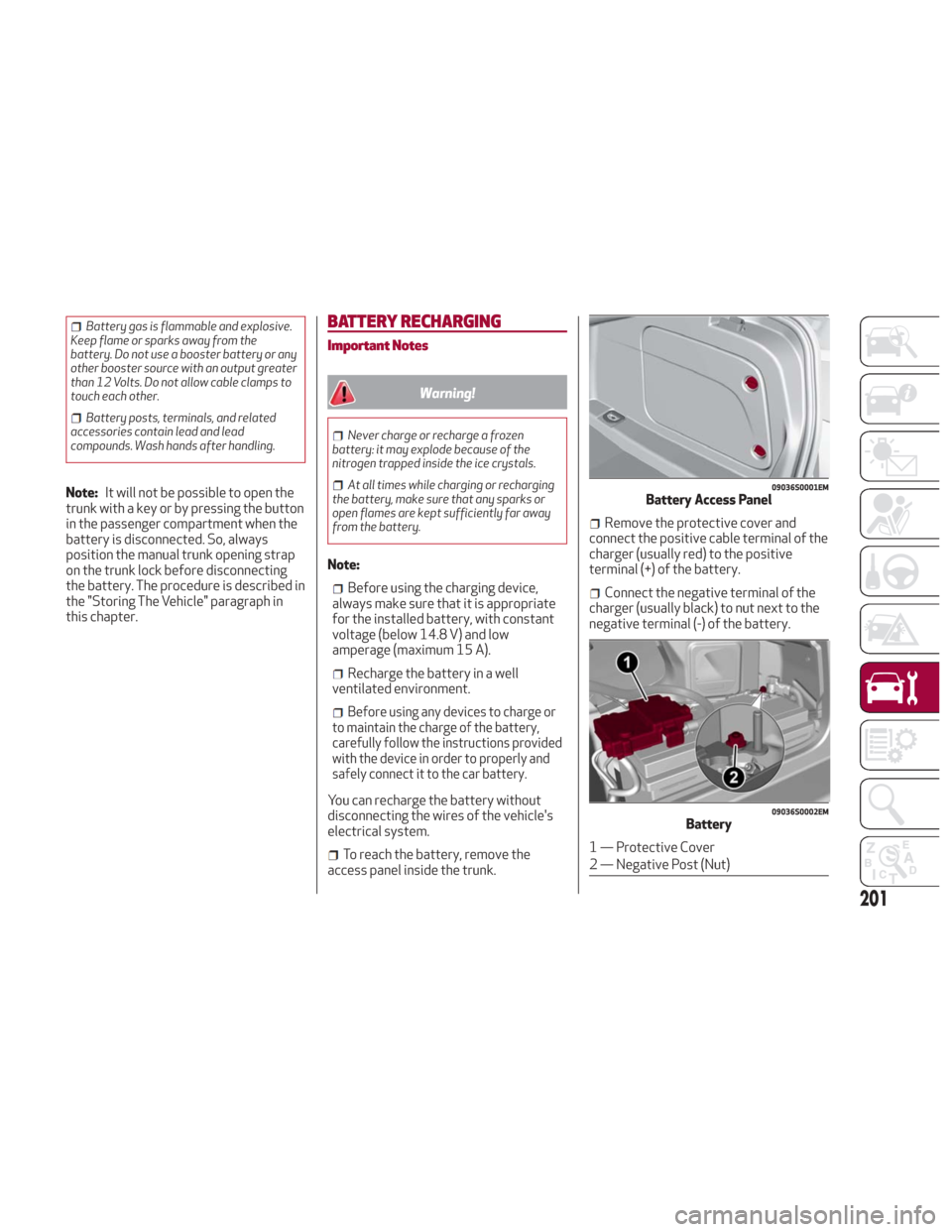
To reach the battery, remove the
access panel inside the trunk.
Remove the protective cover and
connect the positive cable terminal of the
charger (usually red) to the positive
terminal (+) of the battery.
Connect the negative terminal of the
charger (usually black) to nut next to the
negative terminal (-) of the battery.
09036S0001EMBattery Access Panel
09036S0002EMBattery
1 — Protective Cover
2 — Negative Post (Nut)
201
Page 210 of 260
Frequency Of Oil Changes
In normal vehicle operating conditions, it
is not necessary to change the
transmission oil.
Caution!
If a transmission fluid leak occurs, visit an
authorized dealer immediately. Severe
transmission damage may occur. An
authorized dealer has the proper tools to
adjust the fluid level accurately.
Replacing The Battery
If necessary, replace the battery with
another battery with the same
specifications. It is advised to contact an
authorized dealer for replacement.
Follow the battery manufacturer's
instructions for maintenance.
Note:It will not be possible to open the
trunk with a key or by pressing the button
in the passenger compartment when the
battery is disconnected. So, always
position the manual trunk opening strap
on the trunk lock before disconnecting
the battery. The procedure is described in
the "Storing The Vehicle" section in this
chapter.
RAISING THE VEHICLE
If the vehicle requires lifting, visit an
authorized dealer which is equipped with
shop jacks or jack arms.
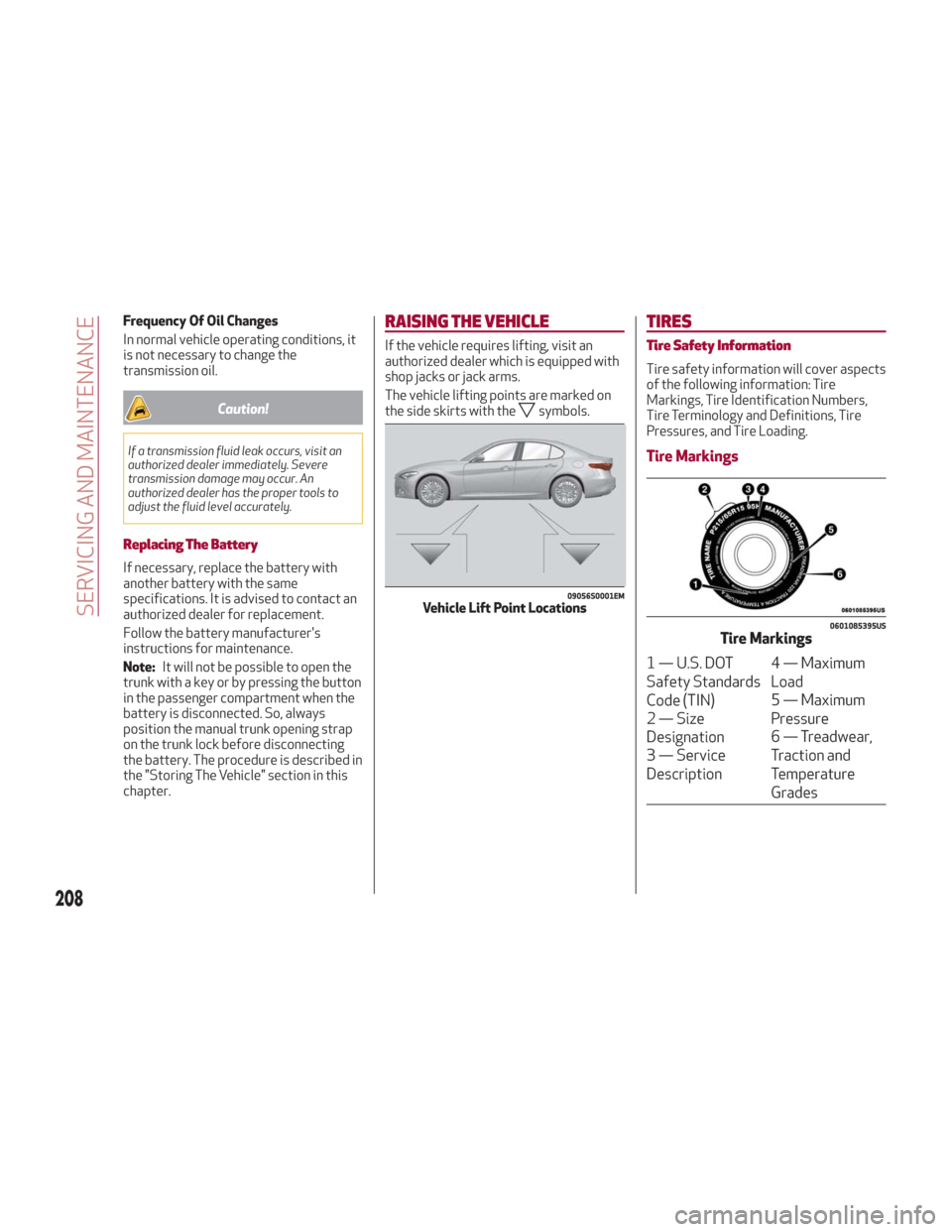
The vehicle lifting points are marked on
the side skirts with the
symbols.
TIRES
Tire Safety Information
Tire safety information will cover aspects
of the following information: Tire
Markings, Tire Identification Numbers,
Tire Terminology and Definitions, Tire
Pressures, and Tire Loading.
Tire Markings
09056S0001EMVehicle Lift Point Locations
0601085395USTire Markings
1 — U.S. DOT
Safety Standards
Code (TIN) 4 — Maximum
Load
2 — Size
Designation 5 — Maximum
Pressure
3 — Service
Description 6 — Treadwear,
Traction and
Temperature
Grades
208
SERVICING AND MAINTENANCE
Page 228 of 260
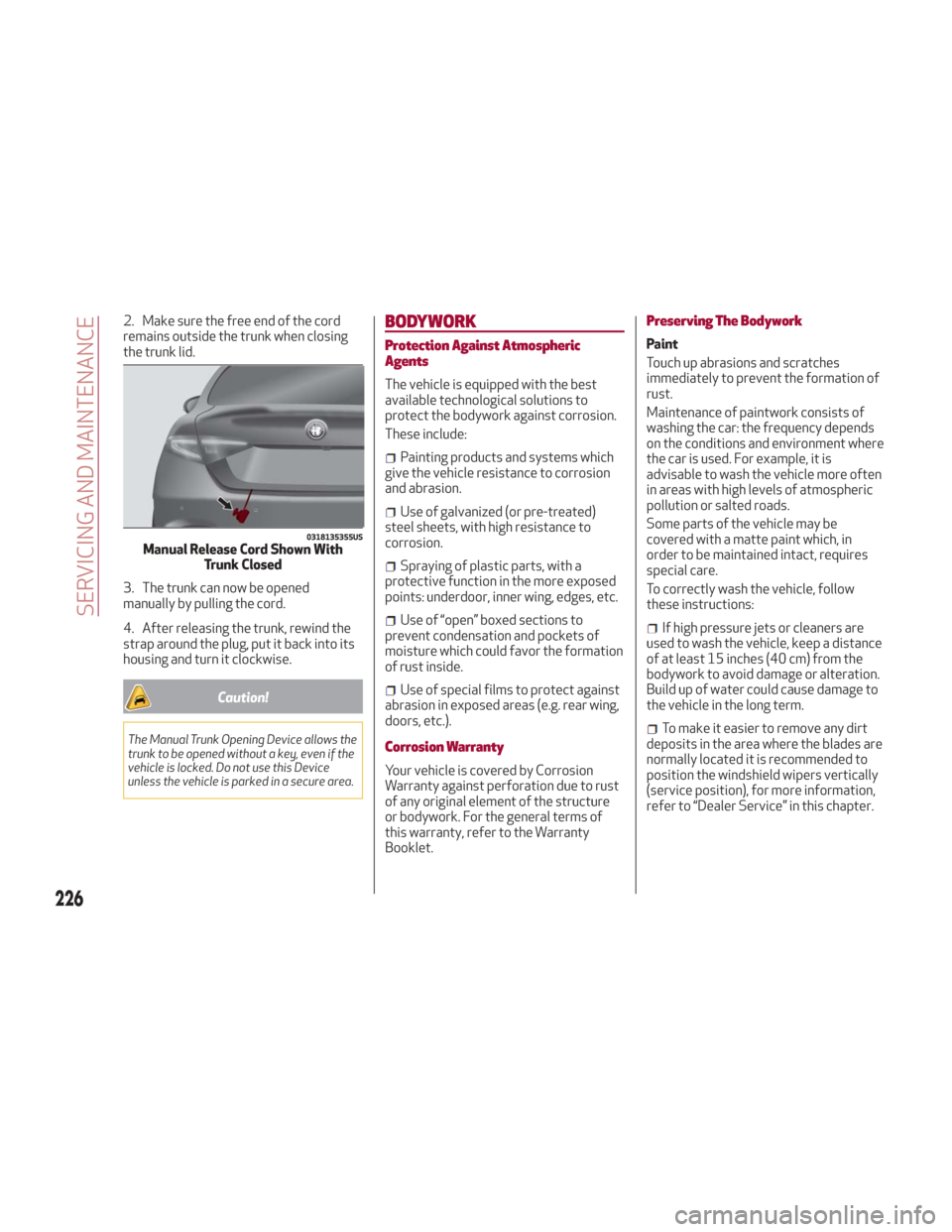
2. Make sure the free end of the cord
remains outside the trunk when closing
the trunk lid.
3. The trunk can now be opened
manually by pulling the cord.
4. After releasing the trunk, rewind the
strap around the plug, put it back into its
housing and turn it clockwise.
Caution!
The Manual Trunk Opening Device allows the
trunk to be opened without a key, even if the
vehicle is locked. Do not use this Device
unless the vehicle is parked in a secure area.
BODYWORK
Protection Against Atmospheric
Agents
The vehicle is equipped with the best
available technological solutions to
protect the bodywork against corrosion.
These include:
Painting products and systems which
give the vehicle resistance to corrosion
and abrasion.
Use of galvanized (or pre-treated)
steel sheets, with high resistance to
corrosion.
Spraying of plastic parts, with a
protective function in the more exposed
points: underdoor, inner wing, edges, etc.
Use of “open” boxed sections to
prevent condensation and pockets of
moisture which could favor the formation
of rust inside.
Use of special films to protect against
abrasion in exposed areas (e.g. rear wing,
doors, etc.).
Corrosion Warranty
Your vehicle is covered by Corrosion
Warranty against perforation due to rust
of any original element of the structure
or bodywork. For the general terms of
this warranty, refer to the Warranty
Booklet.
Preserving The Bodywork
Paint
Touch up abrasions and scratches
immediately to prevent the formation of
rust.
Maintenance of paintwork consists of
washing the car: the frequency depends
on the conditions and environment where
the car is used. For example, it is
advisable to wash the vehicle more often
in areas with high levels of atmospheric
pollution or salted roads.
Some parts of the vehicle may be
covered with a matte paint which, in
order to be maintained intact, requires
special care.
To correctly wash the vehicle, follow
these instructions:
If high pressure jets or cleaners are
used to wash the vehicle, keep a distance
of at least 15 inches (40 cm) from the
bodywork to avoid damage or alteration.
Build up of water could cause damage to
the vehicle in the long term.
To make it easier to remove any dirt
deposits in the area where the blades are
normally located it is recommended to
position the windshield wipers vertically
(service position), for more information,
refer to “Dealer Service” in this chapter.
0318135355USManual Release Cord Shown With Trunk Closed
226
SERVICING AND MAINTENANCE
Page 255 of 260
Garage Door Opener (HomeLink)....52
Gasoline, Clean Air ............239
Gasoline, Reformulated .........239
Gauges Speedometer ..............59
Tachometer ...............59
General Information ...........158
Glove Compartment ............51
Glove Compartment Light ........36
Glove Compartment Light (Bulb Replacement) ..........175
GVWR .................. .166
Hazard Warning Flasher .........172
Head Restraints ..............28
Head Rests .................28
Headlights Switch ............... .32,34
Headlights (Cleaning) ..........227
Heated Mirrors ...............32
High Beam Headlights ...........34
Automatic High Beam
Headlights ................34
Hill Start Assist (HSA) System ......92
Hood .....................48
Hood Release ................48
Identification Data ............230
Ignition ....................16 Installing Electrical/Electronic
Devices ...................3
Instrument Cluster Display Instrument Cluster Display ......60
Reconfigurable Instrument
Cluster Display .............60
Instrument Panel Features Instrument Panel Features ......58
Interior Ambient Lighting .........37
Interior Lights ................35
Interiors (Cleaning) ............228
Internal Equipment ............51
Jack Operation ............. .208
Jump Starting ............186,187
Key Fob Remote Keyless Entry .........14
Keyless Entry System/Immobilizer System ..................18
Lane Change ................35
Lane Change And Turn Signals ......35
Lane Departure Warning System . . .161
LaneSense ................ .161
Lap/Shoulder Belts ...........103
Latches .................. .129
Leaks,
Fluid............... .129
Life Of Tires ............... .219Lifting The Vehicle
............208
Light Bulbs ................ .129
Types Of Bulbs ............173
Light Switch .................32
Lights ................... .129
AirBag ..............108,128
Automatic Headlights .........33
Courtesy/Reading .........35,37
Daytime Running ............33
Exterior ................ .129
Hazard Warning Flasher .......172
Headlight Switch ..........32,34
Headlights .............32,34
High Beam ................34
Instrument Cluster ........32,34
Intensity Control ............38
Interior ..................37
Map Reading ..............35
Park ...................33
Reading .................35
Turn Signal ...............35
Turn Signals ..............129
Loading Vehicle ..............166
Tires .................. .212
Luggage Compartment Light (Bulb Replacement) ..........176
Luggage/Cargo Capacity .........49