battery change Alfa Romeo Giulia 2018 Owner's Manual
[x] Cancel search | Manufacturer: ALFA ROMEO, Model Year: 2018, Model line: Giulia, Model: Alfa Romeo Giulia 2018Pages: 260, PDF Size: 6 MB
Page 5 of 260
VEHICLE CHANGES / ALTERATIONS
Accessories Purchased By The Owner
Warning!
Any change or alteration of the vehicle might seriously affect its safety and road handling, thus causing accidents, in which the occupants could
even be fatally injured.
If you decide to install electrical accessories that require a permanent electrical supply (e.g. radio, satellite anti-theft system, etc.) or
accessories that in any case drain the electrical supply after purchasing the vehicle, contact your authorized dealer. Dealer personnel
will check whether the vehicles's electrical system is able to withstand the load required or whether it needs to be integrated with a
more powerful battery.
Note:Use caution when adding additional spoilers, alloy wheel rims, or non-standard wheel hubs: they could reduce the ventilation
of the brakes and affect efficiency under sharp and repeated braking, or on long descents. Make sure that nothing obstructs the
pedals (mats, etc.).
FCA US LLC shall not be liable for damage caused by the installation of accessories either not supplied or recommended by FCA US
LLC and/or not installed in compliance with the provided instructions.
Installing Electrical/Electronic Devices
FCA US LLC authorizes the installation of transceivers provided that installation is carried out at a specialized center, in compliance
with manufacturer's specifications.
Note: Local authorities may not allow the vehicle on the road if devices that modify the features of the vehicle have been installed.
This also may void the warranty in relation to faults caused by the change either directly or indirectly related to it.
FCA US LLC shall not be liable for damage caused by the installation of accessories either not supplied or recommended by FCA US
LLC and/or not installed in compliance with the provided instructions.
Radio Transmitters And Mobile Phones
Radio transmitter equipment (vehicle mobile phones, CB (Citizen Band) radios, amateur radio etc.) cannot be used inside the vehicle
unless a separate antenna is mounted externally.
Transmission and reception of these devices may be affected by the shielding effect of the vehicle body. As far as the use of
approved mobile phones is concerned, follow the usage instructions provided by the mobile phone Manufacturer.
Page 18 of 260
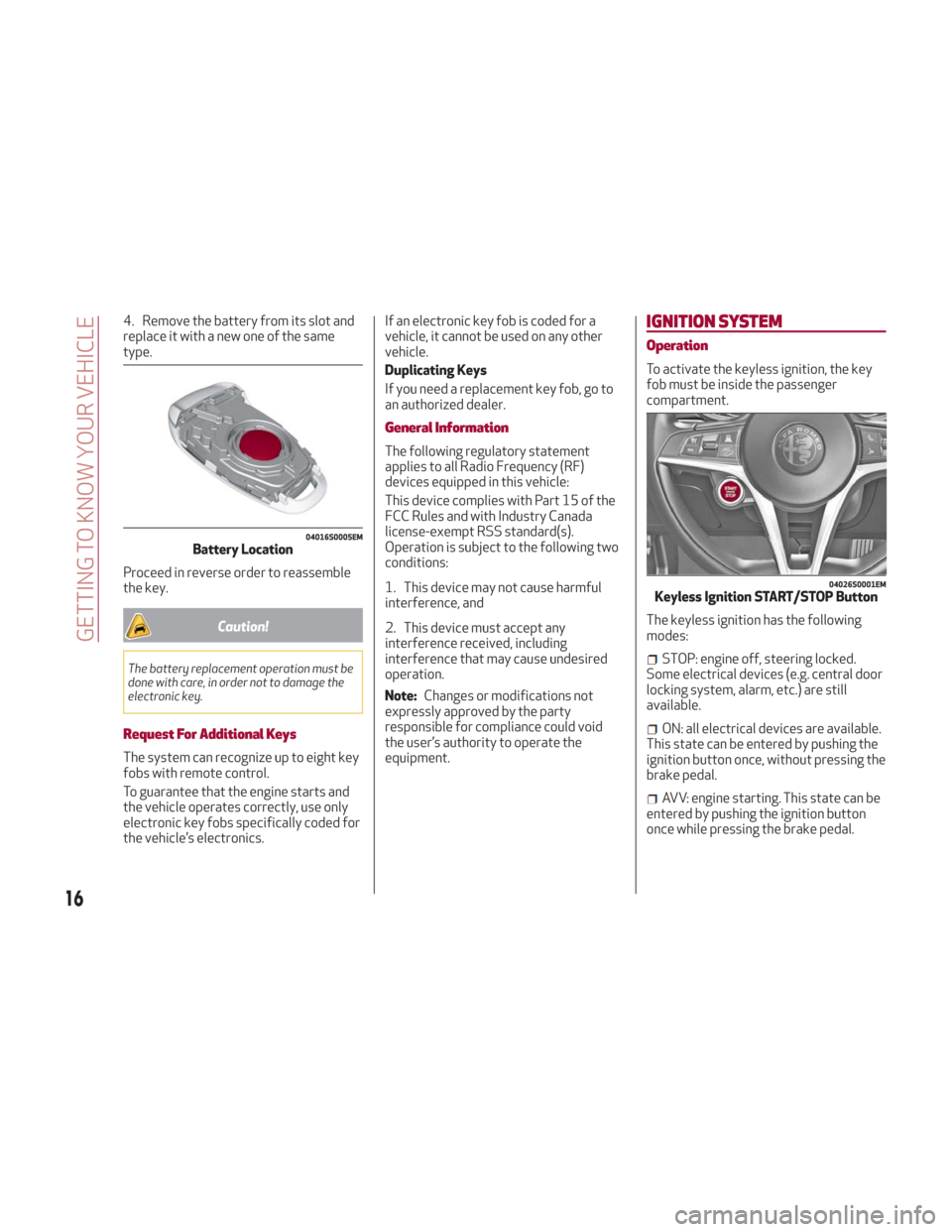
4. Remove the battery from its slot and
replace it with a new one of the same
type.
Proceed in reverse order to reassemble
the key.
Caution!
The battery replacement operation must be
done with care, in order not to damage the
electronic key.
Request For Additional Keys
The system can recognize up to eight key
fobs with remote control.
To guarantee that the engine starts and
the vehicle operates correctly, use only
electronic key fobs specifically coded for
the vehicle’s electronics.If an electronic key fob is coded for a
vehicle, it cannot be used on any other
vehicle.
Duplicating Keys
If you need a replacement key fob, go to
an authorized dealer.
General Information
The following regulatory statement
applies to all Radio Frequency (RF)
devices equipped in this vehicle:
This device complies with Part 15 of the
FCC Rules and with Industry Canada
license-exempt RSS standard(s).
Operation is subject to the following two
conditions:
1. This device may not cause harmful
interference, and
2. This device must accept any
interference received, including
interference that may cause undesired
operation.
Note:
Changes or modifications not
expressly approved by the party
responsible for compliance could void
the user’s authority to operate the
equipment.
IGNITION SYSTEM
Operation
To activate the keyless ignition, the key
fob must be inside the passenger
compartment.
The keyless ignition has the following
modes:
STOP: engine off, steering locked.
Some electrical devices (e.g. central door
locking system, alarm, etc.) are still
available.
ON: all electrical devices are available.
This state can be entered by pushing the
ignition button once, without pressing the
brake pedal.
AVV: engine starting. This state can be
entered by pushing the ignition button
once while pressing the brake pedal.
04016S0005EMBattery Location
04026S0001EMKeyless Ignition START/STOP Button
16
GETTING TO KNOW YOUR VEHICLE
Page 26 of 260
Trunk Lid Lock
The trunk lid of the vehicle may still be
locked by pushing the lock button on the
key fob, pushing the door lock button on
the door handles, or pushing the lock
button on the interior door panel of the
vehicle.
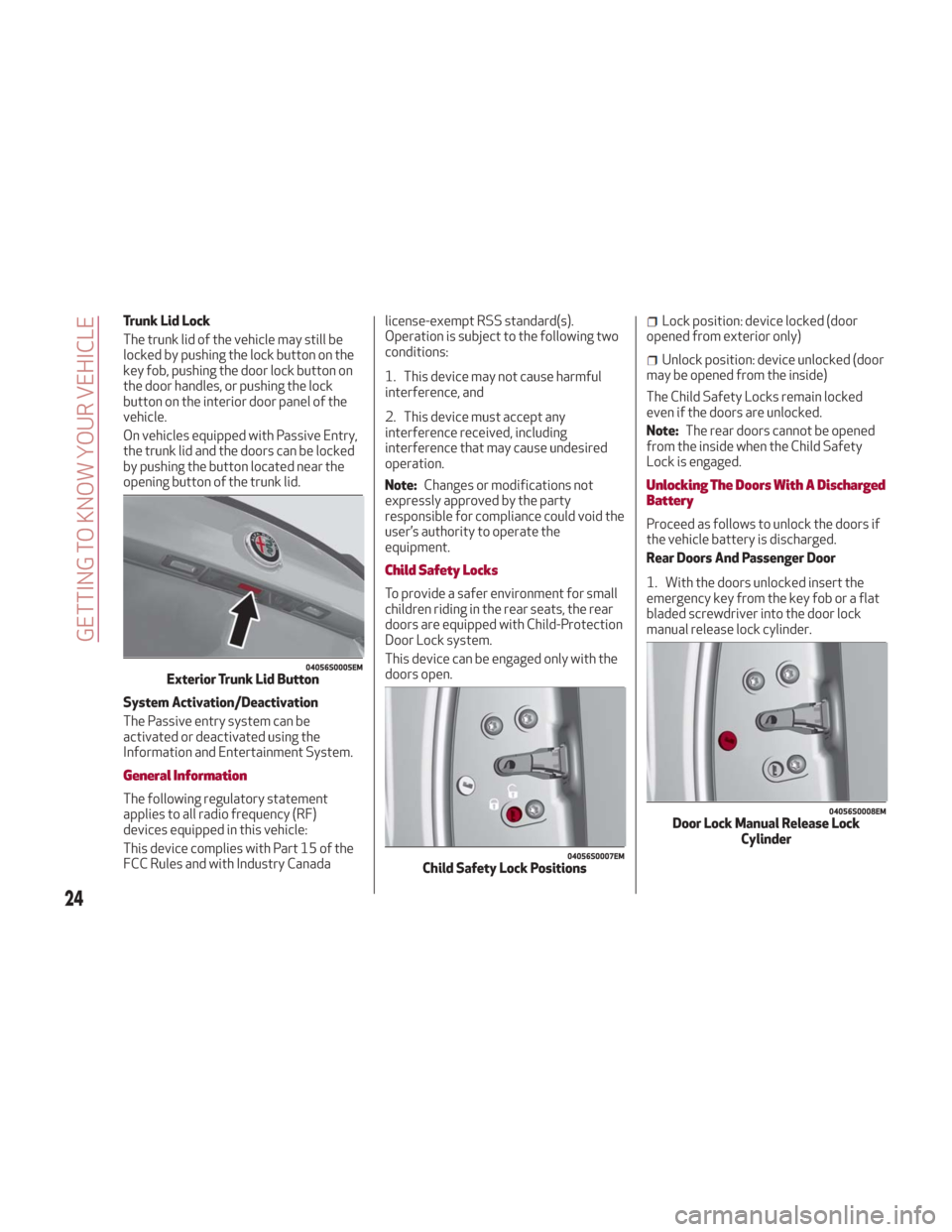
On vehicles equipped with Passive Entry,
the trunk lid and the doors can be locked
by pushing the button located near the
opening button of the trunk lid.
System Activation/Deactivation
The Passive entry system can be
activated or deactivated using the
Information and Entertainment System.
General Information
The following regulatory statement
applies to all radio frequency (RF)
devices equipped in this vehicle:
This device complies with Part 15 of the
FCC Rules and with Industry Canadalicense-exempt RSS standard(s).
Operation is subject to the following two
conditions:
1. This device may not cause harmful
interference, and
2. This device must accept any
interference received, including
interference that may cause undesired
operation.
Note:
Changes or modifications not
expressly approved by the party
responsible for compliance could void the
user’s authority to operate the
equipment.
Child Safety Locks
To provide a safer environment for small
children riding in the rear seats, the rear
doors are equipped with Child-Protection
Door Lock system.
This device can be engaged only with the
doors open.
Lock position: device locked (door
opened from exterior only)
Unlock position: device unlocked (door
may be opened from the inside)
The Child Safety Locks remain locked
even if the doors are unlocked.
Note: The rear doors cannot be opened
from the inside when the Child Safety
Lock is engaged.
Unlocking The Doors With A Discharged
Battery
Proceed as follows to unlock the doors if
the vehicle battery is discharged.
Rear Doors And Passenger Door
1. With the doors unlocked insert the
emergency key from the key fob or a flat
bladed screwdriver into the door lock
manual release lock cylinder.
04056S0005EMExterior Trunk Lid Button
04056S0007EMChild Safety Lock Positions
04056S0008EMDoor Lock Manual Release Lock Cylinder
24
GETTING TO KNOW YOUR VEHICLE
Page 196 of 260
SCHEDULED SERVICING
Correct servicing is crucial for
guaranteeing a long life for the vehicle
under the best conditions.
For this reason, Alfa Romeo has planned
a series of checks and services for your
vehicle at fixed intervals based on
distance and time, as described in the
Scheduled Servicing Plan.
Before each service, it is always
necessary to carefully follow the
instructions in the Scheduled Servicing
Plan (e.g. periodically check level of
fluids, tire pressure, etc.).
Scheduled Servicing is offered by an
authorized dealer according to a set time
schedule. If, during each operation, in
addition to the ones scheduled, the need
arises for further replacements or
repairs, these may be carried out with the
owner’s explicit consent only.
Note:Scheduled Servicing intervals are
required by the Manufacturer. Failure to
have them carried out may invalidate the
New Vehicle Limited Warranty.
You are advised to inform your
authorized dealer of any small operating
irregularities without waiting for the next
service.
Periodic Checks
Every month or every 600miles
( 1,000 km) or before long trips check
and, if necessary, top off:
Engine coolant level.
Brake fluid level (if insufficient, see an
authorized dealer as soon as possible).
Windshield washer fluid level.
Tire inflation pressure and condition.
Operation of lighting system
(headlights, direction indicators, hazard
warning lights, etc.).
Operation of windshield
washing/wiping system and
positioning/wear of wiper blades.
Every 2,000 miles ( 3,000km), check and
top off if required:
Engine oil level.
Heavy Usage Of The Vehicle
If the vehicle is used under one of the
following conditions:
Dusty roads.
Short, repeated journeys less than
4 miles (7-8 km) at sub-zero outside
temperatures.
Engine often idling or driving long
distances at low speeds or long periods
of inactivity.
In the event of a long period of inactivity.
The following checks must be carried out
more often than indicated in the
Scheduled Servicing Plan:
Check cleanliness of hood and trunk
locks, cleanliness and lubrication of
linkage.
Visually inspect conditions of: engine,
transmission, pipes and hoses
(exhaust/fuel system/brakes) and rubber
elements (sleeves/bushes, etc.).
Check battery charge and battery fluid
level (electrolyte).
Visually inspect conditions of the
accessory drive belts.
Check and, if necessary, change engine
oil and replace oil filter.
Check and, if necessary, replace cabin
air filter.
Check and, if necessary, replace air
cleaner.
Severe Duty All Models
Change Engine Oil at 4,000 miles
(6,500 km) if the vehicle is operated in a
dusty and off-road environment or is
operated predominately at idle or only
very low engine RPM’s. This type of
vehicle use is considered Severe Duty.
194
SERVICING AND MAINTENANCE
Page 204 of 260
The vehicle is equipped with an IBS
(Intelligent Battery Sensor), which is able
to measure the charge and discharge
voltage and calculate the charge level
and the general condition of the battery.
The sensor is placed next to the negative
terminal (-) of the battery.
For a correct charge/discharge
procedure, the charge voltage must go
through the IBS sensor.
1. Turn the charger on and follow the
instructions on the user's manual to
completely recharge the battery.
2. When the battery is charged, turn the
charger off before disconnecting it from
the battery.
3. Disconnect the black cable terminal of
the battery charger and then the red
cable terminal.
4. Refit the protective cover of the
positive terminal of the battery and the
access cover to the battery
compartment.
Note:If a "quick-type" battery charger is
used with the battery fitted on the
vehicle, before connecting it disconnect
both cables of the battery itself. Do not
use a "quick-type" battery charger to
provide the starting voltage.DEALER SERVICE
The following pages contain instructions
on the required maintenance from the
technical personnel who designed the
vehicle.
In addition to these specific maintenance
instructions specified for routine
scheduled servicing, there are other
components which may require periodic
maintenance or replacement over the
vehicle’s life cycle.
Engine Oil
Engine Oil Level Check
To ensure correct engine lubrication, the
oil must always be kept at the prescribed
level (see "Engine Compartment" in this
chapter).
Check the oil level at regular intervals, for
example every 1864 miles (3000 km).
It must be checked once full operating
temperature is reached.
The vehicle must also be parked on as
level a surface as possible.
The engine oil level can be checked using
the Information and Entertainment
system. To access the function, activate
the main menu (MENU button) and select
the following options in sequence:
“Applications”; “My Car”; “Oil level”.
Changing The Engine Oil
See the "Maintenance Plan" for the
correct servicing intervals. Choice Of Engine Oil Type
To ensure optimal performance and
maximum protection in all operating
conditions, it is advisable to use solely
certified engine oils (see description in
"Fluid And Lubricants" in the "Technical
Specifications" chapter).
Additives For Engine Oil
It is strongly recommended not to use
additives (other than leak detection dyes)
with the engine oil.
The engine oil is a product designed
specially for the vehicle and its
performance may be deteriorated
through the use of further additives.
Disposal Of Used Engine Oil And Filters
For the disposal of the engine oil and
filters, contact the appropriate body to
determine local regulations.
Note:
Used engine oil disposed of
incorrectly may seriously harm the
environment.
Engine Oil Filter
Replacing The Engine Oil Filter
The engine oil filter must be replaced
each time the engine oil is changed. It is
advised to replace it with a genuine spare
part, specifically designed for this
vehicle.
202
SERVICING AND MAINTENANCE
Page 210 of 260
Frequency Of Oil Changes
In normal vehicle operating conditions, it
is not necessary to change the
transmission oil.
Caution!
If a transmission fluid leak occurs, visit an
authorized dealer immediately. Severe
transmission damage may occur. An
authorized dealer has the proper tools to
adjust the fluid level accurately.
Replacing The Battery
If necessary, replace the battery with
another battery with the same
specifications. It is advised to contact an
authorized dealer for replacement.
Follow the battery manufacturer's
instructions for maintenance.
Note:It will not be possible to open the
trunk with a key or by pressing the button
in the passenger compartment when the
battery is disconnected. So, always
position the manual trunk opening strap
on the trunk lock before disconnecting
the battery. The procedure is described in
the "Storing The Vehicle" section in this
chapter.
RAISING THE VEHICLE
If the vehicle requires lifting, visit an
authorized dealer which is equipped with
shop jacks or jack arms.
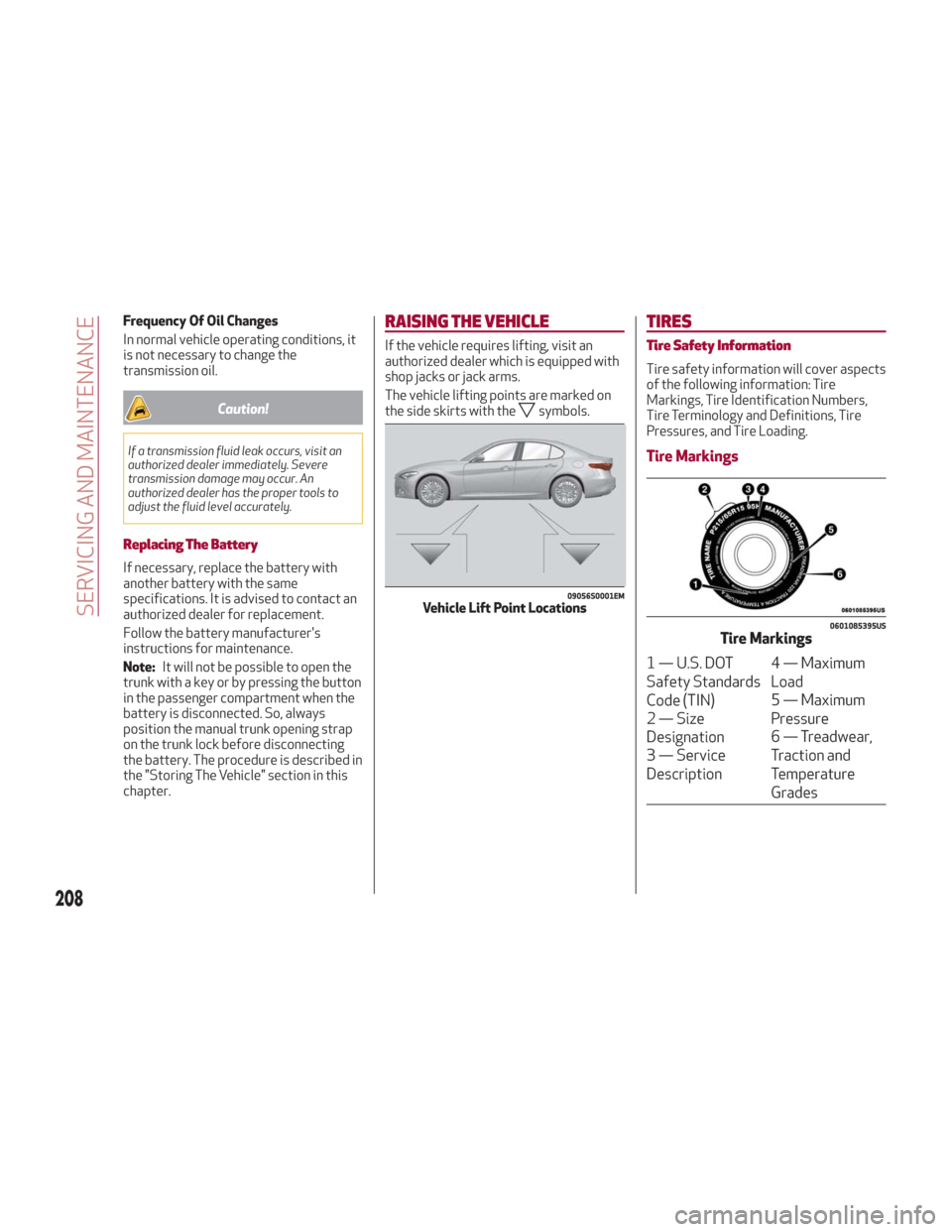
The vehicle lifting points are marked on
the side skirts with the
symbols.
TIRES
Tire Safety Information
Tire safety information will cover aspects
of the following information: Tire
Markings, Tire Identification Numbers,
Tire Terminology and Definitions, Tire
Pressures, and Tire Loading.
Tire Markings
09056S0001EMVehicle Lift Point Locations
0601085395USTire Markings
1 — U.S. DOT
Safety Standards
Code (TIN) 4 — Maximum
Load
2 — Size
Designation 5 — Maximum
Pressure
3 — Service
Description 6 — Treadwear,
Traction and
Temperature
Grades
208
SERVICING AND MAINTENANCE