automatic transmission ALFA ROMEO GIULIA 2021 Owner's Manual
[x] Cancel search | Manufacturer: ALFA ROMEO, Model Year: 2021, Model line: GIULIA, Model: ALFA ROMEO GIULIA 2021Pages: 284, PDF Size: 8.87 MB
Page 202 of 284
IN CASE OF EMERGENCY
200
Cable Disconnection
Once the engine is started, remove the
connection cables in reverse sequence, as
described below:
1. Disconnect the negative (-) jumper cablefrom the remote negative (-) post of the
discharged vehicle.
2. Disconnect the negative end (-) of the jumper cable from the negative (-) post of
the booster battery.
3. Disconnect the opposite end of the posi -
tive (+) jumper cable from the positive (+)
post of the booster battery.
4. Disconnect the positive (+) end of the jumper cable from the positive (+) post of
the vehicle with the discharged battery.
If frequent jump starting is required to start
your vehicle, you should have the battery and
charging system inspected at an authorized
dealer.Bump Starting
Never jump start the engine by pushing,
towing or coasting downhill.
NOTE:
You cannot start a vehicle with an automatic
transmission by pushing it.
IF YOUR ENGINE OVERHEATS
Engine overheating may occur in situations of
extreme environmental temperatures,
frequent engine stops/starts, or driving in
heavy traffic. If the engine becomes over -
heated, the Engine Temperature Warning
Light in the instrument cluster will illuminate
along with a dedicated message
Ú
page 73.
If the vehicle is overheating, it will need to be
serviced by an authorized dealer.
In any of the following situations, you can
reduce the potential for overheating by taking
the appropriate action.
On the highways — slow down.
In city traffic — while stopped, place the
transmission in NEUTRAL, but do not
increase engine idle speed.
NOTE:
There are steps that you can take to slow down
an impending overheat condition:
If your Air Conditioner (A/C) is on, turn it off.
The A/C system adds heat to the engine
cooling system and turning the A/C off can
help remove this heat.
You can also turn the temperature control
to maximum heat, the mode control to floor
and the blower control to high. This allows
the heater core to act as a supplement to
the radiator and aids in removing heat from
the engine cooling system.
CAUTION!
Accessories plugged into the vehicle power
outlets draw power from the vehicle’s
battery, even when not in use (i.e., cellular
phones, etc.). Eventually, if plugged in long
enough without engine operation, the
vehicle’s battery will discharge sufficiently
to degrade battery life and/or prevent the
engine from starting.
WARNING!
You or others can be badly burned by hot
engine coolant (antifreeze) or steam from
your radiator. If you see or hear steam
coming from under the hood, do not open
the hood until the radiator has had time to
cool. Never try to open a cooling system
pressure cap when the radiator or coolant
bottle is hot.
CAUTION!
Driving with a hot cooling system could
damage your vehicle. If temperature gauge
reads “H”, pull over and stop the vehicle.
Idle the vehicle with the air conditioner
turned off until the pointer drops back into
the normal range. If the pointer remains on
the “H”, turn the engine off immediately,
and call for service.
21_GA_OM_EN_USC_t.book Page 200
Page 216 of 284
SERVICING AND MAINTENANCE
214
Engine Coolant
If the level is too low, remove the cap of reser-
voir and add the fluid described on
Ú
page 267.
Washer Fluid For Windshield/Headlights
The windshield and headlights washer fluid
reservoir has a telescopic filler.
If the level is too low, remove reservoir cap and
lift the filler. Then, add the fluid described on
Ú
page 267.
NOTE:
The headlight washing system will not work if
the liquid level is low (as indicated by the
symbol on the instrument cluster display). On
vehicles equipped with headlight washers,
there is a reference notch on the dipstick:
ONLY the windshield/rear window washer
operates with the level below this reference.
Brake Fluid
Check that the fluid is at the maximum level. If
the fluid level in the tank is low, contact an
authorized dealer to have the system checked.
Automatic Transmission Activation System Oil
The transmission control oil level should only
be checked at an authorized dealer.
Useful Advice For Extending The Life Of
Your Battery
To avoid draining your battery and make it last
longer, observe the following instructions:
When you park the car, ensure that the
doors and trunk are closed properly to
prevent any lights from remaining on inside
the passenger's compartment.
Do not keep accessories (e.g. radio, hazard
warning lights, etc.) switched on for a long
time when the engine is not running.
Before performing any operation on the
electrical system, disconnect the negative
battery cable.
If you wish to install electrical accessories
after purchasing the car that require perma -
nent electrical supply (e.g. alarm, etc.), or
accessories which influence the electrical
supply requirements, contact an authorized
dealer, whose qualified staff will evaluate the
overall electrical consumption.
WARNING!
If the engine oil is being topped up, wait for
the engine to cool down before loosening
the filler cap, particularly for vehicles with
aluminum cap (if equipped). WARNING: risk
of burns!
CAUTION!
The oil level must never exceed the MAX
mark.
If the MAX mark is exceeded (last notch on
the right turns red) after the fill-up, go to an
authorized dealer as soon as possible to
have the oil in excess removed.
Do not add oil with specifications different
from those of the oil already in the engine.
Used engine oil and oil filters contain
substances which are harmful to the
environment. To change the oil and filters,
we advise you to contact an authorized
dealer.
CAUTION!
If the charge level remains under 50% for a
long time, the battery may be damaged by
sulphation, reducing its capacity and
efficiency during a vehicle start. The battery
is also more prone to the risk of freezing (at
temperatures as high as 14°F (-10°C).
21_GA_OM_EN_USC_t.book Page 214
Page 224 of 284
SERVICING AND MAINTENANCE
222
Braking System
In order to guarantee the efficiency of the
braking system, periodically check its compo-
nents; for this operation, contact an autho -
rized dealer.
For the correct servicing intervals
Ú
page 204.
NOTE:
Driving with your foot resting on the brake
pedal may compromise its efficiency,
increasing the risk of accidents. When driving,
never keep your foot on the brake pedal and
don’t put unnecessary strain on it to prevent
the brakes from overheating: excess pad wear
may cause damage to the braking system.
When an insufficient oil level is detected,
contact an authorized dealer to have the
system checked.
Always keep the cap of the brake fluid reser-
voir (in the engine compartment)
completely closed.
Automatic Transmission
Use only a transmission oil with the same char -
acteristics as those indicated on
Ú
page 268.
Special Additives
Do not use any type of additive with the auto -
matic transmission oil. The automatic trans -
mission oil is a product designed specially for
this vehicle and its performance may be
compromised through the use of further addi -
tives.
Frequency Of Oil Changes
In normal vehicle operating conditions, it is not
necessary to change the transmission oil.
WARNING!
Use only FCA US LLC recommended brake
fluid
Ú
page 268. Using the wrong type of
brake fluid can severely damage your
brake system and/or impair its perfor -
mance. The proper type of brake fluid for
your vehicle is also identified on the orig -
inal factory installed hydraulic master
cylinder reservoir.
To avoid contamination from foreign
matter or moisture, use only new brake
fluid or fluid that has been in a tightly
closed container. Keep the master
cylinder reservoir cap secured at all times.
Brake fluid in a open container absorbs
moisture from the air resulting in a lower
boiling point. This may cause it to boil
unexpectedly during hard or prolonged
braking, resulting in sudden brake failure.
This could result in a collision.
Overfilling the brake fluid reservoir can
result in spilling brake fluid on hot engine
parts, causing the brake fluid to catch fire.
Brake fluid can also damage painted and
vinyl surfaces, care should be taken to
avoid its contact with these surfaces.
Do not allow petroleum-based fluid to
contaminate the brake fluid. Brake seal
components could be damaged, causing
partial or complete brake failure. This
could result in a collision.
CAUTION!
Do not use chemical flushes in your
transmission as the chemicals can damage
your transmission components. Such
damage is not covered by the New Vehicle
Limited Warranty.
CAUTION!
If a transmission fluid leak occurs, visit an
authorized dealer immediately. Severe
transmission damage may occur. An
authorized dealer has the proper tools to
adjust the fluid level accurately.
21_GA_OM_EN_USC_t.book Page 222
Page 255 of 284
253
Dry the less visible parts (e.g. door frames,
hood, headlight frames, etc.) with special care,
as water may stagnate more easily in these
areas. Do not wash the car after it has been
left in the sun or with the hood hot: this may
alter the shine of the paintwork.
Exterior plastic parts must be cleaned in the
same way as the rest of the vehicle.
If washing the car in a service that moves the
car, for cars with automatic transmissions,
PARK (P) must be cut out. You have to shut off
the engine in the following conditions: car
stopped, transmission in NEUTRAL (N), push
the starter button for at least three seconds.
NOTE:
Avoid parking under trees; the resin dropped
by trees makes the paintwork go opaque and
increases the possibility of corrosion.
Windows
Use specific detergents and clean cloths to
prevent scratching or altering the transpar -
ency. Front Headlights
Use a soft cloth soaked in water and detergent
for washing cars.
NOTE:
Never use aromatic substances (e.g. gaso -
line) or ketones (e.g. acetone) for cleaning
the plastic lenses of the headlights.
When cleaning with a pressure washer,
keep the pressure washer at least eight
inches (20 cm) away from the headlights.
Engine Compartment
At the end of every Winter, wash the engine
compartment thoroughly, taking care not to
aim the jet of water directly at the electronic
control units or at the windshield wiper
motors. Have this operation performed at a
specialized workshop. For further information
Ú
page 215.
NOTE:
The washing should take place with the engine
cold and the ignition device in the STOP posi -
tion. After the washing operation, make sure
that the various protections (e.g. rubber caps
and guards) have not been removed or
damaged.
INTERIORS
Periodically check the cleanliness of the inte -
rior, beneath the mats, which could cause
oxidation of the sheet metal.
Seats And Fabric Parts
Remove dust with a soft brush or a vacuum
cleaner. Rub the seats with a sponge moist -
ened with a solution of water and neutral
detergent.
Cleaning heat press images on seats — if
equipped:
Due to the color, opacity and wear-resistant
protection with which the heat press images
on some seats are made, they may be subject
to temporary scratching if they are touched by
finger nails, keys, or other hard objects. In
such cases, the visible signs do not impair the
profiled images, and can easily be removed by
wiping the affected area with a microfiber
cloth moistened with water (not dry) to restore
the seat to its original condition. The micro -
fiber cloth must not have been previously
soaked in other substances or detergents.
CAUTION!
Wipe the rear window inside gently with a
cloth following the direction of the filaments
to avoid damaging the heating device.
21_GA_OM_EN_USC_t.book Page 253
Page 267 of 284
265
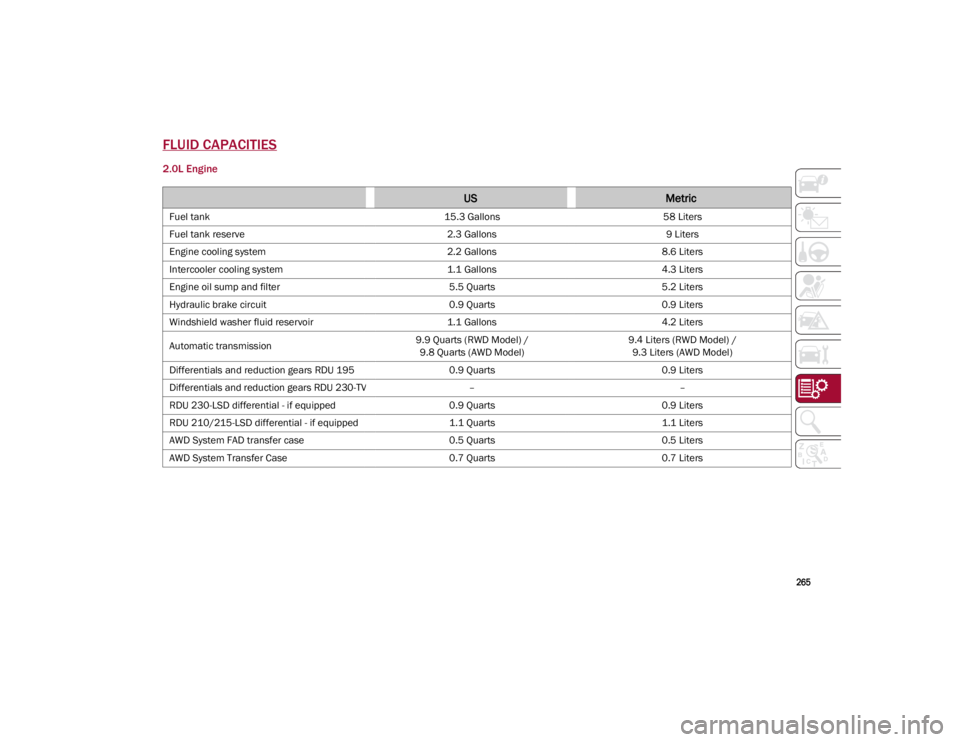
FLUID CAPACITIES
2.0L Engine
USMetric
Fuel tank15.3 Gallons58 Liters
Fuel tank reserve 2.3 Gallons9 Liters
Engine cooling system 2.2 Gallons8.6 Liters
Intercooler cooling system 1.1 Gallons4.3 Liters
Engine oil sump and filter 5.5 Quarts5.2 Liters
Hydraulic brake circuit 0.9 Quarts0.9 Liters
Windshield washer fluid reservoir 1.1 Gallons4.2 Liters
Automatic transmission 9.9 Quarts (RWD Model) /
9.8 Quarts (AWD Model) 9.4 Liters (RWD Model) /
9.3 Liters (AWD Model)
Differentials and reduction gears RDU 195 0.9 Quarts0.9 Liters
Differentials and reduction gears RDU 230-TV ––
RDU 230-LSD differential - if equipped 0.9 Quarts0.9 Liters
RDU 210/215-LSD differential - if equipped 1.1 Quarts1.1 Liters
AWD System FAD transfer case 0.5 Quarts0.5 Liters
AWD System Transfer Case 0.7 Quarts0.7 Liters
21_GA_OM_EN_USC_t.book Page 265
Page 268 of 284
TECHNICAL SPECIFICATIONS
266
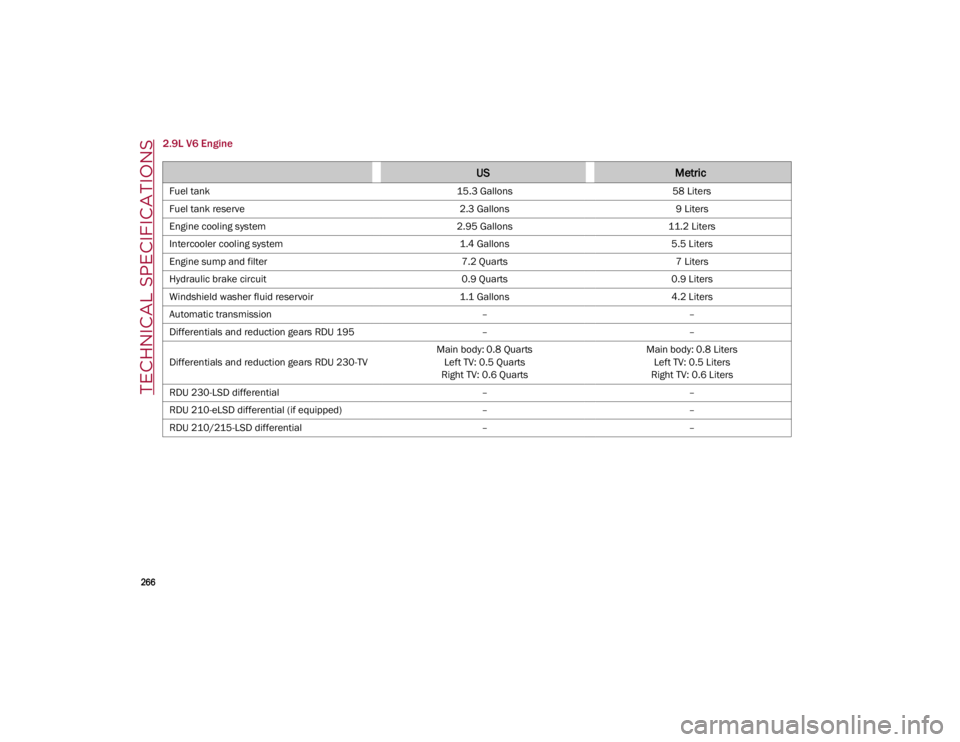
2.9L V6 Engine
USMetric
Fuel tank15.3 Gallons58 Liters
Fuel tank reserve 2.3 Gallons9 Liters
Engine cooling system 2.95 Gallons11.2 Liters
Intercooler cooling system 1.4 Gallons5.5 Liters
Engine sump and filter 7.2 Quarts7 Liters
Hydraulic brake circuit 0.9 Quarts0.9 Liters
Windshield washer fluid reservoir 1.1 Gallons4.2 Liters
Automatic transmission ––
Differentials and reduction gears RDU 195 ––
Differentials and reduction gears RDU 230-TV Main body: 0.8 Quarts
Left TV: 0.5 Quarts
Right TV: 0.6 Quarts Main body: 0.8 Liters
Left TV: 0.5 Liters
Right TV: 0.6 Liters
RDU 230-LSD differential ––
RDU 210-eLSD differential (if equipped) ––
RDU 210/215-LSD differential ––
21_GA_OM_EN_USC_t.book Page 266
Page 270 of 284
TECHNICAL SPECIFICATIONS
268
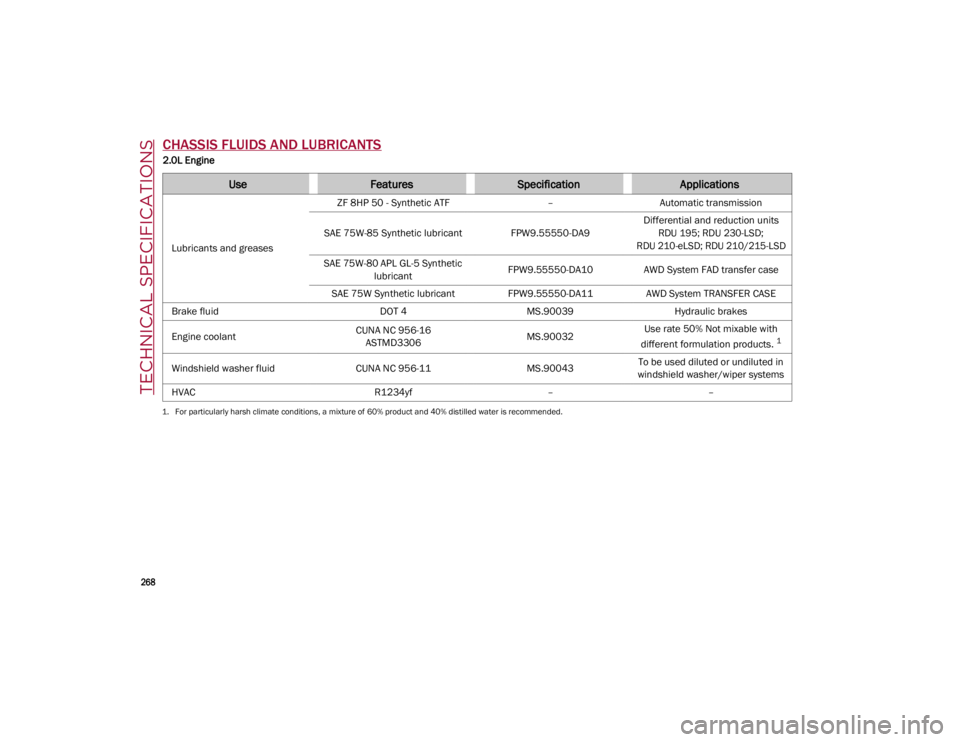
CHASSIS FLUIDS AND LUBRICANTS
2.0L Engine
UseFeaturesSpecificationApplications
Lubricants and greasesZF 8HP 50 - Synthetic ATF
–Automatic transmission
SAE 75W-85 Synthetic lubricant FPW9.55550-DA9 Differential and reduction units
RDU 195; RDU 230-LSD;
RDU 210-eLSD; RDU 210/215-LSD
SAE 75W-80 APL GL-5 Synthetic lubricant FPW9.55550-DA10 AWD System FAD transfer case
SAE 75W Synthetic lubricant FPW9.55550-DA11AWD System TRANSFER CASE
Brake fluid DOT 4MS.90039 Hydraulic brakes
Engine coolant CUNA NC 956-16
ASTMD3306 MS.90032Use rate 50% Not mixable with
different formulation products.
1 1.
For particularly harsh climate conditions, a mixture of 60 % product and 40 % distilled water is recommended.
Windshield washer fluid CUNA NC 956-11MS.90043To be used diluted or undiluted in
windshield washer/wiper systems
HVAC R1234yf––
21_GA_OM_EN_USC_t.book Page 268
Page 271 of 284
269
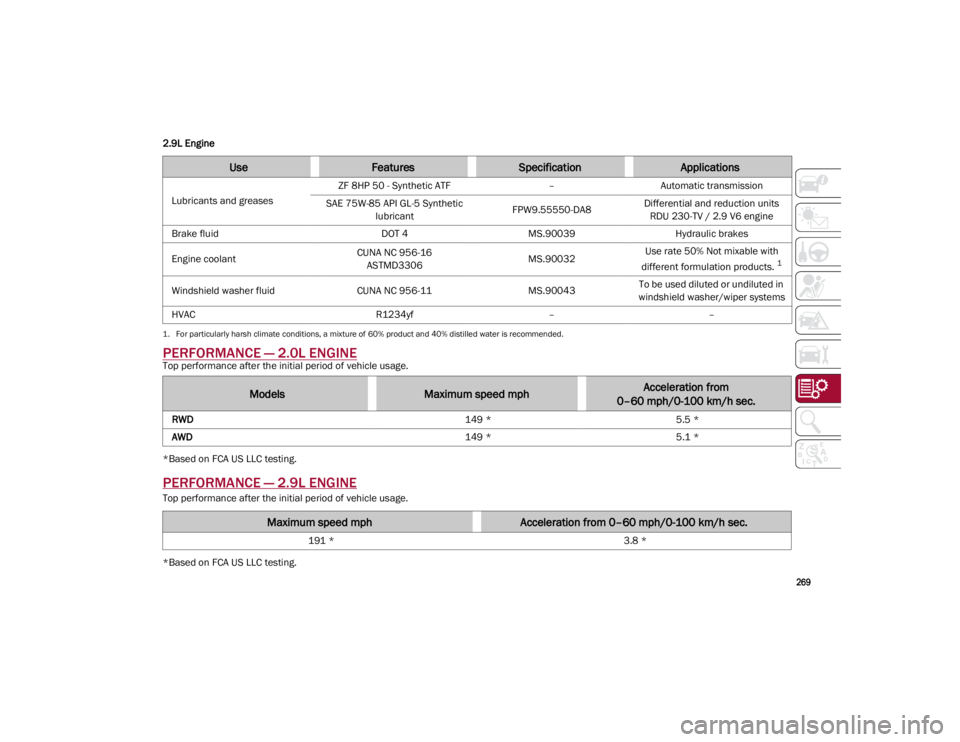
2.9L Engine
*Based on
FCA US LLC testing.
PERFORMANCE — 2.9L ENGINE
Top performance after the initial period of vehicle usage.
*Based on FCA US LLC testing.
UseFeaturesSpecificationApplications
Lubricants and greases ZF 8HP 50 - Synthetic ATF
–Automatic transmission
SAE 75W-85 API GL-5 Synthetic lubricant FPW9.55550-DA8Differential and reduction units
RDU 230-TV / 2.9 V6 engine
Brake fluid DOT 4MS.90039 Hydraulic brakes
Engine coolant CUNA NC 956-16
ASTMD3306 MS.90032Use rate 50% Not mixable with
different formulation products.
1 1.
For particularly harsh climate conditions, a mixture of 60% product and 40% distilled water is recommended.
PERFORMANCE — 2.0L ENGINE
Top performance after the initial period of vehicle usage.
Windshield washer fluid CUNA NC 956-11MS.90043To be used diluted or undiluted in
windshield washer/wiper systems
HVAC R1234yf––
ModelsMaximum speed mphAcceleration from
0–60 mph/0-100 km/h sec.
RWD 149 *5.5 *
AWD 149 *5.1 *
Maximum speed mphAcceleration from 0–60 mph/0-100 km/h sec.
191 * 3.8 *
21_GA_OM_EN_USC_t.book Page 269
Page 276 of 284
274
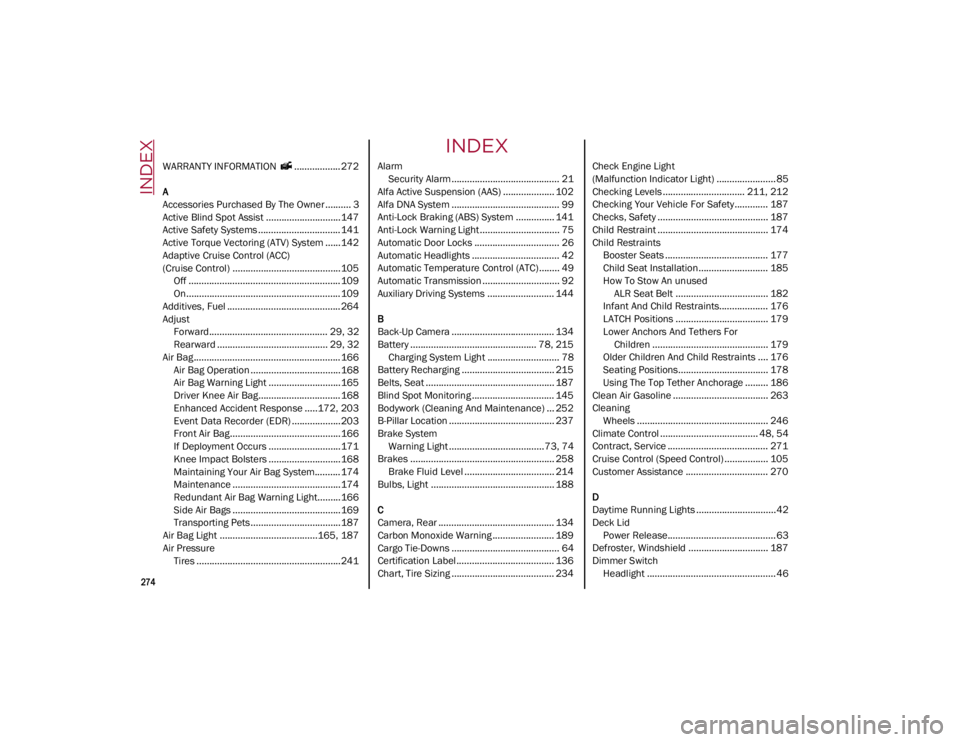
INDEX
INDEX
WARRANTY INFORMATION .................. 272
A
Accessories Purchased By The Owner.......... 3
Active Blind Spot Assist .............................147
Active Safety Systems ................................ 141
Active Torque Vectoring (ATV) System ......142
Adaptive Cruise Control (ACC)
(Cruise Control) ..........................................105 Off ........................................................... 109
On............................................................109
Additives, Fuel ............................................ 264
Adjust Forward.............................................. 29, 32
Rearward ........................................... 29, 32
Air Bag......................................................... 166 Air Bag Operation ...................................168Air Bag Warning Light ............................165
Driver Knee Air Bag................................ 168Enhanced Accident Response .....172, 203
Event Data Recorder (EDR) ...................203
Front Air Bag...........................................166
If Deployment Occurs ............................171
Knee Impact Bolsters ............................168
Maintaining Your Air Bag System.......... 174
Maintenance ..........................................174
Redundant Air Bag Warning Light.........166
Side Air Bags ..........................................169
Transporting Pets...................................187
Air Bag Light ......................................165, 187
Air Pressure Tires ........................................................241 Alarm
Security Alarm.......................................... 21
Alfa Active Suspension (AAS) .................... 102
Alfa DNA System .......................................... 99
Anti-Lock Braking (ABS) System ............... 141
Anti-Lock Warning Light............................... 75
Automatic Door Locks ................................. 26
Automatic Headlights .................................. 42
Automatic Temperature Control (ATC)........ 49
Automatic Transmission .............................. 92
Auxiliary Driving Systems .......................... 144
B
Back-Up Camera ........................................ 134
Battery ................................................. 78, 215 Charging System Light ............................ 78
Battery Recharging .................................... 215
Belts, Seat .................................................. 187
Blind Spot Monitoring ................................ 145
Bodywork (Cleaning And Maintenance) ... 252
B-Pillar Location ......................................... 237
Brake System Warning Light .....................................73, 74
Brakes ........................................................ 258 Brake Fluid Level ................................... 214
Bulbs, Light ................................................ 188
C
Camera, Rear ............................................. 134
Carbon Monoxide Warning ........................ 189
Cargo Tie-Downs .......................................... 64
Certification Label...................................... 136
Chart, Tire Sizing ........................................ 234 Check Engine Light
(Malfunction Indicator Light) .......................85
Checking Levels................................ 211, 212
Checking Your Vehicle For Safety............. 187
Checks, Safety ........................................... 187
Child Restraint ........................................... 174
Child Restraints
Booster Seats ........................................ 177
Child Seat Installation........................... 185
How To Stow An unused ALR Seat Belt .................................... 182
Infant And Child Restraints................... 176
LATCH Positions .................................... 179
Lower Anchors And Tethers For Children ............................................. 179
Older Children And Child Restraints .... 176
Seating Positions................................... 178
Using The Top Tether Anchorage ......... 186
Clean Air Gasoline ..................................... 263
Cleaning Wheels ................................................... 246
Climate Control ...................................... 48, 54
Contract, Service ....................................... 271
Cruise Control (Speed Control) ................. 105
Customer Assistance ................................ 270
D
Daytime Running Lights ...............................42
Deck Lid Power Release.......................................... 63
Defroster, Windshield ............................... 187
Dimmer Switch Headlight ..................................................46
21_GA_OM_EN_USC_t.book Page 274