technical Alfa Romeo Giulia Quadrifoglio 2017 Owner's Manual
[x] Cancel search | Manufacturer: ALFA ROMEO, Model Year: 2017, Model line: Giulia Quadrifoglio, Model: Alfa Romeo Giulia Quadrifoglio 2017Pages: 268, PDF Size: 110.98 MB
Page 3 of 268
DEAR CUSTOMER
Dear Customer,
We would like to congratulate and thank you for choosing Alfa Romeo.
We have written this Owner’s Manual to help you get to know all of the features of your vehicle and use it in the best possible
way. Please take the necessary time to familiarize yourself with all the dynamic features of your car.
Here you will find important information and warnings regarding the use of your vehicle, and how to achieve the best
performance from the technical features of your Alfa Romeo.
You are advised to read through the Owner’s Manual before taking it on the road for the first time. It is important to become
familiar with the controls of your vehicle, especially with sections concerning the brakes, handling, transmission, and vehicle
behavior on different road surfaces.
This Owner’s Manual also provides a description of special features and tips, as well as essential information for the safe driving,
care, and maintenance of your Alfa Romeo over time.
In the provided Warranty Booklet, you will also find a description of the services that Alfa Romeo offers to its customers.
The New Vehicle Limited Warranty will detail the terms and conditions for maintaining its validity.
We are sure that these will help you to get in touch with and appreciate both your new car and the service provided by the
people at Alfa Romeo.
Page 4 of 268
READ THIS CAREFULLY
REFUELING
Do not use fuel containing methanol or ethanol E85. Using these mixtures may cause misfiring and driving issues, as well as damage vital
components of the supply system.For further details on the use of the correct fuel, see the "Fuel Requirements" paragraph in the "Technical Specifications" chapter.
STARTING THE ENGINE
Make sure that the electric park brake is engaged and that the transmission is in PARK (P) or NEUTRAL (N). Next, press the brake pedal, and
then push the engine START/STOP button.
PARKING ON FLAMMABLE MATERIAL
The catalytic converter develops high temperatures during operation. Do not park the car on grass, dry leaves, pine needles or other flammable
material: fire hazard.
RESPECTING THE ENVIRONMENT
The vehicle is fitted with a system that carries out a continuous diagnosis of the emission-related components in order to help protect the
environment.
ELECTRICAL ACCESSORIES
If you decide to add electrical accessories after purchasing the vehicle, (with the risk of gradually draining the battery), contact your authorized
dealer. They can calculate the overall electrical requirement and check that the vehicle's electric system can support the required load.
SCHEDULED SERVICING
Correctly performed maintenance procedures are essential for ensuring that your vehicle continuously maintains its quality in performance and
safety features, environmental friendliness, and low running costs.
Page 7 of 268
HOW TO USE THIS MANUAL
Operating Instructions
Each time an instruction is given that concerns direction (left/right or forward/backward), it is written to be read from the
perspective of an occupant in the driver's seat. If a direction is written from a different perspective, it will be specified as such in
the text as appropriate.
The figures in the manual are only examples: this might imply that some details of the image do not correspond to the actual
arrangement of your vehicle.
To identify the chapter with the information necessary, you can consult the index at the end of this manual.
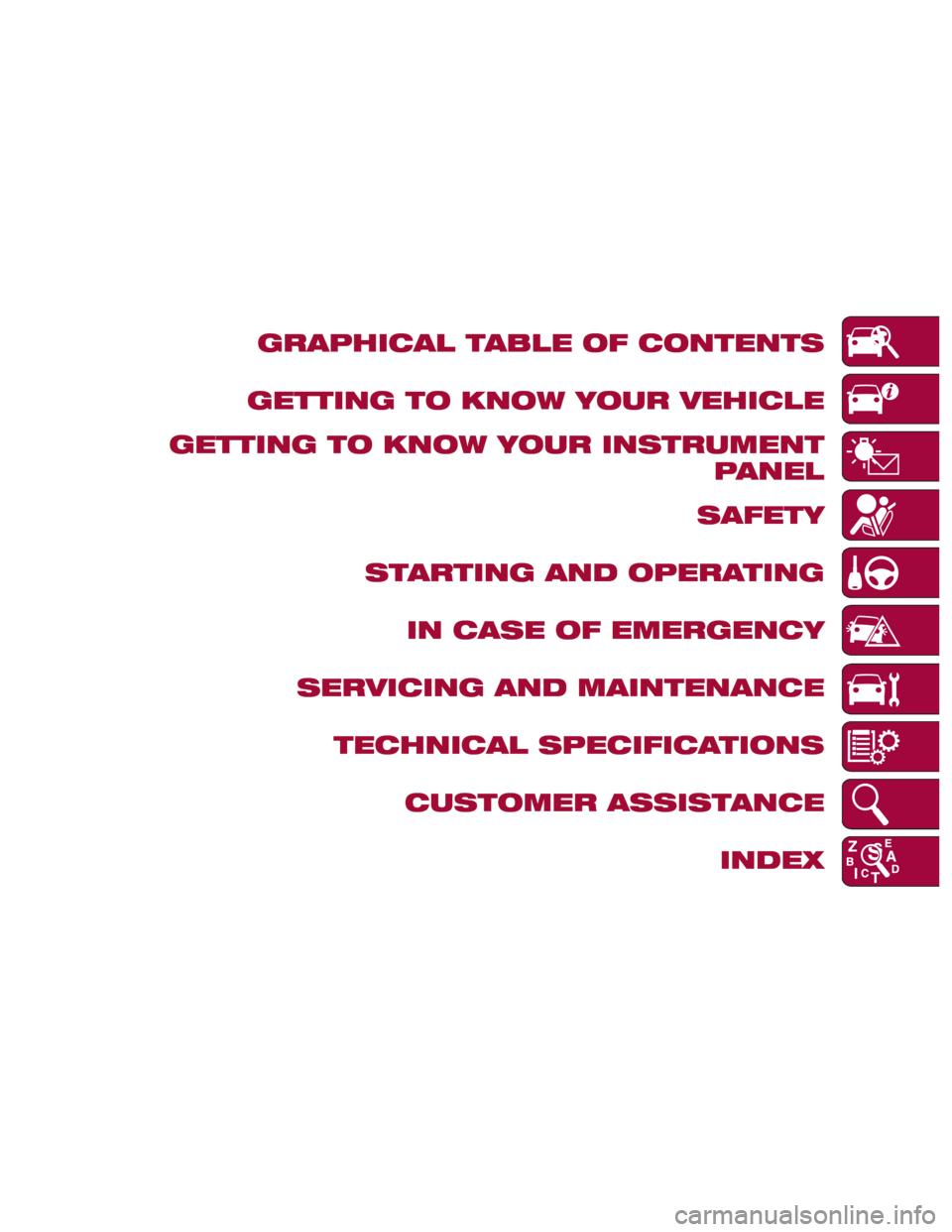
Chapters can be rapidly identified with dedicated graphic tabs, located at the side of each odd page. There is also a key for
getting to know the chapter order and the relevant symbols in the tabs. Additionally, there is a textual indication of each current
chapter at the side of each even page.
Warnings And Cautions
There are alsoWARNINGSthat must be carefully followed to prevent incorrect use of the components of the vehicle, which
could cause accidents or injuries.
While reading this Owner’s Manual you will find a series of CAUTIONSto prevent procedures that could damage your vehicle.
Therefore all WARNINGS andCAUTIONS must always be carefully followed.
WARNINGS andCAUTIONS are recalled in the text with the following symbols:
Personal Safety:
Vehicle Safety:
Note:
This Owner’s Manual describes the Quadrifoglio model. Optional contents, including equipment meant for specific
Markets or particular models, are not identified as such in the text: you need to consider only the information
related to the model you own. Any content introduced throughout the production of the model, outside of the
specific request of options at the time of purchase, will be identified with the wording (if-equipped).
All data contained in this publication is intended to help you use your vehicle in the best possible way. FCA US LLC
aims at a constant improvement of the vehicles produced. For this reason, it reserves the right to make changes to
the model described for technical and/or commercial reasons.
For further information, contact your authorized dealer.
Page 9 of 268
GRAPHICAL TABLE OF CONTENTS
GETTING TO KNOW YOUR VEHICLE
GETTING TO KNOW YOUR INSTRUMENT PANEL
SAFETY
STARTING AND OPERATING IN CASE OF EMERGENCY
SERVICING AND MAINTENANCE TECHNICAL SPECIFICATIONS CUSTOMER ASSISTANCE INDEX
Page 60 of 268
Note:Activate the handbrake and
place the ignition to ON without starting
the engine.
Proceed as follows:
1. Push the desired HomeLink button
and keep it pushed (1, 2 or 3). Do not
release the button until the last
operation has been performed.
2. When the HomeLink indicator
begins to flash slowly, move the
portable remote control 1 to 3 inches
from the system (keeping the
programmable button pressed down).
If the indicator does not begin to flash
quickly, change the distance between
the HomeLink and the portable remote
control and try the procedure again.
The HomeLink indicator flashes, first
slowly and then quickly. When the
indicator starts to flash quickly, release
both buttons on the remote control.
The system previously programmed to
HomeLink has now been deleted and
the new system is ready to use. This
does not affect the other two HomeLink
buttons in any way. Deleting Programmed Keys
It is recommended to delete HomeLink
programming before selling the car.
All three keys are deleted simultaneously.
Proceed as follows:
1. Push and hold the outer buttons
(1 and 3). After about 10 seconds, the
indicator will start to flash.
2. Release both keys.
Technical Information For After
Sales Service
If you are unable to set up HomeLink
successfully after following the above
instructions, contact After Sales Service
(HomeLink free hotline number
1-800-355-3515 ) with the following
information:
Vehicle make and model, including
manufacturing year and country of
purchase;
Make, model, age and frequency of
use of the original portable remote
control (if known).
Note: For US:
FCC ID: M3N-82135300
For Canada:IC: 7812A-82135300
For Mexico:RLVC-A213-0334
This device complies with Part 15 of the
FCC Rules. Operation is subject to the
following two conditions:
(1) this device may not cause harmful
interference, and (2) this device must
accept any interference received,
including interference that may cause
undesired operation.
Note:Changes or modifications not
expressly approved by the party
responsible for compliance could void
the user's authority to operate the
equipment.
Center Console
The center console storage
compartment is located between the
front seats.
To access the center console storage,
lift the upper part of the center console
as shown below.
GUID-04246S0004EMCenter Console
58
GETTING TO KNOW YOUR VEHICLE
Page 94 of 268
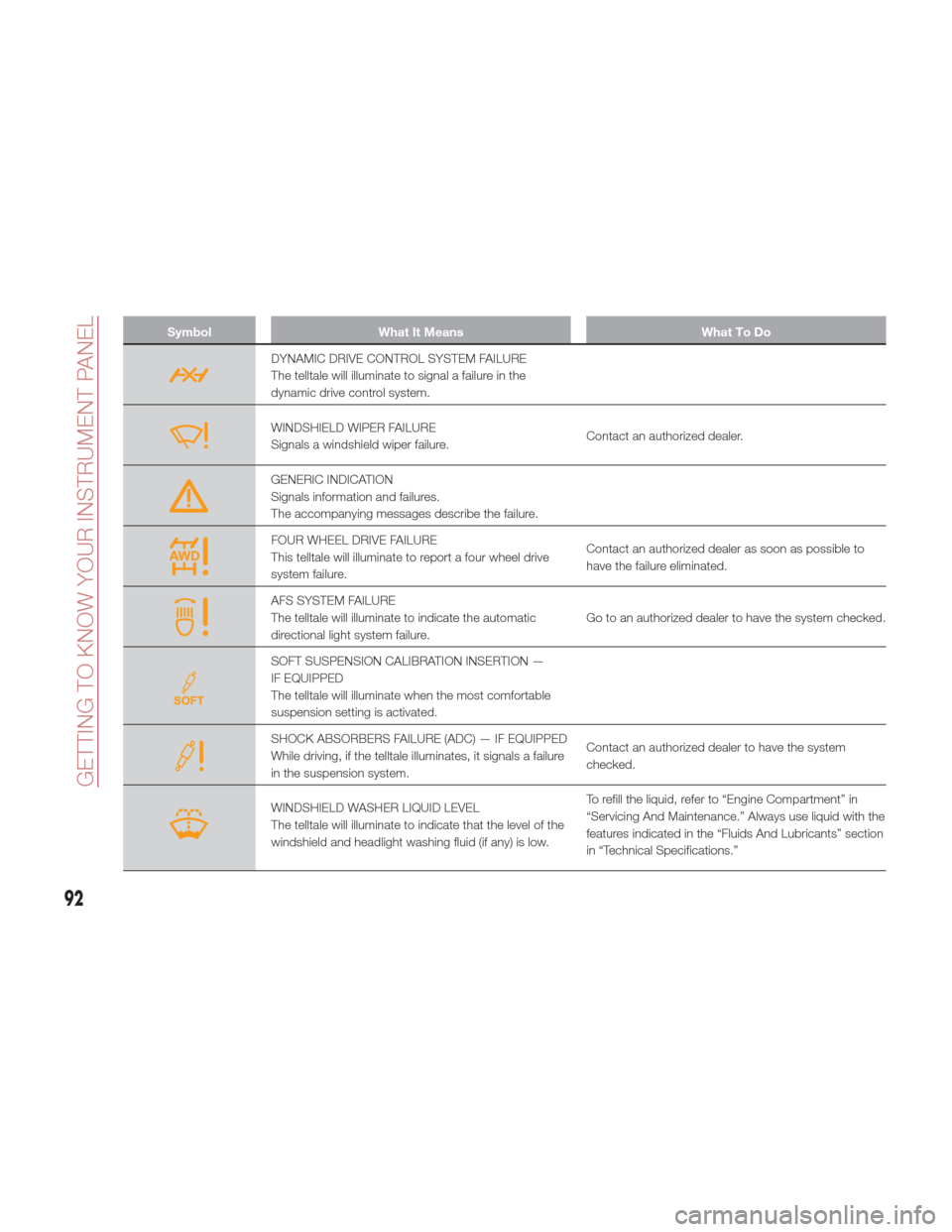
SymbolWhat It Means What To Do
DYNAMIC DRIVE CONTROL SYSTEM FAILURE
The telltale will illuminate to signal a failure in the
dynamic drive control system.
WINDSHIELD WIPER FAILURE
Signals a windshield wiper failure.Contact an authorized dealer.
GENERIC INDICATION
Signals information and failures.
The accompanying messages describe the failure.
FOUR WHEEL DRIVE FAILURE
This telltale will illuminate to report a four wheel drive
system failure.Contact an authorized dealer as soon as possible to
have the failure eliminated.
AFS SYSTEM FAILURE
The telltale will illuminate to indicate the automatic
directional light system failure.
Go to an authorized dealer to have the system checked.
SOFT SUSPENSION CALIBRATION INSERTION —
IF EQUIPPED
The telltale will illuminate when the most comfortable
suspension setting is activated.
SHOCK ABSORBERS FAILURE (ADC) — IF EQUIPPED
While driving, if the telltale illuminates, it signals a failure
in the suspension system.Contact an authorized dealer to have the system
checked.
WINDSHIELD WASHER LIQUID LEVEL
The telltale will illuminate to indicate that the level of the
windshield and headlight washing fluid (if any) is low.To refill the liquid, refer to “Engine Compartment” in
“Servicing And Maintenance.” Always use liquid with the
features indicated in the “Fluids And Lubricants” section
in “Technical Specifications.”
92
GETTING TO KNOW YOUR INSTRUMENT PANEL
Page 206 of 268
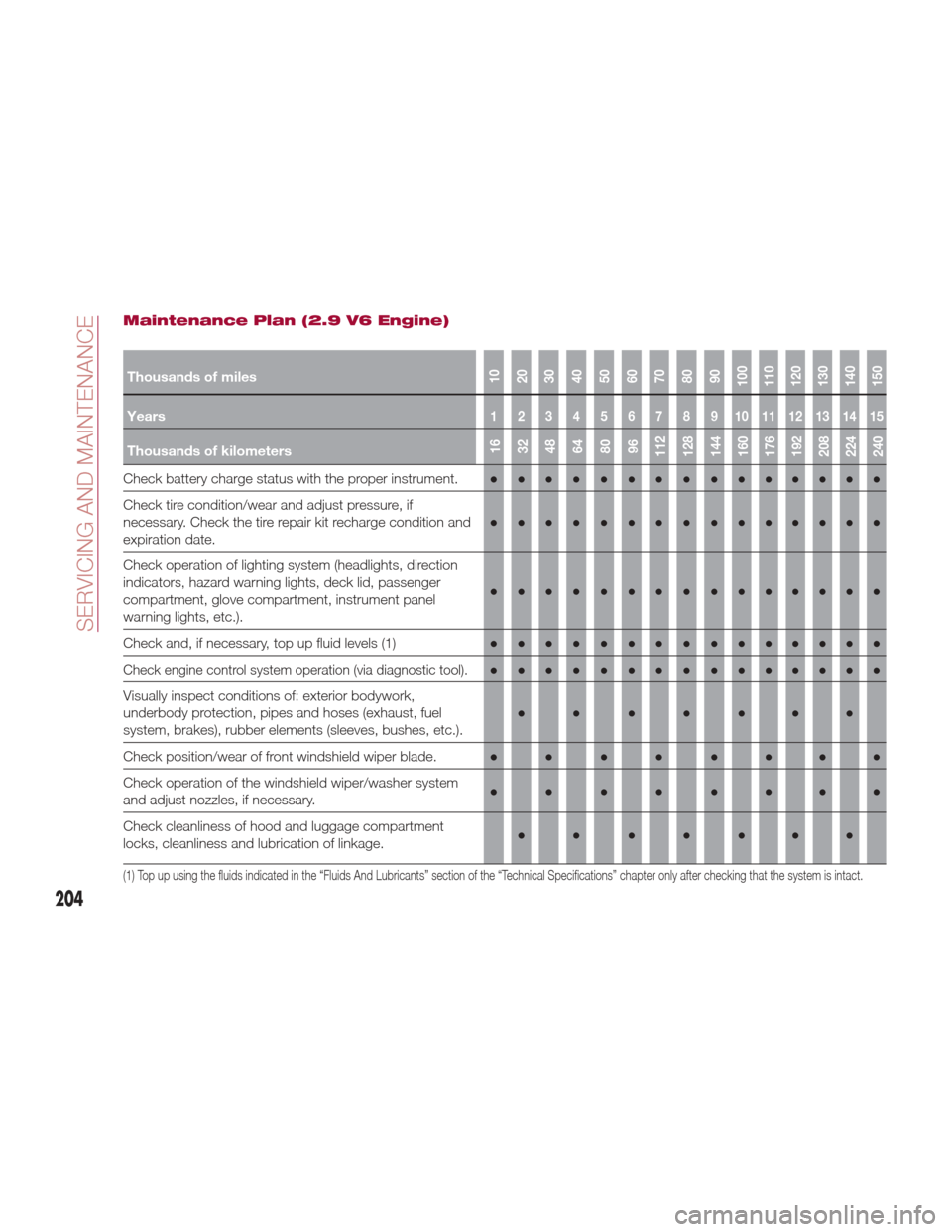
Maintenance Plan (2.9 V6 Engine)
Thousands of miles10
20
30
40
50
60
70
80
90
100
110
120
130
140
150
Years123456789101112131415
Thousands of kilometers16
32
48
64
80
96
112
128
144
160
176
192
208
224
240
Check battery charge status with the proper instrument. ●●●●●●●●●●●●●●●
Check tire condition/wear and adjust pressure, if
necessary. Check the tire repair kit recharge condition and
expiration date. ●●●●●●●●●
●●●●●●
Check operation of lighting system (headlights, direction
indicators, hazard warning lights, deck lid, passenger
compartment, glove compartment, instrument panel
warning lights, etc.). ●●●●●●●●●
●●●●●●
Check and, if necessary, top up fluid levels
(1)●●●●●●●●● ●●●●●●
Check engine control system operation (via diagnostic tool).●●●●●●●●●●●●●●●
Visually inspect conditions of: exterior bodywork,
underbody protection, pipes and hoses (exhaust, fuel
system, brakes), rubber elements (sleeves, bushes, etc.). ●●●●●●●
Check position/wear of front windshield wiper blade. ●●●●●●●●
Check operation of the windshield wiper/washer system
and adjust nozzles, if necessary. ●●●●●●●●
Check cleanliness of hood and luggage compartment
locks, cleanliness and lubrication of linkage. ●●●●●●●
(1) Top up using the fluids indicated in the “Fluids And Lubricants” section of the “Technical Specifications” chapter only after checking that the system is intact.
204
SERVICING AND MAINTENANCE
Page 211 of 268
Engine Coolant Fluid
If the level is too low, unscrew the cap
of reservoir and add the fluid described
in the "Technical Specifications"
chapter.
Washer Fluid For
Windshield/Headlights
The windshield and headlights washer
fluid reservoir (if equipped) has a
telescopic filler.
If the level is too low, remove reservoir
cap and lift the filler. Then, add the fluid
described in the "Technical
Specifications" chapter.
Note:
The headlight washing system will not
work if the liquid level is low (situation
indicated by the symbol on the
instrument panel display). The
windshield washer will keep working.
On vehicles equipped with headlight
washers, if equipped, there is a
reference notch on the dipstick: ONLY
the windshield/rear window washer
operates with the level below this
reference.
Brake Fluid
Check that the fluid is at the maximum
level. If the fluid level in the tank is low,
contact your authorized dealer to have
the system checked.
Automatic Transmission
Activation System Oil
The transmission control oil level should
only be checked at your authorized
dealer.
Useful Advice For
Extending The Life Of
Your Battery
To avoid draining your battery and
make it last longer, observe the
following instructions:
When you park the car, ensure that
the doors and trunk are closed properly
to prevent any lights from remaining on
inside the passenger's compartment.
Do not keep accessories (e.g. radio,
hazard warning lights, etc.) switched on
for a long time when the engine is not
running.
Before performing any operation on
the electrical system, disconnect the
negative battery cable.
If you wish to install electrical
accessories after purchasing the car
that require permanent electrical supply
(e.g. alarm, etc.), or accessories which
influence the electrical supply
requirements, contact your authorized
dealer, whose qualified staff will
evaluate the overall electrical
consumption.
Caution!
If the charge level remains under 50% for a
long time, the battery may be damaged by
sulphation, reducing its capacity and
efficiency at start the vehicle. The battery
is also more prone to the risk of freezing
at temperatures as high as 14°F (-10°C).
Note:
After the battery is disconnected, the
steering must be initialized. The
warning light on the instrument
panel switches on to indicate this. To
carry out this procedure, simply turn the
steering wheel all the way from one end
to the other, and then turn it back to the
central position.
209
Page 214 of 268
DEALER SERVICE
The following pages contain
instructions on the required
maintenance from the technical
personnel who designed the vehicle.
In addition to these specific
maintenance instructions specified for
routine scheduled servicing, there are
other components which may require
periodic maintenance or replacement
over the vehicle’s life cycle.
Engine Oil
Engine Oil Level Check
To ensure correct engine lubrication,
the oil must always be kept at the
prescribed level (see "Engine
Compartment" in this chapter).
Check the oil level at regular intervals,
for example every 1864 miles
(3000 km).
It must be checked about five minutes
after stopping the engine, once full
operating temperature is reached.
The vehicle must also be parked on as
level a surface as possible.
Ensure that the oil level is within the
interval on the dipstick between the
minimum and maximum limits.
The engine oil level can be checked
using the Connect system. To access
the function, activate the main menu
(MENU button) and select the following
options in sequence: “Applications”;
“My Car”; “Oil level”.Changing the Engine Oil
See the "Maintenance Plan" for the
correct servicing intervals.
Choice of Engine Oil Type
To ensure optimal performance and
maximum protection in all operating
conditions, it is advisable to use solely
certified engine oils (see description in
"Fluid And Lubricants" in the "Technical
Specifications" chapter).
Additives for Engine Oil
It is strongly recommended not to use
additives (other than leak detection
dyes) with the engine oil.
The engine oil is a product designed
specially for the vehicle and its
performance may be deteriorated
through the use of further additives.
Disposal of Used Engine Oil and
Filters
For the disposal of the engine oil and
filters, contact the appropriate body to
determine local regulations.
Note:
Used engine oil disposed of incorrectly
may seriously harm the environment.
Engine Oil Filter
Replacing the Engine Oil Filter
The engine oil filter must be replaced
each time the engine oil is changed. It is
advised to replace it with a genuine
spare part, specifically designed for this
vehicle.
Air Filter
Replacing the Air Cleaner
See the "Maintenance Plan" for the
correct servicing intervals. It is advised
to replace it with a genuine spare part,
specifically designed for this vehicle.
Air Conditioning System
Maintenance
To ensure the best possible
performance, the air conditioning
system must be checked and undergo
maintenance at an authorized dealer at
the beginning of the summer.
Caution!
Do not use chemicals to clean the air
conditioning system, since the internal
components may be damaged. This kind
of damage is not covered by warranty.
Replace The Cabin Air Filter
See the "Maintenance Plan" for the
correct servicing intervals. For cleaner
replacement, contact an authorized
dealer.
212
SERVICING AND MAINTENANCE
Page 218 of 268
(e.g. if frequent top ups are required),
have the seal checked at an authorized
dealer.
With the engine off and at normal
operating temperature, check that the
cooling system radiator cap is closed
properly.
Warning!
Do not open hot engine cooling system.
Never add engine coolant (antifreeze) when
the engine is overheated. Do not loosen or
remove the cap to cool an overheated
engine. Heat causes pressure to build up in
the cooling system. To prevent scalding or
injury, do not remove the pressure cap
while the system is hot or under pressure.
Do not use a pressure cap other than
the one specified for your vehicle. Personal
injury or engine damage may result.
Note:
Before removing the engine coolant
reservoir cap, wait for the system to
cool down.
Topping Up / Draining / Flushing
The Engine Coolant
If the engine coolant (antifreeze) is dirty,
have cleaning and flushing carried out
at an authorized dealer.
See the "Maintenance Plan" for the
correct servicing intervals. Note:
For topping up, use a fluid with the
same characteristics as those
indicated in the "Fluids And
Lubricants" table (see "Technical
Specifications" chapter).
Do not use pure water,
alcohol-based coolants, corrosions
inhibitors or additional anti-rust
products because they may be
incompatible with the engine coolant
and cause the clogging of the radiator.
The use of propylene glycol-based
coolant is also not recommended.
Engine Cooling System Cap
To prevent loss of engine coolant, make
sure that the expansion tank cap is
closed. If it is open, screw it completely
until you reach/hear the click.
Periodically check the cap and clean it
from any foreign bodies that may have
deposited on the external surface.
Warning!
Never add coolant with the engine hot
or overheated.
Do not attempt to cool an overheated
engine by loosening or removing the cap.
The heat causes a considerable increase in
pressure in the cooling system.
To prevent damage to the engine, only
use the engine cooling circuit caps
provided.
Disposal of Used Engine Coolant
Disposal of engine coolant is subject to
legal requirements: contact the
appropriate body to determine local
regulations.
Note:
To prevent the fluid from being
ingested by children or animals, do
not keep it in open containers or pour
it on the ground. If ingested, contact a
doctor immediately. Eliminate any
traces of fluid from the ground
immediately.
When the vehicle stops after a short
trip, steam may be seen coming out
from front of the hood. This is a
normal phenomenon which is due to
the presence of rain, snow or a lot of
moisture on the surface of the
radiator.
With engine and system cold, do
not top up with coolant beyond the
maximum level indicated on the
reservoir in the engine compartment.
216
SERVICING AND MAINTENANCE