technical Alfa Romeo Giulia Quadrifoglio 2017 User Guide
[x] Cancel search | Manufacturer: ALFA ROMEO, Model Year: 2017, Model line: Giulia Quadrifoglio, Model: Alfa Romeo Giulia Quadrifoglio 2017Pages: 268, PDF Size: 110.98 MB
Page 219 of 268
Braking System
In order to guarantee the efficiency of
the braking system, periodically check
its components; for this operation,
contact an authorized dealer.
See the "Maintenance Plan" for the
correct servicing intervals.
Note:Driving with your foot resting on
the brake pedal may compromise its
efficiency, increasing the risk of
accidents. When driving, never keep
your foot on the brake pedal and don’t
put unnecessary strain on it to prevent
the brakes from overheating: excess
pad wear may cause damage to the
braking system.
When an insufficient oil level is
detected, contact an authorized dealer
to have the system checked.
Always keep the cap of the brake
fluid reservoir (in the engine
compartment) completely closed.
Warning!
Use only manufacturer's recommended
brake fluid. Refer to “Fluids And Lubricants”
in “Technical Specifications” for further
information. Using the wrong type of brake
fluid can severely damage your brake
system and/or impair its performance. The
proper type of brake fluid for your vehicle is
also identified on the original factory
installed hydraulic master cylinder reservoir.
To avoid contamination from foreign
matter or moisture, use only new brake
fluid or fluid that has been in a tightly
closed container. Keep the master cylinder
reservoir cap secured at all times. Brake
fluid in a open container absorbs moisture
from the air resulting in a lower boiling
point. This may cause it to boil
unexpectedly during hard or prolonged
braking, resulting in sudden brake failure.
This could result in a collision.
Overfilling the brake fluid reservoir can
result in spilling brake fluid on hot engine
parts, causing the brake fluid to catch fire.
Brake fluid can also damage painted and
vinyl surfaces, care should be taken to
avoid its contact with these surfaces.
Do not allow petroleum based fluid to
contaminate the brake fluid. Brake seal
components could be damaged, causing
partial or complete brake failure. This could
result in a collision.
Automatic Transmission
Use only a transmission oil with the
same characteristics as those indicated
in the "Fluids and Lubricants" table (see
"Technical Specifications" chapter).
Special Additives
Do not use any type of additive with the
automatic transmission oil. The
automatic transmission oil is a product
designed specially for this vehicle and
its performance may be compromised
through the use of further additives.
Caution!
Do not use chemical flushes in your
transmission as the chemicals can damage
your transmission components. Such
damage is not covered by the New Vehicle
Limited Warranty.
Frequency of Oil Changes
In normal vehicle operating conditions,
it is not necessary to change the
transmission oil.
217
Page 239 of 268
TECHNICAL SPECIFICATIONS
Everything you may find useful for
understanding how your vehicle is
made and works is contained in this
chapter and illustrated with data, tables
and graphics. For the enthusiasts and
the technician, but also just for those
who want to know every detail of their
vehicle.IDENTIFICATION DATA.........238
ENGINE..................239
POWER SUPPLY............240
TRANSMISSION .............241
BRAKES ................. .242
SUSPENSION ..............243
STEERING SYSTEM ..........244 DIMENSIONS
..............245
WEIGHTS................ .247
FUEL REQUIREMENTS ........248
FLUID CAPACITIES ...........250
FLUIDS AND LUBRICANTS ......251
PERFORMANCE ............253
237
Page 240 of 268
IDENTIFICATION
DATA
Vehicle Identification
Number
The Vehicle Identification Number (VIN)
is stamped on a plate on the front left
corner of the dashboard cover, which
can be seen from outside the vehicle,
through the windshield.This number is also printed on the
chassis at the front left shock absorber
and can be seen by opening the engine
compartment hood.
Vehicle Identification
Number (VIN) Plate
The plates are located on the left side
A pillar and contain the data about:
Chassis number (VIN).
Vehicle type (USA and Canada only).
Color code.
Place of manufacturing of the vehicle
(USA and Mexico only).
Vehicle manufacturing date.
Maximum permitted weights.
Permitted tire inflation pressure
(USA and Canada only).
GUID-10016S0001EMVehicle Identification Number
GUID-10016S0002EMVehicle Identification Number
238
TECHNICAL SPECIFICATIONS
Page 242 of 268
POWER SUPPLY
Power supply
2.9L V6 Engine Phased
sequential electronic injection with knock control and variable
intake valve actuation
240
TECHNICAL SPECIFICATIONS
Page 244 of 268
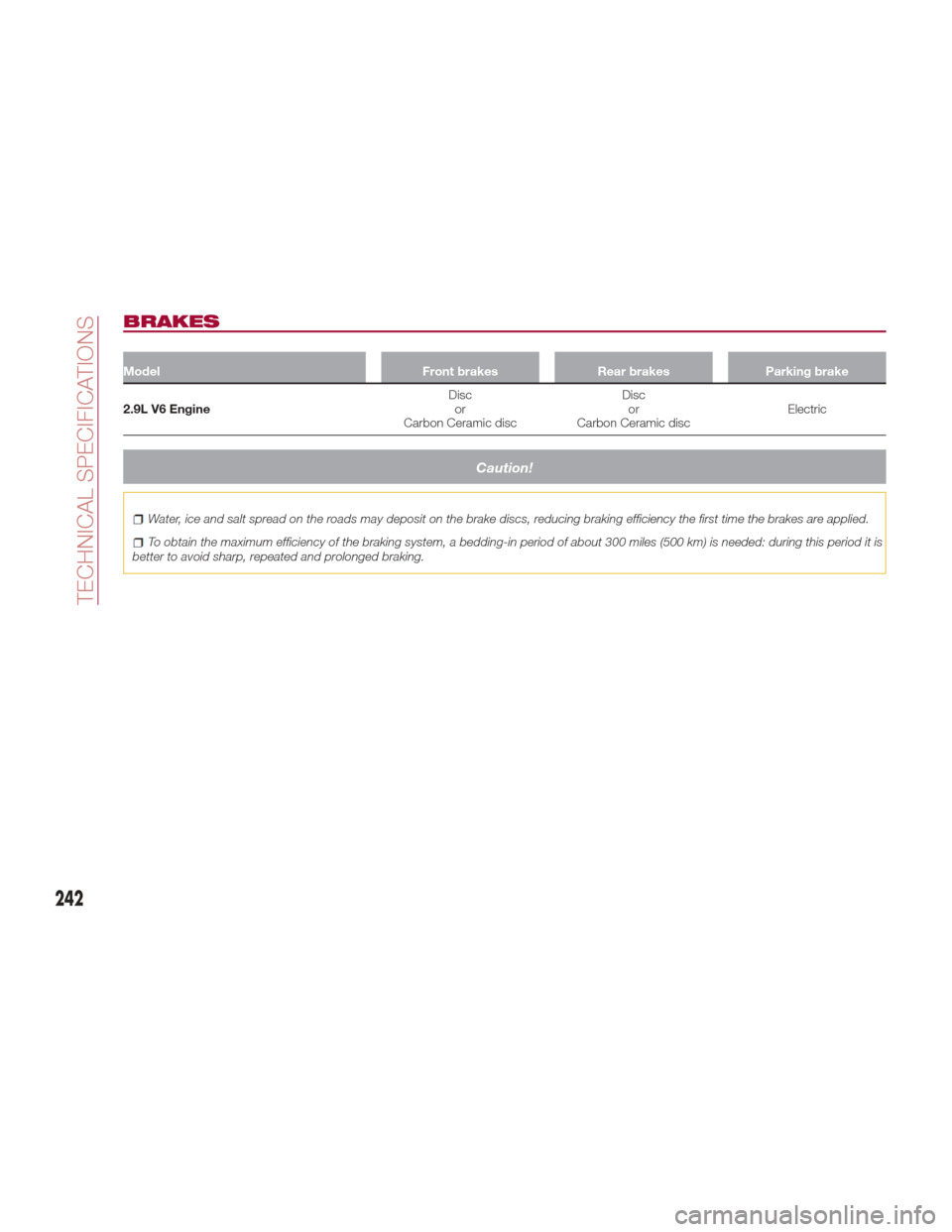
BRAKES
ModelFront brakesRear brakesParking brake
2.9L V6 Engine Disc
or
Carbon
Ceramic discDisc
or
Carbon Ceramic disc Electric
Caution!
Water, ice and salt spread on the roads may deposit on the brake discs, reducing braking efficiency the first time the brakes are applied.
To obtain the maximum efficiency of the braking system, a bedding-in period of about 300 miles (500 km) is needed: during this period it is
better to avoid sharp, repeated and prolonged braking.
242
TECHNICAL SPECIFICATIONS
Page 246 of 268
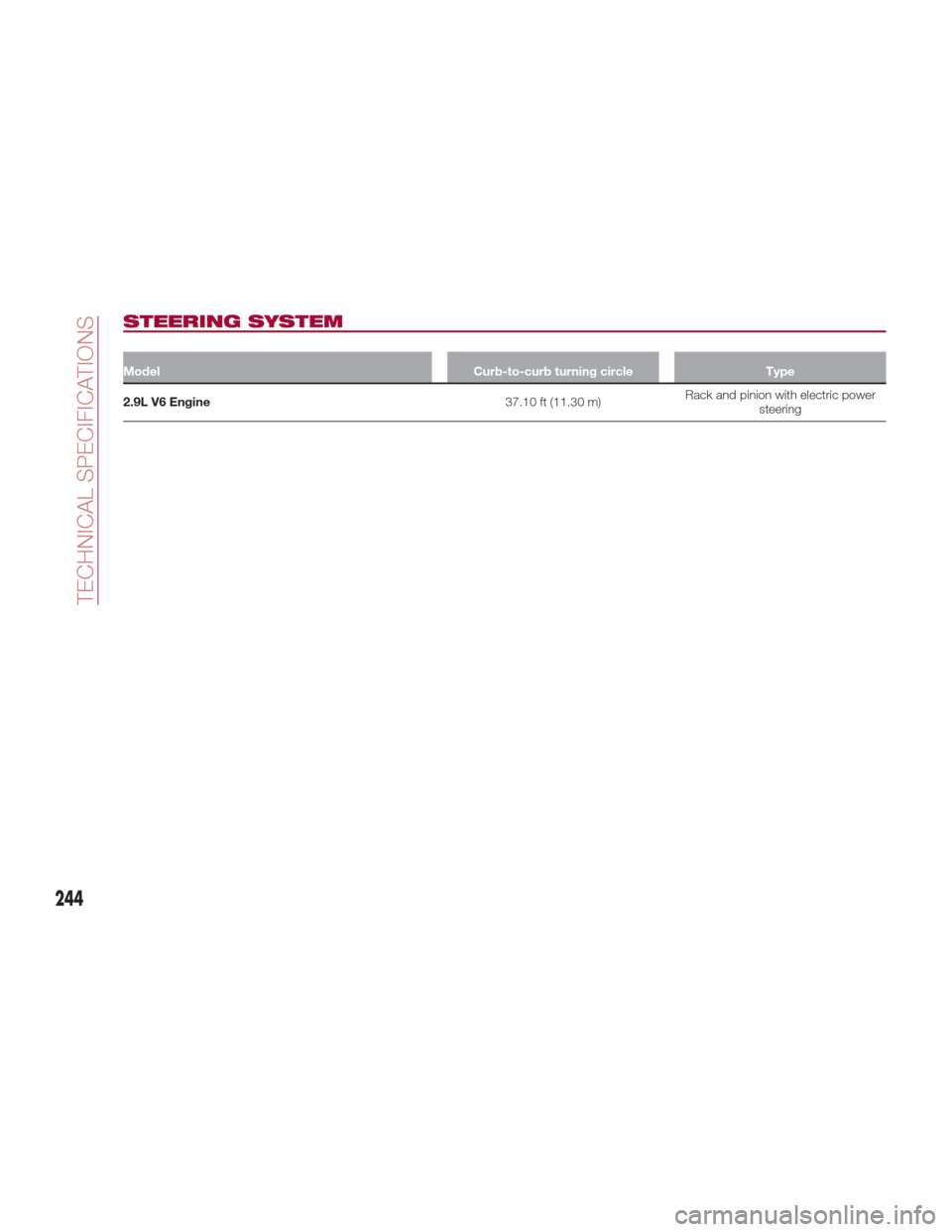
STEERING SYSTEM
ModelCurb-to-curb turning circleType
2.9L V6 Engine 37.10
ft (11.30 m)Rack and pinion with electric power
steering
244
TECHNICAL SPECIFICATIONS
Page 248 of 268
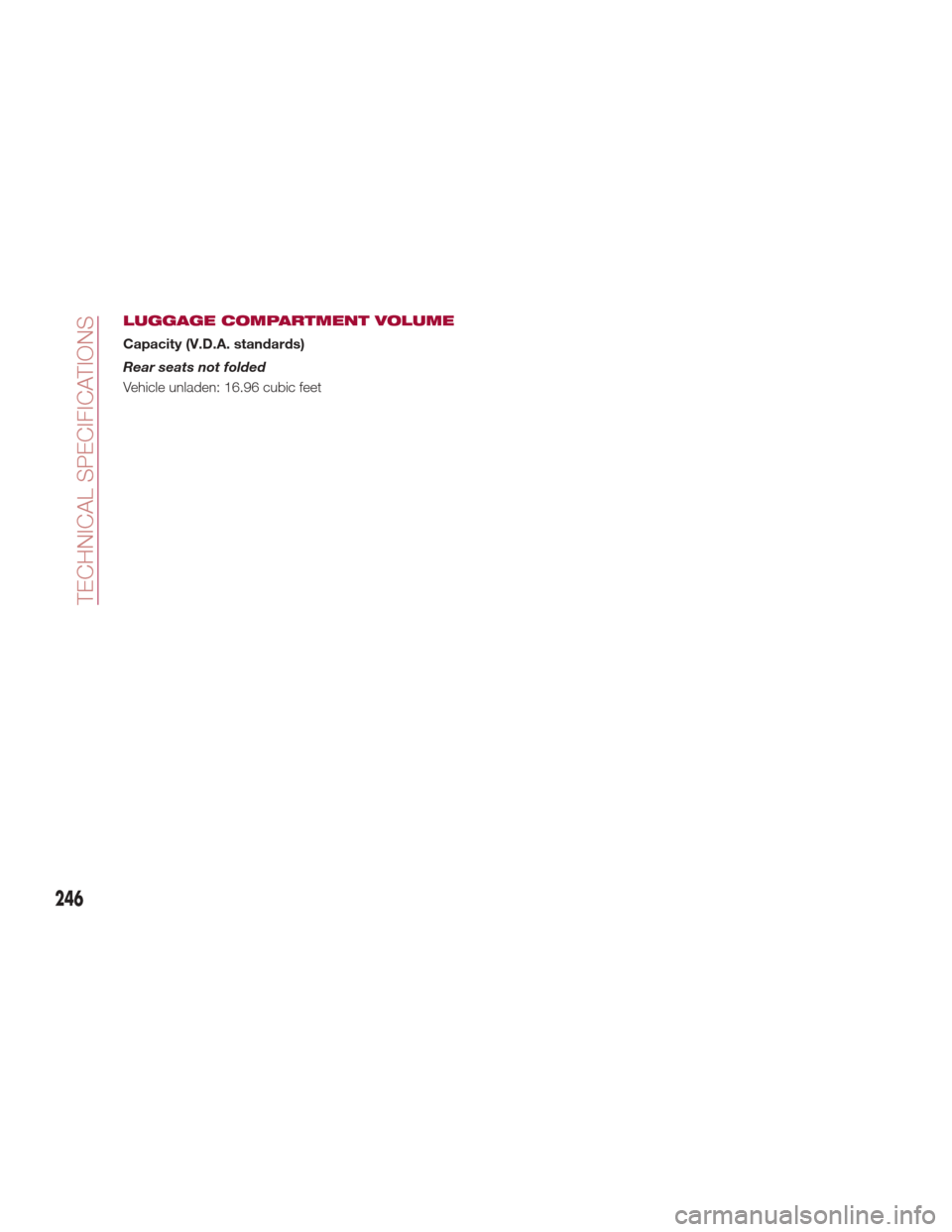
LUGGAGE COMPARTMENT VOLUME
Capacity (V.D.A. standards)
Rear seats not folded
Vehicle unladen: 16.96 cubic feet
246
TECHNICAL SPECIFICATIONS
Page 250 of 268
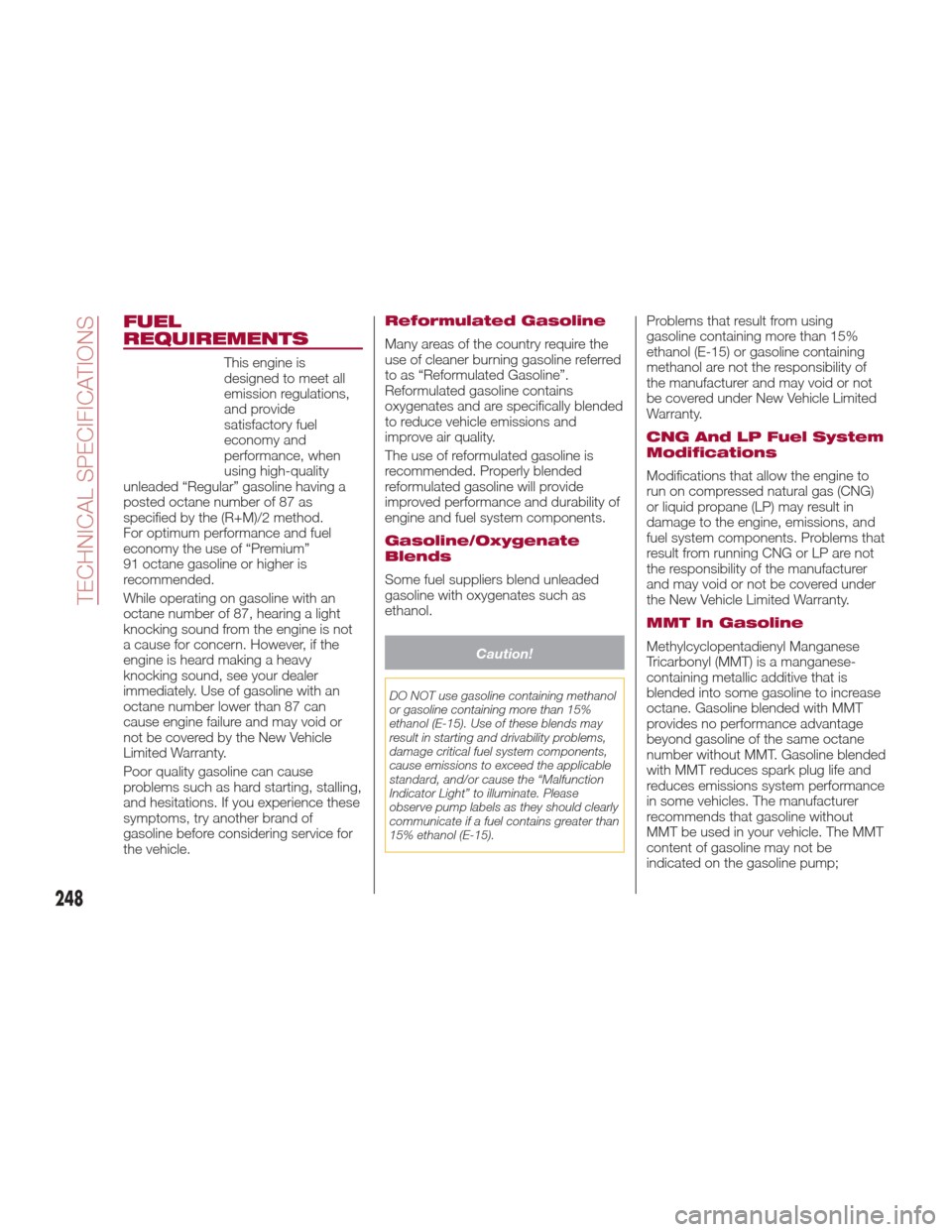
FUEL
REQUIREMENTS
This engine is
designed to meet all
emission regulations,
and provide
satisfactory fuel
economy and
performance, when
using high-quality
unleaded “Regular” gasoline having a
posted octane number of 87 as
specified by the (R+M)/2 method.
For optimum performance and fuel
economy the use of “Premium”
91 octane gasoline or higher is
recommended.
While operating on gasoline with an
octane number of 87, hearing a light
knocking sound from the engine is not
a cause for concern. However, if the
engine is heard making a heavy
knocking sound, see your dealer
immediately. Use of gasoline with an
octane number lower than 87 can
cause engine failure and may void or
not be covered by the New Vehicle
Limited Warranty.
Poor quality gasoline can cause
problems such as hard starting, stalling,
and hesitations. If you experience these
symptoms, try another brand of
gasoline before considering service for
the vehicle.
Reformulated Gasoline
Many areas of the country require the
use of cleaner burning gasoline referred
to as “Reformulated Gasoline”.
Reformulated gasoline contains
oxygenates and are specifically blended
to reduce vehicle emissions and
improve air quality.
The use of reformulated gasoline is
recommended. Properly blended
reformulated gasoline will provide
improved performance and durability of
engine and fuel system components.
Gasoline/Oxygenate
Blends
Some fuel suppliers blend unleaded
gasoline with oxygenates such as
ethanol.
Caution!
DO NOT use gasoline containing methanol
or gasoline containing more than 15%
ethanol (E-15). Use of these blends may
result in starting and drivability problems,
damage critical fuel system components,
cause emissions to exceed the applicable
standard, and/or cause the “Malfunction
Indicator Light” to illuminate. Please
observe pump labels as they should clearly
communicate if a fuel contains greater than
15% ethanol (E-15).
Problems that result from using
gasoline containing more than 15%
ethanol (E-15) or gasoline containing
methanol are not the responsibility of
the manufacturer and may void or not
be covered under New Vehicle Limited
Warranty.
CNG And LP Fuel System
Modifications
Modifications that allow the engine to
run on compressed natural gas (CNG)
or liquid propane (LP) may result in
damage to the engine, emissions, and
fuel system components. Problems that
result from running CNG or LP are not
the responsibility of the manufacturer
and may void or not be covered under
the New Vehicle Limited Warranty.
MMT In Gasoline
Methylcyclopentadienyl Manganese
Tricarbonyl (MMT) is a manganese-
containing metallic additive that is
blended into some gasoline to increase
octane. Gasoline blended with MMT
provides no performance advantage
beyond gasoline of the same octane
number without MMT. Gasoline blended
with MMT reduces spark plug life and
reduces emissions system performance
in some vehicles. The manufacturer
recommends that gasoline without
MMT be used in your vehicle. The MMT
content of gasoline may not be
indicated on the gasoline pump;
248
TECHNICAL SPECIFICATIONS
Page 252 of 268
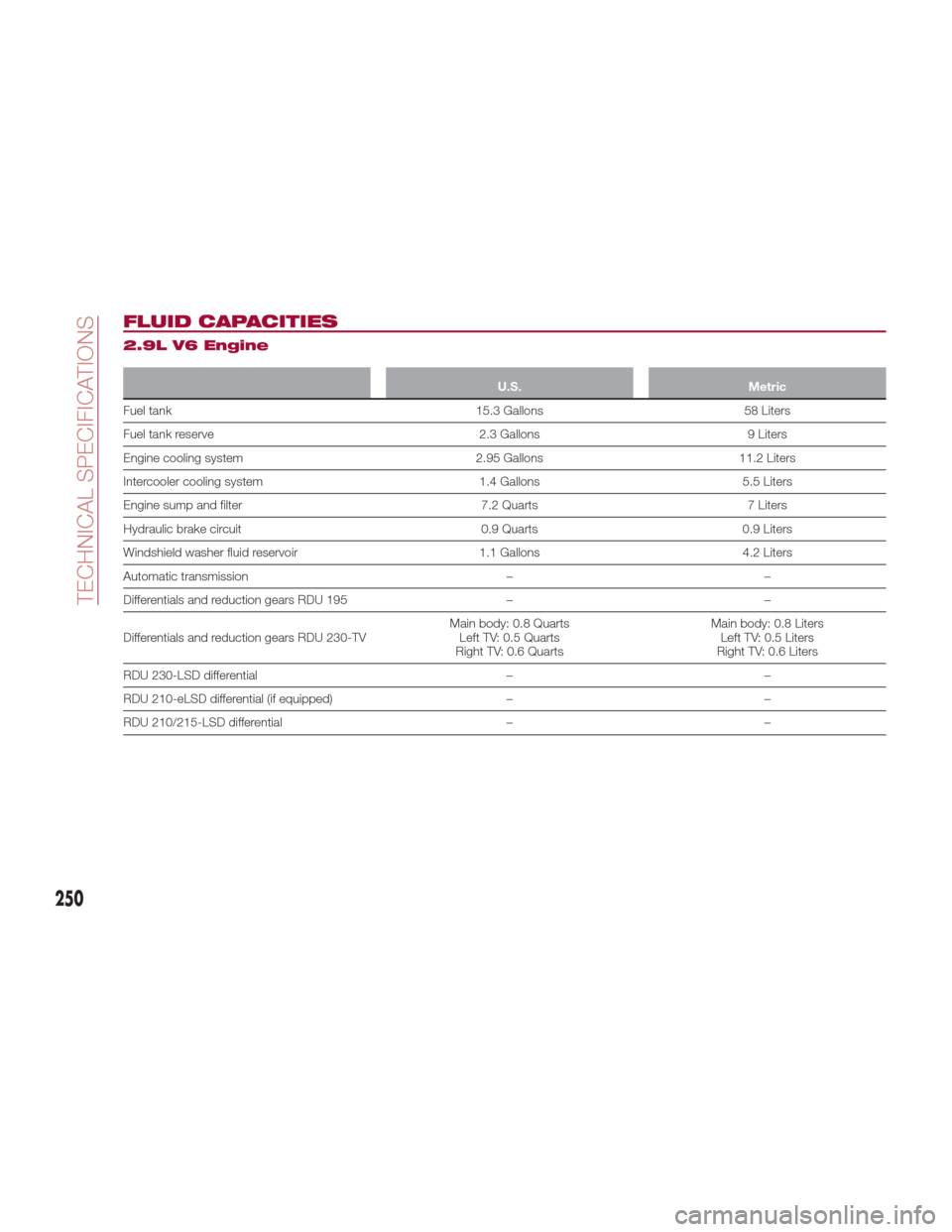
FLUID CAPACITIES
2.9L V6 Engine
U.S.Metric
Fuel tank 15.3 Gallons58 Liters
Fuel
tank reserve 2.3 Gallons9 Liters
Engine cooling system 2.95 Gallons11.2 Liters
Intercooler cooling system 1.4 Gallons5.5 Liters
Engine sump and filter 7.2 Quarts7 Liters
Hydraulic brake circuit 0.9 Quarts0.9 Liters
Windshield washer fluid reservoir 1.1 Gallons4.2 Liters
Automatic transmission ––
Differentials and reduction gears RDU 195 ––
Differentials and reduction gears RDU 230-TV Main body: 0.8 Quarts
Left TV: 0.5 Quarts
Right TV: 0.6 Quarts Main body: 0.8 Liters
Left TV: 0.5 Liters
Right TV: 0.6 Liters
RDU 230-LSD differential ––
RDU 210-eLSD differential (if equipped) ––
RDU 210/215-LSD differential ––
250
TECHNICAL SPECIFICATIONS
Page 254 of 268
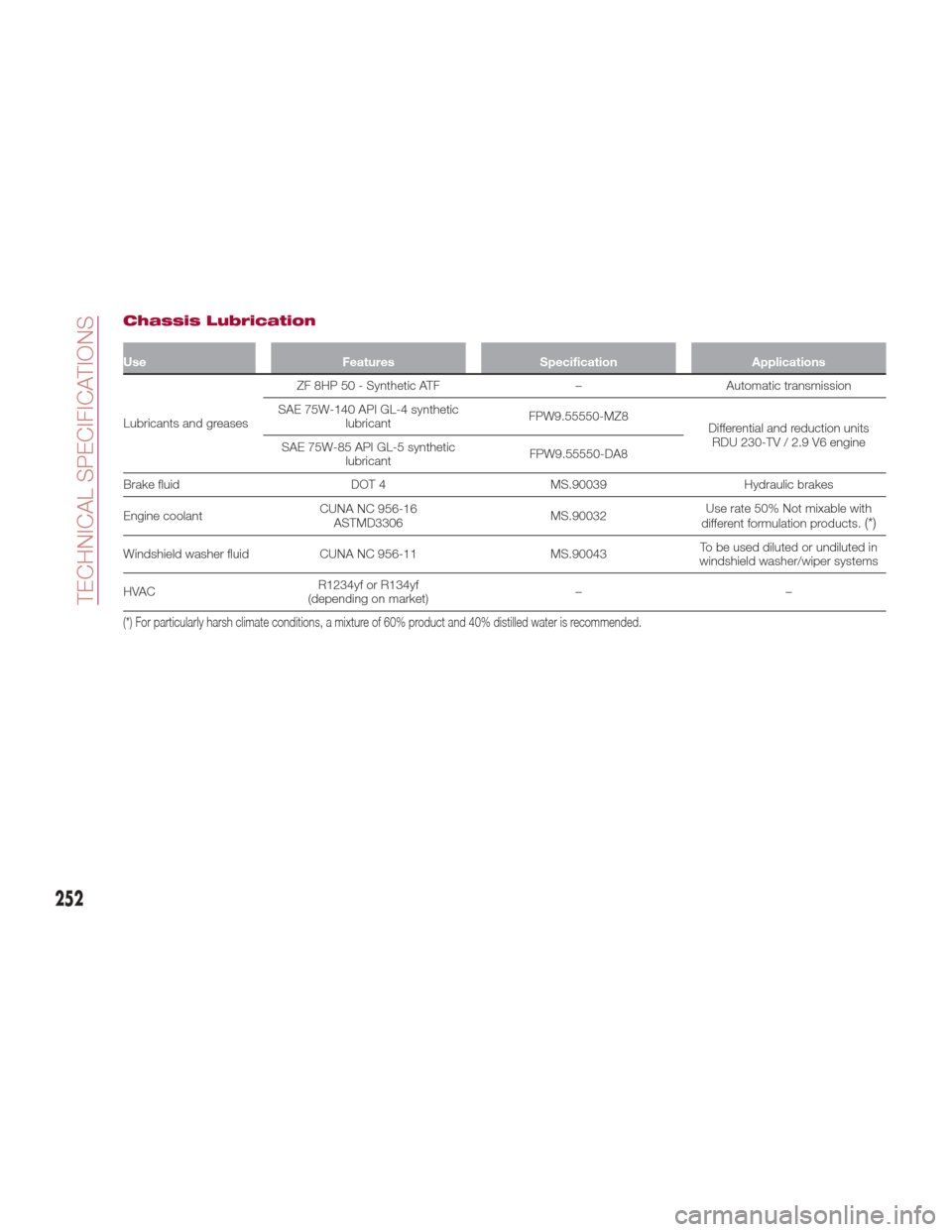
Chassis Lubrication
UseFeaturesSpecification Applications
Lubricants and greases ZF
8HP 50 - Synthetic ATF
–Automatic transmission
SAE 75W-140 API GL-4 synthetic lubricant FPW9.55550-MZ8
Differential and reduction units
RDU 230-TV / 2.9 V6 engine
SAE 75W-85 API GL-5 synthetic
lubricant FPW9.55550-DA8
Brake fluid DOT 4MS.90039Hydraulic brakes
Engine coolant CUNA NC 956-16
ASTMD3306 MS.90032Use rate 50% Not mixable with
different formulation products.
(*)
Windshield washer fluid CUNA NC 956-11 MS.90043To be used diluted or undiluted in
windshield washer/wiper systems
HVAC R1234yf or R134yf
(depending on market) ––
(*) For particularly harsh climate conditions, a mixture of 60% product and 40% distilled water is recommended.
252
TECHNICAL SPECIFICATIONS