seats Alfa Romeo Giulietta 2011 Owner handbook (in English)
[x] Cancel search | Manufacturer: ALFA ROMEO, Model Year: 2011, Model line: Giulietta, Model: Alfa Romeo Giulietta 2011Pages: 297, PDF Size: 9.37 MB
Page 138 of 297
134
GETTING
TO KNOW
YOUR CAR
SAFETY
STARTING
AND DRIVING
IN AN
EMERGENCY
SERVICING AND
MAINTENANCE
TECHNICAL
SPECIFICATIONS
CONTENTS
Front seats (warning light no. 1 = driver and
no. 5 = passenger)
Driver
If the driver is the only occupant and the seat belt is not fastened,
when 20 km/h is exceeded or when travelling at a speed from 10
to 20 km/h for longer than 5 seconds, an acoustic signal sequence
will be started (front seats) consisting of a tone for 6 seconds fol-
lowed by a 90 second beep. The warning light will blink. Once the
cycle is complete, the warning lights stay on with a fixed light un-
til the car is turned off. The acoustic signal will be interrupted im-
mediately when the driver’s seat belt is fastened and the warning
light will turn green.
If the seat belt is again unfastened when the car is in motion, the
acoustic signal and the red warning light blinking resume as de-
scribed previously.
Passenger
A similar solution applies for the front passenger, with the differ-
ence that the warning light turns green and the signal is interrupted
also when the passenger leaves the car.
If both front seat belts are unfastened with the car in motion a few
seconds apart, the acoustic signal will refer to the most recent event
while the two warning lights will issue a visual signal independently.
Rear seats (warning light no. 2, no. 3
and no. 4)
The signalling cycle is run only when any rear seat belt is unfas-
tened (blinking red). In this condition, the warning light referred
to the seat belt which has been unfastened will start blinking (red)
for approximately 30 seconds. An acoustic signal will also sound.
The visual signal (blinking red) will start and end independently for
each warning light if several seat belts are unfastened. The visual
signal will turn green after the corresponding seat has been fas-
tened.
The rear seat warning lights will go out, regardless of the state of
the belt (red or green) approximately 30 seconds after the last sig-
nal.
WARNINGS
All warning lights will remain off if all the seat belts (front and rear)
are already fastened when the key it turned to MAR.
All the warning lights will come on when at least one belt changes
from fastened to unfastened status or vice versa.
Page 140 of 297
136
GETTING
TO KNOW
YOUR CAR
SAFETY
STARTING
AND DRIVING
IN AN
EMERGENCY
SERVICING AND
MAINTENANCE
TECHNICAL
SPECIFICATIONS
CONTENTS
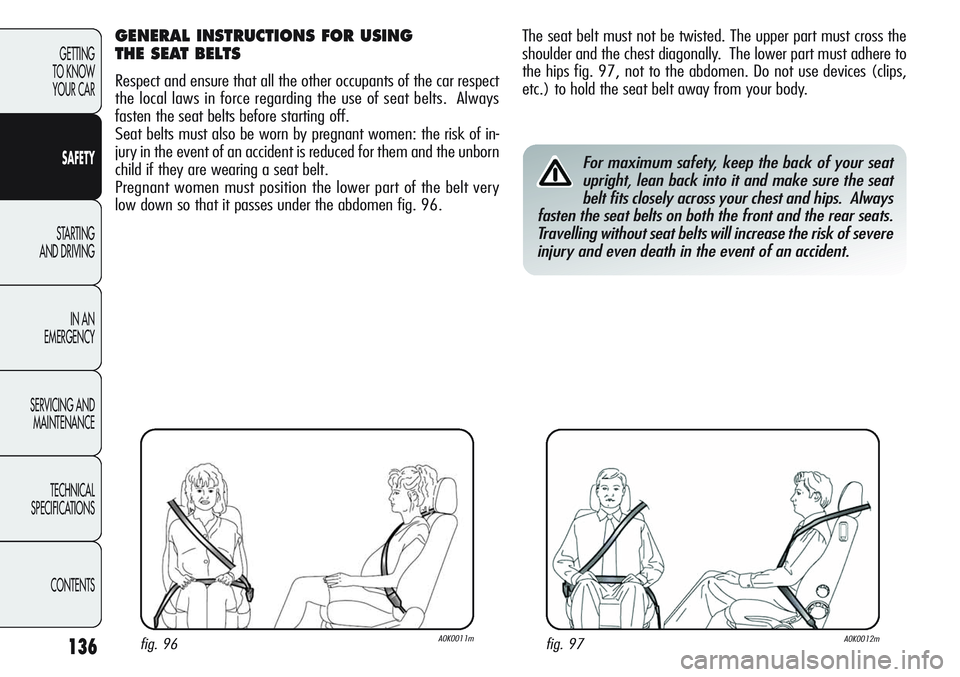
The seat belt must not be twisted. The upper part must cross the
shoulder and the chest diagonally. The lower part must adhere to
the hips fig. 97, not to the abdomen. Do not use devices (clips,
etc.) to hold the seat belt away from your body.
fig. 97A0K0012m
For maximum safety, keep the back of your seat
upright, lean back into it and make sure the seat
belt fits closely across your chest and hips. Always
fasten the seat belts on both the front and the rear seats.
Travelling without seat belts will increase the risk of severe
injury and even death in the event of an accident.
GENERAL INSTRUCTIONS FOR USING
THE SEAT BELTS
Respect and ensure that all the other occupants of the car respect
the local laws in force regarding the use of seat belts. Always
fasten the seat belts before starting off.
Seat belts must also be worn by pregnant women: the risk of in-
jury in the event of an accident is reduced for them and the unborn
child if they are wearing a seat belt.
Pregnant women must position the lower part of the belt very
low down so that it passes under the abdomen fig. 96.
fig. 96A0K0011m
Page 142 of 297
138
GETTING
TO KNOW
YOUR CAR
SAFETY
STARTING
AND DRIVING
IN AN
EMERGENCY
SERVICING AND
MAINTENANCE
TECHNICAL
SPECIFICATIONS
CONTENTS
CARRYING CHILDREN SAFELY
For optimum protection in the event of a crash, all passengers must
be seated and wearing adequate restraint systems. This is even
more important for children. This prescription is compulsory in all
EC countries according to EC Directive 2003/20/EC. Compared
with an adult, a child’s head is larger and heavier in proportion to
his/her body and the child’s muscular and bone structures are
not fully developed. For this reason, they require restraint systems
which are different from those used by adults to protect them in
the event of an accident.
The result of research in relation to the best protection for chil-
dren is illustrated in European Regulation ECE-R44, which divides
child seats into five groups in addition to making their use com-
pulsory:
Group 0 up to 10 kg
Group 0+ up to 13 kg
Group 1 9-18 kg
Group 2 15-25 kg
Group 3 22-36 kg
All restraint devices must bear the type-approval data along with
the control mark on a label firmly secured to the child seat which
must never be removed. When over 1.50 m in height, from the
point of view of restraint systems, children are considered as adults
and have to wear the standard seat belts.
Should it be absolutely necessary to carry a child
on the front seat in a cradle seat facing backwards,
the passenger’s front air bag and side bag should
be deactivated by using the Set-Up Menu. Deacti-
vation can be verified by checking the
“warn-
ing light in the instrument panel. Also, the passenger seat
should be adjusted as far back as possible to avoid con-
tact between the child seat and the dashboard.
Lineaccessori Alfa Romeo includes child seats for each weight group.
These devices are recommended, having been specifically designed
for Alfa Romeo cars.
Do not arrange child seats facing backwards if the
front air bag on the passenger’s side is enabled.
Deployment of the air bag in an accident could
cause fatal injuries to the baby regardless of the severity
of the collision. It is advisable to carry children in dedi-
cated child seats on the rear seat, which is the most pro-
tected position in the event of an accident.
Page 143 of 297
139
GETTING
TO KNOW
YOUR CAR
SAFETY
STARTING
AND DRIVING
IN AN
EMERGENCY
SERVICING AND
MAINTENANCE
TECHNICAL
SPECIFICATIONS
CONTENTS
FITTING “UNIVERSAL” CHILD SEAT
(with seat belts)
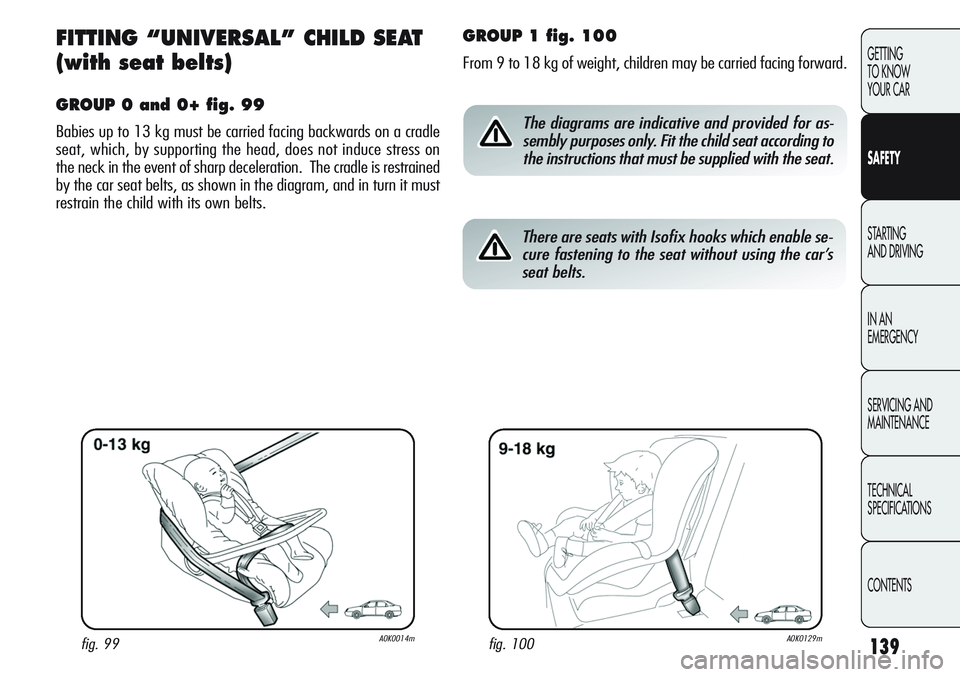
GROUP 0 and 0+ fig. 99
Babies up to 13 kg must be carried facing backwards on a cradle
seat, which, by supporting the head, does not induce stress on
the neck in the event of sharp deceleration. The cradle is restrained
by the car seat belts, as shown in the diagram, and in turn it must
restrain the child with its own belts.
fig. 99A0K0014mfig. 100A0K0129m
The diagrams are indicative and provided for as-
sembly purposes only. Fit the child seat according to
the instructions that must be supplied with the seat.
GROUP 1 fig. 100
From 9 to 18 kg of weight, children may be carried facing forward.
There are seats with Isofix hooks which enable se-
cure fastening to the seat without using the car’s
seat belts.
Page 145 of 297
141
GETTING
TO KNOW
YOUR CAR
SAFETY
STARTING
AND DRIVING
IN AN
EMERGENCY
SERVICING AND
MAINTENANCE
TECHNICAL
SPECIFICATIONS
CONTENTS
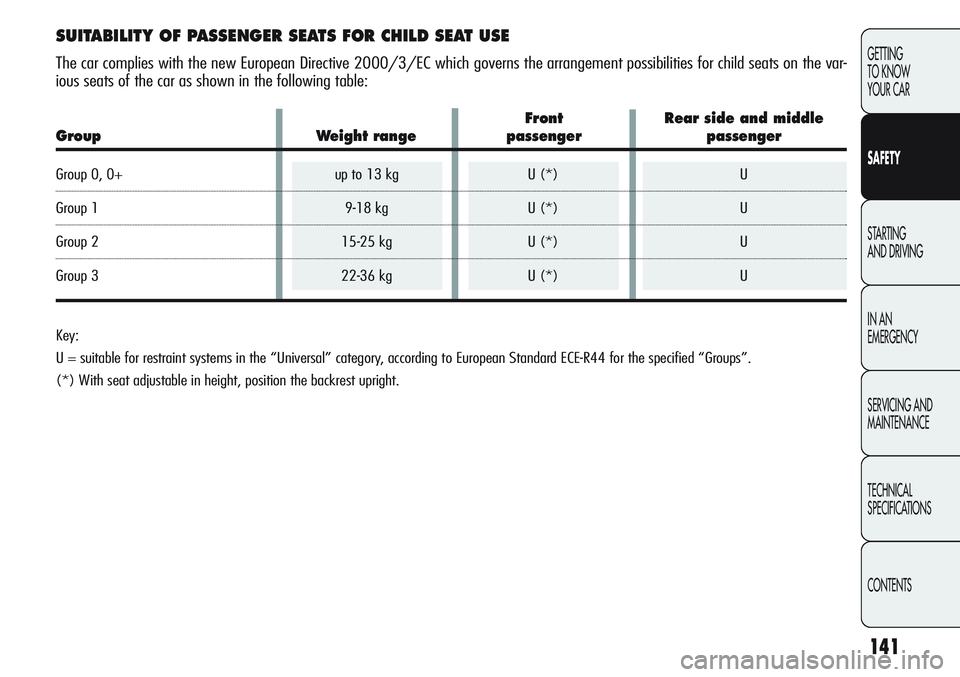
SUITABILITY OF PASSENGER SEATS FOR CHILD SEAT USE
The car complies with the new European Directive 2000/3/EC which governs the arrangement possibilities for child seats on the var-
ious seats of the car as shown in the following table:
Key:
U = suitable for restraint systems in the “Universal” category, according to European Standard ECE-R44 for the specified “Groups”.
(*) With seat adjustable in height, position the backrest upright.
Front Rear side and middle
Group Weight range passenger passenger
Group 0, 0+ up to 13 kg U (*) U
Group 1 9-18 kg U (*) U
Group 2 15-25 kg U (*) U
Group 3 22-36 kg U (*) U
Page 146 of 297
142
GETTING
TO KNOW
YOUR CAR
SAFETY
STARTING
AND DRIVING
IN AN
EMERGENCY
SERVICING AND
MAINTENANCE
TECHNICAL
SPECIFICATIONS
CONTENTS
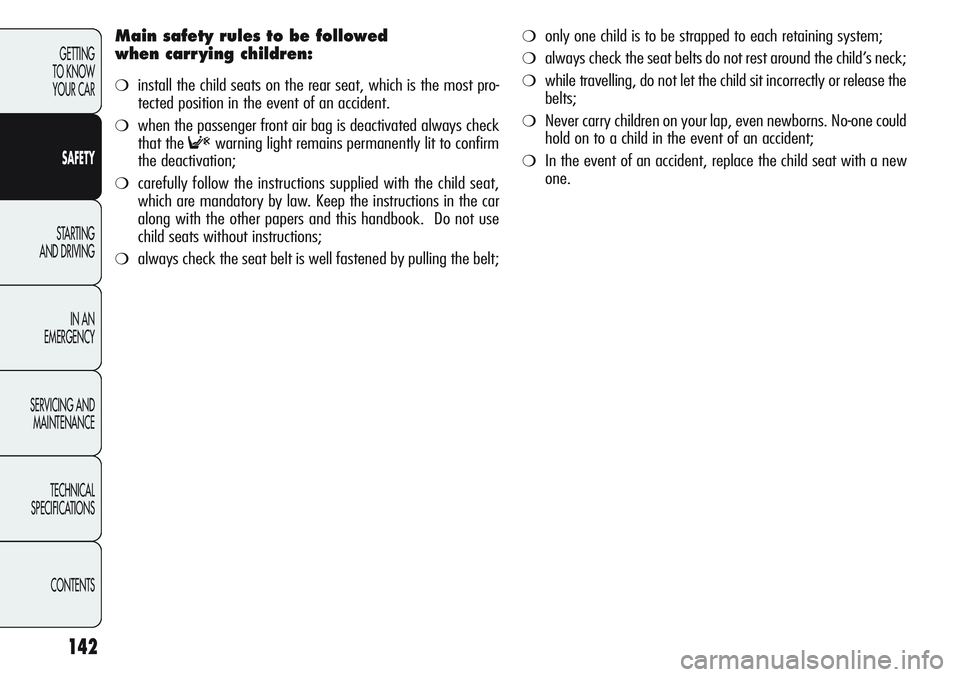
Main safety rules to be followed
when carr ying children:
❍install the child seats on the rear seat, which is the most pro-
tected position in the event of an accident.
❍when the passenger front air bag is deactivated always check
that the
Fwarning light remains permanently lit to confirm
the deactivation;
❍carefully follow the instructions supplied with the child seat,
which are mandatory by law. Keep the instructions in the car
along with the other papers and this handbook. Do not use
child seats without instructions;
❍always check the seat belt is well fastened by pulling the belt;
❍only one child is to be strapped to each retaining system;
❍always check the seat belts do not rest around the child’s neck;
❍while travelling, do not let the child sit incorrectly or release the
belts;
❍Never carry children on your lap, even newborns. No-one could
hold on to a child in the event of an accident;
❍In the event of an accident, replace the child seat with a new
one.
Page 148 of 297
144
GETTING
TO KNOW
YOUR CAR
SAFETY
STARTING
AND DRIVING
IN AN
EMERGENCY
SERVICING AND
MAINTENANCE
TECHNICAL
SPECIFICATIONS
CONTENTS
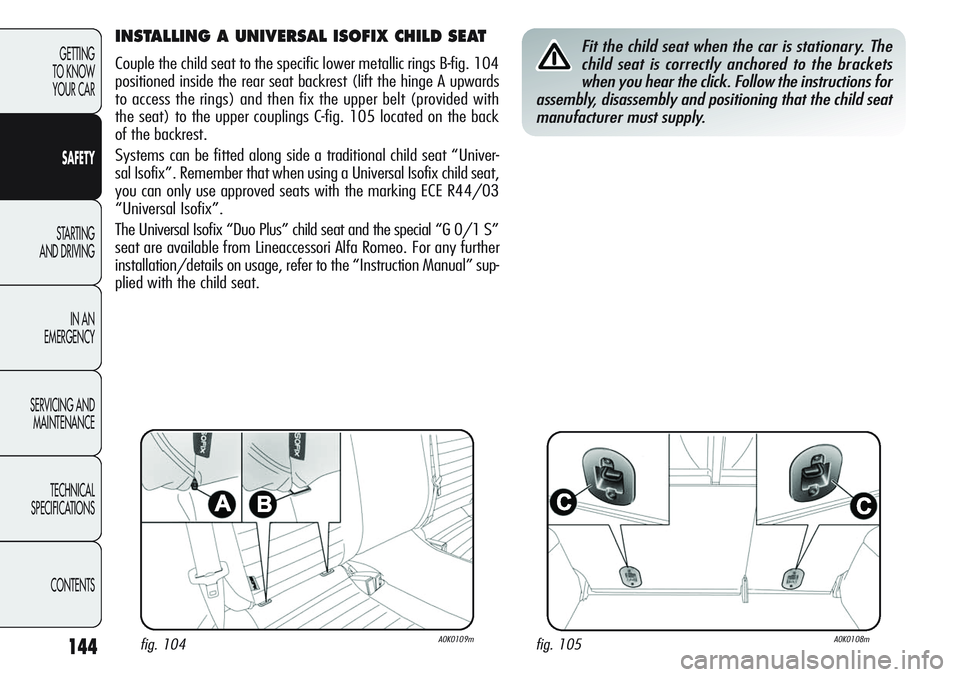
INSTALLING A UNIVERSAL ISOFIX CHILD SEAT
Couple the child seat to the specific lower metallic rings B-fig. 104
positioned inside the rear seat backrest (lift the hinge A upwards
to access the rings) and then fix the upper belt (provided with
the seat) to the upper couplings C-fig. 105 located on the back
of the backrest.
Systems can be fitted along side a traditional child seat “Univer-
sal Isofix”. Remember that when using a Universal Isofix child seat,
you can only use approved seats with the marking ECE R44/03
“Universal Isofix”.
The Universal Isofix “Duo Plus” child seat and the special “G 0/1 S”
seat are available from Lineaccessori Alfa Romeo. For any further
installation/details on usage, refer to the “Instruction Manual” sup-
plied with the child seat.
fig. 104A0K0109mfig. 105A0K0108m
Fit the child seat when the car is stationary. The
child seat is correctly anchored to the brackets
when you hear the click. Follow the instructions for
assembly, disassembly and positioning that the child seat
manufacturer must supply.
Page 149 of 297
145
GETTING
TO KNOW
YOUR CAR
SAFETY
STARTING
AND DRIVING
IN AN
EMERGENCY
SERVICING AND
MAINTENANCE
TECHNICAL
SPECIFICATIONS
CONTENTS
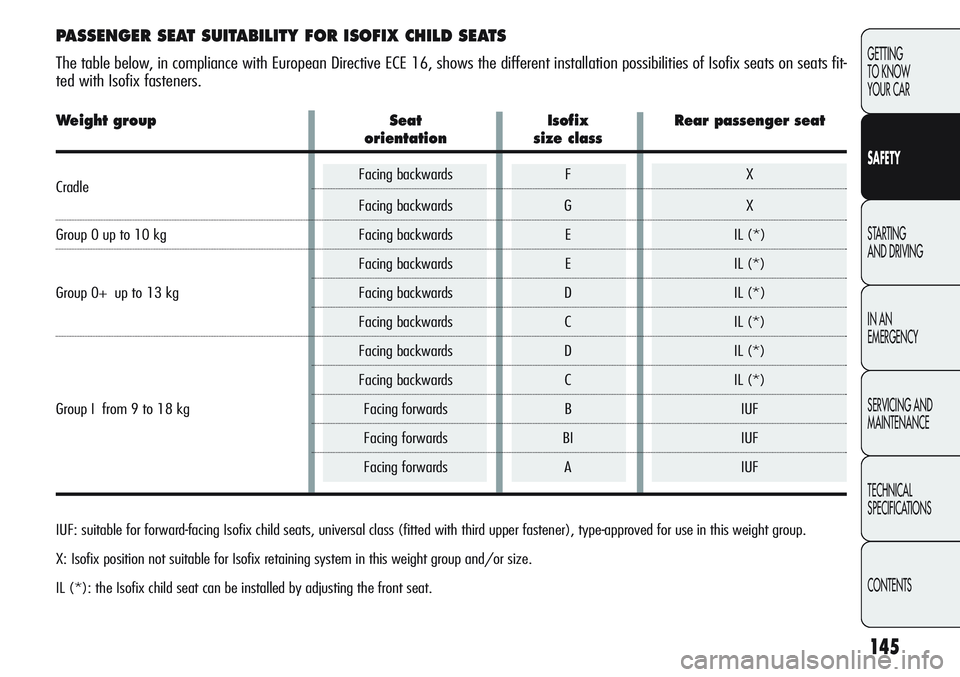
PASSENGER SEAT SUITABILITY FOR ISOFIX CHILD SEATS
The table below, in compliance with European Directive ECE 16, shows the different installation possibilities of Isofix seats on seats fit-
ted with Isofix fasteners.
IUF: suitable for forward-facing Isofix child seats, universal class (fitted with third upper fastener), type-approved for use in this weight group.
X: Isofix position not suitable for Isofix retaining system in this weight group and/or size.
IL (*): the Isofix child seat can be installed by adjusting the front seat.
Weight group Seat Isofix Rear passenger seat
orientation size class
CradleFacing backwards F X
Facing backwards G X
Group 0 up to 10 kg Facing backwards E IL (*)
Facing backwards E IL (*)
Group 0+ up to 13 kg Facing backwards D IL (*)
Facing backwards C IL (*)
Facing backwards D IL (*)
Facing backwards C IL (*)
Group I from 9 to 18 kg Facing forwards B IUF
Facing forwards BI IUF
Facing forwards A IUF
Page 151 of 297
147
GETTING
TO KNOW
YOUR CAR
SAFETY
STARTING
AND DRIVING
IN AN
EMERGENCY
SERVICING AND
MAINTENANCE
TECHNICAL
SPECIFICATIONS
CONTENTS
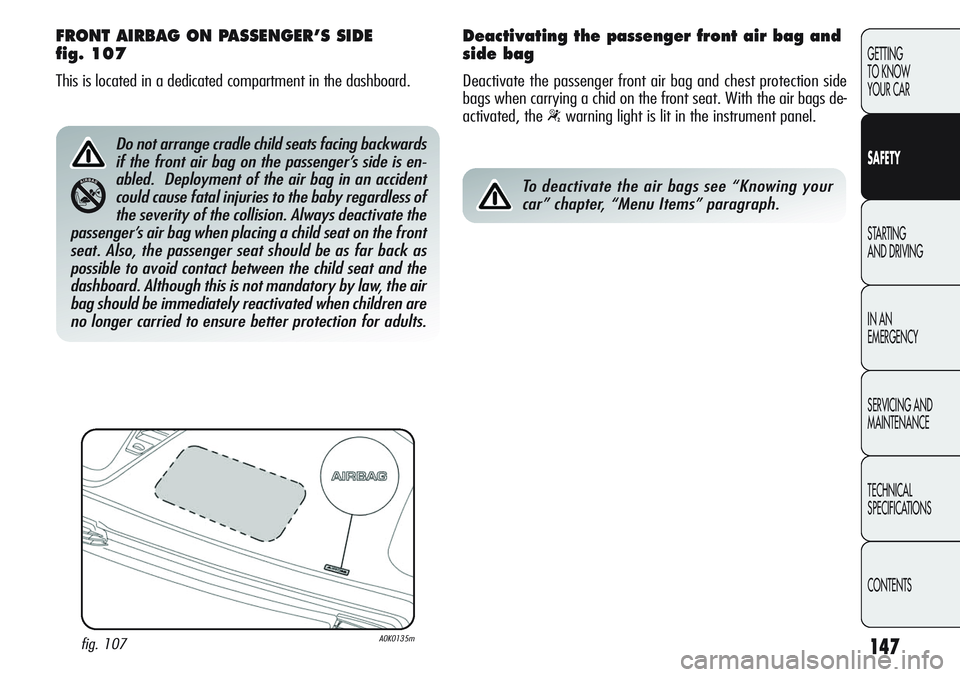
FRONT AIRBAG ON PASSENGER’S SIDE
fig. 107
This is located in a dedicated compartment in the dashboard.
fig. 107A0K0135m
Do not arrange cradle child seats facing backwards
if the front air bag on the passenger’s side is en-
abled. Deployment of the air bag in an accident
could cause fatal injuries to the baby regardless of
the severity of the collision. Always deactivate the
passenger’s air bag when placing a child seat on the front
seat. Also, the passenger seat should be as far back as
possible to avoid contact between the child seat and the
dashboard. Although this is not mandatory by law, the air
bag should be immediately reactivated when children are
no longer carried to ensure better protection for adults.
To deactivate the air bags see “Knowing your
car” chapter, “Menu Items” paragraph.
Deactivating the passenger front air bag and
side bag
Deactivate the passenger front air bag and chest protection side
bags when carrying a chid on the front seat. With the air bags de-
activated, the
“warning light is lit in the instrument panel.
Page 153 of 297
149
GETTING
TO KNOW
YOUR CAR
SAFETY
STARTING
AND DRIVING
IN AN
EMERGENCY
SERVICING AND
MAINTENANCE
TECHNICAL
SPECIFICATIONS
CONTENTS
WARNINGS
Do not wash the seats with water or pressurised steam (wash by
hand or at automatic seat washing stations).
The front and/or side air bags may activate in the event of sharp
impacts to the underbody of the car (e.g. impact with steps, pave-
ments, potholes or road bumps etc.).
A small amount of dust will be released when the airbags are de-
ployed. This is not harmful and does not indicate a fire. Dust may
irritate your skin and eyes: in this case, wash with mild soap and
water.
All operations on air bags (inspections, repairs and replacement)
must be carried out by Alfa Romeo Authorized Services.
If the car is to be scrapped, contact Alfa Romeo Authorized Ser-
vices to have the air bags deactivated.
Pretensioners and airbags are deployed according to different log-
ics on the basis of the type of collision. Failure to deploy of one
or more of these devices does not therefore indicate a system fault.Do not hook rigid objects to the clothes hangers or
support handles.
Do not rest your head, arms or elbows on the door,
windows or on the window bag area to avoid in-
juries during inflation.
Never lean your head, arms or elbows out of the
window.