Temperature Alfa Romeo Giulietta 2014 User Guide
[x] Cancel search | Manufacturer: ALFA ROMEO, Model Year: 2014, Model line: Giulietta, Model: Alfa Romeo Giulietta 2014Pages: 280, PDF Size: 6.65 MB
Page 38 of 280
SWITCHING OFF/ON THE
CLIMATE CONTROL
SYSTEM
Switching off the
climate control system
Press the
button (LED on button off).
With climate control off:
❒air recirculation is on, thus isolating
the passenger compartment from
the outside;
❒the compressor is off;
❒the fan is off;
❒the heated rear window can be
switched on or off;
❒the AQS (Air Quality System) function
cannot be activated.
IMPORTANT The climate control
system control unit stores the
temperatures set before the system
was switched off and restores them
when any button of the system is
pressed (except for button D).
Switching on the climate
control system
To switch on the climate control system
in fully automatic mode press the AUTO
button.START&STOP
Automatic Climate
Control
The dual zone automatic climate control
manages the Start&Stop function
(engine off when the car speed is zero)
to guarantee a suitable comfort inside
the car.
Specifically, the Start&Stop function is
turned off when the weather is
particularly hot or cold to guarantee an
adequate level of comfort inside the
passenger compartment; therefore, the
engine will not be stopped during
these transient conditions, even if the
speed is zero.
When the Start&Stop function is active
(engine off at zero car speed), the
climate control system will request
restarting of the engine if the inside
temperature conditions rapidly
deteriorate (or if the user requests
maximum cooling – LO – or quick
demisting – MAX DEF).
With the Start&Stop function on (engine
off at zero speed), air flow is reduced
to the minimum to maintain comfort
conditions inside the passenger
compartment as long as possible when
the system is in AUTO mode (LED N
on).The climate control system control unit
attempts to manage the discomfort
caused by the engine stopping
(compressor and engine coolant pump
off) but operation of the climate control
system can be enhanced by turning
the Start&Stop off by pressing the
dedicated button on the dashboard.
NoteIn particularly severe climate
conditions it is recommended to limit
the use of the Start&Stop function
to prevent the compressor from
continuously switching on and off, with
consequent rapid misting of the
windows and accumulation of humidity
with unpleasant smells in the passenger
compartment.
NoteWhen the Start&Stop function is
on (engine off and vehicle speed zero),
the automatic recirculation
management is turned off always taking
air in from outside, to reduce the
probability of window misting up (as the
compressor is off).
34
GETTING TO KNOW YOUR CAR
Page 39 of 280
ADDITIONAL HEATER
(for versions/markets, where provided)
This allows the passenger
compartment to be heated more
quickly in cold weather conditions. The
additional heater turns off automatically
after the required comfort conditions
are achieved.
Automatic dual zone
climate control system
(for versions/markets, where provided)
The additional heater activates
automatically depending on the
environmental conditions and with
engine started.
Manual climate control
system
The additional heater activates
automatically when knob A is turned to
the end of the red section and the fan
is set to at least 1
stspeed.
IMPORTANT The heater only works if
the outside temperature and engine
coolant temperature are low. The heater
will not activate if the battery voltage is
too low.
IMPORTANT
2) The climate control system
detects the passenger
compartment temperature with a
mean radiant temperature sensor
fitted in a cover under the internal
rear view mirror. Obstructing the
field of view of this sensor with
any object could cause the
climate control system to operate
with less than optimal efficiency
EXTERNAL LIGHTS
IN BRIEF
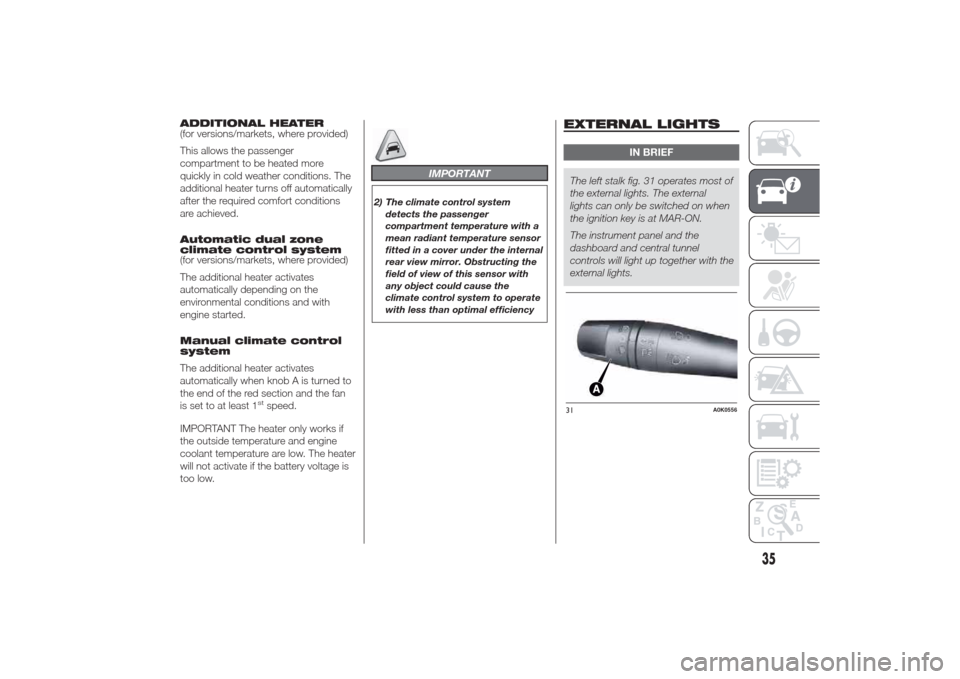
The left stalk fig. 31 operates most of
the external lights. The external
lights can only be switched on when
the ignition key is at MAR-ON.
The instrument panel and the
dashboard and central tunnel
controls will light up together with the
external lights.31
A0K0556
35
Page 51 of 280
INTERIOR FITTINGSSTORAGE
COMPARTMENTS
19)
Upper compartment
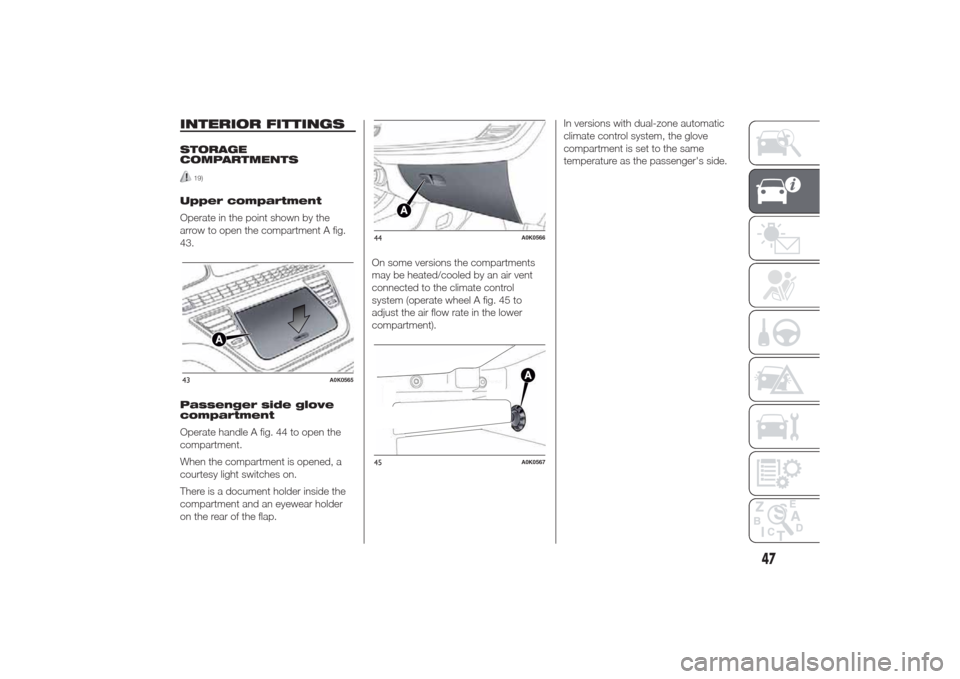
Operate in the point shown by the
arrow to open the compartment A fig.
43.
Passenger side glove
compartment
Operate handle A fig. 44 to open the
compartment.
When the compartment is opened, a
courtesy light switches on.
There is a document holder inside the
compartment and an eyewear holder
on the rear of the flap.On some versions the compartments
may be heated/cooled by an air vent
connected to the climate control
system (operate wheel A fig. 45 to
adjust the air flow rate in the lower
compartment).In versions with dual-zone automatic
climate control system, the glove
compartment is set to the same
temperature as the passenger's side.43
A0K0565
44
A0K0566
45
A0K0567
47
Page 55 of 280
SUN VISORS
These are located at the sides of the
interior rear view mirror. They can be
adjusted forwards and sideways.
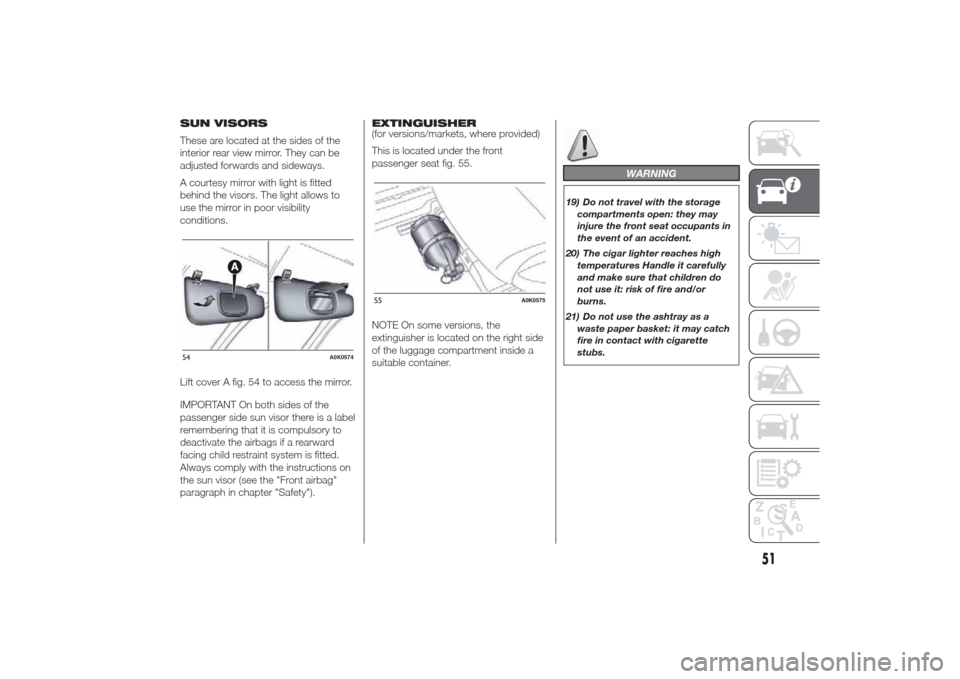
A courtesy mirror with light is fitted
behind the visors. The light allows to
use the mirror in poor visibility
conditions.
Lift cover A fig. 54 to access the mirror.
IMPORTANT On both sides of the
passenger side sun visor there is a label
remembering that it is compulsory to
deactivate the airbags if a rearward
facing child restraint system is fitted.
Always comply with the instructions on
the sun visor (see the "Front airbag"
paragraph in chapter "Safety").EXTINGUISHER
(for versions/markets, where provided)
This is located under the front
passenger seat fig. 55.
NOTE On some versions, the
extinguisher is located on the right side
of the luggage compartment inside a
suitable container.
WARNING
19) Do not travel with the storage
compartments open: they may
injure the front seat occupants in
the event of an accident.
20) The cigar lighter reaches high
temperatures Handle it carefully
and make sure that children do
not use it: risk of fire and/or
burns.
21) Do not use the ashtray as a
waste paper basket: it may catch
fire in contact with cigarette
stubs.
54
A0K0574
55
A0K0575
51
Page 78 of 280
ENGINE STOPPING
FAILURE CONDITIONS
When the system is active, due to
comfort, emission control and safety
reasons, the engine does not stop
in some conditions, among which
10):
❒engine still cold;
❒especially cold outside temperature;
❒battery not sufficiently charged;
❒particulate filter regeneration (DPF) in
progress (diesel engines only);
❒driver's door not shut;
❒driver's seat belt not fastened;
❒reverse gear engaged (for example,
for parking manoeuvres);
❒for versions equipped with dual zone
automatic climate control (for
versions/markets, where provided), if
an adequate level of thermal comfort
has not been reached or with
MAX-DEF function activation;
❒during the first period of use, to
initialise the system.ENGINE RESTARTING
CONDITIONS
Due to comfort, emission control and
safety reasons, the engine can restart
automatically without any action by the
driver, under special conditions, such
as:
❒battery not sufficiently charged;
❒reduced braking system vacuum
(e.g. if the brake pedal is pressed
repeatedly);
❒car moving (e.g. when driving on
roads with a gradient);
❒engine stopping by Start&Stop
system for over 3 minutes;
❒for versions equipped with dual zone
automatic climate control system (for
versions/markets, where provided),
if an adequate level of thermal
comfort has not been reached or
MAX-DEF function activation.
With gear engaged, automatic engine
restarting is possible only by fully
depressing the clutch pedal. The driver
is informed by the displaying of a
message on the display and -
for versions/markets, where provided -
by the flashing of the symbol
.Notes
If the clutch is not pressed, about 3
minutes after the engine stops, the
engine can be restarted only using the
ignition key.
In cases when the engine stops and
this is not desired, due for example to
the clutch pedal being released sharply
with a gear engaged, if the Start&Stop
system is activated, the engine can
be restarted by fully depressing the
clutch pedal or by placing the gear lever
in neutral.
SAFETY FUNCTIONS
When the engine is stopped by the
Start&Stop system, if the driver releases
his/her seat belt and opens the driver's
or passenger's door, the engine can
be restarted only using the ignition key.
The driver is informed by a buzzer
and by the flashing of the symbol
on
the display; on some versions, a
message is displayed as well.
74
GETTING TO KNOW YOUR CAR
Page 89 of 280
60) Parking and other dangerous
manoeuvres are, however, always
the driver’s responsibility. While
carrying out these manoeuvres,
always make sure that no people
(especially children) or animals are
in the area concerned. The
parking sensors are an aid for the
driver, but the driver must never
allow their attention to lapse
during potentially dangerous
manoeuvres, even those executed
at low speeds.
REFUELLING THE
CARStop the engine before refuelling.
PETROL ENGINES
Only use unleaded petrol 95 R.O.N.
compliant with the European
specification EN228. The petrol octane
rating (R.O.N.) must not be lower than
95. In order to prevent damage to
the catalytic converter never introduce
even the smallest amount of leaded
petrol, even in the event of an
emergency.
DIESEL ENGINES
Use only diesel fuel compliant with
European specification EN590. The use
of other products or mixtures may
damage the engine beyond repair and
consequently invalidate the warranty,
due to the damage caused.Operation at low
temperatures
If the outside temperature is very low,
the diesel thickens due to the formation
of paraffin clots with consequent
defective operation of the fuel supply
system.
In order to avoid these problems,
different types of diesel are distributed
according to the season: summer type,
winter type and arctic type (cold,
mountain areas).
If refuelling with diesel whose
specifications are not suitable for the
usage temperature, it is advisable
to mix TUTELA DIESEL ART additive in
the proportions shown on the container
with the fuel. Pour the additive into
the tank before the fuel.
When using or parking the car for a
long time in the mountains or cold
areas, it is advisable to refuel using
locally available fuel. In this case, it is
also advisable to keep the tank over
50% full.
85
Page 91 of 280
PROTECTING THE
ENVIRONMENTThe following devices are used for
reducing petrol fuel engine emissions:
catalytic converter, oxygen sensors and
evaporation control system
The following devices are used for
reducing diesel fuel engine emissions:
oxidising catalytic converter, exhaust
gas recirculation system (EGR) and
particulate filter (DPF).
62)
DIESEL PARTICULATE
FILTER (DPF)
(Diesel Particulate Filter)
(for versions/markets, where provided)
The Diesel Particulate Filter is a
mechanical filter, integral to the exhaust
system, that physically traps carbon
particles present in the exhaust gases
of diesel engines.
The diesel particulate filter is needed to
eliminate almost all carbon particle
emissions in compliance with
current/future regulations and
standards.During standard use of the vehicle, the
engine control unit records a set of data
(e.g.: travel time, type of route,
temperatures, etc.) and it will then
calculate how much particulate has
been trapped by the filter.
Since this filter physically traps
particulate, it should be periodically
regenerated (cleaned) at regular
intervals by burning carbon particles.
The regeneration procedure is
controlled automatically by the engine
management control unit according
to the filter conditions and vehicle use
conditions.
During the regeneration there may be a
limited increase in the engine idle
speed, fan activation, a limited increase
in fumes and high temperatures at the
exhaust.
These are not faults; they do not impair
normal car performance or damage
the environment. If the dedicated
message is displayed, see contents of
"Warning lights and messages"
paragraph, in chapter "Knowing the
instrument panel".
WARNING
62) The catalytic converter and
particulate filter (DPF) reach very
high temperatures during
operation. Therefore do not park
the car on flammable materials
(e.g. grass, dry leaves, pine
needles, etc.): fire hazard.
87
Page 93 of 280
KNOWING THE INSTRUMENT PANEL
This section of the booklet gives you all
the information you need to
understand, interpret and use the
instrument panel correctly.DISPLAY ......................................... 90
MENU ITEMS .................................. 93
CONTROL PANEL AND
INSTRUMENTS ...............................100
TRIP COMPUTER ...........................102
WARNING LIGHTS AND
MESSAGES ...................................10
- LOW BRAKE FLUID/HANDBRAKE
ENGAGED .......................................... 106
- EBD FAILURE .................................. 107
- AIRBAG FAILURE ............................. 107
- SEAT BELTS NOT FASTENED .......... 107
- ALTERNATOR FAILURE ................... 108
- LOW ENGINE OIL PRESSURE ......... 1
-ENGINE OIL DETERIORATED ........... 110
- ENGINE COOLANT TEMPERATURE
TOO HIGH .......................................... 112
- ALFA TCT FAILURE .......................... 113
-INCOMPLETE DOOR LOCKING ........ 113
-SPEED LIMIT EXCEEDED ................. 113
- DUAL PINION ACTIVE STEERING
FAILURE ............................................. 114
- ALFA ROMEO CODE SYSTEM
FAILURE/ALARM FAILURE ................. 114
- FUEL RESERVE/LIMITED RANGE .... 115
- GENERAL FAILURE ......................... 116
- GENERAL FAILURE ......................... 117
-REAR FOG LIGHTS ........................... 11
- ABS FAILURE ................................... 119
-BRAKE PAD WEAR ........................... 119
- PASSENGER SIDE AIRBAG
DEACTIVATED .................................... 119
- INJECTION/EOBD SYSTEM
FAILURE ............................................. 120
- GLOW PLUG HEATING/GLOW
PLUG HEATING FAILURE (diesel
versions) ............................................. 121-WATER IN DIESEL FILTER (diesel
versions) ............................................. 121
- DPF CLEANING (particulate trap) in
progress (diesel versions with DPF
only) ................................................... 123
- iTPMS SYSTEM ............................... 125
- ELECTRONIC STABILITY CONTROL
(ESC) SYSTEM ................................... 126
- CRUISE CONTROL .......................... 127
- SIDE LIGHTS ................................... 127
- FOLLOW ME HOME ........................ 12
- DIPPED BEAM HEADLIGHTS .......... 127
- FOG LIGHTS .................................... 128
- LEFT-HAND DIRECTION
......................................... 128
- RIGHT-HAND DIRECTION
INDICATOR ........................................ 128
- MAIN BEAM HEADLIGHTS .............. 128
- FUEL CUT-OFF ................................ 12
- POSSIBLE ICE ON ROAD ................ 129
- BRAKE LIGHT FAILURE ................... 129
- DUSK SENSOR FAILURE ................. 129
- RAIN SENSOR FAILURE .................. 130
- PARKING SENSOR FAILURE ........... 130
-START&STOP SYSTEM
ACTIVATION/DEACTIVATION .............. 131
-START&STOP FAILURE .................... 131
- DISPLAY OF SELECTED DRIVING
MODE (“Alfa DNA” system) ................. 13
89
INDICATOR
687
2 9 09
Page 94 of 280
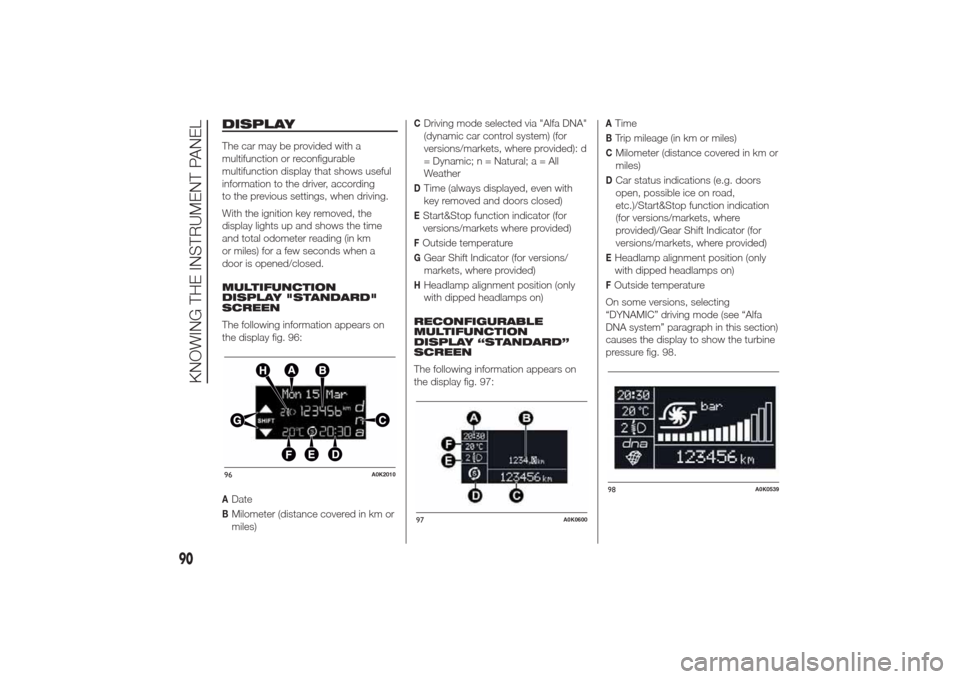
DISPLAYThe car may be provided with a
multifunction or reconfigurable
multifunction display that shows useful
information to the driver, according
to the previous settings, when driving.
With the ignition key removed, the
display lights up and shows the time
and total odometer reading (in km
or miles) for a few seconds when a
door is opened/closed.
MULTIFUNCTION
DISPLAY "STANDARD"
SCREEN
The following information appears on
the display fig. 96:ADateBMilometer (distance covered in km or
miles)
CDriving mode selected via "Alfa DNA"
(dynamic car control system) (for
versions/markets, where provided): d
= Dynamic; n = Natural;a=All
WeatherDTime (always displayed, even with
key removed and doors closed)EStart&Stop function indicator (for
versions/markets where provided)FOutside temperatureGGear Shift Indicator (for versions/
markets, where provided)HHeadlamp alignment position (only
with dipped headlamps on)
RECONFIGURABLE
MULTIFUNCTION
DISPLAY “STANDARD”
SCREEN
The following information appears on
the display fig. 97:
ATimeBTrip mileage (in km or miles)CMilometer (distance covered in km or
miles)DCar status indications (e.g. doors
open, possible ice on road,
etc.)/Start&Stop function indication
(for versions/markets, where
provided)/Gear Shift Indicator (for
versions/markets, where provided)EHeadlamp alignment position (only
with dipped headlamps on)FOutside temperature
On some versions, selecting
“DYNAMIC” driving mode (see “Alfa
DNA system” paragraph in this section)
causes the display to show the turbine
pressure fig. 98.
96
A0K2010
97
A0K0600
98
A0K0539
90
KNOWING THE INSTRUMENT PANEL
Page 101 of 280
Unit of measurement
(Setting the unit of
measurement)
With this function it is possible to set
the measurement units through three
sub-menus: “Distance”, “Consumption”
and “Temperature”.
To set the desired measurement unit,
proceed as follows:
❒briefly press the SET/
button to
display the three sub-menus;
❒press the "
"or"
" button
to navigate through the three
submenus;
❒once the submenu to be modified
has been selected, briefly press
the SET/
button;
❒when the “Distance” submenu is
entered: briefly pressing
SET/
displays "km" or "mi"
depending on the previous setting;
❒press the "
"or"
" button
to select;
❒when the “Consumption” submenu is
entered, pressing SET/displays
km/l, l/100 km or mpg depending
on the previous setting;
If the set distance unit is "km", the fuel
consumption unit will be displayed in
km/l or l/100 km.If the distance unit set is “mi” the fuel
consumption unit will be displayed
in “mpg”.
❒press the "
"or"
" button
to select;
❒when the “Temperature” submenu is
entered, pressing SET/displays
“°C” or “°F” depending on the
previous setting;
❒press the "
"or"
" button
to select;
When you have made the required
settings, briefly press the
SET/
button to go back to the
submenu screen or hold the button
down to go back to the main menu
screen without saving the new settings.
Hold the SET/
button down again
to return to the standard screen or
to the main menu according to where
you are in the menu.
Language (Language
selection)
Display messages can be shown in
different languages: Italian, English,
German, Portuguese, Spanish, French,
Dutch, Turkish and Brazilian.
To set the desired language proceed as
follows:❒briefly press the SET/
button: the
previously set "language" starts
flashing on the display;
❒press the "
"or"
" button
to select;
❒briefly press the SET/button to
go back to the menu screen or hold
the button down to go back to the
standard screen without saving.
Warnings volume
(Adjusting the
alert/warning acoustic
signal volume)
With this function it is possible to adjust
(to eight levels) the volume of the
acoustic signal which sounds in the
event of alerts and warning.
To set the desired volume proceed as
follows:
❒press the SET/
button briefly,
making the display flash the
previously set volume "level";
❒press the "
"or"
" button
to make the adjustment;
❒briefly press the SET/button to
go back to the menu screen or hold
the button down to go back to the
standard screen without saving.
97