Temperature Alfa Romeo Giulietta 2014 Owner's Guide
[x] Cancel search | Manufacturer: ALFA ROMEO, Model Year: 2014, Model line: Giulietta, Model: Alfa Romeo Giulietta 2014Pages: 280, PDF Size: 6.65 MB
Page 170 of 280
CONDITIONS OF USE
Cold starting
Short distances and frequent cold
start-ups will prevent the engine from
reaching optimal running temperature.
This results in a significant increase
in consumption levels (from +15 to
+30% on the urban cycle) and
emissions.
Traffic and road
conditions
High fuel consumption is caused by
heavy traffic, for instance when
travelling in a queue with frequent use
of low gears or in large towns with
many traffic lights. Winding mountain
roads and rough road surfaces also
adversely affect consumption.
Stops in traffic
During prolonged hold-ups (e.g. level
crossings) switch off the engine.
TOWING TRAILERSIMPORTANT
The vehicle must be provided with a
type-approved tow hook and adequate
electrical system to tow caravans or
trailers. Installation must be carried out
by a specialist.
Fit any specific and/or additional rear
view mirrors as specified by the
Highway Code.
Remember that when towing a trailer,
steep hills are harder to climb, the
braking spaces increase and overtaking
takes longer depending on the overall
weight.
Engage a low gear when driving
downhill, rather than constantly using
the brake.
The weight of the trailer reduces the
load capacity of the car by the same
amount. Consider the weight at full
load, including accessories and
luggage, to make sure you do not
exceed the maximum towable weight
(shown in the registration document).
Do not exceed the speed limits specific
to each country you are driving in, in
the case of vehicles towing trailers.
In any case do not exceed 100 km/h.INSTALLING A TOW
HOOK
Contact an Alfa Romeo Dealership to
install a tow hook.
108) 109)
WARNING
108) The ABS with which the car is
equipped will not control the
braking system of the trailer.
Particular caution is therefore
required when travelling on
slippery roads.
109) Never modify the braking
system of the car to control the
trailer brake. The trailer braking
system must be fully independent
from the hydraulic system of the
car.
166
STARTING AND DRIVING
Page 180 of 280
"Fix&Go Automatic"
kitThis is located in the luggage
compartment (the kit container may
vary according to version - see fig.
149).
The kit also contains a screwdriver and
a tow hook.
The kit also contains:❒bottle A fig. 150 containing sealant
and fitted with: filling tube B and
adhesive label C with the wording
“max. 80 km/h” to be placed in
a clearly visible position (e.g. on the
dashboard) after repairing the tyre;
❒a compressor D complete with
pressure gauge and connectors;
❒an information leaflet fig. 151,
providing instructions for using the kit
correctly. This booklet should be
given to the persons charged with
handling the tyre treated with this kit;
❒a pair of gloves located in the side
compartment of the compressor;
❒adapters for inflating different
elements.
2)117) 118) 120)
IMPORTANT The sealing liquid is
suitable for use at temperatures in the
range from –20°C to +50°C. The
sealant has an expiry date.
INFLATION PROCEDURE
119) 121) 122) 123) 124) 125)
Proceed as follows:
❒engage the handbrake, unscrew the
tyre valve cap, take out filler hose A
fig. 152 and tighten ring nut B on the
tyre valve;
❒make sure that switch A for the
compressor is in position0(off), start
the engine, insert the plug into the
luggage compartment power socket
(see fig. 154) or on central tunnel
(see fig. 155) and switch on the
compressor by bringing switch A to
positionI(on);
149
A0K0515
150
A0K0516
151
A0K0517
176
IN AN EMERGENCY
Page 184 of 280
IMPORTANT When the weather is cold
or damp or after heavy rain or washing,
the surface of headlights or rear lights,
may steam up and/or form drops of
condensation on the inside. This is
a natural phenomenon due to the
difference in temperature and humidity
between the inside and the outside
of the glass which does not indicate a
fault and does not compromise the
normal operation of lighting devices.
The mist disappears quickly when the
lights are turned on, starting from
the centre of the diffuser, extending
progressively towards the edges.
IMPORTANT
28) Halogen bulbs must be handled
by holding the metallic part only.
Touching the transparent part
of the bulb with your fingers may
reduce the intensity of the
emitted light and even reduce the
lifespan of the bulb. In the case
of accidental contact, rub the
lamp with a cloth and spirit and
leave to dry.
WARNING
126) Changes or repairs to the
electrical system carried out
incorrectly and without due
consideration for the technical
specifications of the system may
lead to malfunctioning and
generate a fire hazard.
127) Halogen bulbs contain
pressurised gas. If they break,
glass fragments could fly
everywhere.
128) Due to the high supply voltage,
gas discharge bulbs (Bi-Xenon)
should only be replaced by
specialised personnel: danger of
death! Contact an Alfa Romeo
Dealership.
180
IN AN EMERGENCY
Page 211 of 280
PERIODIC CHECKSEvery 1,000 km or before long
journeys, check and, if necessary, top
up the following:
❒engine coolant, brake fluid and
windscreen washer fluid level;
❒tyre inflation pressure and condition;
❒operation of lighting system
(headlamps, direction indicators,
hazard warning lights, etc.);
❒operation of window washer/wiper
system and positioning/wear of
windscreen/rear window wiper
blades
Check and top up, if required, the
engine oil level every 3,000 km.
HEAVY-DUTY USE OF
THE CARIf the car is used mainly under one of
the following conditions:
❒towing a trailer or caravan;
❒dusty roads;
❒short, repeated journeys (less than
7-8 km) at sub-zero outside
temperatures;
❒engine often idling or driving long
distances at low speeds or long
periods of idleness;
the following checks must be carried
out more often than indicated in the
Scheduled Servicing Plan:
❒check front disc brake pad
conditions and wear;
❒check cleanliness of bonnet and boot
locks, cleanliness and lubrication of
linkage;
❒visually inspect conditions of: engine,
gearbox, transmission, pipes and
hoses (exhaust - fuel system -
brakes) and rubber elements (boots -
sleeves - bushes - etc.);
❒check battery charge and battery
fluid level (electrolyte);
❒visually inspect condition of the
accessory drive belts;❒check and, if necessary, change
engine oil and replace oil filter;
❒check and, if necessary, replace
pollen filter;
❒check and, if necessary, replace air
cleaner.
207
Page 218 of 280
BATTERYBattery F (see previous pages) does not
require the electrolyte to be topped up
with distilled water. A periodic check
carried out at an Alfa Romeo Dealership
is, however, necessary to check
efficiency.
REPLACING THE
BATTERY
145) 146) 147) 148)36)5)
If necessary, replace the battery with
another original battery with the same
specifications. Follow the battery
manufacturer's instructions for
maintenance.
USEFUL ADVICE FOR
EXTENDING THE LIFE OF
YOUR BATTERY
To avoid draining your battery and
make it last longer, observe the
following instructions:
❒when you park the car, ensure that
the doors, tailgate and bonnet are
closed properly, to prevent any lights
from remaining on inside the
passenger's compartment;❒switch off all roof lights inside the car:
the car is however equipped with a
system which switches all internal
lights off automatically;
❒do not keep accessories (e.g. sound
system, hazard lights, etc.) switched
on for a long time when the engine
is not running;
❒before performing any operation on
the electrical system, disconnect
the negative battery cable.
IMPORTANT After the battery is
disconnected, the steering must be
initialised. The warning light switches
on to indicate this. To carry out this
procedure, simply turn the steering
wheel all the way from one end to the
other or drive in a straight line for about
a hundred metres.
IMPORTANT If the charge level remains
under 50% for a long time, the battery
is damaged by sulphation, reducing
its capacity and efficiency at start-up.
The battery will also be more at risk
of freezing (this can happen as early as
–10°C). Refer to the paragraph "Car
inactivity" in "Starting and driving"
chapter if the car is left parked for a
long time.If, after purchasing the car, you wish to
install electrical accessories which
require permanent electrical supply (e.g.
alarm, etc.) or accessories which
influence the electrical supply
requirements, contact an Alfa Romeo
Dealership, whose qualified staff will
evaluate the overall electrical
consumption.
WARNING
145) Battery liquid is poisonous and
corrosive. Avoid contact with the
skin and eyes. Keep naked flames
and sources of sparks away from
the battery: risk of explosion and
fire.
146) Using the battery with
insufficient fluid irreparably
damages the battery and may
cause an explosion.
147) If the car must remain unused
for a long time at a very low
temperature, remove the battery
and take it to a warm place, to
avoid freezing.
214
SERVICING AND MAINTENANCE
Page 220 of 280
WARNING
149) The road holding qualities of
the car also depend on the correct
inflation pressure of the tyres.
150) If tyre pressure is too low, it
may overheat and be severely
damaged as a result.
151) Do not switch tyres from the
left to the right side and vice
versa, in order to prevent
inversion of the rotation direction.
152) Do not repaint alloy wheel rims
at temperatures higher than
150°C. The mechanical
characteristics of the wheels
might be compromised.
WINDSCREEN/REAR
WINDOW WIPERSBLADES
It is advisable to replace the blades
about once a year.
153)
A few simple precautions can reduce
the possibility of damage to the blade:
❒if the temperature falls below zero,
make sure that ice has not frozen
the rubber to the glass. Use an
antifreeze product to release it if
required;
❒remove any snow from the glass;
❒do not operate the windscreen/rear
window wipers on dry glass.
Replacing the
windscreen wiper
blades
Proceed as follows:
❒raise the wiper arm, press tab A fig.
190 of the attachment spring and
remove the blade from the arm;
❒fit the new blade by inserting the tab
into the special slot in the arm. Make
sure that it is properly locked into
place.
❒lower the wiper arm on the
windscreen.Raising the windscreen
wipers
If it is necessary to lift the blade from
the windscreen (e.g. in the event of
snow or if the blade needs
replacement) proceed as follows:
❒turn the ignition key to the MAR-ON
position;
❒operate the lever to the right of the
steering wheel to activate a
windscreen wiper stroke (see
paragraph "Window washing" in
chapter "Getting to know your car");
❒turn the ignition key to the STOP
position when the driver's side wiper
blade reaches the windscreen side
pillar and lift the windscreen wiper to
the rest position;
❒bring the wiper blades back into
contact with the windscreen before
activating the windscreen wiper.
190
A0K0532
216
SERVICING AND MAINTENANCE
37)
Page 224 of 280
IMPORTANT
38) In order to preserve the aesthetic
appearance of the paint abrasive
products and/or polishes should
not be used for cleaning the car.39) Avoid washing with rollers
and/or brushes in washing
stations. Wash the car only by
hand using neutral pH detergents;
dry it with a wet chamois leather.
Abrasive products and/or polishes
should not be used for cleaning
the car. Bird droppings must
be washed off immediately and
thoroughly as the acid they
contain is particularly aggressive.
Avoid (if at all possible) parking
the car under trees; remove
vegetable resins immediately as,
when dried, it may only be
possible to remove them with
abrasive products and/or polishes,
which is highly inadvisable as
they could alter the typical opacity
of the paint. Do not use pure
windscreen washer fluid for
cleaning the front windscreen and
rear window; dilute it min. 50%
with water. Only use pure screen
washer fluid when strictly
necessary due to outside
temperature conditions.
INTERIORS
154) 155) 156)
Periodically check the cleanliness of the
interior, beneath the mats, which could
cause oxidation of the sheet metal.
SEATS AND FABRIC
PARTS
Remove dust with a soft brush or a
vacuum cleaner. It is advisable to use a
moist brush on velvet upholstery. Rub
the seats with a sponge moistened with
a solution of water and neutral
detergent.
LEATHER SEATS
(for versions/markets, where provided)
Remove the dry dirt with a slightly
damp buckskin or cloth, without
exercising too much pressure. Remove
any liquid or grease stains using an
absorbent dry cloth, without rubbing.
Then clean with a soft cloth or buckskin
cloth dampened with water and mild
soap. If the stain persists, use specific
products and observe the instructions
carefully.
IMPORTANT Never use alcohol. Make
sure that the cleaning products used
contain no alcohol or alcohol
derivatives, even in small quantities.
220
SERVICING AND MAINTENANCE
Page 225 of 280
PLASTIC AND COATED
PARTS
Clean interior plastic parts with a damp
cloth (if possible made from microfibre),
and a solution of water and neutral,
non-abrasive detergent. To clean oily or
persistent stains, use specific products
free from solvents and designed to
maintain the original appearance and
colour of the components.
Remove any dust using a microfibre
cloth, if necessary moistened with
water. The use of paper tissues is not
recommended as these may leave
residues.
40)
LEATHER PARTS
(for versions/markets, where provided)
Use only water and mild soap to clean
these parts. Never use alcohol or
alcohol-based products. Before using a
specific product for cleaning interiors,
make sure that it does not contain
alcohol and/or alcohol-based
substances.
WARNING
154) Never use flammable products,
such as petroleum ether or
modified petrol, to clean the
inside of the car. The electrostatic
charges which are generated by
rubbing during the cleaning
operation may cause a fire.
155) Do not keep aerosol cans in the
car: they might explode. Aerosol
cans must not be exposed to a
temperature exceeding 50°C.
When the car is exposed to
sunlight, the internal temperature
can greatly exceed this value.
156) There should be no obstacles
on the floor underneath the
pedals; make sure that mats are
always flat and do not interfere
with the pedals.
IMPORTANT
40) Never use alcohol, petrols and
derivatives to clean the dashboard
and instrument panel lens.
221
Page 253 of 280
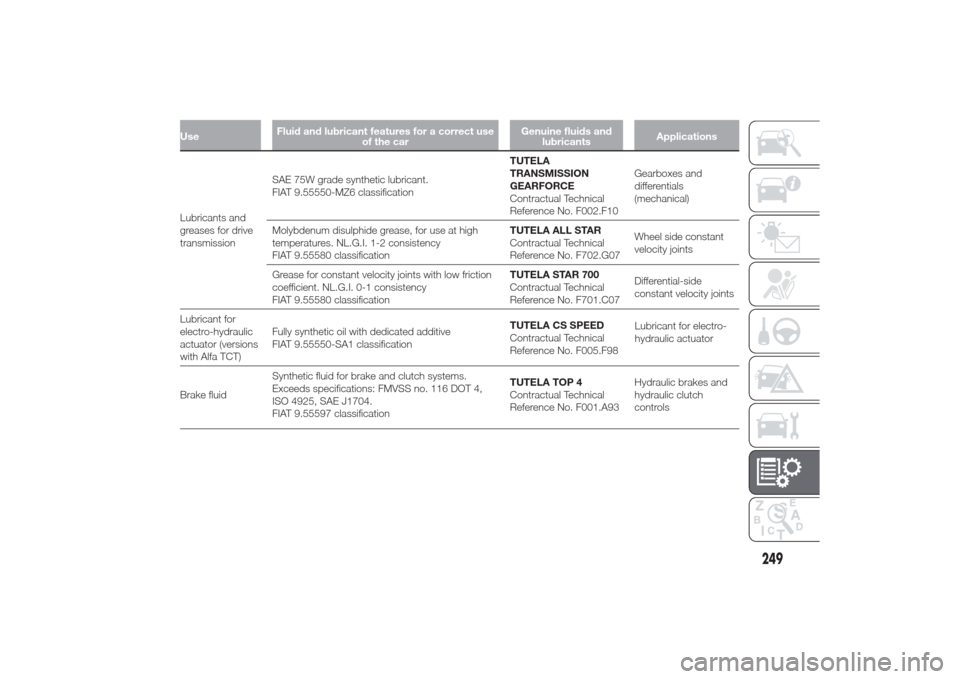
UseFluid and lubricant features for a correct use
of the carGenuine fluids and
lubricantsApplicationsLubricants and
greases for drive
transmissionSAE 75W grade synthetic lubricant.
FIAT 9.55550-MZ6 classificationTUTELA
TRANSMISSION
GEARFORCE
Contractual Technical
Reference No. F002.F10Gearboxes and
differentials
(mechanical)
Molybdenum disulphide grease, for use at high
temperatures. NL.G.I. 1-2 consistency
FIAT 9.55580 classificationTUTELA ALL STAR
Contractual Technical
Reference No. F702.G07Wheel side constant
velocity joints
Grease for constant velocity joints with low friction
coefficient. NL.G.I. 0-1 consistency
FIAT 9.55580 classificationTUTELA STAR 700
Contractual Technical
Reference No. F701.C07Differential-side
constant velocity joints
Lubricant for
electro-hydraulic
actuator (versions
with Alfa TCT)Fully synthetic oil with dedicated additive
FIAT 9.55550-SA1 classificationTUTELA CS SPEED
Contractual Technical
Reference No. F005.F98
Brake fluidSynthetic fluid for brake and clutch systems.
Exceeds specifications: FMVSS no. 116 DOT 4,
ISO 4925, SAE J1704.
FIAT 9.55597 classificationTUTELA TOP 4
Contractual Technical
Reference No. F001.A93Hydraulic brakes and
hydraulic clutch
controls
249
Lubricant for electro-
hydraulic actuator
Page 260 of 280
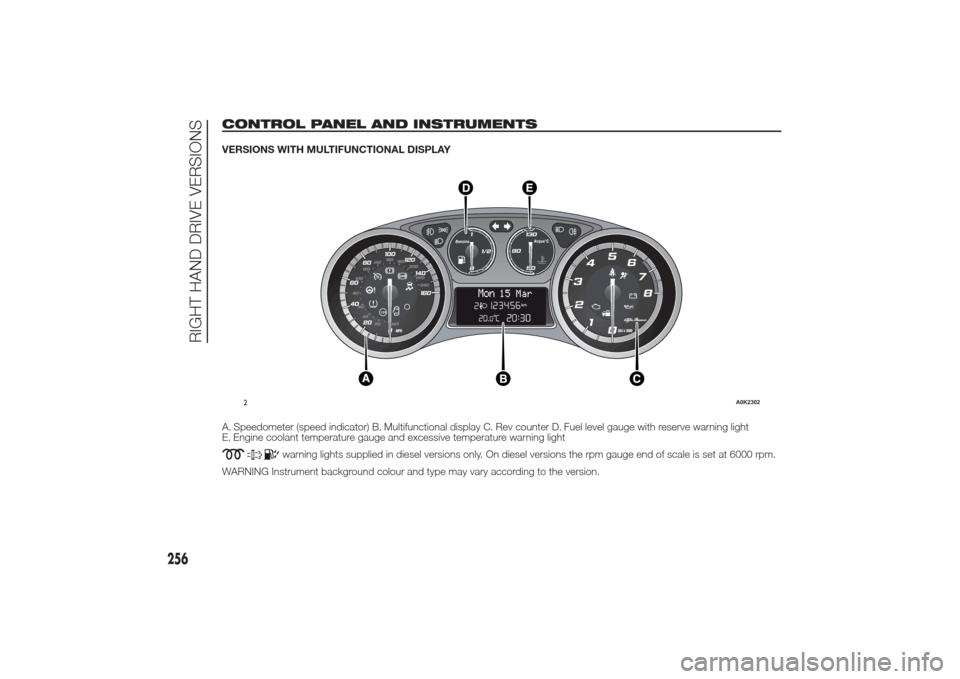
CONTROL PANEL AND INSTRUMENTSVERSIONS WITH MULTIFUNCTIONAL DISPLAY
A. Speedometer (speed indicator) B. Multifunctional display C. Rev counter D. Fuel level gauge with reserve warning light
E. Engine coolant temperature gauge and excessive temperature warning light
warning lights supplied in diesel versions only. On diesel versions the rpm gauge end of scale is set at 6000 rpm.
WARNING Instrument background colour and type may vary according to the version.
2
A0K2302
256
RIGHT HAND DRIVE VERSIONS