Windscreen Alfa Romeo Giulietta 2014 User Guide
[x] Cancel search | Manufacturer: ALFA ROMEO, Model Year: 2014, Model line: Giulietta, Model: Alfa Romeo Giulietta 2014Pages: 280, PDF Size: 6.65 MB
Page 43 of 280
WINDOW CLEANING
IN BRIEF
The right stalk controls screen
wiper/washer operation.
This operates only with the ignition
key turned to MAR.
WINDSCREEN
WASHER/WIPER
Operation
13) 14)
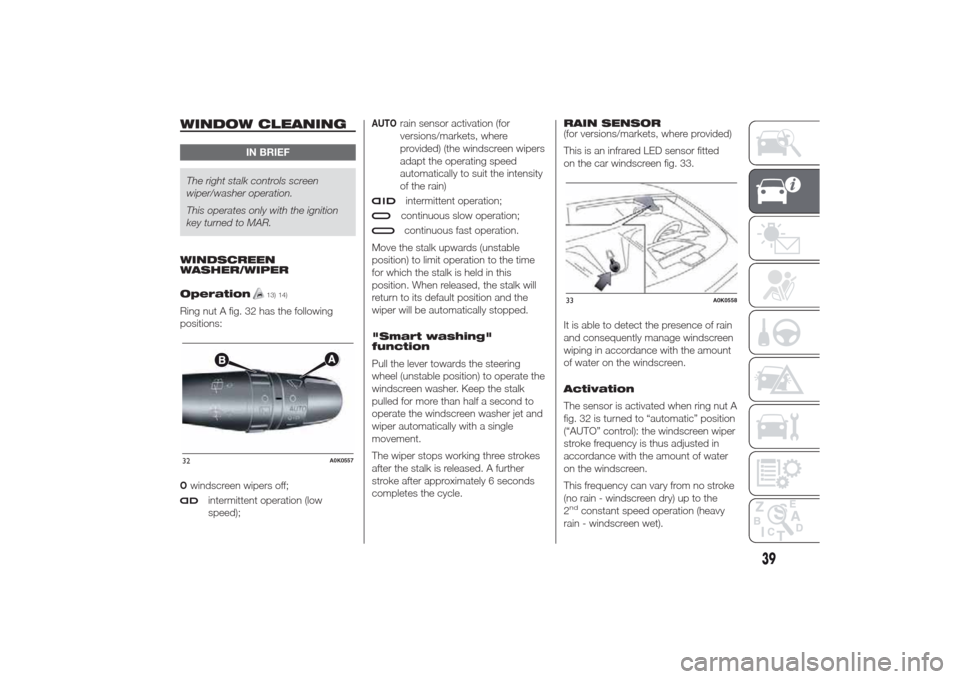
Ring nut A fig. 32 has the following
positions:Owindscreen wipers off;
intermittent operation (low
speed);
AUTO
rain sensor activation (for
versions/markets, where
provided) (the windscreen wipers
adapt the operating speed
automatically to suit the intensity
of the rain)intermittent operation;continuous slow operation;continuous fast operation.
Move the stalk upwards (unstable
position) to limit operation to the time
for which the stalk is held in this
position. When released, the stalk will
return to its default position and the
wiper will be automatically stopped.
"Smart washing"
function
Pull the lever towards the steering
wheel (unstable position) to operate the
windscreen washer. Keep the stalk
pulled for more than half a second to
operate the windscreen washer jet and
wiper automatically with a single
movement.
The wiper stops working three strokes
after the stalk is released. A further
stroke after approximately 6 seconds
completes the cycle.RAIN SENSOR
(for versions/markets, where provided)
This is an infrared LED sensor fitted
on the car windscreen fig. 33.
It is able to detect the presence of rain
and consequently manage windscreen
wiping in accordance with the amount
of water on the windscreen.
Activation
The sensor is activated when ring nut A
fig. 32 is turned to “automatic” position
(“AUTO” control): the windscreen wiper
stroke frequency is thus adjusted in
accordance with the amount of water
on the windscreen.
This frequency can vary from no stroke
(no rain - windscreen dry) up to the
2
nd
constant speed operation (heavy
rain - windscreen wet).
32
A0K0557
33
A0K0558
39
Page 44 of 280
The sensitivity of the rain sensor can be
adjusted through the Setup menu
(see paragraph “Menu Items” in the
“Knowing the instrument panel”
section).
If the engine is stopped with the lever in
“automatic” position, when it is next
started no wiping cycle will take place
even if it is raining. This prevents
accidental activation of the rain sensor
when the engine is started (e.g. when
the windscreen is being washed by
hand or the wipers are stuck to the
windscreen when there is ice).
To restore automatic operation of the
rain sensor, turn the ring nut on the
right stalk A fig. 32 from automatic
position (AUTO) toOposition and then
turn A ring nut back to the AUTO
position.
When the rain sensor is reactivated
using any of the manoeuvres described
above, reactivation is indicated by a
single stroke of the windscreen wipers,
regardless of the condition of the
windscreen.
If the sensitivity is changed whilst the
rain sensor is operating, a windscreen
wiper stroke is carried out to confirm
the change.In the event of malfunction of the rain
sensor whilst it is active, the
windscreen wiper operates
intermittently at a speed consistent with
the sensitivity setting of the rain sensor,
regardless of whether there is rain on
the glass (sensor failure is indicated on
the display).
The sensor continues to operate and it
is possible to set the windscreen wiper
to continuous mode (1
stor 2
nd
speed).
The failure indication remains for as
long as the sensor is active.
REAR WINDOW
WASHER/WIPER
(for versions/markets, where provided)
Activation
This operates only with the ignition key
turned to MAR.
Turn ring nut B fig. 32 from positionO
to position
to operate the rear
window wiper as follows:
❒in intermittent mode when the
windscreen wiper is not operating;
❒in synchronous mode (at half the
speed of the windscreen wiper) when
the windscreen wiper is operating;
❒in continuous mode with reverse gear
engaged and the control active.With reverse gear engaged and
windscreen wiper on, the rear window
wiper is activated in continuous mode.
Pushing the stalk towards the
dashboard (unstable position) will
activate the rear window washer jet.
Keep the stalk pushed for more than
half a second to activate the rear
window wiper as well. Releasing the
stalk will activate the smart washing
function, as described for the
windscreen wiper.
WARNING
13) Do not use the screen wiper to
remove layers of snow or ice
from the windscreen. In such
conditions, the windscreen wiper
may be subjected to excessive
stress and the motor cut-out
switch, which prevents operation
for a few seconds, may intervene.
If operation is not restored (even
after restarting that car with the
key), contact an Alfa Romeo
Dealership.
14) Do not operate the windscreen
wiper with the blades lifted from
the windscreen.
40
GETTING TO KNOW YOUR CAR
Page 66 of 280
BAG HOOKS
There are also bag hooks inside the
luggage compartment.
LUGGAGE RETAINING
NET
(for versions/markets, where provided)
This is useful for correctly arranging
the load and/or for transporting light
materials. The luggage retaining net is
available from Lineaccessori Alfa
Romeo.
WARNING
24) A heavy load that has not been
secured may cause serious
injuries to passengers in the event
of an accident.
25) If you are travelling in an area
with limited opportunities for
refuelling and you wish to bring
petrol with you in a petrol can, you
must do so in compliance with
current regulations and using an
approved can, appropriately
secured to the load securing
attachments. However, the risks
of fire in case of collision increase
anyway.
BONNETOPENING
Proceed as follows:
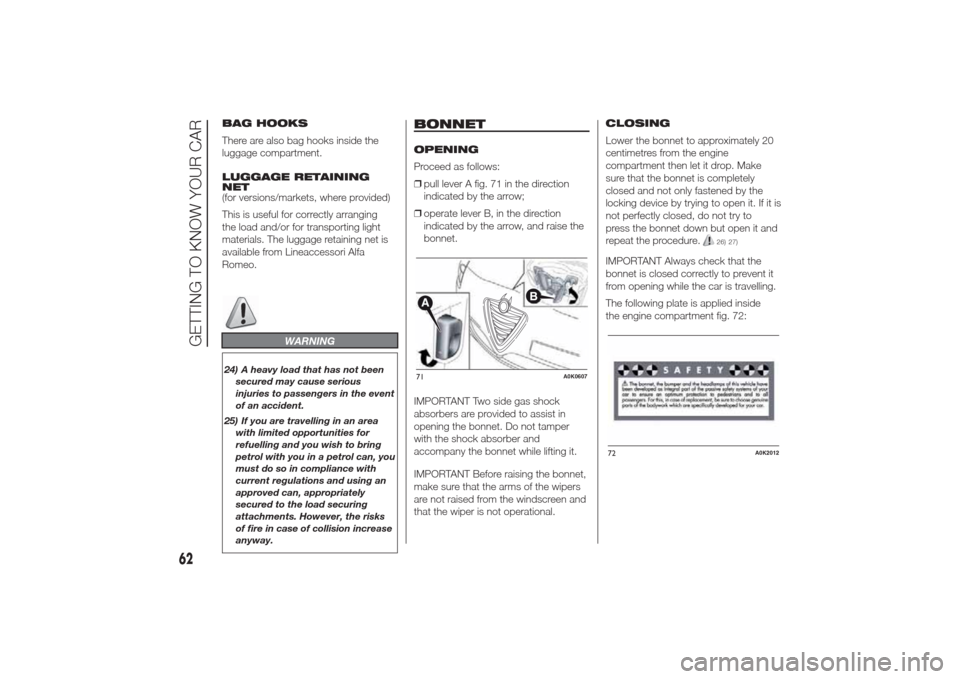
❒pull lever A fig. 71 in the direction
indicated by the arrow;
❒operate lever B, in the direction
indicated by the arrow, and raise the
bonnet.
IMPORTANT Two side gas shock
absorbers are provided to assist in
opening the bonnet. Do not tamper
with the shock absorber and
accompany the bonnet while lifting it.
IMPORTANT Before raising the bonnet,
make sure that the arms of the wipers
are not raised from the windscreen and
that the wiper is not operational.CLOSING
Lower the bonnet to approximately 20
centimetres from the engine
compartment then let it drop. Make
sure that the bonnet is completely
closed and not only fastened by the
locking device by trying to open it. If it is
not perfectly closed, do not try to
press the bonnet down but open it and
repeat the procedure.
26) 27)
IMPORTANT Always check that the
bonnet is closed correctly to prevent it
from opening while the car is travelling.
The following plate is applied inside
the engine compartment fig. 72:
71
A0K0607
72
A0K2012
62
GETTING TO KNOW YOUR CAR
Page 172 of 280
IMPORTANT
23) Keep your speed down when
snow chains are fitted; do not
exceed 50 km/h. Avoid potholes,
steps and pavements and avoid
driving for long distances on
roads not covered with snow to
prevent damaging the car and the
road surface.
STORING THE CARIf the car is to be left inactive for longer
than a month, the following precautions
should be noted:
❒park the car in covered, dry and if
possible well-ventilated premises and
slightly open the windows;
❒check that the handbrake is not
engaged;
❒disconnect the negative battery
terminal and check the battery
charge. Repeat this check once
every three months during storage;
❒if the battery is not disconnected
from the electrical system, checks its
state of charge every thirty days;
❒clean and protect the painted parts
using protective wax;
❒clean and protect the shiny metal
parts using special compounds
available commercially;
❒sprinkle talcum powder on the
windscreen and rear window wiper
rubber blades and lift them off the
glasses;
❒slightly open the windows;❒cover the car with a cloth or
perforated plastic sheet. Do not use
compact plastic sheets which do
not allow humidity to evaporate from
the surface of the car.
❒inflate tyres to +0.5 bar above the
standard prescribed pressure and
check it periodically;
❒do not drain the engine cooling
system;
❒Any time the car is left inactive for
two weeks or more, operate the
air conditioning system with engine
idling for at least 5 minutes, setting
external air and with fan at maximum
speed. This operation will ensure a
suitable lubrication to minimise
possibility of damage to the
compressor when the system is
operated again.
IMPORTANT After turning the ignition
key to STOP, wait at least 1 minute
before disconnecting the electrical
supply to the battery.
168
STARTING AND DRIVING
Page 196 of 280
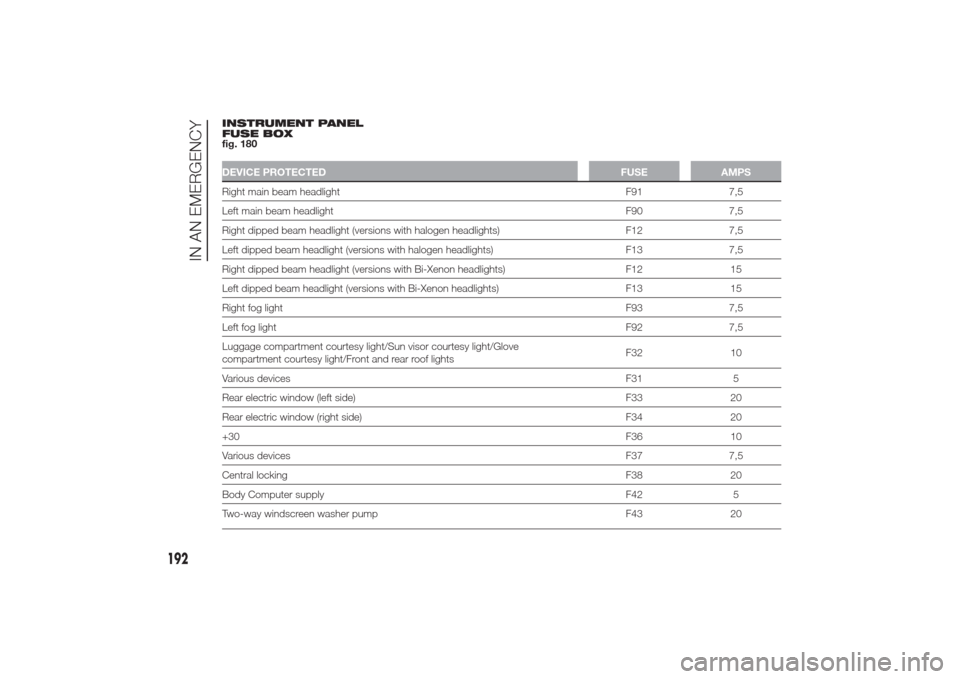
INSTRUMENT PANEL
FUSE BOX
fig. 180DEVICE PROTECTED FUSE AMPSRight main beam headlight F91 7,5
Left main beam headlight F90 7,5
Right dipped beam headlight (versions with halogen headlights) F12 7,5
Left dipped beam headlight (versions with halogen headlights) F13 7,5
Right dipped beam headlight (versions with Bi-Xenon headlights) F12 15
Left dipped beam headlight (versions with Bi-Xenon headlights) F13 15
Right fog lightF93 7,5
Left fog lightF92 7,5
Luggage compartment courtesy light/Sun visor courtesy light/Glove
compartment courtesy light/Front and rear roof lightsF32 10
Various devicesF31 5
Rear electric window (left side) F33 20
Rear electric window (right side) F34 20
+30F36 10
Various devicesF37 7,5
Central lockingF38 20
Body Computer supply F42 5
Two-way windscreen washer pump F43 20
192
IN AN EMERGENCY
Page 203 of 280
SERVICING AND MAINTENANCE
Correct maintenance permits the
performance of the car to be
maintained over time, as well as limited
running costs and safeguarding the
efficiency of the safety systems.
This chapter explains how.SCHEDULED SERVICING ...............200
SCHEDULED SERVICING PLAN .....201
PERIODIC CHECKS ........................20
HEAVY-DUTY USE OF THE CAR .....207
CHECKING LEVELS........................208
AIR CLEANER/POLLEN
FILTER/DIESEL FILTER....................213
BATTERY ........................................214
WHEELS AND TYRES.....................215
WINDSCREEN/REAR WINDOW
WIPERS ..........................................21
BODYWORK ...................................218
INTERIORS .....................................220
199
7
6
Page 205 of 280
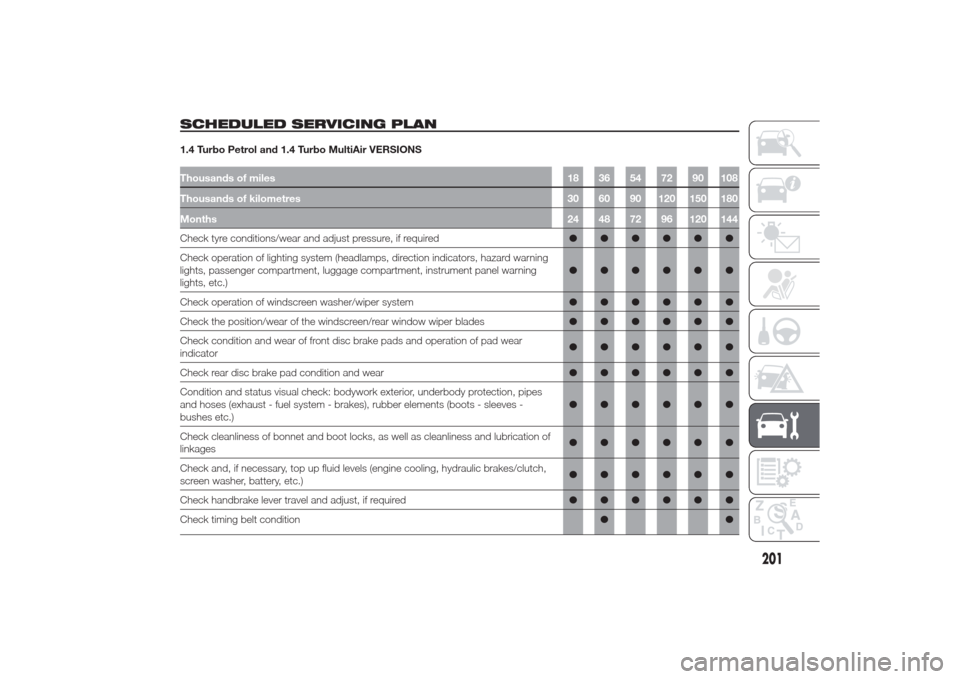
SCHEDULED SERVICING PLAN1.4 Turbo Petrol and 1.4 Turbo MultiAir VERSIONSThousands of miles 18 36 54 72 90 108
Thousands of kilometres 30 60 90 120 150 180
Months24 48 72 96 120 144Check tyre conditions/wear and adjust pressure, if required●●●●●●
Check operation of lighting system (headlamps, direction indicators, hazard warning
lights, passenger compartment, luggage compartment, instrument panel warning
lights, etc.)●●●●●●
Check operation of windscreen washer/wiper system●●●●●●
Check the position/wear of the windscreen/rear window wiper blades●●●●●●
Check condition and wear of front disc brake pads and operation of pad wear
indicator●●●●●●
Check rear disc brake pad condition and wear●●●●●●
Condition and status visual check: bodywork exterior, underbody protection, pipes
and hoses (exhaust - fuel system - brakes), rubber elements (boots - sleeves -
bushes etc.)●●●●●●
Check cleanliness of bonnet and boot locks, as well as cleanliness and lubrication of
linkages●●●●●●
Check and, if necessary, top up fluid levels (engine cooling, hydraulic brakes/clutch,
screen washer, battery, etc.)●●●●●●
Check handbrake lever travel and adjust, if required●●●●●●
Check timing belt condition●●
201
Page 207 of 280
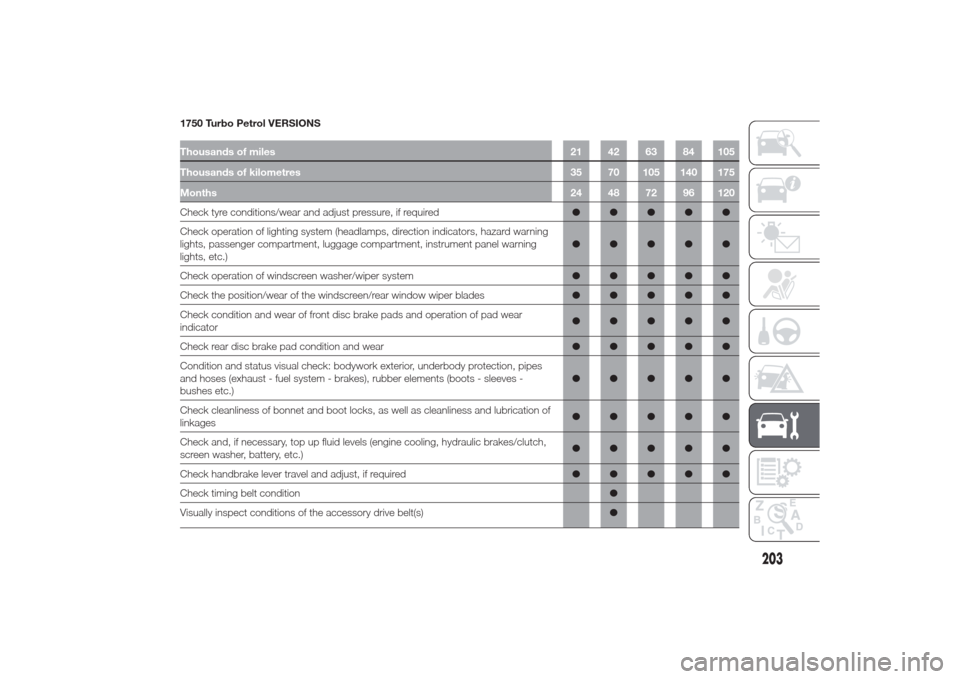
1750 Turbo Petrol VERSIONSThousands of miles 21 42 63 84 105
Thousands of kilometres 35 70 105 140 175
Months24 48 72 96 120Check tyre conditions/wear and adjust pressure, if required●●●●●
Check operation of lighting system (headlamps, direction indicators, hazard warning
lights, passenger compartment, luggage compartment, instrument panel warning
lights, etc.)●●●●●
Check operation of windscreen washer/wiper system●●●●●
Check the position/wear of the windscreen/rear window wiper blades●●●●●
Check condition and wear of front disc brake pads and operation of pad wear
indicator●●●●●
Check rear disc brake pad condition and wear●●●●●
Condition and status visual check: bodywork exterior, underbody protection, pipes
and hoses (exhaust - fuel system - brakes), rubber elements (boots - sleeves -
bushes etc.)●●●●●
Check cleanliness of bonnet and boot locks, as well as cleanliness and lubrication of
linkages●●●●●
Check and, if necessary, top up fluid levels (engine cooling, hydraulic brakes/clutch,
screen washer, battery, etc.)●●●●●
Check handbrake lever travel and adjust, if required●●●●●
Check timing belt condition●
Visually inspect conditions of the accessory drive belt(s)●
203
Page 209 of 280
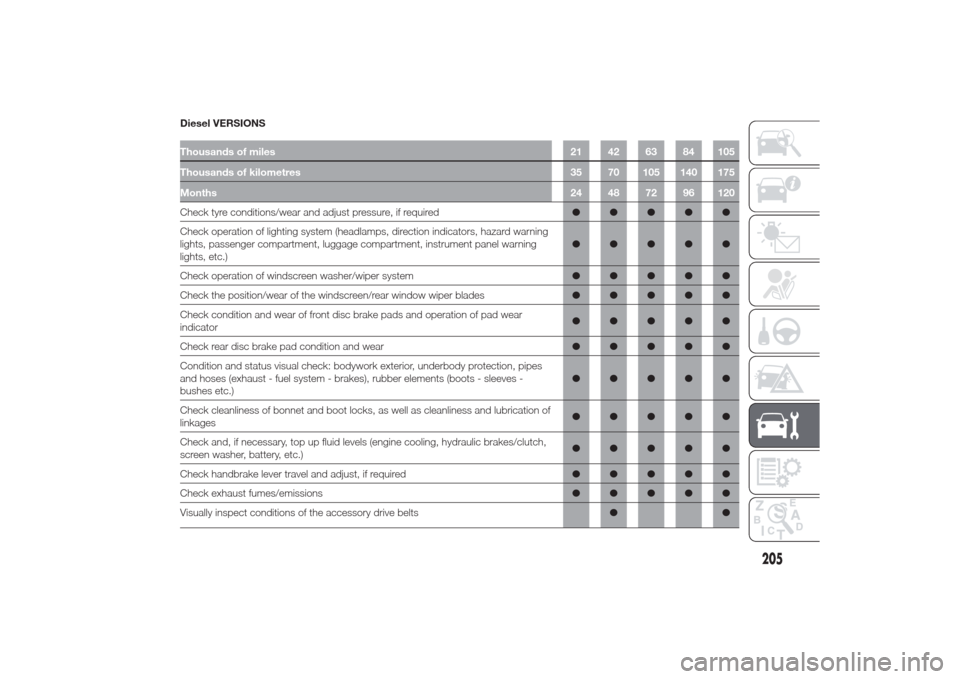
Diesel VERSIONSThousands of miles 21 42 63 84 105
Thousands of kilometres 35 70 105 140 175
Months24 48 72 96 120Check tyre conditions/wear and adjust pressure, if required●●●●●
Check operation of lighting system (headlamps, direction indicators, hazard warning
lights, passenger compartment, luggage compartment, instrument panel warning
lights, etc.)●●●●●
Check operation of windscreen washer/wiper system●●●●●
Check the position/wear of the windscreen/rear window wiper blades●●●●●
Check condition and wear of front disc brake pads and operation of pad wear
indicator●●●●●
Check rear disc brake pad condition and wear●●●●●
Condition and status visual check: bodywork exterior, underbody protection, pipes
and hoses (exhaust - fuel system - brakes), rubber elements (boots - sleeves -
bushes etc.)●●●●●
Check cleanliness of bonnet and boot locks, as well as cleanliness and lubrication of
linkages●●●●●
Check and, if necessary, top up fluid levels (engine cooling, hydraulic brakes/clutch,
screen washer, battery, etc.)●●●●●
Check handbrake lever travel and adjust, if required●●●●●
Check exhaust fumes/emissions●●●●●
Visually inspect conditions of the accessory drive belts●●
205
Page 211 of 280
PERIODIC CHECKSEvery 1,000 km or before long
journeys, check and, if necessary, top
up the following:
❒engine coolant, brake fluid and
windscreen washer fluid level;
❒tyre inflation pressure and condition;
❒operation of lighting system
(headlamps, direction indicators,
hazard warning lights, etc.);
❒operation of window washer/wiper
system and positioning/wear of
windscreen/rear window wiper
blades
Check and top up, if required, the
engine oil level every 3,000 km.
HEAVY-DUTY USE OF
THE CARIf the car is used mainly under one of
the following conditions:
❒towing a trailer or caravan;
❒dusty roads;
❒short, repeated journeys (less than
7-8 km) at sub-zero outside
temperatures;
❒engine often idling or driving long
distances at low speeds or long
periods of idleness;
the following checks must be carried
out more often than indicated in the
Scheduled Servicing Plan:
❒check front disc brake pad
conditions and wear;
❒check cleanliness of bonnet and boot
locks, cleanliness and lubrication of
linkage;
❒visually inspect conditions of: engine,
gearbox, transmission, pipes and
hoses (exhaust - fuel system -
brakes) and rubber elements (boots -
sleeves - bushes - etc.);
❒check battery charge and battery
fluid level (electrolyte);
❒visually inspect condition of the
accessory drive belts;❒check and, if necessary, change
engine oil and replace oil filter;
❒check and, if necessary, replace
pollen filter;
❒check and, if necessary, replace air
cleaner.
207