headlight Alfa Romeo Giulietta 2014 User Guide
[x] Cancel search | Manufacturer: ALFA ROMEO, Model Year: 2014, Model line: Giulietta, Model: Alfa Romeo Giulietta 2014Pages: 280, PDF Size: 6.65 MB
Page 132 of 280
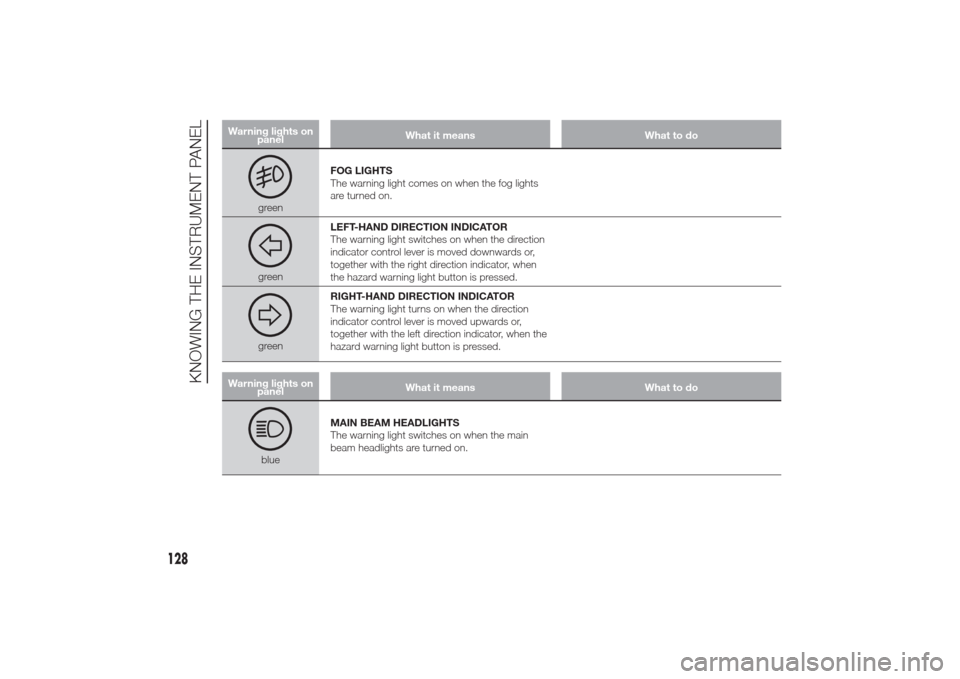
Warning lights on
panelWhat it means What to do
greenFOG LIGHTS
The warning light comes on when the fog lights
are turned on.greenLEFT-HAND DIRECTION INDICATOR
The warning light switches on when the direction
indicator control lever is moved downwards or,
together with the right direction indicator, when
the hazard warning light button is pressed.greenRIGHT-HAND DIRECTION INDICATOR
The warning light turns on when the direction
indicator control lever is moved upwards or,
together with the left direction indicator, when the
hazard warning light button is pressed.
Warning lights on
panelWhat it means What to do
blueMAIN BEAM HEADLIGHTS
The warning light switches on when the main
beam headlights are turned on.
128
KNOWING THE INSTRUMENT PANEL
Page 169 of 280
Roof rack/ski rack
Remove the roof rack or the ski rack
from the roof after use. These
accessories lower aerodynamic
penetration and adversely affect
consumption levels. When transporting
particularly large objects, use a trailer
if possible.
Electrical devices
Use the electrical devices only for the
necessary amount of time. The heated
rear window, additional headlights,
screen wipers and heater fan require a
considerable amount of energy;
increasing the current uptake increases
fuel consumption (by up to +25% in
an urban cycle).
Climate control system
Using the climate control system will
increase consumption: use the air vents
when the temperature outside permits.
Devices for
aerodynamic control
The use of non-certified devices for
aerodynamic control may adversely
affect air drag and fuel consumption.DRIVING STYLE
Starting
Do not warm up the engine at low or
high revs when the car is stationary;
this causes the engine to warm up
more slowly, thereby increasing fuel
consumption and emissions. It is
therefore advisable to move off
immediately, slowly, avoiding high
speeds: in this way the engine will
warm up more quickly.
Unnecessary actions
Avoid accelerating when stopped at
traffic lights or before switching off the
engine. The latter action, as well as
double-declutching, is unnecessary and
causes increased fuel consumption
and pollution.
Gear selection
Use a high gear when traffic and road
conditions allow it. Using a low gear for
faster acceleration will increase fuel
consumption. In the same way
improper use of a high gear increases
consumption, emissions and engine
wear.Maximum speed
Fuel consumption considerably
increases as speed increases. Maintain
a constant speed, avoiding
unnecessary braking and acceleration,
which cost in terms of both fuel
consumption and emissions.
Acceleration
Accelerating violently severely affects
consumption and emissions:
acceleration should be gradual and
should not exceed the maximum
torque.
165
Page 183 of 280
122) Always indicate that the tyre
was repaired using the quick
tyre repair kit. Give the booklet to
the technicians who will be
handling the tyre that was treated
using the kit.
123) Repair is not possible if the
wheel rim is damaged (groove
is deformed, causing air to
escape). Do not remove foreign
bodies (screws or nails) from the
tyre.
124) Do not operate the compressor
for longer than 20 minutes
consecutively. Risk of
overheating. The kit is not suitable
for definitive repairs, so the
repaired tyres may only be used
temporarily.125) The bottle contains ethylene
glycol and latex: it may cause
an allergic reaction. It is harmful if
swallowed. It is irritant for the
eyes. It may cause sensitisation if
inhaled or on contact. Avoid
contact with eyes, skin and
clothes. In the event of contact,
rinse immediately with plenty
of water. If ingested, do not
induce vomiting. Rinse out your
mouth, drink large quantities
of water and seek immediate
medical attention. Keep out of the
reach of children. The product
must not be used by asthmatics.
Do not inhale the vapours during
insertion and suction. Call a
doctor immediately if allergic
reactions are noted. Store the
bottle in its proper compartment,
away from sources of heat. The
sealant fluid has an expiry date.
Replace the bottle containing
out-of-date sealant fluid.
CHANGING A BULB
28)126) 127) 128)
GENERAL
INSTRUCTIONS
❒Before changing a bulb check the
contacts for oxidation;
❒replace blown bulbs with others of
the same type and power;
❒after replacing a headlight bulb,
always check its alignment;
❒when a light is not working, check
that the corresponding fuse is intact
before changing the bulb. For the
location of fuses, refer to the
paragraph “If a fuse blows” in this
chapter.
179
Page 184 of 280
IMPORTANT When the weather is cold
or damp or after heavy rain or washing,
the surface of headlights or rear lights,
may steam up and/or form drops of
condensation on the inside. This is
a natural phenomenon due to the
difference in temperature and humidity
between the inside and the outside
of the glass which does not indicate a
fault and does not compromise the
normal operation of lighting devices.
The mist disappears quickly when the
lights are turned on, starting from
the centre of the diffuser, extending
progressively towards the edges.
IMPORTANT
28) Halogen bulbs must be handled
by holding the metallic part only.
Touching the transparent part
of the bulb with your fingers may
reduce the intensity of the
emitted light and even reduce the
lifespan of the bulb. In the case
of accidental contact, rub the
lamp with a cloth and spirit and
leave to dry.
WARNING
126) Changes or repairs to the
electrical system carried out
incorrectly and without due
consideration for the technical
specifications of the system may
lead to malfunctioning and
generate a fire hazard.
127) Halogen bulbs contain
pressurised gas. If they break,
glass fragments could fly
everywhere.
128) Due to the high supply voltage,
gas discharge bulbs (Bi-Xenon)
should only be replaced by
specialised personnel: danger of
death! Contact an Alfa Romeo
Dealership.
180
IN AN EMERGENCY
Page 186 of 280
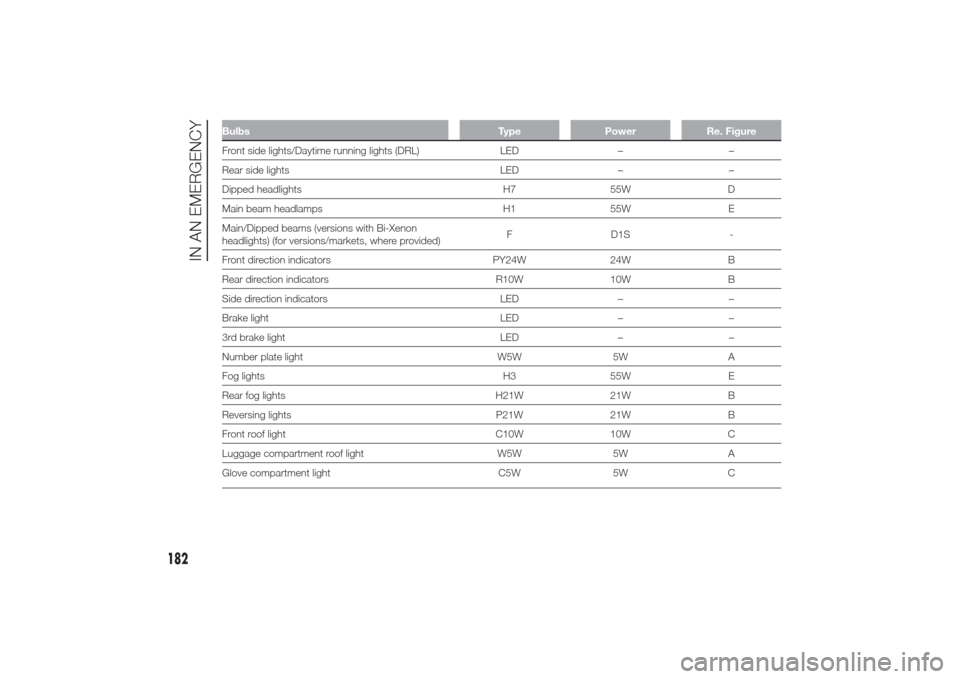
Bulbs Type Power Re. FigureFront side lights/Daytime running lights (DRL) LED – –
Rear side lights LED – –
Dipped headlights H7 55W D
Main beam headlamps H1 55W E
Main/Dipped beams (versions with Bi-Xenon
headlights) (for versions/markets, where provided)F D1S -
Front direction indicators PY24W 24W B
Rear direction indicators R10W 10W B
Side direction indicators LED – –
Brake light LED – –
3rd brake light LED – –
Number plate light W5W 5W A
Fog lights H3 55W E
Rear fog lights H21W 21W B
Reversing lights P21W 21W B
Front roof light C10W 10W C
Luggage compartment roof light W5W 5W A
Glove compartment light C5W 5W C
182
IN AN EMERGENCY
Page 187 of 280
REPLACING
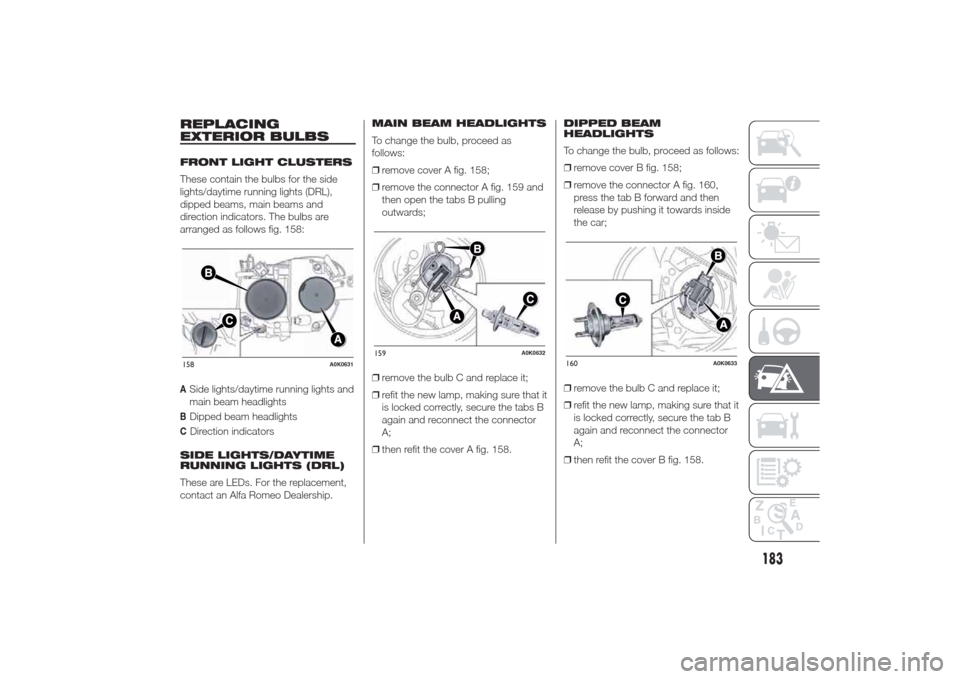
EXTERIOR BULBSFRONT LIGHT CLUSTERS
These contain the bulbs for the side
lights/daytime running lights (DRL),
dipped beams, main beams and
direction indicators. The bulbs are
arranged as follows fig. 158:ASide lights/daytime running lights and
main beam headlightsBDipped beam headlightsCDirection indicators
SIDE LIGHTS/DAYTIME
RUNNING LIGHTS (DRL)
These are LEDs. For the replacement,
contact an Alfa Romeo Dealership.MAIN BEAM HEADLIGHTS
To change the bulb, proceed as
follows:
❒remove cover A fig. 158;
❒remove the connector A fig. 159 and
then open the tabs B pulling
outwards;
❒remove the bulb C and replace it;
❒refit the new lamp, making sure that it
is locked correctly, secure the tabs B
again and reconnect the connector
A;
❒then refit the cover A fig. 158.DIPPED BEAM
HEADLIGHTS
To change the bulb, proceed as follows:
❒remove cover B fig. 158;
❒remove the connector A fig. 160,
press the tab B forward and then
release by pushing it towards inside
the car;
❒remove the bulb C and replace it;
❒refit the new lamp, making sure that it
is locked correctly, secure the tab B
again and reconnect the connector
A;
❒then refit the cover B fig. 158.158
A0K0631
159
A0K0632
160
A0K0633
183
Page 196 of 280
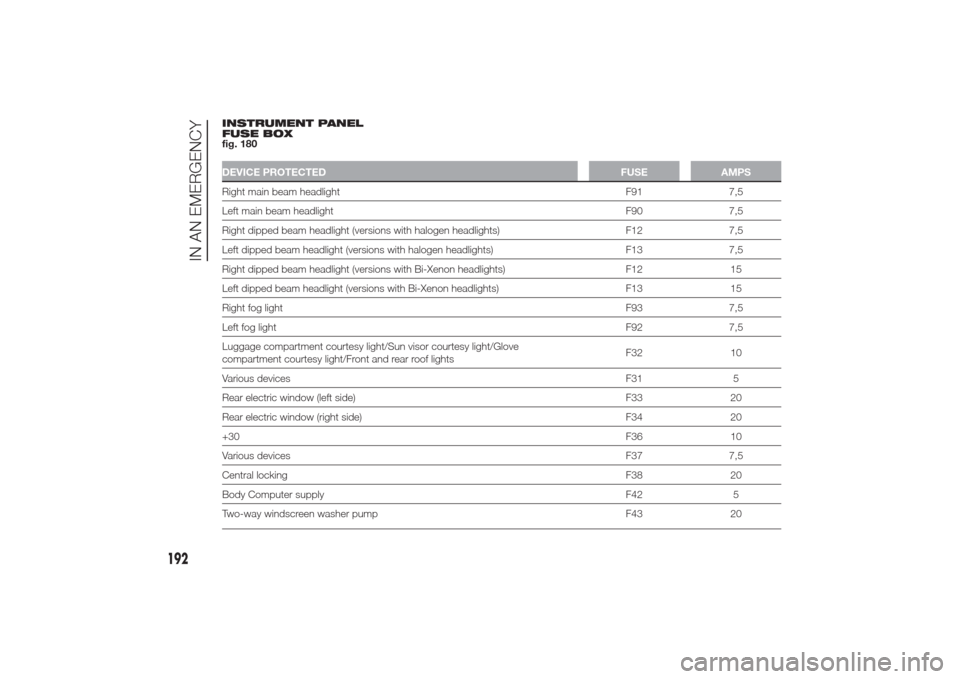
INSTRUMENT PANEL
FUSE BOX
fig. 180DEVICE PROTECTED FUSE AMPSRight main beam headlight F91 7,5
Left main beam headlight F90 7,5
Right dipped beam headlight (versions with halogen headlights) F12 7,5
Left dipped beam headlight (versions with halogen headlights) F13 7,5
Right dipped beam headlight (versions with Bi-Xenon headlights) F12 15
Left dipped beam headlight (versions with Bi-Xenon headlights) F13 15
Right fog lightF93 7,5
Left fog lightF92 7,5
Luggage compartment courtesy light/Sun visor courtesy light/Glove
compartment courtesy light/Front and rear roof lightsF32 10
Various devicesF31 5
Rear electric window (left side) F33 20
Rear electric window (right side) F34 20
+30F36 10
Various devicesF37 7,5
Central lockingF38 20
Body Computer supply F42 5
Two-way windscreen washer pump F43 20
192
IN AN EMERGENCY
Page 216 of 280
ENGINE COOLANT
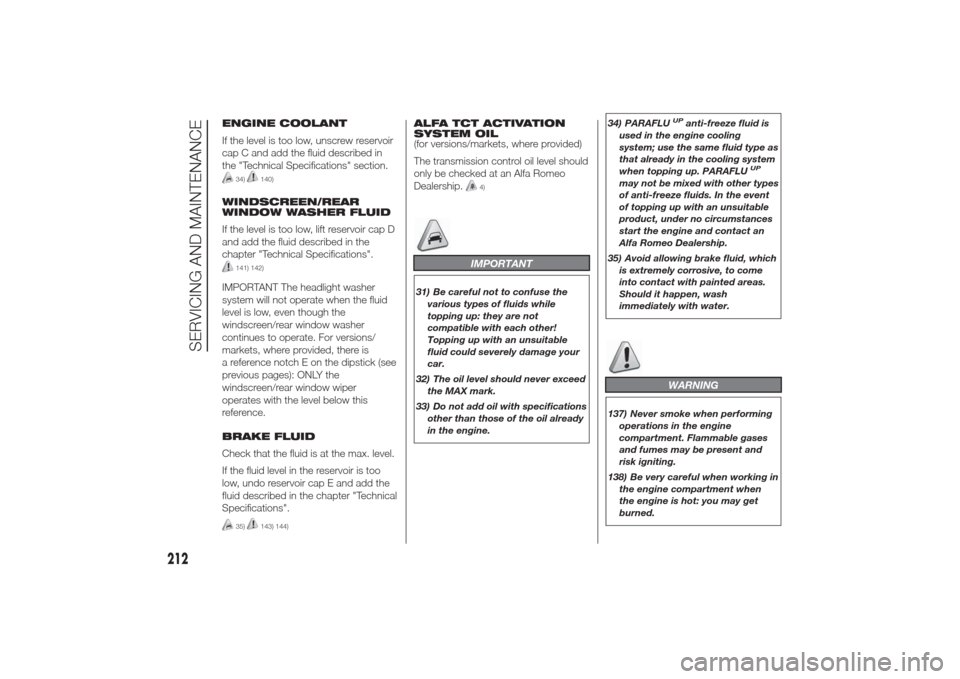
If the level is too low, unscrew reservoir
cap C and add the fluid described in
the "Technical Specifications" section.
34)
140)
WINDSCREEN/REAR
WINDOW WASHER FLUID
If the level is too low, lift reservoir cap D
and add the fluid described in the
chapter "Technical Specifications".
141) 142)
IMPORTANT The headlight washer
system will not operate when the fluid
level is low, even though the
windscreen/rear window washer
continues to operate. For versions/
markets, where provided, there is
a reference notch E on the dipstick (see
previous pages): ONLY the
windscreen/rear window wiper
operates with the level below this
reference.
BRAKE FLUID
Check that the fluid is at the max. level.
If the fluid level in the reservoir is too
low, undo reservoir cap E and add the
fluid described in the chapter "Technical
Specifications".
35)
143) 144)
ALFA TCT ACTIVATION
SYSTEM OIL
(for versions/markets, where provided)
The transmission control oil level should
only be checked at an Alfa Romeo
Dealership.
4)IMPORTANT
31) Be careful not to confuse the
various types of fluids while
topping up: they are not
compatible with each other!
Topping up with an unsuitable
fluid could severely damage your
car.
32) The oil level should never exceed
the MAX mark.
33) Do not add oil with specifications
other than those of the oil already
in the engine.34) PARAFLU
UP
anti-freeze fluid is
used in the engine cooling
system; use the same fluid type as
that already in the cooling system
when topping up. PARAFLU
UP
may not be mixed with other types
of anti-freeze fluids. In the event
of topping up with an unsuitable
product, under no circumstances
start the engine and contact an
Alfa Romeo Dealership.
35) Avoid allowing brake fluid, which
is extremely corrosive, to come
into contact with painted areas.
Should it happen, wash
immediately with water.
WARNING
137) Never smoke when performing
operations in the engine
compartment. Flammable gases
and fumes may be present and
risk igniting.
138) Be very careful when working in
the engine compartment when
the engine is hot: you may get
burned.
212
SERVICING AND MAINTENANCE
Page 221 of 280
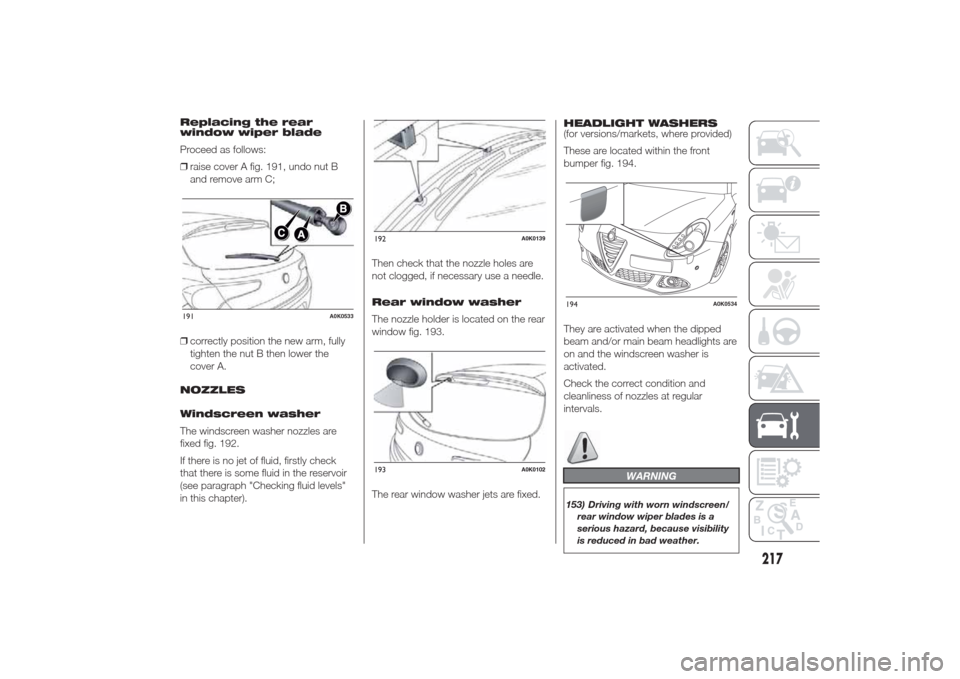
Replacing the rear
window wiper blade
Proceed as follows:
❒raise cover A fig. 191, undo nut B
and remove arm C;
❒correctly position the new arm, fully
tighten the nut B then lower the
cover A.
NOZZLES
Windscreen washer
The windscreen washer nozzles are
fixed fig. 192.
If there is no jet of fluid, firstly check
that there is some fluid in the reservoir
(see paragraph "Checking fluid levels"
in this chapter).Then check that the nozzle holes are
not clogged, if necessary use a needle.
Rear window washer
The nozzle holder is located on the rear
window fig. 193.
The rear window washer jets are fixed.HEADLIGHT WASHERS
(for versions/markets, where provided)
These are located within the front
bumper fig. 194.
They are activated when the dipped
beam and/or main beam headlights are
on and the windscreen washer is
activated.
Check the correct condition and
cleanliness of nozzles at regular
intervals.
WARNING
153) Driving with worn windscreen/
rear window wiper blades is a
serious hazard, because visibility
is reduced in bad weather.
191
A0K0533
192
A0K0139
193
A0K0102
194
A0K0534
217
Page 223 of 280
❒remove the aerial from the roof when
using a carwash;
❒if high pressure jets or cleaners are
used to wash the car, keep a
distance of at least 40 cm from the
bodywork to avoid damage or
alteration. Bear in mind that a build
up of water could cause damage
to the car in the long term;
❒wash the bodywork using a low
pressure jet of water;
❒wipe a sponge with a slightly soapy
solution over the bodywork,
frequently rinsing the sponge;
❒rinse well with water and dry with a
jet of air or a chamois leather.
Dry the less visible parts (e.g. door
frames, bonnet, headlight frames, etc.)
with special care, as water may
stagnate more easily in these areas. Do
not wash the car after it has been left
in the sun or with the bonnet hot:
this may alter the shine of the
paintwork.
Exterior plastic parts must be cleaned
in the same way as the rest of the car.IMPORTANT
Avoid parking under trees; the resin
dropped by trees makes the paintwork
go opaque and increases the possibility
of corrosion.
Bird droppings must be washed off
immediately and thoroughly as the acid
they contain is particularly aggressive.
Windows
Use specific detergents and clean
cloths to prevent scratching or altering
the transparency.
IMPORTANT Wipe the rear window
inside gently with a cloth following the
direction of the filaments to avoid
damaging the heating device.
Front headlights
Use a soft cloth soaked in water and
detergent for washing cars.
IMPORTANT Never use aromatic
substances (e.g. petrol) or ketenes (e.g.
acetone) for cleaning the plastic lenses
of the front headlights.
IMPORTANT When cleaning with a
pressure washer, keep the water jet at
least 20 cm away from the headlights.Engine compartment
At the end of every winter, wash the
engine compartment thoroughly, taking
care not to aim the jet of water directly
at the electronic control units or at
the windscreen wiper motors. Have this
operation performed at a specialised
workshop.
IMPORTANT The washing should take
place with the engine cold and the
ignition key in the STOP position. After
the washing operation, make sure
that the various protections (e.g. rubber
caps and guards) have not been
removed or damaged.
IMPORTANT
6) Detergents cause water pollution.
Only wash your car in areas
equipped to collect and treat
wastewater from this type
of activity.
219